

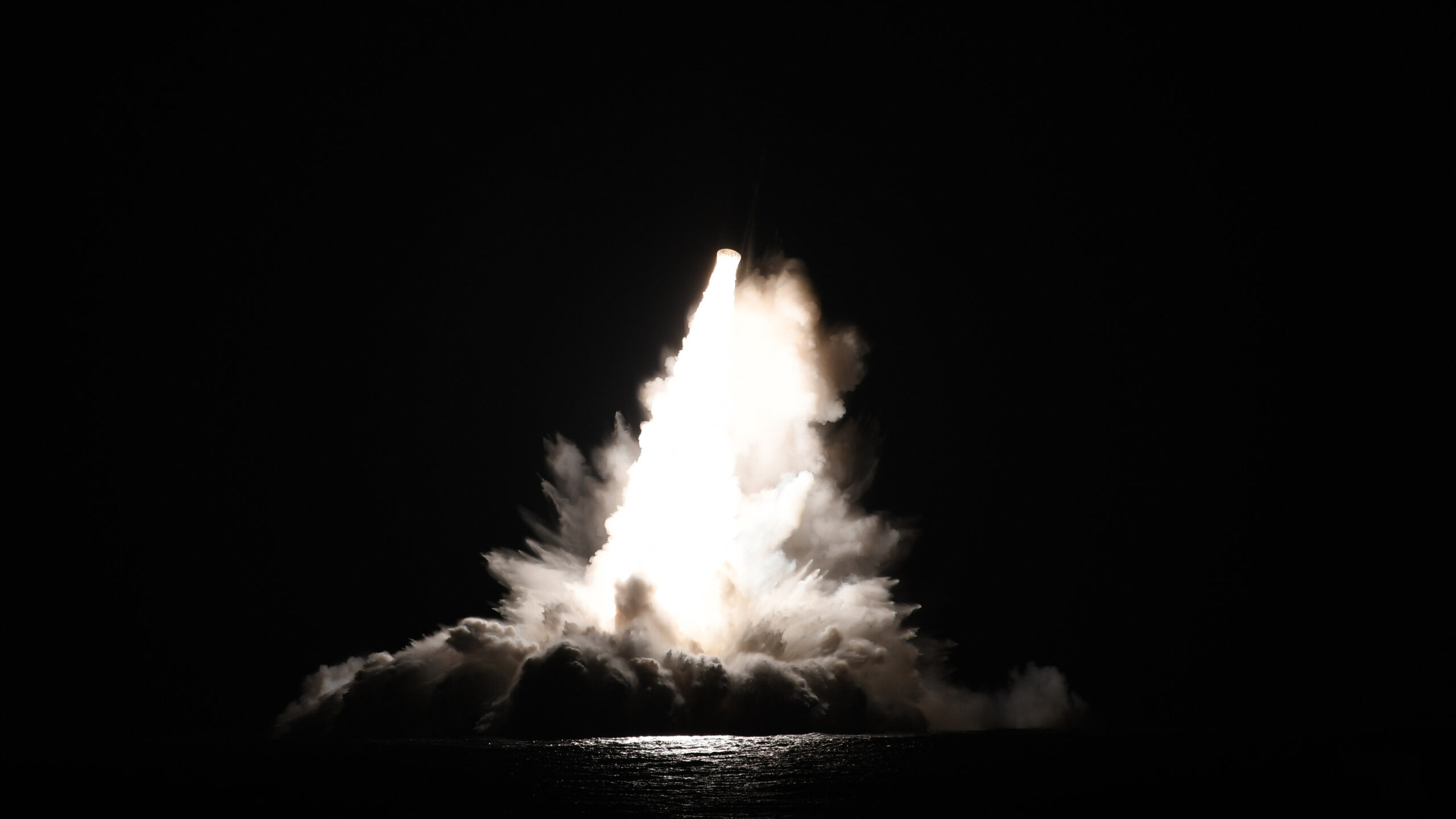
Liberal Democrat leader Sir Ed Davey has called on the UK government to begin developing a domestically built nuclear missile system, arguing Britain should no longer depend on the United States for a key component of its nuclear deterrent.
Writing on the party’s website, Davey said the UK should work towards what he described as a “fully independent British nuclear deterrent”, ending reliance on the US-supplied Trident missile system carried by Royal Navy submarines.
Britain’s nuclear deterrent is based on four Vanguard-class ballistic missile submarines, each capable of carrying Trident II D5 missiles armed with UK-designed nuclear warheads. While the warheads and launch decisions are fully controlled by the UK, the missiles themselves are drawn from a shared US-maintained pool.
Davey argued that reliance on American systems could create risks for the UK’s long-term strategic autonomy. “If the answer to ‘Is our nuclear deterrent working?’ depends on what Donald Trump had for breakfast, then the answer is no, it’s not. And our deterrent is not truly independent. This should be keeping British defence planners awake at night.”
He said Britain’s current system meant a key element of the deterrent relied on US support. “The Trident missiles sitting in our Vanguard submarines are leased from the United States. Their maintenance depends on American facilities. That means the operability of our deterrent ultimately depends on the goodwill of whoever sits in the Oval Office.”
Davey argued the UK should begin developing a sovereign missile capability ahead of the expected retirement of the current Trident system in the 2040s. “Trident missiles will need replacing in 2042. If we haven’t built our own capability before then, we’ll have no choice but to go back to the Americans. Who knows what terms they’ll offer? We cannot afford to leave our national security to chance.”
He said Britain had previously demonstrated the ability to develop nuclear weapons technology independently and should be capable of doing so again.
“I know building a sovereign capability sounds like an enormous undertaking. It is. It will cost billions over the next two decades. But Britain can do it – because we’ve done it before. If France can maintain a fully independent deterrent, Britain certainly can.”
The UK’s nuclear deterrent is often described as “operationally independent”, meaning the decision to launch nuclear weapons rests solely with the British government and Prime Minister. Once a submarine is on patrol, it can operate autonomously and does not require external permission or control to launch its missiles.
However, the system relies on cooperation with the United States for missile supply, maintenance and elements of supporting infrastructure. Davey said Britain should initially focus on developing the ability to maintain existing Trident missiles domestically before moving towards designing and producing a replacement missile system.
“In the short term, that means developing our own capability to maintain existing Trident missiles here in the UK. In the longer term, when those missiles come to the end of their lives, we will have British-made replacements ready. But only if the government starts that work now.”












Who pays for it, and with what we are skint.
It’s not that we don’t spend because we are broke, it’s that we appear broke because we will not spend.
Well put.
Your comment is conceptually true if you believe the UK’s primary problem is a liquidity and investment crisis, but it’s false if you believe the UK is facing a solvency and sustainability crisis. Currently, the UK government is attempting to take a middle path; talking about growth as the primary engine to fix the broke feeling, while remaining very hesitant to borrow large sums to fund it.
The UK currently spends about £1 in every £10 of tax revenue just on interest payments. If borrowing spikes, that interest bill goes up, leaving even less money for the NHS, schools, or defence.
If you look at the the current fiscal architecture of the United Kingdom, which is governed by two primary mandates updated in the Charter for Budget Responsibility and recently approved by the House of Commons in Feb 26′. These rules are designed to ensure that the government lives within its means on a day-to-day basis while keeping the total debt burden under control. The first rule, the ‘Stability Rule,’ dictates that the current budget, which covers day-to-day spending like salaries and pensions but excludes long-term capital investment, must be in balance or surplus by the third year of the rolling forecast period. The second rule, the ‘Investment Rule,’ requires that public sector net financial liabilities (PSNFL) must be falling as a share of Gross Domestic Product by that same third-year horizon.
In the Spring Forecast delivered on 03/03/2026, the Chancellor reported a notable improvement in the available headroom, the margin by which the government is meeting its own targets. This headroom has increased to approximately £24 billion against the Stability Rule, up from roughly £22 billion in late 25′. This increase was not the result of a sudden economic boom, but rather a technical windfall driven by higher-than-expected tax receipts from self-assessment and a slight reduction in forecast debt interest payments. However … this £24 billion figure is deceptively fragile. The OBR has explicitly warned that this buffer is ‘slim by historic standards’ and could be entirely wiped out by even a modest increase in global interest rates or a sustained spike in energy costs.
The paradox of the current situation is that while the government technically has £24 billion of ‘space,’ using it to borrow for day-to-day spending would violate the Stability Rule, potentially triggering a negative reaction from the gilt markets. The ‘Investment Rule’ offers a slightly different perspective, focusing on PSNFL, which is a broader measure of the balance sheet including assets like student loans. Under this rule, debt is forecast to stabilise at approximately 95% of GDP by 2030-31. While the government claims this shows ‘stability,’ the reality is that the UK remains in a high-tax, high-debt environment where the cost of servicing that debt, currently around £106 billion per year, consumes roughly 3.6% of GDP. Consequently, any decision to borrow beyond the current forecast would require the Chancellor to either find new tax revenue or gamble that the investment will generate enough growth to outpace the rising cost of the debt itself.
When government borrowing costs; gilt yields go up, banks usually raise interest rates on mortgages and business loans. This means government borrowing can lead directly to higher monthly bills for households.
Given the volatility in the Middle East right now, it is highly likely that a portion of this headroom is already being spent by the markets in the form of higher risk premiums on UK gilts.
The central tension in all the experts advice remains the ‘borrow to grow’ versus ‘save to stabilise’ dilemma. With the debt interest bill still hovering around £100 billion per year, the cost of being wrong on a borrowing-led growth strategy is higher now than at any point in the 50 years.
I say spend, spend wisely, spend on infrastructure; roads, railways, bridges, airports, public transit systems, tunnels, water supply, sewers, electrical grids, and … defence. Cut the ‘cost of doing business’ it’s a barrier to investment … high energy costs and planning bottlenecks are anchors on the UK economy. Planning bottlenecks are a combination of legislative, administrative, and environmental hurdles that act as a handbrake on capital deployment, no point in spending to move forward if the handbrake is on, ffs.
In 1946/47, the first full financial year of the Attlee government, the UK had a debt to GDP ratio of 252%. Attlee transformed the country, creating strong growth through public spending on education, the NHS and nationalisation. Despite that (I would argue because of it), by 1951/52 debt to GDP had fallen to 169%. He wasn’t afraid of inflation or spending.
Right now debt to GDP is at around 100% and the government cowers, afraid of their own shadows.
The mechanics of the Attlee recovery provide a stark contrast to modern fiscal management.
Attlee’s triumph was not about individual charisma or grand political theatre; it was the victory of method over chaos. He inherited a country that was effectively bankrupt and transformed it into a society where the collective good was no longer a philosophical aspiration, but a tangible, functioning system. He proved that even in the wake of total systemic collapse, a government can successfully shift the entire economic and social paradigm of a nation, provided the leadership is willing to endure the short-term resentment of the public to achieve a long-term, stable re-foundation. Attlee was stoic in face of the hardships he fostered onto the ‘people’ to benefit the country.
When the UK is living through some other catastrophic, cataclysmic … end of days scenario, one hopes an Attlee type pops up afterwards to straight things out.
However, historical records and official archives confirm, Attlee’s dramatic reduction in the debt-to-G.D.P. ratio was not achieved through the contemporary method of ‘paying down’ debt via austerity. Instead, it was a result of rapid economic growth and a deliberate policy of ‘financial repression’. By keeping interest rates low, frequently below the rate of inflation, the government effectively eroded the real value of the national debt over time. This ‘cheap money’ environment provided the necessary capital for the nationalisation of key sectors like coal, rail, and steel, alongside massive investment in housing and education, which served to stimulate domestic demand and industrial output.
However, expert analysis from economic historians adds vital nuance to this narrative. The UK was not acting in isolation; it was a significant beneficiary of the Marshall Plan and a substantial Anglo-American loan. These provided the essential foreign exchange required to keep the nation solvent while these internal transformations were being organised. Additionally, the shift from a total war economy back to civilian production generated a natural ‘rebound’ in G.D.P. that is virtually impossible to replicate in a standard peace-time setting. The observation that Attlee was ‘unafraid of inflation’ is/was grounded in the government’s commitment to prioritising full employment over price stability, a defining characteristic of post-war Keynesianism.
As for whether Keynesianism is relevant today, the short answer is that it remains the emergency manual for most modern governments. During the global shocks of the early 2020s, governments in both the UK and Australia engaged in massive ‘Keynesian’ deficit spending to prevent economic collapse. However, applying Keynesianism in 2026 is far more complex. In the 1940s, the focus was on ‘pump-priming’ an industrial economy with high domestic demand. Today, because our economies are so interconnected, a surge in state-led demand often leads to an increase in imports rather than domestic production, which can weaken the currency.
Furthermore, the Keynesian focus on ‘full employment’ has evolved. In 1946, it meant putting men back into factories; today, it involves navigating a gig economy and high-tech service sectors. While the ‘Keynesian’ impulse to spend during a crisis is alive and well, the long-term Attlee style state management is viewed by many global news commentators and think tanks as difficult to sustain without the unique post-war conditions of capital controls and massive external aid.
How much growth you actually get for every pound or dollar spent. In the 1940s, that multiplier was very high due to the need for basic infrastructure; today, the data is much more contested.
The characterisation of the current UK government as “cowering” in the face of a 100% debt-to-G.D.P. ratio reflects a significant tension between historical ambition and modern constraints. While Clement Attlee operated with a ratio of 252% in 1946, he did so in an era of ‘captive’ capital. Today, as official government reports and Treasury statements make clear, the UK is highly dependent on the “kindness of strangers”**, specifically international investors who fund the national debt.
From a technical perspective, the hesitation seen in 2026 is driven by the cost of servicing that debt. In the 1940s, the government could use ‘financial repression’ to keep interest rates artificially low. Today, interest rates are set by an independent Bank of England to combat inflation, meaning the government must pay market rates to borrow. At 100% debt-to-G.D.P., even a small rise in interest rates can divert billions of pounds away from public services like the NHS and education just to pay the interest. This creates a ‘fiscal trap’ where the government feels it has very little room to manoeuvre without triggering a negative reaction from the markets.
Global, reputable news analysis … Reuters, BBC, New York Times, CNN, Wall Street Jornal, commentary often describe this as a lack of political will, but other think tanks point to a structural reality – the UK’s current growth rate is significantly lower than the ‘rebound’ growth experienced in 1947. Without that rapid expansion, high debt levels are much harder to “inflate away” or “outgrow.” Consequently, the current administration prioritises “fiscal stability” as a prerequisite for any investment, a stance that critics argue prevents the very growth they are trying to achieve. This is a fundamental departure from the Keynesian prioritisation of full employment and industrial output seen under Attlee.
Whether this constitutes “cowardice” or “prudence” is the core pivot of the UK’s economic debate in 26′. Proponents of the current path argue that the “shadow” the government fears is a real and present danger of a currency collapse or a credit rating downgrade, which would make the 1947 crisis look mild by comparison. Critics, however, argue that by failing to invest at scale, as Attlee did, the government is ensuring a cycle of long-term stagnation.
It is an historical certainty that the British public endured significant hardship throughout the immediate post-war years. In many respects, the ‘short-term’ suffering of the populace intensified after 1945 rather than abating, leading to a period often referred to by historians as the ‘age of austerity.’ While the government was constructing the foundations of the welfare state, the day-to-day existence of the average citizen was defined by shortages that, in some cases, were MORE severe than during the war itself.
The primary driver of this hardship was the necessity of export-led recovery. To secure the essential foreign exchange required to pay for food and raw materials, the government restricted domestic consumption. Clothing, furniture, and even food were subject to strict rationing, with bread, which had not been rationed during the conflict, being added to the list in 1946. Fuel shortages, particularly the catastrophic winter of 1947, forced the government to cut power to domestic homes, causing widespread misery and a palpable sense of public exhaustion
The era of ‘state-directed sacrifice’ appears to be a historical relic. Today, governments find themselves attempting to achieve similar fiscal goals through complex tax adjustments or regulatory shifts, carefully avoiding any language that suggests a lowering of living standards for the populace.
The end of rationing in 1954 – I’ll type that date again 1954! of items like bread, butter, sugar, bacon and ham was such a significant cultural and psychological milestone for the British public, it signalled that the period of … intense, STATE-MANDATED SACRIFICE had finally concluded.
No one … not a soul will accept that kind of sacrifice today!!! so there is no point in calling up ‘ghosts’ of the past with romantic ideals of … Land of hope and glory.
–
[**famously popularised in an economic context by Mark Carney, the former Governor of the Bank of England, now Prime Minister of Canada.]
It is a reference to the play A Streetcar Named Desire, and in financial terms, it refers to the UK’s heavy reliance on foreign investors to fund its national deficit. Essentially, when a government spends more than it collects in taxes, it must borrow the difference by selling “Gilts” (government bonds). If a significant portion of these bonds is bought by overseas entities – such as foreign pension funds, central banks, or private investors – the nation is said to be relying on “strangers” to keep its economy afloat.
From a technical standpoint, this is a risk factor because these “strangers” are under no obligation to keep lending to the UK. Unlike domestic pension funds, which often have a structural or regulatory requirement to hold British assets, international investors are ‘price-sensitive’ and mobile. According to 2026 data from the ONS, overseas holdings of UK government debt sit at approximately 28% to 30%. If these investors lose confidence in the UK’s ability to manage its 100% debt-to-G.D.P. ratio, or if they see better returns in the US or EU, they can sell their holdings rapidly.
This ‘reliance’ is what creates the “cowering” effect you mentioned earlier. If the “strangers” stop being “kind”, meaning they stop buying Gilts or demand much higher interest rates to do so, the cost of government borrowing spikes. This can lead to a currency crisis where the Pound Sterling devalues sharply, making imports more expensive and driving up inflation. This is why the Treasury and the Bank of England are so fixated on … “fiscal credibility”; they are essentially performing for a global audience of lenders to ensure the “kindness” continues.
In the post-war Attlee era, the UK did not have this problem to the same extent because it used “exchange controls” to prevent money from leaving the country, effectively forcing “friends”, the domestic savers to fund the debt at low rates. In the open global markets of 26′, those controls are gone, leaving the government exposed to the whims of global capital.
tl;dr – sorry.
magenta – thank you.
You have helped me understand my father a little better. Born during the war, he was one of the postwar ‘austerity’ children. The bit about it being more severe than during the war, that hit hard.
He once took his young grandsons into a sweet shop here in Australia. The traditional type, wood shelves to the ceiling. It was full of sweets and the kids were delighted. I noticed tears in his eyes.
You forget the Petol ration books of1973…Although never implemented …I do remember them…
I don’t recall ration books for petrol in 74′, but I do remember seeing long queues at petrol stations and I distinctly remember the … ‘Three day week’.
The Three day week, arguably the, pivotal moment of 20th century British politics because it did not just change laws; it shattered the ‘post war consensus’ that had previously bound Labour and the Conservatives to the idea that full employment and powerful unions were the essential bedrock of society.
This period proved that the old methods of running the UK were no longer viable, leading to the dramatic fall of consensus politics where both parties had once tried to manage unions through negotiation. When the National Union of Mineworkers ‘toppled’ Edward Heath’s democratically elected government following the “Who Governs Britain?” election, it sent a shockwave through the Conservative Party that convinced a young Margaret Thatcher that negotiation was merely a sign of weakness.
This was the birth of Thatcherism, you can draw a direct line from the candles and blackouts of 74′ to the aggressive policies of the 80’s.
Working by flickering candles and the 1030 pm television blackout, the Three day week of 74′ fundamentally re-engineered almost every aspect of British daily life in an attempt to achieve a 25% reduction in electricity consumption. The British workplace became a true endurance test as central heating in offices and public buildings was banned, forcing civil servants and clerks to work in heavy overcoats, scarves, and even fingerless gloves while reverting to manual typewriters and hand-cranked adding machines. In many city skyscrapers, the lifts were switched off to conserve power, leaving office workers to trek up twenty flights of stairs in near darkness.
Retailers faced similar struggles, as shops were permitted to stay open on their ‘off’ days only if they operated without electricity, leading to shopkeepers using camping lanterns to show stock and assistants calculating totals by hand from cash tins because electronic tills were useless.
The industrial landscape was equally transformed as factories split their workforces to make the most of their allocated three days of power, which meant that Saturday became a standard full working day for millions of people for the first time in decades. Public safety was also impacted as street lighting was slashed by half, leaving cities in a deep gloom that made navigating suburban pavements a hazard and night-time driving a nerve-wracking experience under the national 50 mph speed limit.
Domestically, families often retreated into a one-room living setup, huddling around a single coal fire to avoid using electric heaters elsewhere, while the early television shutdown sparked a brief renaissance for board games and radio. Even the national pastime was affected, as midweek football matches had to be played in the middle of Tuesday afternoons because the use of floodlights was strictly forbidden … forcing fans to sneak away from work just to see their teams play.
The Conservatives realised that any future confrontation with the miners would require massive coal stockpiles and a police force prepared for flying pickets, eventually leading to the 84/85′ miners’ strike, a decisive rematch that the government finally won.
Beyond the industrial strife, the Three day week cemented Britain’s international reputation as … “The Sick Man of Europe” by triggering a period of inflation that reached over 24% by 75′ and necessitated a humiliating bailout from the International Monetary Fund in 76′. UK gov. requested £2.3 billion, that £2.3 billion in today’s money would be equivalent to approximately £18 billion to £20 billion (depending on the which inflation index you use.) Although the loan was a source of national shame, the UK actually only ended up drawing down about half of the total credit and managed to repay the entire debt by 79′, thanks largely to the arrival of tax revenues from North Sea Oil.
Ultimately, it caused a profound psychological shift in society as the public confronted the fragility of modern life, and while a brief ‘blitz spirit’ emerged through improvised candlelit trading, it left behind a lasting anxiety about the nation’s future that would persist for a decade.
–
Ahhh, I miss the good old days, this was the peak of Glam Rock, and while the streets were grey and our homes were cold, on the up side, the radio was playing David Bowie, Slade, and T. Rex, a sublime contrast between the drab reality and the glittery, flamboyant music was striking … in hindsight.
Python’s Holy Grail 75′ filmed and released in the wake of the Three day week, features that famous scene where King Arthur (The King aka Edward Heath played by Graham Chapman) encounters a ‘Constitutional Peasant’ called Dennis (aka The NUM played by Michael Palin). Dennis refuses to acknowledge Arthur’s authority, shouting, “I thought we were an autonomous collective!” and “Help, help, I’m being repressed!”
A parody directly evoked by the 74’ industrial language conversant* in the clash between old-fashioned British authority ‘Edward Heath’ and the new, militant, Marxist trade unionism ‘The NUM’.
The scene is the sharpest of political satire, it highlights the clash between King Arthur’s medieval “Divine Right” and the very 70’s British concepts of trade unionism and collectivism.
– Monty Python and the Holy Grail: The “Constitutional Peasant” Scene –
ARTHUR: Old woman!
DENNIS: Man!
ARTHUR: Old man, sorry. What knight lives in that castle over there?
DENNIS: I’m thirty-seven.
ARTHUR: What?
DENNIS: I’m thirty-seven … I’m not old!
ARTHUR: Well, I can’t just call you “Man.”
DENNIS: Well, you could say “Dennis.”
ARTHUR: I didn’t know you were called Dennis.
DENNIS: Well, you didn’t bother to find out, did you?
ARTHUR: I did say sorry about the “old woman,” but from the behind you looked—
DENNIS: What I object to is you automatically treating me like an inferior!
ARTHUR: Well, I am king!
DENNIS: Oh king, eh, very nice. An’ how’d you get that, eh? By exploitin’ the workers … by hangin’ on to outdated imperialist dogma which perpetuates the economic an’ social differences in our society! If there’s ever going to be any progress—
WOMAN (Peasant): Dennis, there’s some lovely filth down here. Oh … how do you do?
ARTHUR: How do you do, good lady. I am Arthur, King of the Britons. Who’s your lord?
WOMAN: Who’s a what?
ARTHUR: Who lives in that castle?
WOMAN: No one lives there.
ARTHUR: Then who is your lord?
WOMAN: We don’t have a lord.
ARTHUR: What?
DENNIS: I told you. We’re an anarcho-syndicalist commune. We take it in turns to act as a sort of executive officer for the week.
ARTHUR: Yes.
DENNIS: But all the decisions of that officer have to be ratified at a special bi-weekly meeting.
ARTHUR: Yes, I see.
DENNIS: By a simple majority in the case of purely internal affairs…
ARTHUR: Be quiet!
DENNIS: …but by a two-thirds majority in the case of more…
ARTHUR: Be quiet! I order you to be quiet!
WOMAN: Order, eh? Who does he think he is?
ARTHUR: I am your king!
WOMAN: Well, I didn’t vote for you.
ARTHUR: You don’t vote for kings.
WOMAN: Well, how did you become king then?
ARTHUR: The Lady of the Lake, her arm clad in the purest shimmering samite, held aloft Excalibur from the bosom of the water, signifying by divine providence that I, Arthur, was to carry Excalibur. THAT is why I am your king!
DENNIS: Listen … strange women lying in ponds distributing swords is no basis for a system of government. Supreme executive power derives from a mandate from the masses, not from some farcical aquatic ceremony!
ARTHUR: Be quiet!
DENNIS: Well, you can’t expect to wield supreme executive power just ’cause some watery tart threw a sword at you!
ARTHUR: Shut up!
DENNIS: I mean, if I went around sayin’ I was an emperor because some moistened bint had lobbed a scimitar at me they’d put me away!
ARTHUR: (Grabbing Dennis and shaking him) Shut up! Will you shut up!
DENNIS: Ah, now we see the violence inherent in the system!
ARTHUR: Shut up!
DENNIS: Oh! Come and see the violence inherent in the system! HELP! HELP! I’m being repressed!
ARTHUR: Bloody peasant!
DENNIS: Oh, what a giveaway! Did you hear that? Did you hear that, eh? That’s what I’m on about! Did you see him repressing me? You saw it, didn’t you?
* I got to use the word “conversant” : )
Must at admit the complexities of economics are not my strong point but a great difference then to now which I think is loosely covered in what you cover. Fact is our war economy was quickly moved over to civilian production in an environment where there was very little competition in the World for many years. Our motor industry thrived post war even by selling pre war designs and our motorbike industry had something like 60% of World production at one time. The reason that Harley Davison is the classic it is today is down to the fact it survived by playing up its heritage while the UK effectively wiped out the rest of the industry. There’s a reason that British bikes (even cars to a lesser degree) were often the prized possessions of US film stars. Sadly as quickly as it grew our economic ‘miracle’ died as foreign competitors grew and innovated as we briefly grew fat on outdated technology. So within ten years of destroying the US motor ikr industry our own was wiped out by Japan. A certain irony is that Royal Enfield is part of the largest motorbike business in the a world thanks to that post war export to India, a small footnote in a greater industrial picture. So this is all a simplistic take compared to your very complex economic take but importantly it too demonstrates that a unique post war economic and industrial scenario and thus decisions and actions at all manner of levels that could flourish in that environment (if relatively briefly) is very different to thinking similar policies are relevant to today. Any such conclusion would need to be heavily stress tested before presuming we could learn financial/economic lessons or presumptions from that post war period… well unless Trump starts and finishes WW3 and any of us survive.
‘In fact, far from Marshall Aid boosting British investment, planned programmes were heavily cut after the debacle of a Sterling devaluation in 1949, caused by a balance-of-payments crisis. In what had been intended as the ‘decisive’ Marshall Aid years of 1949 and 1950, investment was only a little higher than in 1948 – barely ahead of inflation.
What a monumental waste of a great … opportunity.
In 1950, Britain’s investment in industry and infrastructure came to only 9 per cent of GNP, as opposed to Germany’s 19 per cent. Thus the actual total of the investment was a fifth less than the German total.
It followed that during the 1950s German industry would enter export markets with new plant and new machines. For instance, the Volkswagen factory at Wolfsburg was no longer the bombed-out wreck of 1945-6, but was poised to achieve sensational global success in coming decades. Then again, more autobahns had been constructed in Germany, whilst the German rail network – and the French and Italian – had been totally re-engineered, with all the main lines electrified.
In Britain, steam haulage, semaphore signalling and clapped-out track still prevailed, and were to do so until the 1960s. Moreover, the road and telecommunications network in Britain remained equally inadequate, ill-maintained and out-of-date.
The sad irony is that it had been in vain that the Labour Government had sacrificed the modernisation of Britain as an industrial country for the sake of using Marshall Aid to support a world power role – strategic and financial.
Britain’s estimated defence expenditure for 1950-1 – the final year of Marshall Aid – amounted to 7.7 per cent of GNP – at a time when Germany and Japan were not spending a pfennig or a yen on defence. And in spring 1950, Hugh Gaitskell, Chancellor of the Exchequer, reported that the Sterling Area’s dollar reserves were ‘still at a lower level than when Marshall Aid began’.
What a monumental waste of a great and unrepeatable opportunity’
That would be the Wolfsburg VW factory set up by the British Army in 1945! All Attlee had to do was consult the Royal Engineers! This Chancellor should definitely consult the Royal Engineers.
This is indeed the great example of British incompetence post war. I was born the year rationing finished, we had deprived ourselves of food and goods to help support Continental Countries as they rebuilt and renewed. The British Army ran VW incredibly successfully for some years as if was rebuilt while our own ‘thrived’ briefly on old designs because there was nothing else available in most markets. The great irony was that the Army didn’t want to run it, they offered it to all manner of British car companies Morris turned it down because they considered the ‘people’s car’ inferior in every way to the Morris 1000, Wolseley saw no value in taking on the company even for free, the rest has never been more history than that decision. The complacency of post war industrial Britain was never so stark I remember how the UK car industry had become a joke by the 60s the cars unreliable rust buckets (Fords were known as Dagenham Dustbins where I grew up) that ha# plagued our reputation ever since often unfairly. What’s not mentioned mind is how at BL every morning the engineers were having to reset the ancient presses to make the days production viable. By then of course finance for investment in new machinery wasn’t available and Govt investment was in maintaining jobs and a slow managed ignominious decline rather than as with Renault used to totally reorganise and update the production methods. How very British and I fear there are sniffs of similar policies today over true defence industrial capability and mass.
Attlee was a good man but he was a lawyer…you know the rest…
Trying to Compare diffrent eras is very difficult…our Economy now is very diffrent to the 1940s/50s era when the Economy had Room to Grow…our Heavy Industries were at the forefront of a Developing Global and Domestic Economy…..Now we Import from the Far East…! Our Growth is Very limited…And Little Sign of improvement…!
Quite so. I was responding to the extraordinary claim: “(Attlee) proved that even in the wake of total systemic collapse, a government can successfully shift the entire economic and social paradigm of a nation, provided the leadership is willing to endure the short-term resentment of the public to achieve a long-term, stable re-foundation.’
In fact he was widely recognised as having been a bit of a disaster as PM as the subsequent general election demonstrated. We appear to be reliving those years right now.
‘No one else in the 20th century did more damage to GDP than Clement Attlee. By messing up our housing market he did more damage to GDP than anything since the plague. By not maintaining protectionism he put much needed growth off by about 20 years leading to us falling behind our friends in Europe. And by nationalising so much of the economy he made sure that innovation and increasing productivity would never happen in Britain.
Given GDP is the best indicator of national wellbeing for both present and future generations, and Clement Attlee has had the biggest negative impact on GDP, then it is safe to say that he is most certainly the worst PM in the 20th century.’
Clement Attlee’s legacy remains a profound paradox of good intentions versus harsh economic realities. On one hand, he is the visionary behind the National Health Service and the modern welfare state, transforming Britain from a nation of Victorian-era inequality into a society with a genuine social safety net. To his supporters, he was a force of immense moral good who prioritised the dignity and health of the working class after six years of total war.
On the other hand, his detractors, like your friend Correlli Barnett, see him as the man who squandered the ‘Great Opportunity’ of Marshall Aid by funnelling limited resources into social comforts and a bloated military instead of the radical industrial modernisation that saved West Germany. Ultimately, while Attlee succeeded in building a … “New Jerusalem” that provided security for millions, some argue that he did so by mortgaging the nation’s future, creating an inflexible, state-heavy economy that would eventually fracture under the weight of the stagflation and industrial strife of the 70’s (see above).
Barnett’s critique highlights a painful truth about post-war Britain, while the nation celebrated its victory, it was quietly losing the industrial race to its former enemies. The statistics regarding the investment gap are largely accurate; by 50’s, West Germany was indeed ploughing nearly double the proportion of its national income back into its infrastructure compared to the UK. This “monumental waste” was driven by a government that attempted to do everything at once, maintaining a global empire, building the NHS, and rehousing a blitzed population, all while managing a recurring balance-of-payments crisis that culminated in the humiliating 49′ devaluation of the pound. While Barnett is often accused of being overly harsh on the social achievements of the era, his core observation remains a sobering one, that Britain chose to build a “New Jerusalem” on the foundations of an ageing industrial base, a decision that arguably set the stage for the economic “stagflation” and decline that would eventually lead to the chaos of the 70’s.
The Korean War was a pivotal ‘external shock’ that transformed West Germany from a recovering ward of the Allies into a global industrial powerhouse. By 1950, as Britain and the United States diverted their industrial might and raw materials toward a massive rearmament programme, a unique market vacuum was created … because West Germany was prohibited from producing armaments, its newly modernised factories were perfectly positioned to supply the world’s desperate demand for peace-time machinery, chemicals, and vehicles.
So, while Britain’s economy groaned under the weight of increased military spending and stop-go export restrictions, West Germany, untroubled by the costs of global policing enjoyed a spectacular export boom, between 50/51 alone, West German exports shot up by over 70 per cent. This period effectively allowed Germany to capture international markets that Britain would never truly reclaim, the Korean War was not just a side-note, but the primary catalyst that allowed the Wirtschaftswunder (Economic Miracle) to outpace the stuttering British economy.
While Correlli Barnett’s data on Britain’s industrial under investment is undeniable, his conclusions are often criticised for being heavily polished by the ‘easy lens’ of hindsight. It is far simpler to look back from the 90’s and identify a ‘wasted opportunity’ than it was to navigate the harrowing reality of 45′, when a bankrupt and exhausted nation was demanding a ‘New Jerusalem’ they felt that they had earned through blood and sacrifice.
To the leaders of the time, building houses and the NHS was not merely a sentimental choice, but a vital necessity to prevent total social collapse and the rise of political extremism. Barnett’s “Total Strategy” essentially asks why Britain didn’t behave like a defeated nation under occupation, stripping its own comforts to rebuild its machines, when, in reality, no democratic victor could have ever survived such a policy.
Ultimately, while his critique accurately identifies the roots of Britain’s later economic stagflation it arguably fails to account for the human cost and the impossible geopolitical pressures that made his ideal path almost impossible to walk at the time.
Barnett’s lack of first hand combat experience is often cited as the reason for the clinical coldness of his historical analysis. Having spent the war years in the halls of Oxford rather than the foxholes of Normandy, he was able to view the British population not as a weary, traumatised collective in need of “Parlours” and the NHS, but as a failed industrial workforce. This detachment allowed him to treat the post-war era as a missed strategic opportunity for ‘Total Strategy’, unburdened by the emotional empathy that dictated the politics of the time.
While his data on the ‘German Miracle’ and the Korean War bonus remains a vital part of the economic debate, his critics argue that his perspective is that of a technocrat with hindsight, fundamentally disconnected from the human reality of a nation that had given everything for victory and was unwilling to be treated like a mere cog in a modernised machine. To Barnett, the war was an industrial competition that Britain won but mismanaged. To someone like Denis Healey a Labour politician who was a beach master at Anzio during the war; the post-war era was about preventing another 30’s depression and rewarding the common man for their sacrifice.
Your comment appears to be a modern revisionist polemic, written by a someone who views British history through a strictly libertarian lens. It aggregates the most severe economic critiques of the 20th century, specifically the planning laws and nationalisation, and presents them as a singular act of “vandalism” by Attlee. While it successfully identifies the long-term structural issues that contributed to the “stagflation” of the 70’s, it does so by stripping away the human and geopolitical context of 45′. It is a classic example of ‘GDP-extremism’, where the social stability and health of a post-war generation are treated as secondary to a statistical growth curve that might have been.
The GDP-only critics often ignore that Britain in 45′ wasn’t just a country; it was an Empire in liquidation, and was carrying massive debts to the US via the Anglo-American loan. Britain was trying to police half the world while its own people were on rations. Even if Attlee had been a radical free-marketeer, the sheer weight of Britain’s global commitments likely would have crushed the statistical growth curve anyway.
So, to strip away the human context of 45′ is to treat history like a spreadsheet rather than a lived experience, and while the GDP-first critics are technically correct that Britain’s post war choices led to a long term loss of competitiveness and the eventual Three day week crisis, they overlook the fact that a government’s first duty is the survival of its society. In 45’, the British public was spent, physically and emotionally. Had Attlee ignored their demand for the NHS and housing in favour of a cold, German-style industrial reboot, he might have achieved a higher growth rate on paper, but at the cost of the very social peace that allowed Britain to remain a stable democracy. Ultimately, it’s not the growth curve itself, but the refusal to acknowledge that in the shadow of the Blitz, national wellbeing was measured in doctors and new front doors, not just in the percentage of GNP invested in steel mills.
Thank you very much for your most interesting response. Corelli Barnett wrote some fascinating books of military history which provoked much debate. I have not read anything else of his. I was quoting from Tom Spencer of the Ex Aequo et Bono blog
‘The Good Intentions Paving Company’ (much in common with British governments of the last thirty five years) was a fictional creation of Saul Bellow: ‘The projects of this enterprise are always well-meant, but when those projects turn out to have undesired costs and trade-offs and side-effects, the company leaders sincerely believe that none of the blame can possibly attach to them. After all, their intentions were good!’
The first Earl Attlee (Churchill never accepted a peerage, Alanbrooke, Monty and Slim were all Viscounts) was not a visionary. How could he have been? He was a lawyer. The post WW2 policies of his government were not his but those of the wartime coalition government. The good Earl was simply excellent at chairing meetings while the country’s ebullient and charismatic leader was out and about engaged in ‘Action this day!’. Leaders lead and Prime Ministers should lead their governments rather than simply look for consensus. The cloistered consensus of Whitehall/Westminster during WW2 inevitably had its roots within the previous decade.
As you say, given the context, Attlee meant well. That also made him a poor political leader. The ‘New Jerusalem’, post war Britain, was fighting the previous economic war of the thirties, coming up with the same solutions that had proved so disastrous elsewhere: ‘It is not the nation which generates the State…Rather is it the State which creates the nation, conferring volition and therefore real life on a people made aware of their moral unity’.
And disastrous it was:’In 1949 the highest rate of income tax sat at 97.5%…the nationalisation of over 20% of the economy…failure to join the European Coal and Steel Community, the real engine of European economic growth…the Town and Country Planning Act (which crashed house building, another engine of growth)…the NHS (which killed the, so successful now in the Netherlands and elsewhere, social insurance model of health provision)…universal state provision of education (private education drives economic growth in India today at a fraction of the cost of universal state provision) and so on and so forth.
WW2 was an engine for growth in the U.S.A. Had Marshall plan funding been used to encourage the private manufacturing sector, particularly aviation, he Korean War could have been an engine for growth in Britain…had it not been for the protectionism, nationalisations of Earl Attlee’s government.
He was a good man…but a quite dreadful Prime Minister. Could anyone have done any better? Probably Hugh Gaitskell…
Clear post. Thx. The govt is trying to follow a middle road because the UK suffers culturally from both problem: lack of investment and lack of self control of spending. I think Rachel Reeves sees herself as a Moses leading a stubborn people to the promised land.😂
…or the land of promises anyway.
We appear broke because the large national debt as a percentage of GDP. Though thankfully it’s not as bad as France’s…
Or Japans in particular. Or indeed the US. Mind you these figures are a little like herding cats when trying to nail them down.
Indeed. The USA only gets away with it due to the $ being the reserve currency. Japan, well it’s suffered economic stagnation since the 90s…
True we just refuse to pay what what we really have to for defence.
If you start refusing to pay bonds the economy will collapse in a few weeks.
Just ask Argentina, even in WW2 we never threatened not to pay bonds.
Ok, my point was we could have a much better Armed forces but as Government and as a Nation no one wants pay for it. If need money could be found but no one is ever going be that bold. It’s make do and mend and hope there is no war for 4 or 5 years
Mind you the US threatened to go to war with us when we stopped paying our WW1 debts.
Rather not have to design build new missile for sole purpose of delivering nuke payloads. Could we consider limited servicing of the missiles ourselves in extreme circumstances or with American consent on uk mainland. Lib Dem’s are obviously pro French But they probably don’t want to share
As our two launcher businesses are gone or arguably on shaky financial ground I doubt sadly it is an option any time soon (soon being about 20 years in Labour Speak). We were a lot closer to it in the sixties when we designed, developed and built some very successful, innovative rockets and engines on a minuscule budget with a reliability record Musk could only have dreamed of with the Falcon 1. That technology like most of the designers went off to to NASA sadly.
Completely unrelated (almost) was just doing some work on the Avro 730 from the mid 50s and can’t help but see a superficial resemblance to the Skylon spaceplane, especially as it at one point planned to have wing tip engine pods just like Skylon sported. Back to the (failed) future it seems.
All for it, how are they going to pay for it?
The defence budget is increasing so presumably out of that. Surely a few billion could cover it? Every other nuclear power can builds their own, if they can do it so can we. We’re the only nuclear power to use foreign missiles.
Wonder if we can get a few cheap used ones from Iran.
With the changing situation Germany might make the step. France might offer a Euro solution based on their missile. Some form of cooperation on design, sovereign manufacture and independent warhead married to the missiles could be possible. Keeping pace with ABM technology would be the hard bit.
The UK has a satellite launch footprint with small companies . AWE could do the warheads so it would be possible. Huge cost but would be a good for industry.
As a cruise missiles, ELSA plus a UK war head would provide a more basic deterrent.
Or one designed around Tempest. Stratos LO nuclear
I would have thought a joint project with the French would be the best way forward. I can’t see any other European country wanting to develop their own at sea deterrent. It would mean developing nuclear submarine tech, a huge under taking on its own. Without adding in developing a war head and a missile.
Trump has tested Lib Dem’s to the limit grabbing a big headline. So our nuclear deterrent was set up to survive say 2 terms of an unfriendly White House but we can see this becoming a reality and America is becoming unreliable possibly even when after trump leaves. We have committed to aukus which ties us with yanks and Australia, so interesting times.
I disagree on the AUKUS front . Trump will happily throw Australia under the bus without a moments thought, Leaving Australia in a difficult position. They are facing the very real possibility of no subs at all. Americas sub production is getting slower by the day. We have let our sub building capacity atrophy however to Labour credit they are trying to reverse the trend. In an ideal world we could gift them two Astutes but we dont have enough as it is. Nor will we have the capacity to build then any time soon. Thinking out of the box, Japan is rumoured to be putting out feelers for Nuclear propulsion tech. They could build an Astute submarine with minimum input from ourselves with the UK providing the propulsion compartments.
I don’t know where we are we the design of the AUKUS boat and whether we can accelerate the project .
One man causes so much mayhem .
Trump wont thow Australia under the bus, Australia, geopolitically, is far too imprtant to the US.
It may seem like US sub production is getting slower because of the high number of subs in repair and the delays on the new Columbia class, but the industrial capacity is actually expanding at its fastest rate since the Cold War. Besides the U.S. is currently in a race to build the “machine that builds the machine.” The next two years 26/28’ will determine if these new automated factories can actually overcome the shortage of human shipbuilders … I‘m of the perspective they will.
Australia is not interested in ‘last gen’ Astutes! especialy as the Astute production line is obsolete, the tools and jigs used to make them at Barrow-in-Furness are being ripped out to make way for the SSN-AUKUS and Dreadnought programs. Even though Boat 7 (Achilles) isn’t finished yet, the Royal Navy already views the class as a closed chapter. They are ‘old’ in the sense that they are a 20th-century design being finished in a 21st-century world.
If the U.S. misses the 2.33 target but the new factories are clearly cranking, the deal will still go ahead. The U.S. President will simply use “creative certification”, arguing that the future health of the industrial base justifies the current risk of selling the boats as the 2024 NDAA legislation doesn’t actually say “The U.S. must build exactly 2.33 boats.” It says the President must certify that the U.S. is making “sufficient investments” to meet its requirements.
The only thing that would actually kill the Green Light is a sustained slump, if 2030 arrives and the U.S. is still stuck at 1.2 boats a year with no improvement. In that case, no amount of promise will save the deal. But if they are at 2.0 and the graph is pointing up? Australia gets its subs.
But yes it’s amazing how … ‘One man causes so much mayhem’.
I am sorry but with Trump and his incompetent Hegseth all bets are off and previous alliances and geopolitics no longer exist.
AWE already do our warheads…
They do, designed specifically for the D5 and US bus. Unless a UK independent system was going to he a clone of the D5 wouldn’t there be considerable redesign in the top end of the missile and the separation mechanism and control of the MIRV and decoys?
Any UK system would be a direct clone of D5, at least externally. It would have to fit in the common missile tubes on Dreadnought which imposes some requirements, like not being able to use M51.
Inside we would probably use both our experiences of working with Trident and the projects we had going in the 50s and 60s which got thrown away.
The government also played a blinder on Orbex. The only UK-built space launch rocket lies rusting in Sutherland, because this government changed its mind on supplying £30m support at the last minute, driving Orbex into bankruptcy. I couldn’t believe how stupidly short sighted the decision was, until I remembered their Harland and Wolff track record.
This time though they wouldn’t let the firm be bought as a going concern by a foreign ally. Skyrora might pick up a few bits and pieces, but our best chance of sovereign launch technology was torpedoed by the Treasury only last month.
I exaggerated about Orbex having the only UK-built rocket. They were aiming to have the only UK vertically integrated space launch facilities. Of course Skrora are also trying to build rockets.
Think that might be a more likely project, indeed it should be a priority, it gives us both scalability, flexibility, usage options and overall capability and European joint involvement, should the US stab us in the back.
Considering the current government is kicking DIP down the road, has disastrous programs like AJAX, and politicians being clowns on defence in general, what the hell makes you think we can do this? Also, care about their defence.
I was meant to say, the French care about their defence.
Deranged…..
Of all the various defence things to spend money on…..frigates….submarines…..F35……Tempest…..E7……P8…..155mm……more tanks…..the list is massive.
Now sense might suggest an air launch missile type solution of free fall as we have the COTS tech to deliver it and make it.
Can we add a GBAD network for the UK to your list?
And a £14bn hole in the defence equipment budget…
Hah! After years of whinging about it, suddenly their minds are changed.
However I agree a sovereign nuclear capability would be best… relying on the US for our entire deterrent is silly.
In the old days there were at least free fall bombs and tactical nukes, now it’s Trident or bust. At a minimum we should have nuclear capable storm shadow / stratus or something like the French ASMP
ASMP is not a strategic deterrent – it’s a war fighting first shot sub strategic ‘warning shot’.
Great idea with the nuclear warhead for Storm Shadow… only one problem. We fire Storm Shadows at Russia, do they wait to see what warhead they are carrying or just assume the worst and launch a retaliatory nuclear strike?…
One of the reasons why basing your deterrent on a Cruise missile isn’t a good idea.
Exactly 👍🏻
Indeed that’s the best option. That said building a launch vehicle isn’t quite as daunting as it once was look at what New Zealand managed with what might well become the best launcher Company around and presently the only true competitor to Falcon 9. Italy produced the Vega and Spain is building a very promising launcher platform, then there’s the Germans. Would have thought between us all we could produce a militarised ballistic missile to at least the capability of the French. Indeed as there is much more interest in long range strike solutions and the space launcher programmes a lot of the capability is there, growing and potentially able to be built upon to build a flexible ballistic weapon that can be used with importantly standard or nuclear warheads. Indeed a joint programme of this nature featuring non nuclear warheads could be a good way to widening European nuclear strike potential should things get so bad that nuclear proliferation is the least bad option for Europe and divide and conquer far less of an option for an enemy.
Indeed I wonder if some of the cooperation we are initiating with Germany on long range strike couldn’t potentially branch into such an option eventually.
His hatred of America dilutes what little sense he has left (which isn’t saying much) Though this is surprising coming from a clownish party that has historically wanted to scrap our nuclear deterrent
Absolutely, the man’s a laughing stock, in charge of a washed up party…
I think he’s possibly as nuts as Zak and his crazy crew….
I mean this sentiment isn’t baseless, it doesn’t come from thin air or by itself and tbf it existed before Trump among many groups
Especially after Brexit, philosophically questioning the extent of autonomy in our own defense is sound
What’s practical/possible/achievable now or in the mid the distant future is another question entirely
Perhaps the proposed LD appraoch is really a two stage plan to get rid of UK Nuclear weapons. Scrap the UK/US agreement on the supply of missiles and piss off the US Administration. Spend a few thousand on trying to design a UK balistic missile programme and determine its unaffordable so scrap the lot.
As opposed to trumps hatred of everyone that isn’t MAGA?? except Putin
Who mentioned Trump? The Lib dems have always had an ideological hatred of the USA going back to Nick Clegg, probably even earlier
1776 you mean, check your history. You might get a clue by checking out their former headquarters where even today architectural remnants of their support of the Americans can still be seen. That’s how ingrained it’s been over centuries. It’s just the warped bigots who run it now that is their problem and rightfully so.
🥱
Nah, he made it pretty clear that Trump and the precedent he sets is the problem, not America. Even says that Polaris and Trident were a good idea at the time.
Trump will always do What he believes is good for America…!.After All He wasn’t Voted in by Any other Electorate…!
No matter How Stupid, Annoying or Hostile TD appears to us…!
Perhaps its a good lesson That Future US Presidents may Not have OUR interest at heart Also….!
A Warning for our future Politicians..!
Well said TJ some common sense on the subject.
Good appraisal of Trump there 👍🏻
TDS dominates your life, let it go boy 😔
You’ll be all the healthier for it
As I’m not a supporter of his I’m thankfully TDS free.
Clunker, Most of the clowns are running things in America mate, or hadn’t you noticed. He doesn’t hate America the Liberal Party founders indeed supported the American calls for Independence. Quite rightly as the majority of Britains trend towards the America we see now and it’s truly moronic leaders and their association with the American radical religious right make it not only unreliable but a dangerous potentially tyrannical expansionist entity with no concern for any of the rest of us. I would say he is the one talking sense even if the ideal task of producing a launcher may not be feasible. However I would like it to be explored in liaison with real allies in and away from Europe because the expertise and budget may just be feasible in such cooperation, as difficult to achieve as that may be. The head in sand approach and hope for the best surely isn’t a better option America is potentially going to get far worse than what we see now as economic and military setbacks really hit home.
Personally I’d rather we put the money into our regular military instead of wasting money on fixing a problem that doesn’t exist.
The dipshit running Lib dems should not be taken seriously on anything, especially defence.
Ed Davey – always the clown.
UK has no ballistic missile design capability
UK has no sovereign nuclear warhead design capability
‘UK’ warheads are licensed copies of the US W76 and we buy in the technical and physics packages.
UK has no test capability – all testing is done in Nevada
We would literally have to invent and design everything, and create the manufacturer infrastructure from zero – and would then no ability to live test the warhead – it’s not as if the Australians are going to let us light off sub critical and critical nuclear tests again.
• U.K. warheads are not licensed copies.
• Nobody in the West performs actual tests, either in Nevada, or anywhere else. They are all tested using computer simulations.
WE177 was a copy of the W59
We stopped designing our own weapons as part of the UK US treaty – UK designs were big, clunky and costing us money we didn’t have. We did have a very clever trigger though which the US were delighted to trade us for.
We have no facilities to do non criticality weapon tests, we do that testing in Nevada
No one uses a nuclear weapon that’s design wasn’t ‘hot tested’ – see fatty Kim’s fizzer while he was getting his weapons perfected.
Our weapon design was hot tested before the test ban treaty by the Americans.
IF we designed our own design, we would not be able to verify it in physics, rather than software.
On earth, yes
We have a whopping great laser array at AWE for testing the physics of new warheads, no?
And the new Astraea warheads are as far as I can tell entirely UK.
Future warheads for Trident will be based on the W-93…. The A21/MK7..
A Much more Powerful Warhead than the Current type….
Point 2 is wrong: The UK does indeed have a sovereign Nuclear Warhead design capability, The UK designs its own nuclear warheads, with a new warhead generation currently being developed to replace the existing Trident system.
AWE Aldermaston: The Atomic Weapons Establishment is responsible for the design, manufacture, and servicing of the UK’s nuclear warheads.
So the UK would not have to literally design everything and create manufacturing infrastructure from zero.
Point 3 is wrong: No, UK nuclear warheads are not technically licensed copies of US warheads, though they are developed through a close partnership and share design features.
Design Partnership: While the UK’s Trident warheads are designed and built by the UK (primarily at AWE Aldermaston), they are developed to be compatible with US-designed Trident D5 missiles.
Cooperation: The UK and US share warhead technology under the 1958 US–UK Mutual Defence Agreement, leading to a warhead design that is closely related to the US W76 warhead but is still a UK-designed and manufactured product.
Sovereign Control: The UK maintains sovereign control over the design, manufacture, and deployment of its warheads.
The UK Trident missile delivery system is technically leased from the US, but the warheads placed on them are British-made.
The ‘sharing’ is all one way since 1958. All we brought to that party was some trigger design features…. We build W76’s, right down to the US supplied aero shell.
‘British’ nuclear warheads is a polite fiction that lets the politicians feel a little bit good about themselves.
Would be a little silly of us to have a ballistic missile design capacity and not have our own missiles, wouldn’t it? I suspect that’s what Mr Davey is trying to suggest.
Your other three points are a Google away from correction, so I won’t argue with them.
Not quite.
We could always use Diego Garcia. Most of what you say simply isn’t true by the way, warhead capability is absolutely there, yes the launcher is no mean task but can be done, we did it before and any launcher would be done with others as it would not have to be exclusively a nuclear project.
They all like to mandate where they think money should go, without first guaranteeing the money. Call for 5% of GDP going into Defence from next month, Sir Ed, with all new money going on capability, only then might I give a stuff what you want it spent on.
That’s impractical as you well know Jon. Work out a more realistic date and Zi might agree with you, ut at least he is calling on money to be spent on defence and has called out the Govt hiding behind projects. Easy in opposition maybe, but a bit rich calling for it ourselves and then slagging off a politician who is calling for it too, though sadly very British we like argument in a phone box it’s why we struggle to get anything done unless it’s like the best engineers in the World like those building F1 cars who don’t have the time to swat imaginary flies in the ointment.
I’m surprised that it’s the Lib Dem’s stating the nuclear deterrent obvious – I welcome that but a British system must be ballistic missile based.
I’m not actually against this, the French can manage with their own systems and so can we. We already spend many billions on paying for the US missiles so why not do it here and support British industry? Sure there would be an initial cost probably a few billion to develop it but it would go back into the economy.
I’ll repeat what I’ve said a lot of times on a lot of posts – the FIRST priority of any government is the defence of the realm. UK defence spending was over 3% in 1990; currently it’s about 2.3-2.4%. Meanwhile welfare spending has gone up every year… welfare spending was about 9.5% in 1990; today it’s about 13.3% including social services and personal social services… so the INCREASE in welfare/social services since then is more than defence spending! Defence only accounts for about 5.7% of total government expenditure.
Now, I appreciate welfare spending is important – it’s just that it seems to be going up more than I feel is justified – it’s not policed as well as it used to be, too many people, for example, claiming on mental health grounds that are perhaps not as well looked at, or issues not dealt with in a reasonable time frame. Very few people should be off work on a permanent basis on mental health grounds! Where practical – and I mean where practical, not where there is genuine need – people with disabilities should be assessed and offered work that they can do, just for personal pride and self esteem if nothing else.
Until you cannot decide for anything because you are conquered or destroyed, yes.
These are the same Lib Dems who- not that long ago- were arguing for an end to CASD in favour of a ‘flexible’ deployment model that made no sense whatsoever from a deterrence perspective. They are fundamentally ‘unserious’ people.
I’d recommend to those immediately trashing the idea to go and read the actual article and Davey’s reasoning. He phrased it almost entirely in terms of strategic independence and the removal of uncertainty in our long term, with a little bit of ‘science jobs’ thrown in.
It’s not the most sensible thing we could be doing short of 3.5-4% spending, but it’s nice that at least one of the parties is doing some deep thinking for a change.
Interesting thought. I have often wondered what is the point of the liberals, which I always considered to be a lightweight, unserious libertine party – a protest party for ‘traditional’ conservative voters with a social conscience who can’t bring themselves to vote labour. But the unserious baton seems to be passing to the Greens. It could be that the liberals are maturing and taking over the centre-ground of one nation conservatism that the Conservatives forsook.
How do the French managed this with a smaller defence budget than us?
Easy enough….
The Defence budget operates in a 5 year cycle – voted for and agreed at the start of a Parliament. It’s not a political football that can be cut annually to pay the chancellors latest fad.
The ability to plan long term allows substantial savings
A quick search on the internet points to the UK and France spending a similar percentage of their military budget (12%-13%) on nuclear deterrent. However, France has a smaller military budget so it spends less than the UK in absolute terms, it has more nuclear warheads than the UK, it as air-based deterrent too, and it is all nationally produced and totally independent from the US. The UK might be able to develop its own missiles, it is about spending better not more. And in the long-term, doing it as a European solution with the French makes a lot of sense for both countries.
Hmmmm.
All sounds good, until you recall the Lib Dems have pushed before for a Cruise missile to replace SLBMs.
Which isn’t great for a quite a few reasons.
Replacing support chain vulnerability with another.
So he’s looking at it not from a military standpoint, but on an anti American standpoint.
Maybe he’d scrap the F35, Chinook, C17, TLAM, Apache, and lots else.
All American.
Cruise missiles can be shot down, no one uses them as a deterrent weapon.
France uses ASMP as a first shot sub strategic ‘warning shot’ or a warfighting tactical weapon.
But when deterrence fails, the French have SLBMs
Which is one reason why they are a bad idea.
Just increase conventional forces.
It sounds like he means business now with full SLBM development, which is an unexpected brave step by Mr Davey.
I’m inclined to agree with him on this, but mostly out of blind patriotism rather than a cost-benefit analysis. Of course we can never cut the US out entirely but having our deterrent dependent on a largely inwards-looking superpower doesn’t feel like a good idea long term.
it’s hard to know who the bigger clowns are, the lib dem’s or the greens
Increasing the already high cost of defence nuclear would put even greater strain on the equipment budget.
There are 2 risks from the current arrangement.
First, our reliance on the US to maintain the Trident missiles. Polaris missiles were maintained by the UK. Rebuilding the ability to carry out this work in the UK would increase the independence of the deterrent and might be affordable.
Second, if the US replaces Trident, there is a risk that UK sharing would not be agreed, leaving us with an orphan delivery vehicle. It happened before, when US replaced Polaris with Poseidon and UK didn’t. But then UK could maintain Polaris.
The bigger question is whether a single SSBN at sea with typically 12 missiles is still a credible deterrent.
Ed Davey has a point. Though I would not trust the Liberals with anything to do with UK defence – especially not the nukes – or anything else.
As with all things related to defence, I think it is far better that the UK plans long-term an invests in British companies and products, rather than keep sending money overseas to companies (Thales, LHM etc.). Yes it would take a sea change, but the money would be retained within the British economy. That’s also not to say that co-operation with reliable partners like Canada and Australia would not be unwelcome too.
Money we don’t have…Conventional forces needs are greater…Politicians not thinking straight as Normal…! what’ was LD Brilliant Plan last time ?? Cruise missles and 3 Trident Subs…LD and Ed ,A little bit more thought Please…!! Seems you have drawn Defence policy from some Focus Groups…! DT goating us for Ships in Straighrs of Hormuz.., Knowing full well we have Nothing to give..!. Is Not a Good look And leaving our Foreign Policy in Tatters…! D-
Britain is building a lot of.kit for Ukraine.
At least consider it possible that Ukraine, which has already developed its own ballistic missile capability, would be very interested in assisting its close ally to develop a cost effective independent nuclear deterrent.
Britain must leverage its relationship with Ukraine to build on the battlefield proven autonomous systems technologies of that country in order to modernise the tiny armed forces that Britain still possesses.
And nowhere are autonomous systems more urgently required right now than in the Straits of Hormuz. But I’m sure the Ministry is on top of all of this…