

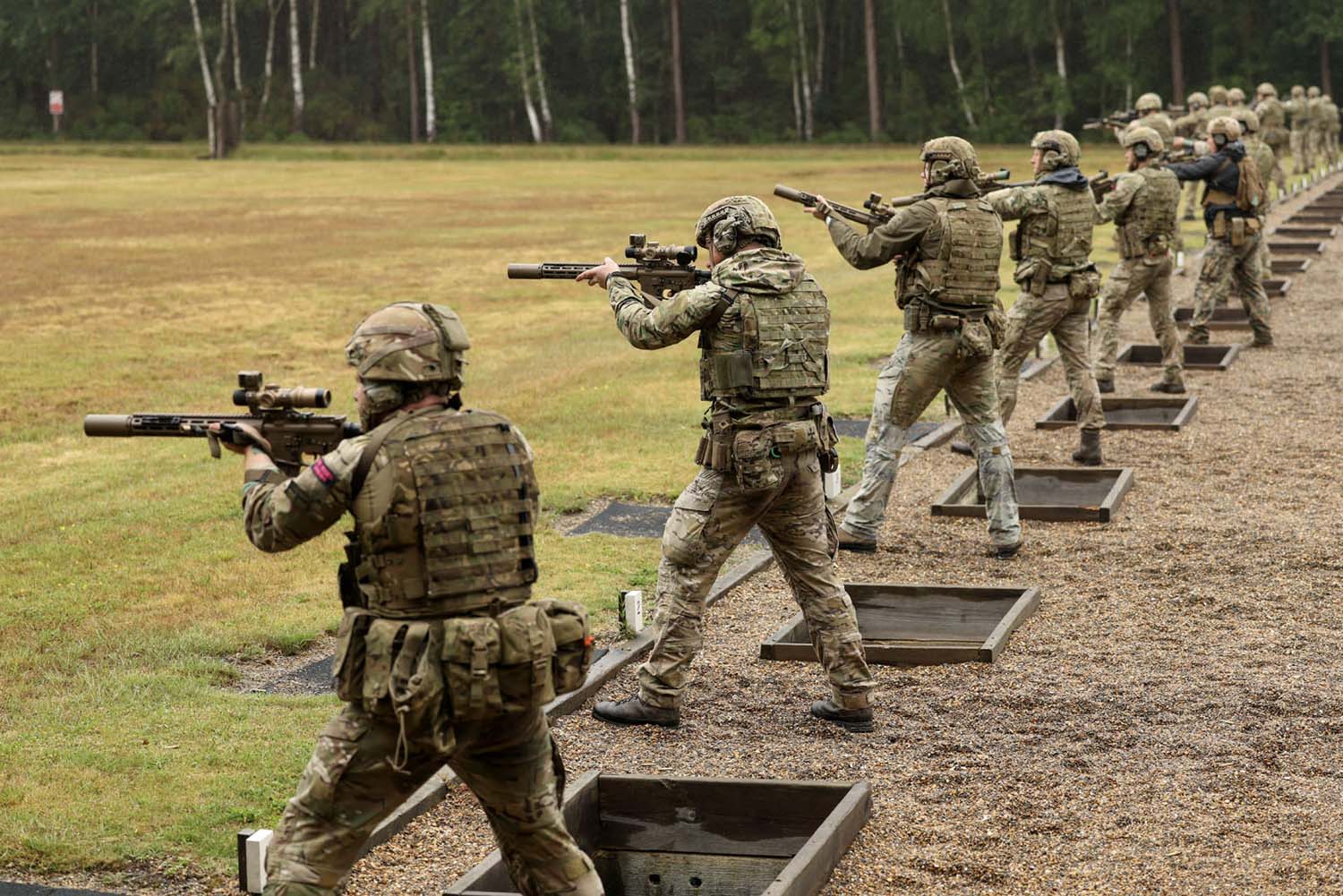
A combined Royal Marines and Royal Navy team of expert marksmen has won the UK Armed Forces’ top prize for shooting for only the fourth time in 117 years, the Royal Navy stated.
The Senior Service shooters triumphed at the InterServices Operational Shooting Contest, held on the range at Hythe in Kent, finishing ahead of their Army and RAF counterparts. The nine-strong team comprised Royal Marines from 30 Commando and the Commando Training Centre Royal Marines at Lympstone, under their captain, Petty Officer Chris McIntyre.
The team used the new KS1 rifle, which according to the Royal Navy showed marked improvements over the SA80 A2 that has served as the UK military’s standard-issue weapon. The RN and RM shooters had earlier proven themselves at Bisley during the Royal Navy Operational Shooting Contest, hosted at the National Shooting Centre in Surrey, where thirty competitors worked through 22 live-firing serials over a fortnight. Those serials involved shooting standing, prone, sitting and kneeling, while stationary or running, with pistol and rifle at ranges from 500 metres down to just ten.
The Royal Navy stresses that the event is a military training exercise rather than a sporting competition, using contest conditions to drive participants toward the highest possible standards. The focus, according to the service, is on developing instinctive combat marksmanship: firing a better shot, faster and under pressure, so that delivering a well-aimed shot calmly becomes second nature, a skill it describes as still vital in an age of drones and missiles.
This year’s winner of the King’s Medal for Champion Shot of the Royal Navy and Royal Marines, the United Kingdom’s highest award for military marksmanship, was Sergeant ‘Robbo’ Robinson from Yorkshire, who was carried around in a sedan chair in keeping with military tradition. He received a provisional presentation from the Royal Navy’s Commander Operations, Major General Rich Cantrill, on behalf of the Fleet Commander, before receiving the medal itself from King Charles, who also decorated the top shots in the Army and RAF. It was Robinson’s second attempt at the prize, having placed seventh on his first attempt in 2023.
A further nine shooters earned the Service Marksman badge, which they will wear on parade uniforms for the remainder of their careers. In the Senior Officer’s Pistol Competition, which drew ten firers, Commodore Matt Flegg from Navy Headquarters in Portsmouth won the trophy by a single point.
The KS1 has been entering British service as part of a wider small arms replacement effort, with the rifle selected to succeed elements of the ageing SA80 family that has equipped UK forces since the 1980s, and its appearance in the hands of the Royal Navy’s top shooters marks one of the more visible outings for the weapon since its introduction.








I mean… yeah.
Okay so shooting comps have always been a tad unfair, as units compete with what’s in their armouries; a rear echelon unit with old A2’s with green furniture and SUSAT’s (even crow cannons for machine gun shoots vs GPMG’s) might have to compete against a ground close quaters unit with A3’s and LDS’s, so nothing new. But let’s be real, the KS-1 is a high end boutique rifle with a incredibly expensive competition grade sight on it. It’s hardly a wonder why the RN took first place if they where using it (and hardly a wonder why they are trying to pretend the various marksmanship comps are training exercises rather than sporting competitions [they absolutely are sporting competitions]).
I remember the drastic improvement in accurately hitting and placing shots after moving from SUSAT to ACOG. It was a revelation, especially when tracking and firing at moving targets. Was always fairly crap with the SUSAT on moving targets, completely changed with the ACOG. No longer needed to guess where the target would be against the single needle. The ACOG with its illuminated “dot” and the horizontal bullet drop lines, made it so much easier.
With a descent sight you can significantly raise the game of a fairly mediocre shooter, to someone who is highly effective.
Yeah, I had the same feeling going from SUSAT to LDS/ELCAN (never was the biggest fan of ACOG though). Sights very much make the difference, and the sight the Army bought for the KS-1 is an excellent competition shooting sights.
Also worth noting the Red dot sights now standard on British Army sights compared to having to use the EBS on a SUSAT!
@Dern Does that argue that the regular army should get KS-1’s?? Curious on your thoughts.
My consistent position has been no. The KS-1 is too expensive to issue en-masse to the army, and the vast majority of troops don’t need that. For most of the army you want something rugged enough that a bored 18year old loggy can yeet it into the back of a truck and it not be too big of a deal, and something cheap enough that if said bored loggie runs it over it won’t cost a fortune to replace or repair. The KS-1 is neither of those things, and for what benefit?
On a competition shoot it will run circles against a normal military issue rifle, it’s a pleasure to shoot, but even the infantry don’t get enough range time really to get the full advantage of it (at least once you factor in the sausage factory nature of normal ranges). And even infantry don’t really need that capability; most engagements aren’t snap shooting someone at 300m, it’s suppressing the enemy so that you can either fire and manuever onto a position, another element can flank the position, or you call fires onto the position, while the enemy has their heads down. For non-infantry, blokes who need an IW for an emergency self defence weapon if the tank is on fire or the MRS is over run, it’s even less needed.
Expensive boutique kit like that makes sense for non-conventional forces that are potentially the only UK assets in country and ultimately are reliant on what’s on the man, the extra % points of capability do matter in those cases. But for conventional forces? Not so much.
Thanks!
I came second place at Bisley in the 80s using an SLR, the guy that beat me was from 2 Para with the L85! Those were the days!
Ummm … er … sorry, but this exercise (competition) does not pass the chuckle test of the famed British spirit of fair play. Basic fairness dictates that all competitors should be issued the same baseline equipment, whether SA-80 or KS1, at least for the duration of the exercise. Apparently the principals never heard of Marquis of Queensbury rules or the “Spirit of Cricket.” BA and RAF entitled to call foul. Simply a colonial’s perspective … 🤔
Marquess of Queensberry … 🙄
It was ever thus. You don’t shoot in an operational shooting comp without understanding that you might be disadvantaged by your kit, or training opportunities. The Gurkhas rather famously maintain a full-time shooting team that’s only job is to do well in these comps.
It was a bone of contention in other Rifles Bns that the best shots were posted to 4 RIFLES for the same reason (once HERRICK was finished).
Mind you, good rugby players often found themselves in 1 RIFLES too somehow…
The more that changes….
Well truth be told Dern, whilst you get different levels of kit, my day the choice was iron or Susat. However, having shot your way through the cycles we on Iron ( RE’S) were instructed to get Susat by hook or crook for the higher levels of the comp cycles ( Bisley etc ) as the expectation was the folks attending were singing off the same song sheet. ( Often sabotaged by other units you were trying to get the sights from as a lot were sent over as duff items) Worked out in the end tho and had loads of fun. Interesting to shoot the other nations kit when the chance came up. Was surprised by the resistance of the Americans on the shoots as they were surprised they had to run! ( Presume they thought everything would be from the bench but never shot in the States comps so could be wrong. They were however horrified at the weight of the A2, but if its the tool you have you get used to it. I used to tell them it was the cast iron piece in the butt that caused the issue )
I don’t know about military shooting competitions. But I’ve done some qual badge comps in America which where pretty nails, even if I questioned how they where scored. There’s also a lot of civie two gun and three gun shoots that are extremely mobile so I’d be very shocked if American shooting comps where static. Maybe first time those blokes where on an actual comp rather than just a static range package?
Only competed twice on shooting comps though, I don’t think my brigade even competes now but could be wrong, and both times didn’t get further than divisional level, so for all I know a team might scrounge LDS’s and A3’s for the final rounds. But no way anyone is grabbing KS-1’s for Bisley though.