

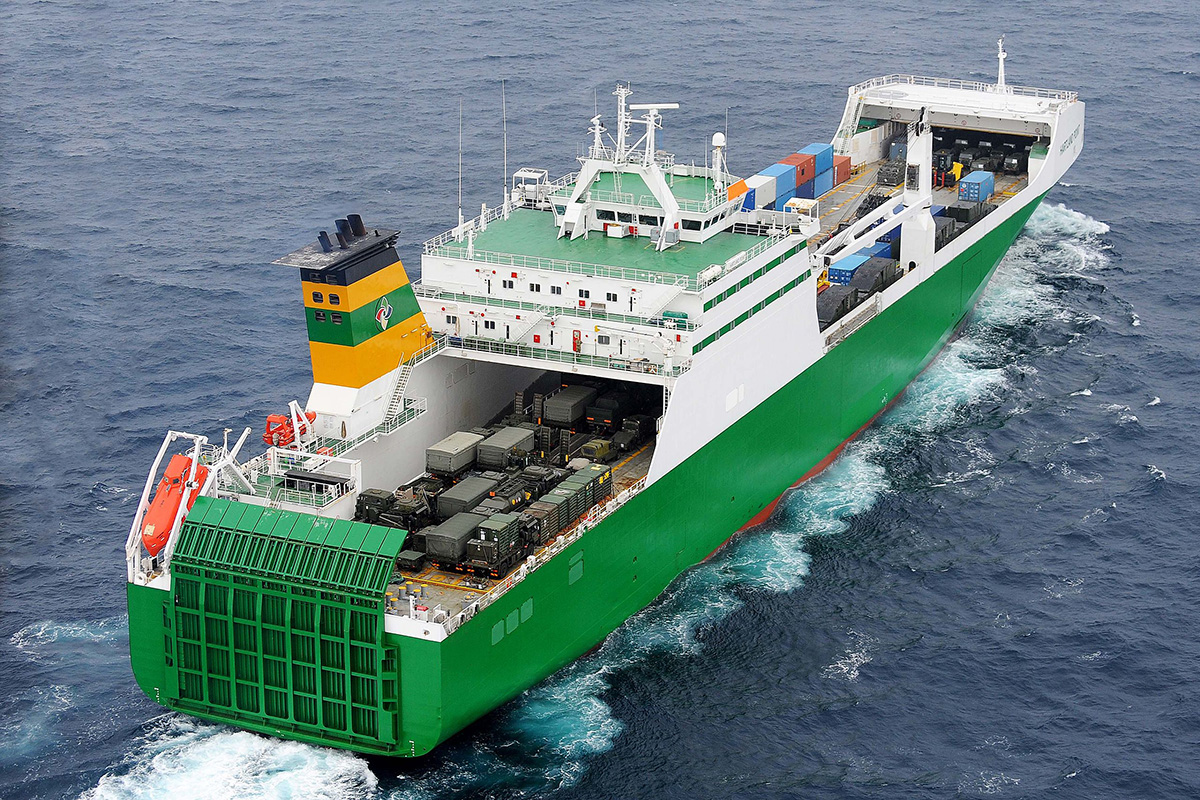
The Defence Investment Plan has allocated £290 million for a future strategic sealift capability, with the current contract for the Point class running until the end of 2031 and decommissioning of the existing ships a matter for their private owner, according to an answer given in Parliament.
Ben Obese-Jecty, the Conservative member for Huntingdon, asked what the expected decommissioning date is for the Point class and what progress had been made on identifying capital allocation to fund their replacement under the Strategic Sealift Future initiative.
Luke Pollard, the Minister of State for Defence, said: “The Point class vessels are privately owned and decisions on their decommissioning are therefore a matter for their owner. The current strategic sealift contract runs until 31 December 2031. The Defence Investment Plan has allocated £290 million for the provision of a future strategic sealift capability.”
The Point class are four roll-on roll-off ships that carry the Army’s vehicles and equipment when a force deploys, held under a private finance arrangement that has run since 2002 and that places ownership and crewing outside the Ministry of Defence, with a £476 million contract awarded to Foreland Shipping to run the service. Two more of the original six were sold some years ago. The ships carried the force into Iraq, have run the Falklands resupply and move equipment to exercises and operations across Europe and beyond.
Private ownership constrains what the department can say in answer to a question like this. The ships can be withdrawn by their owner, and the department’s hold on them runs only as far as the contract, which now has five years and a bit to run.
Replacing them has been under examination through the Strategic Sealift Future work, and the department has said it wants a larger fleet than it has now. A January request to industry for information set out a requirement for four ships of 2,600 lane metres each for routine tasking, and at least 15,600 lane metres across six ships for a crisis, which is around sixty per cent more capacity than the present fleet. Lane metres are the measure that matters, being the length of deck available for vehicles parked nose to tail in a single lane.
Any replacement also has to carry Challenger 3, which is heavier than the tank the Point class was designed around, and that drives deck strength, ramp capacity and stowage planning as much as the raw length does.








…so..on 1st Jan 2032 the private owner could say ” oh gosh we have a buyer for them” and take them out of service?
Or say….the contract is over…do you want to re-hire at twice the previous price ..or…
AA
I would say no as The MoD already extended the contract with Foreland once for 7 years at a reasonable price and there were other contract options they were examining.
Thanks. AA
Almost 16,000 meters of vehicle lanes is a hell of a lot.. 2000 challengers and boxers would come to that total …
A submariners dream target..!
Says a lot about where we are regarding the size of the army that those numbers represents more than the total size of the planned combined Challenger and Boxer fleet. I think I am right in saying the total number of Boxers will likely end up at 700 and there are only 147 Challenger 3 ordered, plenty of room for a few logistics vehicles as well!
Cheers CR
Perhaps some positive news for once after several weeks of gloom but I won’t hold my breath . Let’s hope thought is being given to seamless integration with LST , offloading to landing craft from the ramp etc etc. I know we already do this from the Points but let’s hope the capability is included in the spec from the start.
It’s got one hell of a spec, self supporting ramps and the ability to carry, operate and off load from Mexeflote. Self defence weapons, survivability, ice hardened, ramps from all four aspects…
Interesting thanks and encouraging if so – do you have a link to the spec?
Strategic Sealift – Future (SSL-F) programme tender document overviews.
Programme Requirements:
– Increasing back to six vessels.
– Slightly upgraded over Point class.
– The ships must be under sovereign UK control.
– Available to respond quickly to developing military logistics requirements.
– Each ship must be registered in the UK.
– Each ship must be British-owned.
– Each ship must be classified by a full IACS (International Association of Classification Societies) member headquartered in the UK.
– Ship’s lifespan is expected to be around 30 years for a new build. or have at least 10 years service life remaining if second-hand vessels are selected.
– Estimates for building the 6 new ships range broadly from £1–2 billion depending on the level of specification and where they are constructed.
– Given spending constraints, a phased procurement process, where the older ships are replaced incrementally, may be the most viable approach.
Ship requirements:
– Each ship must be less than 200 meters in length and have a draught of no more than 8 meters.
– They must be capable of carrying International Maritime Dangerous Goods Class 1-9 cargo
– They must be capable of supporting refrigerated containers (Reefers) for cold chain storage when necessary.
– The required capacity should provide a minimum of 15,600 Lanes in Meters (LiMs) at a minimum of 2.8 meters width across at least four vessels.
– [Meaning] minimum of 3,900 lane meter capacity per ship.
– Future vessels must have sufficient deck space and load-bearing capability up to 5 tonnes per square metre to transport contemporary and future military platforms.
– The ships must be able to operate from the Arctic to the tropics and built to Ice Class 1A standard to ensure they can navigate through sea ice.
– The new requirement also specifies a side ramp which would allow the ships to make use of a wider range of ports .
– Each ship will have at least one crane capable of handling 20 or 40 foot equivalent (TEU and FEU) containers and cargo.
Access must allow containers to be fully secured to the ship while still accessible at sea, not something possible on board a typical container ship.
– The vessels will include a self-supporting main stern ramp
– The vessels will include an internal ballasting system for offloading to Mexeflote or ashore.
– The vessels will be capable of supporting a SWL of 75 – 150 tonnes.
– Highly augmented crew,+ space for at least 12 augmentees.
Propulsion:
– Propulsion systems must provide for extended range at economical speeds.
– Propulsion systems must be able to run on globally-available fuel sources.
– Propulsion systems must be adaptable to future fuel solutions.
The MoD also wants to explore ways these vessels could play a greater part in amphibious warfare operations, by:
– Serving not merely as just transport
– Incorporating a flight deck for helicopters or UAS
– Command facilities and modular mission bay spaces
– The next-generation vessels must consider potential operation in more contested waters
– Some defensive equipment may be required.
– This could include mounts for crew-served light weapons
– Hardening of the ship’s systems against cyber threats and electronic warfare.
– Likely both soft kill and hard kill system outfit.
Delivery:
. Defence-owned & supported model – where vessels are both owned and operated by the MoD, ensuring full governmental control.
. Defence-owned & commercially supported option – would involve the MoD buying the ships but contracting their operation by a private entity, leveraging commercial expertise for efficiency.
. Commercially owned & defence supported framework, vessels are privately owned but operated by the MoD, allowing the military to maintain operational command while outsourcing ownership.
. Current model could be continued whereby the ships are both commercially owned and managed
That’s great – very encouraging. VMT 🇬🇧👍🏴
Sorry that should read Amphibious Transport Ship or ATS , not the good ol’ LST. I mean the new fangled Anglo/Dutch efforts which as ever at 15,000 tons seem tjust oo short and narrow of beam to allow for a decent sized dock plus a vehicle deck and with a flight deck.lacking an elevator and with only just enough space for two Merlin sized Helos to land on at the same time – that is if we’re lucky that is !
Ah yes, the “no loss in amphibious capability” cobblers from HMG with those.
1SL was holding a model of one the other week.
And a very uninspiring model it was indeed 😁👎🇬🇧
At least it is keeping sealift & some basic amphibious capability. But what we also need is replacements for the Albions to give both better capacity & amphibious command, plus preferably a decent LPH to replace the loss of Ocean. They were on the RNs strength in peacetime but now we’re in at the very least a steamy, aggravated, “cold war” we can’t fool ourselves that we can skimp on the basics like we’ve done in recent decades.
Why they can’t they make them a tad longer/wider and put some decent defensive armaments on them?Even have a mix of different sizes? Seems very self restricting.
There are arrangements possible that would allow ATS to have a flight deck for 3 Merlin plus UAV spots with above deck hangar for 3 Merlin, while having a proper well dock and vehicle deck below. It would be unconventional but it is possible if the designers are willing to go off the beaten track a little.
Understand the Vessels must be No longer than the point class… so fatter..!