

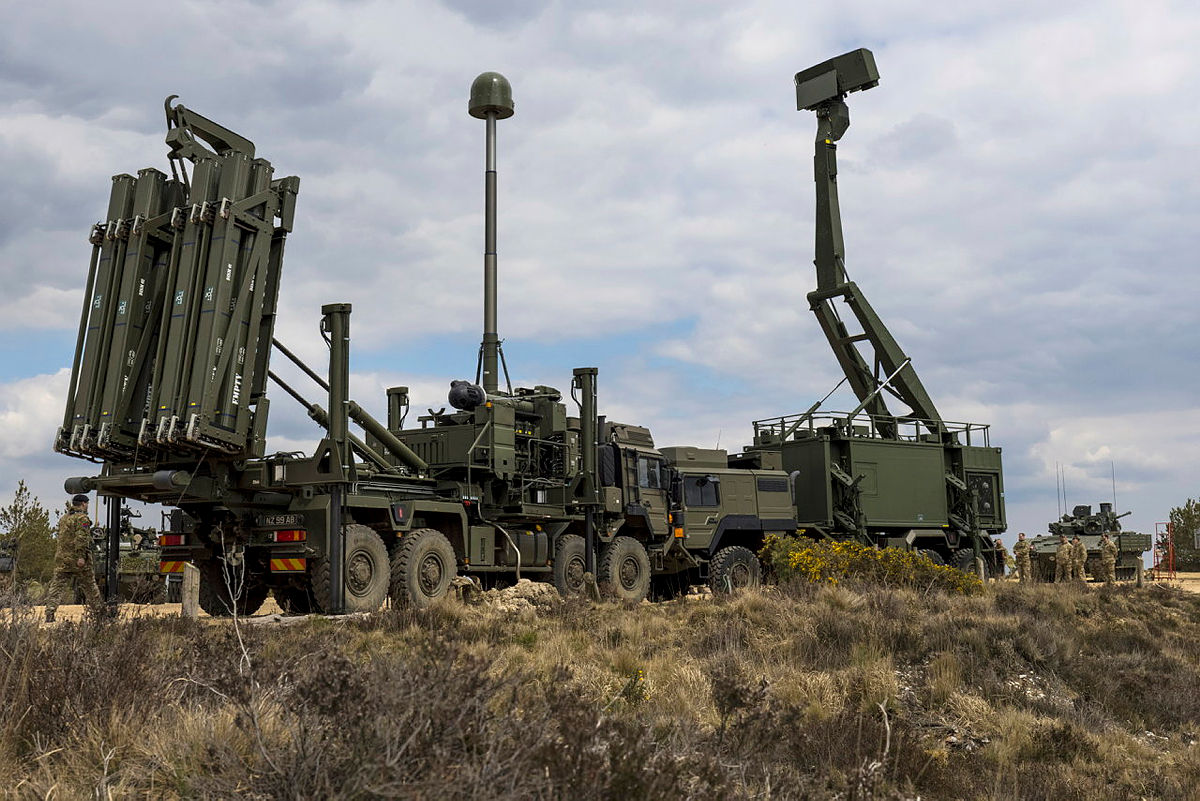
The doubling of the British Army’s Sky Sabre air defence force is on contract and moving towards delivery, the Ministry of Defence has confirmed, with additional operating centres due at the end of 2026 and entering service in 2027, alongside extra Land Ceptor launchers and support vehicles arriving the same year.
The timeline was set out by Defence Minister Luke Pollard in a written answer to Conservative MP Stuart Anderson, who asked when the commitment to double the number of Sky Sabre systems operated by the Army would be delivered. “The Defence Investment Plan commits over £350 million to double the number of deployable Sky Sabre air defence missile systems operated by the Army,” Pollard said, as quoted in the answer.
“This increase is being delivered through the Land Ground Based Air Defence (LGBAD) Programme’s Capability Uplift Package 1 (CUP1). Additional Surface-to-Air Missile Operating Centres are on contract for delivery at the end of 2026 and are expected to enter service in 2027. Additional Land Ceptor launchers and associated support vehicles are also on contract for delivery in 2027. Together, these investments will double the number of deployable Sky Sabre systems operated by the Army.”
The Minister added that the programme is considering further enhancements to Sky Sabre capability beyond the doubling, though he said he was unable to comment further while commercial negotiations are ongoing, an indication that additional investment in the system may follow the current uplift package.
Sky Sabre is the Army’s medium-range ground-based air defence system, operated by 7 Air Defence Group, pairing Saab’s Giraffe Agile Multi-Beam radar with MBDA’s Land Ceptor launchers firing the Common Anti-air Modular Missile, the land counterpart of the Sea Ceptor arming the Royal Navy’s frigates, and a Rafael-supplied command and control node linking the pieces together.
The system replaced the ageing Rapier from 2021 and has deployed operationally, including to Poland to protect key infrastructure and to the Falkland Islands, where it maintains the air defence of the territory, alongside Typhoons.







Great news at last. An increase in active units is a start. Another issue of great importance is when will the army order CAAM-ER, with a good useful increase in range? We must get the longer range missiles to beef up capability.
Saw sonewhere that Brazil has ordered the CAMM-ER (from MBDA Italy) with what looks like a same 2×4 load on a 4×4 vehicle for its Army. Agree, why not the UK? Might even be possible to have both as a mixed fires from the same control unit? And we haven’t heard more on the MR?
And l why not the Aster SAMP/T too and shared inventories with the RN.
Hi QuentinD63, The army have expressed a wish to get CAMM-ER in service ASAP, but as no new money has been released yet, they will have to wait. I did hear in May from a pal who is on Daring that the top brass have asked to get the CAAM-MR to be considered for type 45 refitting when all development work has been finished, but this calls for a major cash input and as yet a lot of money is still being spent on the type 45s, just to get their current upgrades completed. CAMM-ER would be very useful for army but we will just have to wait and see. We are dealing with the MOD after all.
CAMM-MR wouldn’t make sense on T45s with Sea Viper. They just need CAMM for close in engagements.
On the frigates and Sky Sabre batteries, I could see the appeal of CAMM/CAMM-ER mix in terms of cost and number of missiles carried with an increase in reach.
No chance of CAMM-ER for British forces. It uses Italian propulsion and UK don´t want to pay for it instead of own.
It would be very nice to have a firm confirmation on how many systems we actually have. Sky Sabre is a fantastic capability, maybe the best system in the world for interception of low flying cruise missiles. Hopefully the enhancements are to add CAMM MR and give it a true area air defence capability.
Indeed, we’ve done this one to death on here mate.
It’d help if the MoD was consistent in the wording they use.
Launcher, system, are both used, and both are very different as we know.
“ double the number of deployable Sky Sabre air defence missile systems”
Could also mean increasing the % of serviceable units…..
The fact that they are so ambiguous with it is the tell, the “launcher” numbers if they were full systems would be reasonable and they would be putting that number everywhere.
I’ve not noticed any other country referring to Patriot, IRIS T, SAMP T in terms of launchers, always based on systems or batteries, because you can deploy each launcher in a different part of the world just like a system right ?
Then again, admitting best case scenario you have so few that between deployment to the Falklands, potentially Cypress and maintenance you may not have anything left for anywhere else isn’t good publicity.
The obscurity I’m afraid, is for one reason…
It’s not many – at all.
Now they’ve added “operating centres” to the list Daniele, especially to keep you personally guessing! 😜
Hi mate. I assume those are the SAMOC Command Vehicles, of which I believe there are 15 in service
Hello mate,
Can you explain to me why we have 15 Command Vehicles when it seems 16RA only have 4 batteries? My understanding is that there is one Command Vehicle, one Radar and 4 to 6 Fire Units per battery. So that would suggest 11 Command Vehicles going spare or have I missed something?
Thanks CR
Hi mate.
Batteries are split into 2 Fire Groups.
Each FG has a Command vehicle, radar, and X number of launchers, 2,3, not known for sure, comprising a system.
So 8 FG to the Regiment, 8 SAMOC vehicles, 1 Each.
Rest for spare, training, trials, reserve.
This is how I understand things.
I remember seeing 4×4 MAN vehicle with a 2×6 CAMM load on the back. Are these part of the battery which used with the main launcher with the 2×4 set up, radar and fire control?
And are these just for Army, what about everyone else? RAF regiment and Port base protection? You mentioned a while back that the CAV might be the base for Shorad, is that happening?
As far as I know, CAVS is the preferred option for Stormer HVM replacement, yes, nothing official yet.
Thanks Daniele,
Clarified that nicely. Given the flexibility of the system assessing whether the numbers have actually been doubled isn’t straight forward.
The situation might be even more complicated as I read somewhere (I did a bit of digging as a result of this article) that the system can take radar / command feeds from other systems. I can’t remember the precise wording but the inference was that Sky Sabre and or its elements were designed to be able to fit into UK / NATO air defence networks adding another layer of adaptability and utility. It would make sense if I have understood it correctly, to be able to carry on using Fire Units as part of someone else’s system in the event of a Sky Sabre Command Vehicle being lost, for example.
Thank again
Cheers CR
DM , this is really a good bit of news, happy days Sir!
Yes, I think that would make sense. Trust the British Army to come up with their own nomenclature that doesn’t 100% clearly correspond to what the manufacturer does..!
So, can we assume that they’ll be procuring at least another 8, to double the deployable units, if not another 15?
Jim, the last time I researched this we had a mere 7 systems, and a system includes one Giraffe radar, 1 command vehicle and 1 launcher, so we have just 7 launchers, although some media reports say 12 launchers which is confusing. (Tr2 order is for 6 more systems hence the use of the word ‘doubling’)
I think in the heyday we had 200 of the predecessor Rapier Fire Units (FU) held between the Army (RA) and the RAF Regiment, which reduced to 124 at the end of the Cold War held solely by the army and then just 48 afew years later.
[issuu com/official_reme/docs/the_craftsman_march_2026]
Broken link above indicates that the ‘doubling’ takes the UK to four batteries. Currently, there are two batteries.
IIRC, half a battery is in the Falklands. There’s another battery in Saudi Arabia, leaving half doing something else.
A battery is four to six launchers. So, eight to twelve launchers is becoming sixteen to twenty-four launchers.
However, that’s just one piece of evidence. A poster I talked to over on Reddit wrote this:
‘Generally it was accept and worked out through the vague speak that 24 i-Launchers were procured with the Giraffe radars to form 8 fire units and there for 4 batteries (under UK naming convention which is why people take the lower number).
I think what has really added to the confusion is the random use of words from higher government statements regarding CAMM. It should be that a launcher is a the single i-launch vehicle, a fire group is the same as a system and a battery yields two complete systems. When we say we have half a system at Mt Pleasant what we mean is by international standards is a battery. Increasing to 9 systems if we assume there are currently 8 systems based on the estimated 24 launchers would mean adding half a battery (perhaps what HMG meant was they’d be increasing the existing force by a half battery).
Or perhaps we really do just have 6 individual launch vehicles active and the billions spent on developing LandCeptor have turned into the most expensive per launcher airdefense system in the world, but if that were true the Telegraph and Daily Mail would be having a field day of piling the shit on the MoD which they are not.’
So, who knows? We need clarity on this urgently.
Below from Gemini
Seems the total number of systems is officially withheld for operational reasons but speculated to rise to 12 to 14 once purchases are complete by 2027.
“The exact number of operational Sky Sabre systems currently in service—and what the total will be following the completion of the doubling program—remains officially withheld by the UK Ministry of Defence for operational security reasons.
However, looking at the defense contracts and parliamentary statements, we can map out how the UK is defining and achieving this “doubling” by 2027:
What the “Doubling” Actually Means
The MoD’s £350+ million Capability Uplift Package 1 (CUP1) defines the “doubling” based on deployable capability (the number of complete, simultaneous air defense systems or fire groups the British Army can field at once), rather than just buying twice the number of individual missile trucks.
The program is bridging a known equipment bottleneck by matching launchers with new command nodes:
The Core Uplift: The MoD placed a £118 million contract with MBDA to procure 6 brand-new Land Ceptor launcher systems, alongside 12 ammunition support vehicles and 8 threat evaluation/weapon assignment systems.
The Operating Centers: Crucially, new Surface-to-Air Missile Operating Centres (Command & Control nodes) are under contract to arrive at the end of 2026 and officially enter service in 2027. This allows the British Army to split its existing and new hardware into more independent, simultaneously deployable units.
The Estimated Numbers
While open-source defense analysts debate the exact baseline figures (as some equipment is permanently tied up in training, maintenance rotation, or static deployment like the Falkland Islands), independent tracking gives us a clear picture:
Pre-Uplift Baseline: Open-source assessments generally pegged the UK’s frontline capability at 7 core medium-range Sky Sabre systems/fire units (frequently heavily constrained by having only a few fully independent, deployable command suites shared across 16 Regiment Royal Artillery).
Post-2027 Target: Once the new Land Ceptor launchers and additional Operating Centres are fully integrated into service in 2027, the British Army’s pool of deployable fire groups is expected to expand to roughly 12 to 14 active, fully independent systems supported by a total pool of roughly 30 total launchers.
Furthermore, Defense Minister Luke Pollard noted in July 2026 that the MoD is already in commercial negotiations to consider additional enhancements to the Sky Sabre program beyond this initial 2027 doubling phase.”
Both this and Leh’s post pretty much sum up what’s available.
I don’t see how the Fire Group term works with Sky Sabre. By the sounds of it you can link a number of launchers and radars to the control system. So the number of ‘groups’ you can have is limited by the number of those control cabins you have?
Some other systems have modes where you can operate the launcher and radar on their own. Giving another configuration.
It was announced last year that launcher number were going to 15 with an additional 6? Is this another buy or repeating previous news?
My tupeneth is that we had 7 launchers, making 6 deployable systems with a single launcher each, along with a Giraffe radar vehicle and a command vehicle, plus a launcher for training/reserve. Adding six more Land Center launcher vehicles doubled the number of deployable Sky Sabre systems to 12.
According to MBDA blurb, the launcher can be fired as a stand alone system, but only for point defence. I guess it must have an integrated OE like the Raven systems supplied to Ukraine. But it sounds a lot like radar can only be integrated using a SAMOC.
I read previously (from someone actually in the RA) that 9 launchers were in service i.e. two batteries of four plus a spare, which aligns with your adding another 6 to make 15. Not clear if it’s the latter number that’s now doubling, or if that’s just an assumption.
Good summery of what is out there.
I suppose atleast it confirms that the number of deployable systems is officially a secret and it’s hard to define how many individually deployable systems there are as fixed sites like the Falklands don’t need all of the component vehicles to generate an operational system.
So even counting the number of radars as i previously suggested won’t help. If we are moving up to 12 to 14 deployable system, each with two to three launchers that sounds like a decent figure.
If we added on 6 SAMP/T launchers I think the UK woukd have a decent full spectrum air defence.
The Army, Jim.
This is where we continue to differ, in war these are off with the Field Army, so the ARRC.
They’re not sat distributed at Faslane, Lossi, and Marham.
Quadruple the RAF Regiment with Rapid Sentry, add some Sqns of these. ( means more people, so not a hope in hell ) and we might start to improve matters.
In war they’ll go where they’re told to.
Just because they are taskorg’d to the ARRC doesn’t mean that they can’t be sent anywhere else and the Corps left to make do.
Out of all the current GBAD deployments how many are in support of the ARRC?
None, as you know.
I think because it and the Army has not deployed for general war.
But yes, your point stands, maybe the Army will have no GBAD and it’ll all be sent to cover RAF Stations, Aldermaston, Westminster, wherever.
Sure the Army will love that.
Reversing things, with nothing else UK GBAD wise save T45 it’s no wonder they use what is available to cover for going effectively without.
The fact that that makes it one or the other is equally damning.
This recent fad for total GBAD for the homeland is mostly due to the ridiculously restrictive RoE that the USA imposed on Ukraine, leaving them entirely dependent on intercepts, which Russia then saturated with cheap drones, leaving the impression that even more GBAD is needed to solve the problem.
The better answer is to take out the factories that make the aggressor’s missiles. As Ukraine is now doing, since they built their own capabilities like Flamingo that the USA can’t impose RoE on. Funnily enough, we are now putting together similar low cost sovereign capabilities, like Brakestop and Nightfall.
Agreed mate, get the RAF Reg doing what they used to do, 1 x troop Rapid sentry, 1 x troop in Jackal and 1 x admin/loggies, per main airfield with a few more Army Sky Sabre and you have the basis of a mediocre layered defence.
And a “RN Regiment” equivalent to protect the three main bases? The fleet, subs, infrastructure needs protection.
Pretty sure we had 9 launchers, and 6 were added, making 15 (i.e. 14 plus a spare). So have they just split the existing, by adding more SAMOC, to make 14 ‘deployable’ systems, each comprising 1 launcher + 1 radar + 1 SAMOC? I hope not but it seems possible, given what’s known. Also considering that dispersal of smaller units is essential on the drone infested battlefield. And it does make sense to increase the ratio of SAMOC+Radar because it’s the SPOF in a larger system, whereas launchers can be added back to a different fire group if their C2 is lost.
And yes, one Fire Group, so half a Battery, is in the Falklands.
If this completes 4 Batteries that’s good, as that is what 16RA contains, 4 Fire Batteries.
The number of launchers to command systems was specified as being very high.
There was originally a larger buy optioned.
Almost as soon as army got hold of the system and tested it they cancelled the options and wanted a Gucci upgrade.
All that then happened was that the budget got slated back.
So buying more Giraffe and command centres then get more deployable units from the launchers we have. The interesting bit is the mention of more launchers as well.
As I’ve said many times before the trick with these is to hook them up to distributed control systems. That is where the costs savings and performance improvements sit.
The launchers.Arw these just 2×4 as I thought I had seen a 2×6 on a 4×4 MANN as well?
Also some post mentioning a CV90 based CAMM concept being developed by BAE Sweden. That ought to get some interest if the UK wants a tracked system.
Doubling nothing is still nothing, whichever way you spin it.
Yes, this is my position.
They highlight the “doubling” and one’s meant not to think, hang on a minute.
By design.
It’s very hard to announce how many more of something you are buying when the number you have is a secret though. They could either say they are doubling the number or say nothing at all.
Yes. Now why is it a secret?
The number of Tanks isnt, nor the number of Rapier FSC that came before.
This isn’t the UKSF or the UKIC.
The secrecy, oftentimes, is to cover up political embarrassment, incompetence, or the sad reality in this case of just how few exist.
Otherwise, the whole military might as well vanish in a puff of smoke.
I know HMGs “transparency” vows have vanished as well and some docs once published routinely no longer appear, but it’s getting ridiculous.
Deterrance demands one waves ones threat effectively.
Spot on mate 👍
It’s a secret because it’s the UK’s only medium GBAD, not knowing how many there are greatly complicates an enemies threat assessment. We don’t realise things like missile inventories and nuclear warhead counts for the same reason.
Big question is why do we as the public need to know.
Seems to me this figure should be secret much as I would love to know what it is.
Secret from whom? Do you think Russia doesn’t know? Do you think China doesn’t know? Secret from the taxpayers just makes the numbers easier to cut at a later date.
We want our conventional forces to be a deterrent. That means having more and being more open about it.
It is a secret insofar as the general public can’t call on high resolution satellite imagery of the car park at Thorney Island. The trucks are parked out in the open, I’ve tried to count them through binoculars often enough and the Russians and Chinese will have no problem at all working out how many we have.
Technical kit is usually stored inside. Imagine there are plenty of big hangars from the sites previous life?
But count away!
Haha! So you’ve had a walk around Thorney as well? Or were you afloat?
My home sailing club is on Chichester Harbour so I have regular sightseeing opportunities :). Also quite handy with Portsmouth on the way past and the T45 on the hill is visible from everywhere, it makes very nice sunset photos.
A good start but probably it’s also the end according to the DIP, still a single layer, point defence and scattered
A good start but probably it’s also the end according to the DIP, still a single layer, point defence and scattered
Good to see you getting into the spirit of doubling up George.
Personally I think a multi-layered approach with kit ready to intercept everything from fighters to cheap drones and everything in between is needed.
This is clearly part of the picture but where is the rest and will the be enough of these to cover everything which needs to be covered.
I sure many of you are thinking the same and will have already commented.
Pollard up to his tricks again, an old announcement made to look like new.
Some context….
UK used to have just shy of 60 Rapier systems
The original, I assume, which included tracked and static versions.
Rapier FSC, the latter version, I had at 24.
There’s been a relentless decline in air defence since the end of the Cokd war to effectively nothing.
Lessons not being learned from Ukraine
Air defence systems are priority targets and need defending in depth to protect them.
In the real world, a Sky Sabre system needs inner ring Defence with Stormer and close in defence with gun based AAA systems
Rapier FSC covered 200 square km and Sky Sabre covers 1800 square km.
So if doubling sky sabre is that to enlarge 7 Air group or an extra Artillery Regiment ? Do think the RAF should have this System but they again where’s the manpower and money .
Not as far as I know. Possibly with future orders, as a third GBAD Regiment has been rumoured for some time.
16 RA which operate the system were clearly only partially equipped, with their Fire Batteries rotating into role.
Hi mate, methinks we don’t need another Regiment, we just need to uplift the number of Btys in each Regiment, cheaper and more effective all round, and just as effective. More so the RA lads have more affiliation to their Bty than the Regiment, more so than Infantry Companies. Cheers 👍
Hi mate, long time no speak, I hope you’re keeping well.
I believe 12 RA with SHORAD role has done exactly that, with another Fire Battery anc the HQ Battery also having a Fire role.
With 16, yes, could do that too, they’ve only got the 4. But this is a rare occasion where I’d differ from your solution, as Wavell is ongoing and they’re trying to realign the ORBAT with more assets going into 1 Division. A Regiment of SHORAD and a Regiment of Sky Sabre foe each Division, rather than the sub optimal arrangement now with just 4 Batteries having to cover the entire Army plus getting nicked for non Field Army tasks, would give great coverage and also return another missing Divisional level asset.
The current 4 Batteries, if expanded to 6 for example, could give 3 per Division, meaning both 1 and 3 Divs 2 manoeuvre Bdes get a dedicated Battery ( 4x, 7x, 12x, 20x ) and also the rear area lines of supply ( 101x 102x ) could be covered too.
Will never happen! Either way would help mate.
As always.
Respect.
As ever mate I bow to your encyclopaedia knowledge in these matters! It’s just a case of getting these platforms in service with minimum cost, bullshit and change, to which ministers may accept without knowing why! But as you say, most likely never happen but we can always hope 👍 cheers mate chat soon.
I think peacetime structure will be different from wartime postures. I don’t see how a system like Sky Sabre can operate on its own anymore. Everything needs to be layered, so taking bits from multiple units.
12RA have always been with 3 Div, with the HQ Bty being the Div Air Defence cell, while 16RA haven’t been aligned to anyone and just been declared to the Falklands with other jobs at best effort (apart from LEAPP I suppose).
If this brings 16RA up to warfighting establishment will they provide the Regimental HQ into 1 Div?
I think each Div needs a mix of Sky Sabre, SHORAD, cannon and a Sky Hammer type system, so batteries could move around between Regiments as needed.
Also depends if there is now a corps troops? If ARRC are getting their own DRS is that what a third Regiment is needed to provide?
Maybe a Light Role regiment to go with 1Div and leave the Corps to 16RA?
I think 22 would be a good number…..
I agree with all of that, Legbye, all realistic. The “Corps Troops” are in effect 104 OS Bde, 1 S Bde, 3 DRS Bde, 2 MG, 8 Bde,1 Avn Bde, 7 ADG, 1 MPG.
Yes, I’d wondered if the mooted third GBAD Regiment was a Corps asset.
Yes, 12 RA are with 3 Div as they have the CS Stormer elements to go with 12 and 2 Bdes, with 16 ( Minden ) Battery for 16 AA.
“I think each Div needs a mix of Sky Sabre, SHORAD, cannon and a Sky Hammer type system,”
Very much my hope as well!
Rapid Sentry already has two or three layers, add Sky Sabre for short/medium range, Sky Hammer similar. Then there’s Raven which is ground vehicle-fired ASRAAMs, again a similar range. Then we have several choices of laser DEW, from the 15kW Wolfhound mounted one to Dragonfire.
It seems to me we already have plenty of systems to choose from for a layered short range air defence, especially out to 25-30km. We have to choose what we want and order it. Unfortunately we have nothing for medium and longer range that doesn’t come attached to a destroyer. The sooner we spec out CAMM-MR, or plump for SAMP/T the better.
A full multi-layer Rapid Sentry system would cost maybe £10m for the hardware, and maybe an extra £3m for a few Raven systems to extend out the envelope to 25 km. That’s peanuts compared to an admittedly more effective Sky Sabre battery and could well be a better choice for UK sites, just on the grounds of cost.
Cheers mate I guess anything to do with defence in this country of ours we just have to hope for the best .👍
Purposely vague and noting to do with OPSEC etc! Vague as it’s a word salad, no official confirmation of exact numbers “in service” as opposed to training/maintenance etc and therefore a mealy mouthed load of shite to get away from the fact it’s a bare minimum uplift! Do I want them to double the amount, shit yes, but the vagueness of it all plays to the usual HMG spin and bullshit! My bro was RA, GCC and I’ve asked him to speak to some of his contacts to see the insider info!
Hi Airborne,
Haven’t seen you around for awhile, welcome back.
I agree, confusing as hell. The MoD have been getting ever more secretive over the last 10 years or more. The excuse is to ensure operational security. Total rubbish. Our enemies are more than capable of finding out the equipment and readiness levels of the UK’s armed forces.
Real reason is to hide the truth from the British people who are in for a huge shock if Russia pulls a grey zone doozy such as cutting a bunch of data cables under the North Sea or worse a ‘rogue’ captain fires a couple of missiles at a seaside town or some such. I bet most people still think navy has dozens of escorts, the army 100’s of tanks and 1000’s of artillery pieces and there are 100’s of fighter ready to scramble into the air to protect them.
Little do the realise..!
Cheers CR
Exactly. One must not make excuses for these people, though some try.
Hi CR, glad to be back, always had one eye on the reports and comments! Yes mate, total subterfuge yet again by our clowns in charge, and no change expected by the Burnham clown! I’m from Manchester, trust me, unemployment is up, crack heads and immigrants are up, areas of town a total no-go area, city is in debt and a big cloud over a multi million housing contract now under investigation! Defence is the last thing on this clowns mind! Cheers 👍
Hmm, I have read that Andy Burnham has achieved good things in Manchester and yet your post provides a different perspective entirely. Nothing is ever clear cut, especially in politics. The current political set up in the West is completely broken. Dogma is the enemy of progress and it is core to western political set up or right and left.
For me the big problem is that in the west we think in terms of single right answers, that there can only be one way to achieve success. Our philosophical tradition is that contradictions must be solved because they are ‘road blocks’. That might be true but I think that for the most part they are in fact natural checks and balances. Hence, if you want peace prepare for war. Many on the Left hate that idea. Al Carns said that we must prepare for war, but to do that we must unite the country, given everyone a stake in the country. I thought that was probably the most sensible thing I had heard any politician say in a long time, and one of the toughest things to achieve. Probably impossible, but a genuine on going effort to that end would probably be the best contribution to national resilience anyone politician could do.
No chance it would happen. Why? Dogma! And so long as Dogma rules then they will always be Clowns.
Cheers CR
So nothing changed up north!!
That reply was meant for Airborne
Wow. And Burnham’s only been gone a couple of weeks.
lol nah mate it’s thanks to Burnham and his lefty crew the place continues to be a shit hole!
Well said Chariot rider. Exactly what I have been thinking.
If 16th Royal Artillery Air Defence Regiment, is only getting 12 to 14 complete independent Sky Sabre systems, that just enough for four Troops or two Batteries.
What is needed is three Batties, each of two Troops, with 6 complete independent Sky Sabre systems per Air Defence Troops?
Or 18 complete independent Sky Sabre (Command vehicle, .launch Vehicle and sensor vehicle, plus support vehicles too) systems, for each Royal Artillery Air Defence Regiment.
Then the MoD and the new Prime Minister Andy Burnham Labour Government, ordering upto 60 complete Sky Sabre systems, to equip upto three new Sky Sabre Air Defence Regiments (2 Regular Regiments & 1 Reservist Regiment).
Which making up one new Royal Artillery Mobile Air Defence (Regular & Reservist) Brigade, for the Defence of the United Kingdom and for Air defencenof overseas deployed British Forces, plus the defence of the Falklands Islands simultaneously too!
With a new Royal Artillery Light Air Defence (Regular & Reservist) Brigade created too, again consisting of three new Light Air Defence Self-propelled Armoured Wheeled (40mm Cannon, Direct Energy Laser & Missiles) Regiments.
Similarly with 2 Regular Regiments & 1 Reservist Regiment too, for Close Air and Anti-Drone Defence operations.
With each RA LAD Regiment equipped with 18 new Self-propelled Armoured Wheeled Vehicles, armed with one 40mm main gun and coaxial 12.7mm HMG, as well as one Direct Energy Laser, plus 8 Vertical Launched out of an internal magazine short-range low altitude fire and forget laser-beam-self-guiding surface to air missiles, lastly with own built-in early warning, detection and tracking sensor systems too.
To give the Royal Artillery and British Army plus His Majesty’s Forces, the number of Air Defence Regiments, they real needs in the 21st Century and facing a possible Armed Conflict or War, between Nato and Western Europe with Russia?
When European Nations and Nato Countries, cannot count on US President Donald J.Trump or his Maga Far Right Republican Regime, or maybe not even Trump’s Replacement in the White House too, to actually not honour fully Arcticle 5 of Nato Agreement too!
Good news, a doubling is most welcome, but as it’s from a very low base we’re still a long way off where we should be. And as discussed, I suspect the vagueness around the language used is almost certainly deliberate to hide just how low the numbers are.
This is good news. Thought we should look into getter the MR or ER variant. We should add ASTER 30 block 1 or 1NT. We need a ABM defence that can handle hypersonic missiles. We ahold also add drone defence EMP and jammers etc. We need a layered in depth defence.