

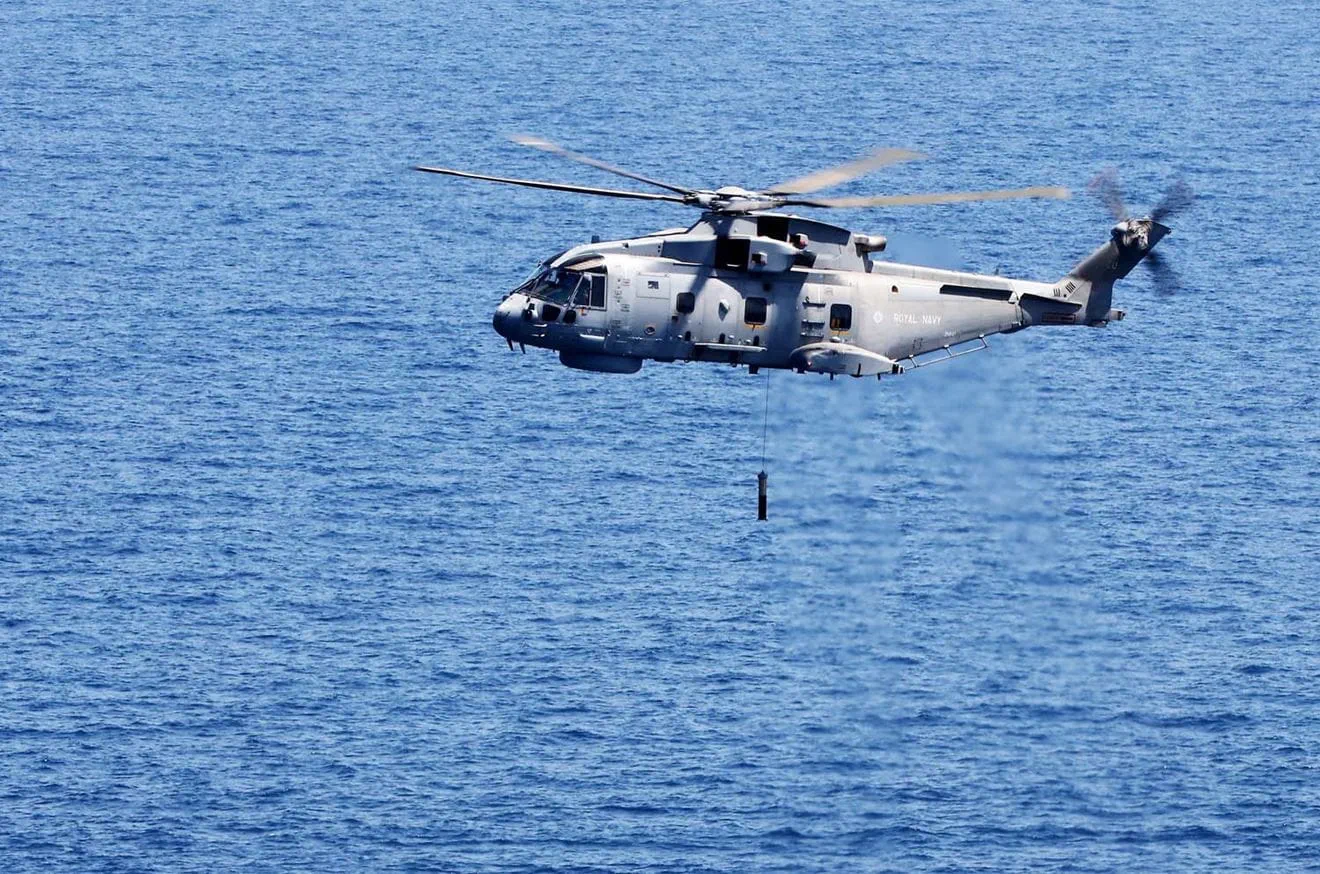
The Royal Navy Merlin helicopter force is set to receive a major boost after the Ministry of Defence awarded a £40 million contract to Ultra Maritime to supply new sonobuoys.
The contract focuses on equipping the Merlin Mk2 fleet with updated sonobuoys, a core component of the Royal Navy’s anti-submarine warfare toolkit. Sonobuoys act as expendable acoustic sensors, allowing aircraft to detect, track and monitor hostile submarines and other underwater threats across wide maritime areas.
Based at RNAS Culdrose in Cornwall, the Merlin Helicopter Force plays a central role in protecting UK waters and supporting allied operations. Merlin aircraft from 814 Naval Air Squadron routinely deploy aboard Royal Navy frigates, Royal Fleet Auxiliary vessels and from forward operating locations such as Prestwick in Scotland, while 824 Naval Air Squadron remains at high readiness to respond rapidly to emerging threats.
Captain James Hall, commanding officer of RNAS Culdrose, underlined the importance of the capability, saying “our anti-submarine capability is essential to protect Royal Navy submarines and the UK’s nuclear deterrent. The capability offered using sonobuoys forms an essential part of the toolkit used to identify, track and deter submarine threats.”
He added that the Merlin force’s reputation in the anti-submarine role was well established, noting “it is not an exaggeration to say that Merlin Helicopter Force combining its aircraft, its sensors and equipment, and the crews’ extensive tactical training is a world leader in anti-submarine warfare.”
Merlin Mk2 helicopters combine multiple sensing methods, including an onboard dipping sonar, with deployed sonobuoys to form a networked acoustic picture of the undersea environment. “The Merlin carries a dipping sonar which, in combination with sonobuoys, creates an acoustic network to hunt for and track adversary submarines,” Hall said, adding that aircraft can be armed with Sting Ray torpedoes “to eliminate that threat if necessary.”
The contract comes amid heightened concern over threats to undersea infrastructure and increased submarine activity around British and allied waters. Hall said “we face an increasingly uncertain and contested world, which includes ever evolving threats to our critical undersea national infrastructure,” describing control of the subsurface domain as “a key pillar of the Royal Navy’s ability to confront global threats and ensure operational success as we defend the nation.”





Question what’s stopping the likes of Russia and China picking up one of these once they have stopped working and been left in the sea? I’m guessing there nothing really “special” about them and they are pretty standard across the world?
Microphone and a radio.
I think they sink after a certain time (not sure), but there might be cases of the Russians looking for them specially in order to recover them.
Wouldn’t they be programmed to self destruct?
My AI query says the RN has 30 Merlin Mk2. Sounds more than enough for our ASW fleet.
Not when many are diverted to ASCS and Crowsnest.
There were 44, some were lost, and 11 never updated to Mk2s.
For me they’re a greater pinch point than F35s, I’d order more Merlin over F35s.