

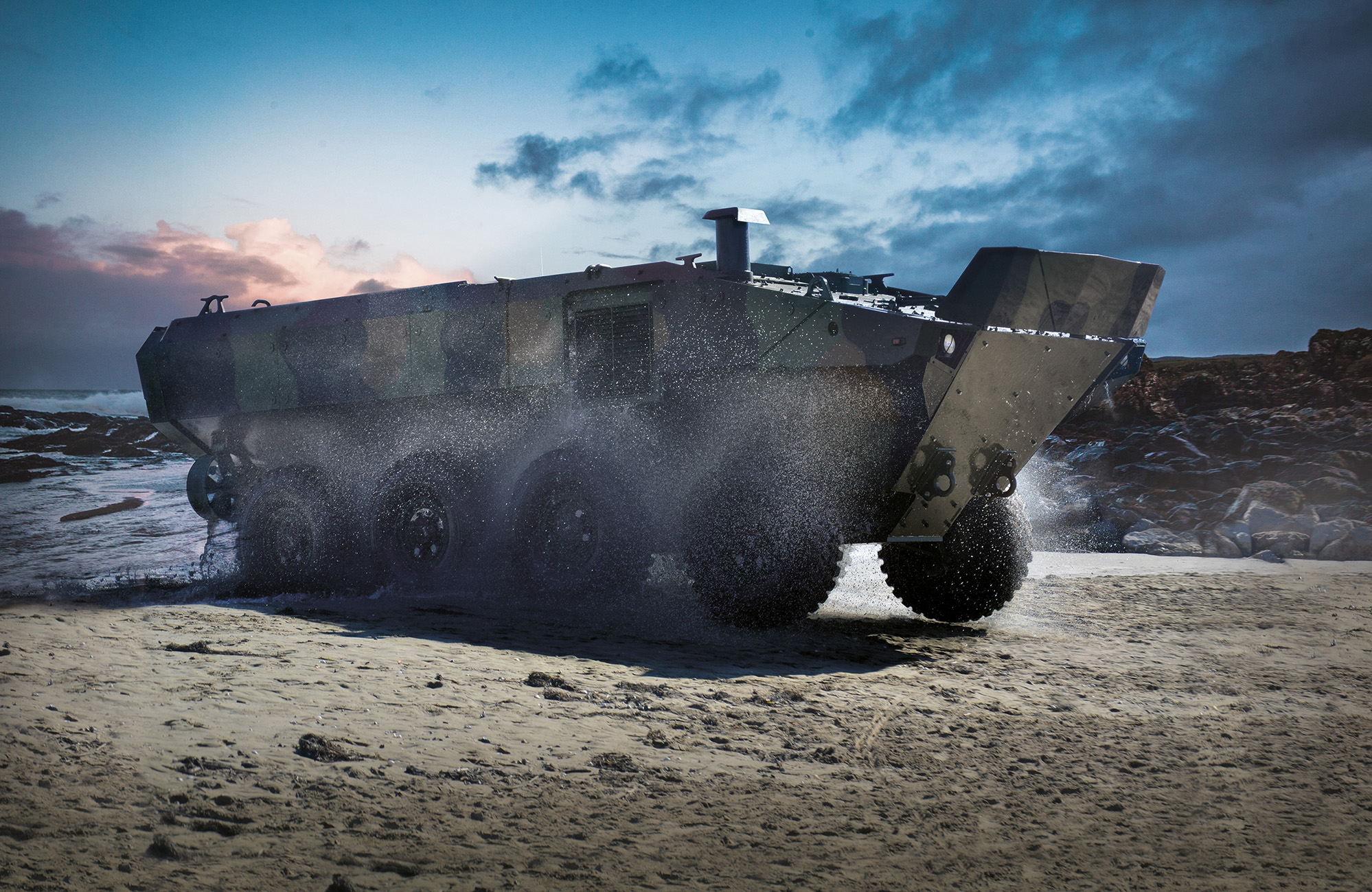
Indra Land Vehicles and Iveco Defence Vehicles (IDV), a Leonardo company, have signed a strategic agreement to support delivery of a new amphibious combat vehicle for the Spanish Marine Infantry.
The agreement forms part of Spain’s Special Modernisation Programme (PEM) and will see IDV supply 34 SUPERAV 8×8 platforms, which will be integrated by Indra into the Marine Infantry Amphibious Combat Vehicle (VACIM). The programme is intended to enhance Spain’s amphibious capabilities and support operations in coastal environments.
Indra will be responsible for delivering four variants of the vehicle to the Spanish Ministry of Defence: troop transport, command and control, recovery, and ambulance. Integration work will be carried out at Indra’s facilities in Spain, including the installation of mission systems, functional adaptation, validation, and final delivery.
The SUPERAV platform is already in service with other operators. “The SUPERAV 8×8 has already been selected by the United States Marine Corps and by the Italian Armed Forces. In the USA IDV’s amphibious platform serves as base of the Amphibious Combat Vehicle (ACV), supplied in partnership with BAE Systems; while in Italy the SUPERAV, equipped with Leonardo’s weapon systems, is the base of the Veicolo Blindato Anfibio (VBA),” said Nazario Bianchini, Head of Sales at IDV.
He added that, “Thanks to the contract signed with Indra, IDV will deliver the state-of-the-art amphibious armoured platform, enabling Spain to renew and expand its National Defence vehicle fleet and effectively address current and future operational challenges.”
For Indra, the programme expands its role as a domestic systems integrator in the land domain, particularly in amphibious vehicle capability. The company stated the agreement would strengthen its industrial base and broaden its portfolio of combat platform solutions.
Frank Torres, CPO and Managing Director of Indra Land Vehicles, said: “The collaboration with IDV will constitute a decisive step within the project to equip the Spanish Marine Infantry with the capabilities required by today’s demanding scenarios, and the beginning of a stable, long-term industrial relationship.”
He continued: “The contract, together with Indra’s delivery of new specialized variants, will enhance the amphibious capabilities of our Armed Forces and enable Indra to continue establishing a robust, innovative, and forward-thinking industrial base.”









The Spanish what? I’m tickled by the very notion of Spain employing anything offensive other than the occasional encroachment on Gibraltar’s waters.
Against an ignorant question, a strong answer: Spain, on the contrary to what a lot of people believe, has a strong army and marine tradition and forces. We have had amphibious capabilities for years and are really good at it, from both dedicated ships and LHD platforms. We’ve suffered from underfunding for a lot of years, something hopefully to change in the near future, but my advice is to not underestimate the capabilities of an ally. In the end, we had a state of the art ship ready the same week in Cyprus while it took you 3 weeks to get there. Currently, all 11 of our frigates and destroyers are active and in fact, at sea, something the RN can’t say (less than half of it), which reflects that, sadly and with respect, the things are not that good there and not that bad here. Have a great day.
Well that told him then !!! 😁😁😁
Worked like a charm 🙂
The man has a point you know. Spain might spend next to nothing on defense but somehow they have more tanks, artillery, IFV’s, AD, Planes and operational ships. And it is good stuff (i.e. Leopard Tanks.) It might be a good idea to have a thorough breakdown of our so called Defense Spending.
Interesting, the “We” bit.
Many have wondered where Alex hails from over the years.
Now we know.
Yes indeed! It is most useful to have input from defence observers from other NATO nations. We in the UK tend to view things from our little goldfish bowl, while there is a lot of good stuff and innovative development going on in Germany, Sweden, Poland, Italy, Spain, Turkey and many others, that we can usefully learn from.
We historically, politicians, manufacturers, defence circles, have a rather isolationist view of defence matters and risk being overtaken by other nations in equipment development and exports. So it is useful and timely to get a correction from Alex on the naval side.
The fact is that the RN is something of a shambles at the moment. Somewhere between the RN staffs and DE&S, politicians and accountants, we have arrived at…
A squadron of Astute SSNs that cost a bomb, have taken well over a decade to produce and we have just ONE operational
A squadron of T45 destroyers that didn’t work and have slowly been cut open to install the new PIP kit, at big cost, and we again have just ONE operational (when current repairs are complete)
Due to putting all the naval procurement budget on two carriers, the RN has not been able to commission one new frigate in what will be 15 years – in which time we should have had a regular drumbeat of one new ship being completed every 18 months. So we are down from 13 to just 7, all well past their sell-by dates.
The list goes on, with very elderly Vanguards, MCMVs halved in numbers, up to eight ships likely to be retired without replacement etc.
It is not all about the budget available to the RN, it is also about poor choices by the RN, manufacturing problems and the RN’s determination year after year not to live within its budget.
The ner result is something of a nation embarrassment. For a nation with just two-thirds of our population, a far smaller defence budget and far less naval pretensions, the Spanish Navy looks to be in a pretty good shape, in rather stark contrast to the RN.
Much of our defence spending has no impact on core conventional military capability, but goes on a long list of other things shoved in so politicians can fool people, especially journalists who parrot their line.
The DNE and keeping the UK MIC going first and foremost.
I read yesterday that ARR Afghan rehoming relocation is up to 5 BILLION.
I thought it less, around 2 billion.
Whatever, what impact does that have on military capability? None whatsoever, apart from draining funds.
Which is rather my point. If we had a transparent account (yea I know, not happening) then we would more than likely see how much of a fallacy our “defense spending” actually is.
Indeed Daniele.
The biggest clue to where our equipment plan is truly up the creek come from the procurement budget. The last attempt at a 10-year ‘DIP’ was in 2023. The procurement figures were revealing:
Nuclear Enterprise [AKA 11 submarines]: £71.5 bn (35.5%)
Other Army, RAF and RN procurement: £99.5 bn (49.4%) (1)
Other MOD spend: £30.4 bn (15.1%) (2)
It gets worse: MOD’s new Armaments Director cheerfully announced that defence nuclear would henceforth increase from 20% to 25% of the defence budget. So only 50% of the procurement budget is currently available to the three services for equipmen , equipment support and weapons. No wonder we seem to spend more than most but get so little in return, leaving the UK well behind peer nations in the size of our forces and the quality, modernity and numbers of equipments.
We made having an independent British nuclear deterrent our big central thing 75 years ago, when we still had a big empire and Commonwealth and were enjoying the prestige of being a permanent member of the UNSC. While our international standing has diminished considerably since then, we still cling to that independent nuclear deterrent as our ultimate safeguard. The fact is we can no longer afford it and it has led directly to the three services being woefully underfunded and reduced to a shadow of their former selves.
In an ideal world, defence nuclear, which of course includes the cost of AWRE and no doubt a lot more non-military expenditure besides, should come out of the defence budget and be funded directly by the Treasury. But where is HMG going to find a spare £7 BILLION a year to pay for it?
It is high time that we looked at defraying the cost among other NATO peer nations. A combined NATO Europe deterrent force of 9 SSBNs – 3 UK, 3 French and 3 others – would at least cut the R&D, urainement enrichment, boat production and operating costs down to a less onerous level.
(1) The services’ allocations were:
Combat air and air support: £33.6 bn
Ships: £24.8 bn
Land: £17.8 bn
Weapons: £15.4 bn
Helicopters: £10.9 bn
Allegedly, only 30% or so is available for new kit, the rest goes on equipment support/paying a load of civilian contractors to do maintenance, upgrades, repairs to things like Astute, and T45, etc.
(2) MOD funnies:
‘Defence digital’: £23.6 bn
‘Integrated airspace’: £6.8 bn
The former seems to describe the purchase of PCs and IT consultancy services, though Gawd knows how anyone could spend the equivalent of 20 T26 frigates on IT stuff, the MIC is having a laugh.
The latter appears to be largely air traffic control, I hadn’t realised that the costs of this had been squeezed into the defence budget.
the 61,000 civvies in MoD won’t come cheap. That’s before you factor in the day rate contractors who love a project over run! JPA, MODNET….bottomless money pits.
If there were zero frigates/ destroyers, no FGR4s and no F35Bs – there would likely still be a black hole in the MoDs budget!
As for Spain – it has a very balanced conventional capability that includes a growing Typhoon force (unlike ours) and a far more comprehensive GBAD than ours. They’ve also not binned off their Harrier capability which we prematurely did.
Hi Cripes, good post with those figures.
Defence Digital is a MoD organisation of a few thousand civil servants, military, and contractor staff. It was known as DCSA in the late 90s, then became ISS, now DD.
That huge budget must include a lot more IT in other areas than just DD.
Yes, the MIC IS having a laugh, and HMG are quite happy feeding them, as we constantly see.
I touched on support previously, with the clever decisions to outsource everything to save money, we’ve lost the in-house expertise in many areas.
Is it cheaper in house, I really don’t know for sure, but I suspect not.
CSOC will have a big budget in all that as well, which includes DSF and all the cyber stuff.
I suspect with the lack of foresight out crop of politicians have, without the nuclear deterrence and everything that supports it. Our conventional forces will still be a shambles.
Nice to hear someone has ships at sea.
It’s also interesting that so many nations still field LPD LPH types with Well Docks to launch Landing Craft and things such as these?
I keep reading it’s all obsolete and that they are sitting ducks.
It baffles me that the UK doesn’t have similar. We have very basic capabiliy but during the cold war we had not only armed vehicles that could swim but also supply vehicles. For an island nation that is always going to fight on someone’s else’s lands, being able to cross rivers without creating pontoon bridges seems essential
Ah but don’t forget that the UK now has the largest collection of rubber boats In Europe.
😁
I guess we can fill the rivers with them 😁
The BVS10s are also amphibious but have the low ground pressure to be used in extremely muddy conditions as well. These are of course for Spain’s marines rather than the regular army.
Spain is planning to build its first modern, conventional, and domestically built aircraft carrier, with a Navantia study underway, say Reddit and Outono. This project (part of the 2050 Navy Plan) is designed to operate 25–30 fixed-wing fighters, potentially featuring CATOBAR (Catapult Assisted Take-Off But Arrested Recovery) capabilities, marking a shift from the current ski-jump, vertical-takeoff Juan Carlos I carrier, El Mundo reports.
Key Details of the Project:
Purpose: To replace the aging Harrier AV-8B fleet which retires in the early 2030s.
Dimensions & Type: The ship is expected to be roughly 40,000–42,000 tons, similar to the French Charles de Gaulle in size, but with conventional, non-nuclear propulsion.
Capability Shift: Moves away from just vertical landing aircraft (like the F-35B) toward a “conventional” carrier capable of using catapults, allowing for more versatile fighter options.
Approval & Feasibility: The study is in its initial phases, commissioned by Navantia, under the direction of the Spanish Armada to bolster long-term maritime power.
Elmundo.es
The UK has 2 far more capable carriers. The question is are we going to invest in the jets to make them viable and the support ships to actually allow them to be deployed. Right now both questions are up in the air.
In theory we have the escorts incoming but equally it’s questionable for how long. The t45 and t23 are going to be great combatants, but the numbers we have ordered is barely enough year one, ten years down the road when they start getting old it will a toss or the coin of they are ready when needed, unless their replacements are ordered in the near future or more hulls are ordered. The t31 is a joke in the current combat environment with so few tubes, they would be saturated with a single wave.
Nah, the T31s would be sunk by a submarine first, as they have no ASW capability other than probably a Wildcat. Far cheaper for the enemy to fire a torpedo than waste a missile!
True but outside russia and china which nation has a big sub fleed. Russia is spent for at least a decade likely two. China isn’t our fight.
Probably any old Argentinean or Iranian sub would do the biz on a T31!
Also not our fight.
Time will tell if Iranian subs are a serious threat or if they were all suck. I suspect the later. Iran tactics seem to be to dig equipment into holes and distribute across the country to avoid US bombing, that is hard to do with subs.
The Argentinians lost most of their qualified submariners when their sub sank in 2017, I think their old SSKs get even less sea time than the Astutes. Not to mention that even a torpedo warning sonar would probably be able to pick them up.
Half-Assed aircraft… Weapons that are not relevant. No. Aew.. no tankers. And not a chance in hell of going into the open ocean without somebody’s SSN, tankers, destroyers and all of that… Not real Handy
Except Spain has state of the art AAW and ASW platforms, submarines and tankers to take part of a carrier group.
I’ve gained $17,240 only within four weeks by comfortably working part-time from home. Immediately when I had lost my last business, I was very troubled and thankfully I’ve located this project now in this way I’m in a position to receive thousand USD directly from home. Each individual certainly can do this easy work & make more greenbacks online by visiting
following website—.,.,.,.,.—>>> JobatHome1.Com
The Superav has a H type drive train, like a Saracen with 2 more wheels.
Can anyone explain to me how it why it won’t be susceptible to transmission wind up when driving on a sealed surface for any length of time.