

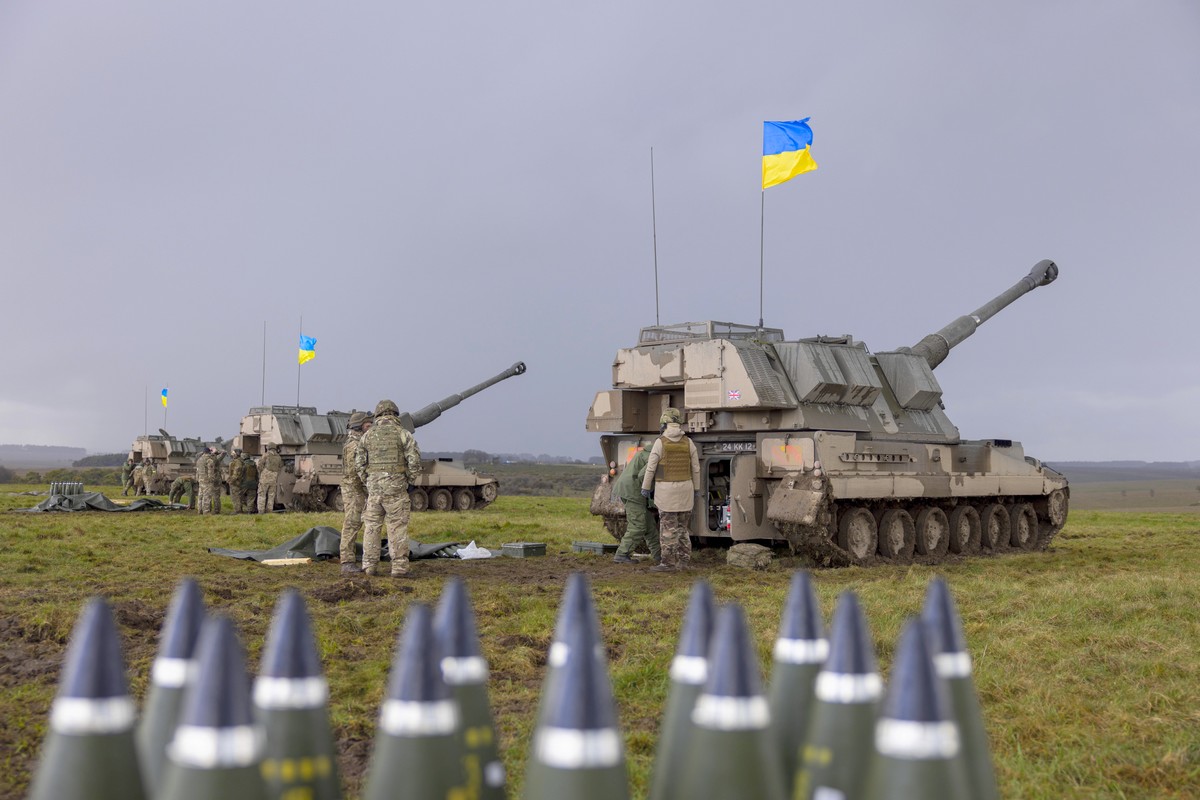
The expanding kill zone along Ukraine’s front line has left much of the country’s existing artillery ammunition unable to reach its targets, driving up demand for costlier extended-range rounds that funding has struggled to keep pace with, a senior NATO military officer has said.
On the sidelines of the NATO Defence Ministers’ meeting, the UK Defence Journal was told that the officer had explained the dynamic behind what is known on the front as the “killing zone”, the stretch of no-man’s-land separating Ukrainian and Russian forces that has grown so wide that neither side can easily bring forward equipment or systems without exposing them to drones and other strikes, pushing logistics, command posts and the launch points for those drones further back from the line, beyond the roughly 20km range of standard artillery ammunition.
That shift means Ukraine, despite now holding sufficient stocks of conventional short-range artillery shells, often has nothing within range to hit with them, the officer said, leaving it dependent on ammunition with a range of 30km or more to strike the logistics nodes, command and control elements and drone launch sites that have moved back out of reach of older stocks.
The difficulty, the officer said, is that the extended-range ammunition is significantly more expensive, meaning that allied funding under the Czech initiative, the scheme coordinating the procurement of artillery ammunition for Ukraine, buys less of it than it once did when shorter-range shells were sufficient. The officer said “I cannot confirm that there is a total drop down of willingness of nations to provide funding”, but acknowledged the requirement for extended-range rounds keeps rising faster than budgets allow.
Artillery remains a vital tool despite the proliferation of drones, the officer argued, saying simply that “artillery still matters” because it can strike logistics and command targets that other systems cannot reach as efficiently, which is why the requirement for extended-range rounds keeps rising even as overall artillery use evolves, with NATO continuing to seek additional funding to maximise what the scheme can deliver.







I’ve gained $17,240 only within four weeks by comfortably working part-time from home. Immediately when I had lost my last business, I was very troubled and thankfully I’ve located this project now in this way I’m in a position to receive thousand USD directly from home. Each individual certainly can do this easy work & make more greenbacks online by visiting…
following website—.,.,.,.,.,.,.—>>> PAYAtHOME1.COM
This is one of those things that really needs to be considers, what artillery looks like in a drone infested battle space and for the British army what is the use of a 105mm gun in the drone infested battlefield with its 17-20km range.
105mm seems pointless in modern battlefield conditions.
I’ve gained $17,240 only within four weeks by comfortably working part-time from home. Immediately when I had lost my last business, I was very troubled and thankfully I’ve located this project now in this way I’m in a position to receive thousand USD directly from home. Each individual certainly can do this easy work & make more greenbacks online by visiting
following website—.,.,.,.,.—>>> JobatHome1.Com
In a moving battlefield it definitely has its place. You wouldn’t say infantry fired mortars are obsolete. But it has to be able to shoot and scoot. The days of it firing all day under a cameo net are gone.
And yet L119 is one of the most survivable artillery pieces in Ukraine….
Easy to dig in, easy to protect, easy to camouflage….more survivable than an SPG…and routinely used at the hardest parts of the front.
Honestly whenever I see comments like this I can only assume that the people making them have not read any of the reports from the Ukrainian artillery units….
I have watched the same videos you have. If you’re digging it in on a fixed front line basically putting it under ground then it can still be used.
However we have 105mm so they are easily transportable. If you have to bring a bulldozer to dig it in then it’s pointless. The 105 doesn’t have much of the modern ammunition or extended range rounds Ukraine desperately needs and it’s far to short ranged to conduct counter battery fire so I stand by my comments that’s 105 is largely useless now.
We are not going to be creating a Maginot Line to put our L119s in… yes they are great to plop inside on of Ukraine fortress towns or outposts.. that’s not how we are going to deploy them with a commando or as part of an air assault..
7th Parachute Regiment Royal Horse Artillery Are not going to dig into a semi permanent position hidden away.. they are going to be helicoptered in and set up to support an air assault.. as such in a drone saturated battle they would be fecked…
Well said 👀💯
Jonathan and Jim, I think the last time we fielded a 105mm artillery piece intended for use in a high intensity conflict (Cold War, if and when it turned hot) it was the FV433 Abbot (admittedly a SPG not a towed gun). Abbott replaced the WW2-era Sexton! It was itself replaced by the 155mm AS-90 from 1992.
The Light Gun is for Light forces, not for heavily armoured and mechanised forces against a peer opponent – 3 Cdo Bde (now the Commando Force) and 16AA Bde. Strategic mobility of equipment for such rapid intervention forces is important, as is the ease of moving artillery around the battlefield and Lt Gun could be easily underslung from medium/heavy helicopters (Puma (as was)/Chinook).
Having said that the BAES M-777 155mm gun is a contender to replace the Lt Gun, notwithstanding that it weighs 2.2 tonnes more.
Hi Graham and I think that’s one of the problems.. in the 21c a low intensity conflict is also going to be a drone intense conflict.. in the end the 105mm worked because in your 20c and early 21c low intensity conflict the enemy had sod all that could reach 17km to the 105mm even sitting in a temporary fire base. But now those low intensity enemies can quite easily throw a ton of cheap tactical drones at that fire base 10-15 km away.. because anyone can can operate a FPV drone and once the Russia Ukrainian war ends you can guarantee that Russia will flood Africa and everywhere else the west may need to fight lower intensity conflicts with decent EW hardened drones.. Russia now produces 7.3 million FPV attack drones a year.. that’s 7 times the annual average production rate of the AK47 over its 75 life.. in the next 10 years at present production Russia alone will have produced as many FPV drones that the entire world production of AK 47s over 77 years.. so the low intensity conflict of the future will not be AKs or IEDs it will be a constant flood of FPVs..
So the question is does the 105 simply sit in the danger zone that makes it more of a target and resource drain than it’s worth.. and would that air mobile fire support be better supplied by systems that are less of a target..
1) a load of guys with 60mm mortars who can hide in a bush and move as needed providing section level indirect or direct fire support.
2) 81mm mortars for platoon level fires, because three guys with a 81mm can hid in a bush and if need be book it quickly even if they need to ditch the mortar.
3) some smaller FPV one way drones at platoon level.
4) a support section at company level that is simply loaded to the gills with FPV one war attack drones
5) then at battle group level instead of a 105 battery in an exposed fire base.. 10km away.. a battery that has its operators is hidden in some trees or holes in the ground 20-30km away with a load of larger drones scattered around. either armed with LMM or large one way attack drones with loitering and recovery capability and big old blast fragments warheads
6) finally at brigade level your 155 with base bleed rounds 50km away
Essentially these are all capabilities that can survive in a the massive drone saturation we are going to see in the mid 21c.. if Russia can produce 7.5million a year world wide you are going to see 50-100million a year produced..
Just going to say, anyone who thinks a 81mm mortar is a good platoon level weapon has never had to use a 81mm.
Sooo… Let’s take stock here. Would you rather, more RCH-155mm guns OR many more recon drones that could direct attack drones from a front line position that not only have the ability to change target after firing and if you lose the launcher, well, you can “buy” another for much less than a Boxer or a 155mm Gun.
We need unmanned tunnel boring artillery drones that can pop up behind enemy lines or deposit huge amounts of explosives right under the enemy.
It’s another one of my cunning plans.
A cunning plan. Have you been listening to Baldrick 😄😄😄😄
Just use UGVs like the Ukrainians 👀 BOOM💥💥
Both? Horses for courses as they say. Drones might be good for hunting no mans land and in the enemies rear, for example, but it is tough to call in a quick drone strike at very short notice in a fluid and moving battlefield.
“Both” is the correct answer.
We need new artillery and new drones.
Both seem logical, but per the above article, a stockpile of extended range munitions that keeps the guns relevant might be an even better investment?
It’s a question of timing. At the moment drones have the advantage, in a year or two’s time who’s to say. If systems such as the Thales Thundershield and RapidDestroyer prove as good in service as the do on a test range. Perhaps the swingometer will be more balanced? There’s also the kill all electronic devices options, where you use a non-nuclear electromagnetic pulse (NN_EMP). Russia has shown and tested these devices in trials, but have yet to field them.
At some point combined arms manoeuvre will incorporate both drones and counter-drone measures as part of their operating procedures. The Nation that manages to coordinate an armoured fighting brigade, air assets and counter-drone capabilities, will be on to a winner.
Both. With the effort that’s going in to counter drone systems don’t bank on drones reigning supreme forever. Not one of the weapons systems that has been claimed to render all before it obsolete has ever maintained that level of advantage, counters have always leveled the playing field.
Both the Ukranians and Russians have moved valuable assets out of Artillery range. Even with the really expensive long range stuff there comes a point where you have to accept the fact the enemy is out of range. At that point you utilize your really, really expensive long range stuff judiciously.
Sounds like WW1 but with a bigger no mans land 🤔
Soo.. tanks, with anti-drone shotguns on the roof..
Some technology will come along to break the deadlock. Some kind of drone death ray.
Yup.
History repeating Itself (again).
Digging tunnels and trenches (again).
A bloody stalemate (again).
A pointless waste of life (again).
A Power mad leader with delusions of Empire (again).
When will Humanity ever learn.
Quite. Join the dots. June 2013, Putin and wife Lyudmila announce that their marriage was over. Feb – March 2014 Russia invades Crimea. 1 April 2014, the Kremlin confirmed that the divorce had been finalised. As CJ would have said, I didn’t where I am today Reggie by not being able to spot suppressed anger in a bruised ego.
We’ve all been there but most of us deal with life’s reverses without resorting to killing hundreds of thousands of innocent people.
One needs three things.
Lots of Artillery.
Lots of Drones.
And, lot’s of Artillery Shells.
I read a very interesting account on X from British Army Review, by a serving officer.
By the looks of things, the RA is stuffed.
It seems to have given away it’s UCLs – Unit Load Containers, that package 155mm shells securely and ready for distribution by DROPS.
So a fancy RCH155, with only 3 men, not the 9 used by an AS90 fire Det, too few to do the tasks needed ( discussed here before ) including loading ammunition into said guns.
Too few RLC assets allocated to move the ammunition to the guns.
Ammunition stocks minimal.
So much for ten times more lethal.
Another telling note.
A shell can be used 24/7, all weathers.
A shell is almost impossible to intercept.
A shell cannot be spoofed or jammed.
I think we are too obsessed with Drones, they supplement, not replace.
Another advantage of a shell it is its time to target unless you have a drone already very near the target.
I think we brought a new fleet of Man trucks with EPLS to replace DROPS so standard ISO containers could be used ?
It says that 155mm shells are being issued in something called ULS – Unit Load Specification, essentially wooden pallets.
These hold 34 shells stacked vertically, held by metal banding.
Open to the elements, so susceptible to dirt and dust.
They cannot travel fused, so more soldiers required at the other end to prepare them at the guns positions.
Then it says that once the metal banding is cut it becomes unstable, so the ULS, and the vehicle carrying it, cannot be moved!
Says this effectively is the equivalent of issuing the infantry with 5.56 ammunition in cardboard boxes rather than bandoliers of stripper clips.
There’s lots more in the article, author is Lt Colonel Martin Smith.
Damning stuff,.
Basically, more UCLs are needed. We gave almost all to Ukraine, the handfull we have left furnish about 5,000 shells, apart from those rusting away.
DE&S IPT responsible for ammunition packaging is Defence General Munitions, they’ve ordered more rounds but the UCLs for them no longer exist.
Then there’s money.
Anything over 100k must be signed off by the Defence secretary! Nuts.
Another problem in DE&S itself, lack of people in the DGM team, so “lack of resource.”
Yet it says they can employ 400 “people coaches” but cannot prioritise a team that prioritises lethality.
Then there are the usual “fiefdom” problems going on, thus ownership, within the various directorates. In other words, not my problem guv.
To get round the “maximum of 3 men” for each RCH155 they’ve had to use an auto loader, which has added complexity and cost. The 9 men per gun det is the bit that made me laugh, as I and others have raised the 3 men per gun as an issue before. Apparently 5 of the 9 in a usual AS90 Det ( the 9 called “Gun numbers” would be “ammunition bashers” preparing rounds.
Where are those people now, with the lean manning?
Fancy gun. Fancy tech. You neglect the logistical train supporting it.
Damning damning damning. Surprised this guys not been suppressed, openly talking in British Army Review.
The RA is in a mess.
I see, so the issue is holders. I suspect this issue in buying more is that we don’t actuality have that much to fire them from in the case of 155mm. not great. At least the EPLS fleet seems to be ok.
BAE are pressing on with upgrading Washington & Glascoed so that should improve production ( you of course need to place an order !!)
I do wonder how many people within the MOD are working on the Ukraine support, as there as I see quite a few urgent request to industry being sent out for all sorts of random stuff need for Ukrainian equipment & support
Link, without spaces:
https:// chacr.org.uk/ 2026/06/16/ the-british-army-review- 198-train-hard/
Article is “Shell Shock”
British Army Review, Summer 2026.
very interesting
And lays bare politicians war footing rhetoric. The RA lacks not only guns, but the means to supply them that we’ve had since the 70s.
All due to lack of money.
Meanwhile, no shortage for their pet projects.
If there are no targets in range because they’ve been pushed further away from your lines… means it’s harder for the enemy forces to attack you and break through. As soon as their attack does move forward… suddenly they’re in range of an artillery force that has had time to build up enough stocks to destroy the attack… You want to take land you have to get in close…
For the kill zone to remain a kill zone they still to be prepared to fire on it.