

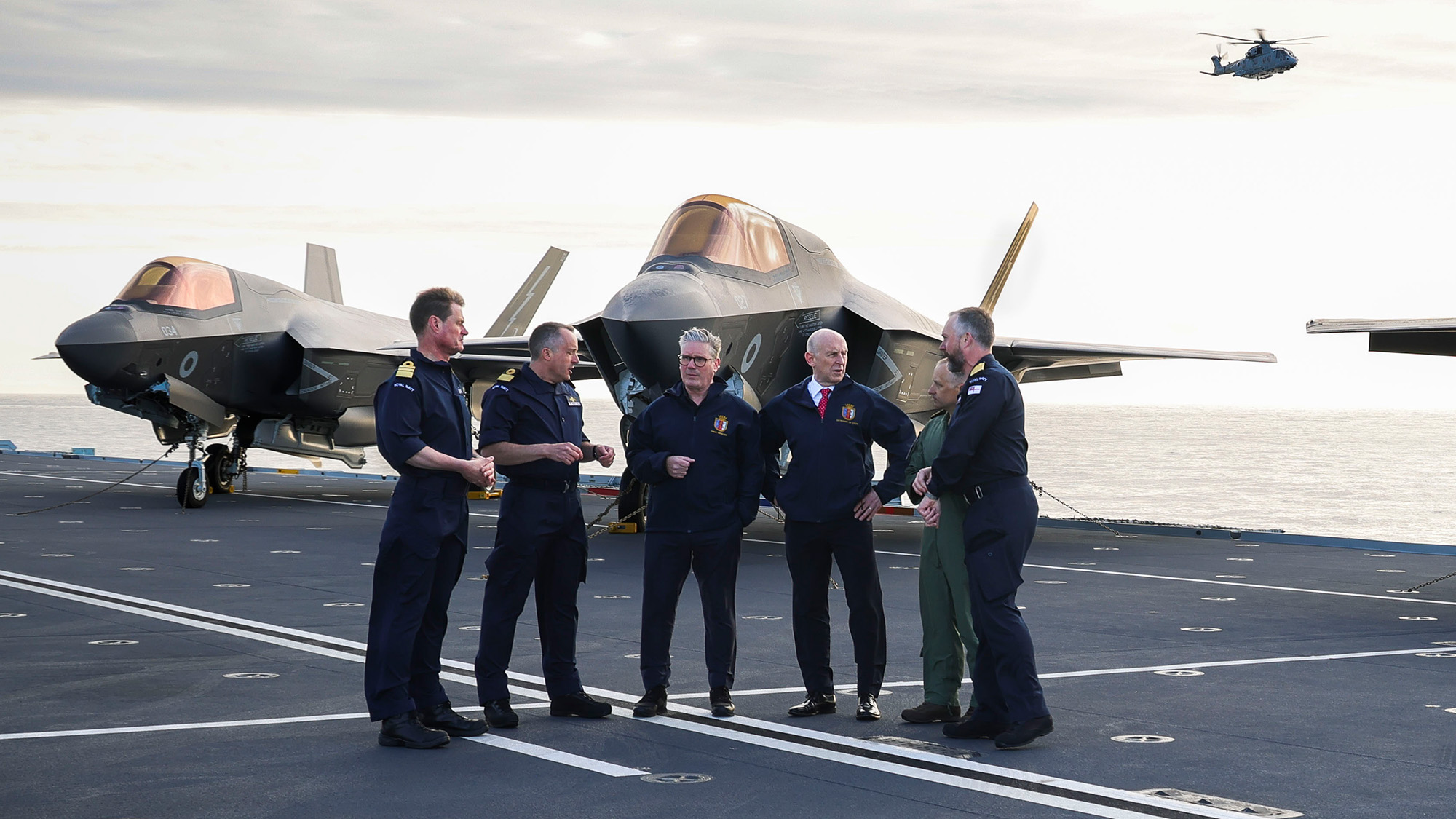
Prime Minister Sir Keir Starmer has confirmed that the government’s long-awaited Defence Investment Plan will be published before the NATO Summit in July, the clearest indication yet of when detailed spending and capability decisions will be unveiled.
Speaking during a visit to defence technology company Stark in Swindon, Starmer said the plan would translate the recommendations of the Strategic Defence Review into funded programmes and procurement priorities.
The announcement comes as industry and the armed forces await further detail on how the government’s commitment to increase defence spending to 2.6% of GDP will be translated into equipment, infrastructure and force development programmes.
Starmer described the Defence Investment Plan as the mechanism that will connect funding to capability requirements identified through the Strategic Defence Review.
“In order to put that strategic review into effect, we’ve got a Defence Investment Plan,” he said. “So that is a plan that says, here’s the money that goes with the capability, we bring the two together.”
The Prime Minister said the plan had been developed in consultation with the armed forces, the Ministry of Defence and other government departments.
“We’ve been working on that Defence Investment Plan for some time, very closely with our armed forces, as you would expect, because we need that interaction.”
He then confirmed its publication timetable.
“That will now be published before the NATO summit, which is in just a few weeks’ time.”
The confirmation effectively places a deadline on publication before NATO leaders gather in Ankara on 7 and 8 July.
The commitment is significant because while the Strategic Defence Review established the government’s broad priorities, including greater emphasis on autonomous systems, advanced technology, resilience and industrial capacity, it did not allocate funding to specific programmes. The Defence Investment Plan is expected to provide that detail.
Throughout the speech, Starmer linked defence spending to the wider security environment, arguing that Britain faces a more dangerous international situation than at any point in recent decades.
“It is no exaggeration to say that we’re living in more dangerous and volatile times than at any time in my life or in your life,” he said.
The Prime Minister pointed to the ongoing war in Ukraine, instability in the Middle East, threats to global energy supplies, cyber attacks and hostile activity against critical infrastructure as evidence that the UK must strengthen its defence posture.
He also referenced allied assessments of the threat posed by Russia.
“It is our intelligence assessment, and the assessment of other countries in NATO, that there could be an attack by Russia on NATO as soon as 2030.”
Much of Starmer’s speech focused on the role of defence industry in delivering future capability. Speaking to employees at Stark, a company involved in autonomous systems development, he argued that technological innovation would play an increasingly important role in military effectiveness.
He said the Strategic Defence Review had placed significant focus on emerging technologies and autonomous capabilities.
“A lot of focus was on technology, on how we equip our armed forces with the best, and how we make more of autonomous capability.”
The Prime Minister also signalled that future defence investment would be closely linked to domestic economic benefits and job creation.
“I’m really determined that as we increase the defence investment plan, as we implement the defence investment plan, which will be published in the coming weeks, it’s really important that what goes alongside that is good, well-paid skilled jobs in this country.”
He added that communities across the UK should see tangible benefits from increased defence spending through employment, industrial activity and technological development.
The Defence Investment Plan is expected to be one of the most consequential defence policy documents published by the government since taking office, setting out how increased spending will be directed across programmes and capabilities identified in the Strategic Defence Review.
With publication now expected before the NATO Summit in Ankara, the document will arrive as allied nations prepare to discuss defence spending, capability targets and collective security in an increasingly unstable international environment.










Are we all going to wake up one morning and suddenly discover it’s published? It seems absurd not to fix a day in advance even if it is later to leave leeway for potential problems.
STARMITE has got to have diary space for all his U turns?
No he’s probably grandstanding abroad again
I’ve gained $17,240 only within four weeks by comfortably working part-time from home. Immediately when I had lost my last business, I was very troubled and thankfully I’ve located this project now in this way I’m in a position to receive thousand USD directly from home. Each individual certainly can do this easy work & make more greenbacks online by visiting
following website—.,.,.,.,.—>>> PayAtHome1.COM
It better be a good-un otherwise he’ll and Labour will get further ridiculed for it and its lateness.
It’s will be all fair coat and no knickers spin job .
I’ve gained $17,240 only within four weeks by comfortably working part-time from home. Immediately when I had lost my last business, I was very troubled and thankfully I’ve located this project now in this way I’m in a position to receive thousand USD directly from home. Each individual certainly can do this easy work & make more greenbacks online by visiting
following website—.,.,.,.,.—>>> JobatHome1.Com
Let’s be honest about things. The defence investment plan (whether it happens or not) will be neutered by Labour MPs. We have to be honest with ourselves as a nation:
(a) We, as a nation, don’t work hard and don’t have enough productivity to grow the economy (it’s flatlined essentially and is going into reverse with Labour). We have too few big companies that are home grown. Look at ARM they delisted from the London stock exchange and relisted on the New York one and they have grown 8 times larger as a consequence. The CEO of ARM recently stated that the UK is fundamentally anti-growth and anti-success in sentiment and policy (tough words but oh so true). This is a British cultural disease that has probably existed since the end of the Victorian period and the beginning of the Edwardian period – mainly due to the coddled upper middle classes. It got substantially worse during WW1 and then the coup de gras was WW2 in terms of bankruptcy and then the 1960s/1970s/1980s when we hollowed out our industrial base. Net Zero has led to exorbitant energy costs for industry and 90% of CO2 reductions are due to de-industrialization not through new technologies as Labour like to say. We need to get back to the pioneering Elizabethan and Georgian periods when we had a sense of national self-interest. As you can clearly see saving Europe in WW1 and WW2 by using our blood and treasure has bought us zero friends. Whereas the Georgian and Victorian periods when we were strong we had many friends. People and nations naturally gravitate to strength and this is real power (not the fictional soft power everyone witters on about). It’s time national self-interest came above all else before it’s too late.
(b) Too many British and non-British nationals are on welfare as they realize they can get paid more money than working and get free bonuses such as NI contributions for their future pension (absolutely true I’m afraid), free dental, free prescriptions, free eyesight tests, free access to museums etc. We force talented people abroad through the exorbitant cost of living, high tax, and poor quality lifestyle whilst importing low skilled illegal migrants with zero benefit to the economy (we now call this irregular migration – very funny this term). I have many friends that re-registering their companies elsewhere to avoid the high taxes in the UK. Look at north sea oil and gas companies they endure an effective tax rate of 78%. How can anyone make any profit from that which is the reason why BP is selling it’s north sea assets and it is considering domiciling elsewhere and potentially delisting itself from the London stock exchange. Who could possibly blame them? Just like ARM they can actually then grow.
(c) Very few people in the UK care about defence and aren’t willing to make the sacrifices needed. They would rather pay for welfare, pensions and overseas aid and being nice to foreign people. It just goes back to (a) where we don’t have any self-survival instincts anymore. We are poor country by GDP per capita pretending to be a rich one….We will get a heavy dose of reality once investors realize the emperor has no clothes. Personally I hope that the UK has a investors gilt strike where they are not interested in buying UK gilts unless at a very high premium. I’d prefer this to happen sooner as it may force the government to cut government spending and focus any resources on a growth strategy. Failure to do this will lead to the ignominy of going cap in hand to the IMF again (assuming they have the fiscal headroom to bail us out).
So in short the country is well and truly screwed thanks to Labour and the Tories but also to a lot of voters out there (in employment and not in employment) that are living a delusion the UK can afford massive welfare, pension and foreign aid liabilities. Therefore, to summarize the defence investment plan can’t avoid the above major issues so it will be a damp squib – they will be searching around the back of a sofa to find any money.
Sorry British people (I’m one of you) but we are all living beyond our means and are deluding ourselves we are rich….time for us to wake up and smell the stuff we have been shoveling for many years.
Due to the time drag (Diverring), since the Defence review was completed, as well as taking into account the additional threat to the UK, from the middle east.
I cant help, but think that the DIP, will be out of date and not funded enough to be what is required as a credible deterrent .I suspect also, a lot of the big ticket purchases, will be scheduled in fir ordering, after the next general election.
Hi guys, my condolences to the families of the crew of the Merlin..my question is why do the aircraft seem to explode as opposed to just breaking up as it hit the ground? Cheers guys
What some people have suggested (and I agree with) is that the Merlin didn’t hit the ground hard. There’s no landing scar for if it made a running stop and no crater for if it simply fell out of the sky.
So to me the most likely thing is that the crew made a crash landing after a problem developed but very quickly after landing it got out of hand and the Merlin burnt out/exploded, otherwise they would have been able to leave the aircraft.
Much of the airframe of a Merlin is carbon fibre, which obviously will burn very effectively. As you state there is no scar which I suspect there would be if the aircraft had flown into the ground, hence I would think it is unlikely to be pilot error. There were two experienced pilots, one was on her last flight before full qualification as a jungly pilot, and the other was the senior training pilot for 846. So regrettably it looks like a major mechanical failure. I think that the Merlin has a FDR so I hope the cause will be found out very soon.
Yes, Mk4/4A have CVFDR (Cockpit Voice and Flight Data Recorder) and all flight computers feed into the two Black (Orange) boxes. However, looking at the crash scene, survivability of the equipment is never guaranteed. The Merlin is not particularly carbon-fibre heavy but anything burns given the right condition. Devastating event whatever.
Thank you
Just for clarity, Which July ?
Wow. You got me twice in one day.
As always, there will be winners and losers, and despite the words, it will primarily disappoint. However, previous defence statements have had the reassurance of American military support even if some decisions were based on the US backfilling any cheeky cost saves. Thankfully, not any more, and Starmer knows if his DIP is a diluted bag of wind, Trump will publicly hang him out to dry.
Some seems to think that all the Government has to do is get past this US Administration, but I don’t think the next Administration regardless of side will go back to how it was, defence is expensive and both sides want to cut its funding to either fund more welfare or tax cuts but either way it means less resourcing at a time when they themselves are struggling to resource their Armed Forces to meet their own ambitions let alone consider others needs.
The win for the U.K./EU is more strategic autonomy from less reliance on another state for defence, less economic reliance due to the defence reliance. It’ll hurt short term but will be better for counties long term to take back responsibly for themselves and neighbours, it’ll be down to each country on whether they want to fund their own defence properly or not to take back that independence, it’s hard to tell if the U.K. wants that or not.
ATJ, I think you are correct in the medium/long term; however, my comment is pertinent to the next few months. Regarding the future US stance, we must not forget that wherever there are American financial interests, there you will find US forces. I doubt that factor will change very quickly, and in the case of the UK, the US Air Force bases will likely remain for some considerable time. AI and robotics are going to play a huge role in moulding the UK’s armed forces, and the retention of personnel will be less critical in the coming decades. The Ukraine war and Trump’s second term have changed the paradigms on so many fronts, and the boost in high tech will continue to rewrite the rule books in terms of warfighting. There is a strong possibility that even schoolboys will be working for the MOD using their keen computer/gaming skills to assist in countermeasures. Many naval vessels will be remote, remaining at sea for months, and remote aircraft will stay on patrol for hours, controlling accompanying drone swarms. At the same time, on the ground, crewless MBTs work with lead-crewed CH3s and a myriad of remote land systems. Yes, defence is going to change, and the UK MOD will need to get deep into these systems in smart order.
It’s been all entirely predictable from the vast majority of European nations since the US backstop has been taken away, who can we find to pay for it, all the defence secretary goes on about is allies to cover capabilities so the UK doesn’t have to put money where its mouth is.
Germany and Poland have stepped up, France carries on with what it has and all the UK has is ‘we will increase spending sometime’ by cutting what we have.
Another of Rachael’s black holes conveniently appearing to stop the treasury having to find the money
It’s not ‘Rachel’s black hole’, she got that parcel when the music stopped, it’s the nation’s long-running and ever-increasing black hole, compounded by the MOD’s ridiculous black hole.
If any CEO in private business overspent their budget by £28 bn, as the MOD had done, they would be fired on the spot. Of course it would never get that far, the board would slap the brakes on long before.
I wonder why the Defence Committee never seems able to abide by its budget and overspends so freely. This comes back to haunt us now in the DIP, as all the new money is not enough to cover the £28 bn black hole legacy from the past.
Nothing to do with Reeves really. But jolly convenient for right-wing press and your average uninformed citizen to have an easy scapegoat.
Cripes, MoD has not overspent their budget by £28bn. If they had, a lot of people would have been sacked. The military Requirements (mainly new equipment and upgrades to in-service equipment) in toto cannot be fully funded. There is a £28bn shortfall…so that kit detailed in a Requirement document will not be ordered.
Place your bets now. £10 on it will be delayed.
No. It will be published Coll. There just won’t be anything in it. Unless you like Tripe of course!
Geoff, I suspect that the main reason that the DIP is grossly delayed is that it is an excessively ambitious and overcomplicated documemt. Rather than having nothing in it, I expect it might be so wordy that we won’t be able to see the wood for the tress (unless the Exec Summary is both good and short). They should never have done away with the Long Term Equipment Plan (LTEP) that looked out 10 years and was quickly and easily produced.
I don’t know where were going Graham, but I don’t think the government do either. If Aukus and GCAP are going to be in the 2040/50 timeframe I’m not even sure anymore whether we should be going forward. I know it’s a bit bizarre for me to say, but our existing forces are in such a dire situation it makes you wonder.
Only take you bet if I can use your money !
According to the Telegraph yesterday, the £18bn Starmer is planning to give the MoD will now be reduced to £15bn. Neither number will adequately fund the 62 recommendations in SDR This represents barely half the £28bn the MoD say they need just to make ends meet.
There had been reports that about £18bn was the amount needed for SDR recommendations and the additional £10bn was cost overruns for existing programs that the Treasury was unwilling to fund due to the fact it keeps happening. There was never any confirmation by an official source though but would be believable considering MOD track record of mismanagement and cost overruns.
‘Consideration’
Firstly, don’t trust the Telegraph on Defence. Its success rate is about 50% on a good day.
Secondly, don’t misrepresent what was written. There is on option ‘under consideration’ to drop to £15b. The three available options are £12b, £15b or £18b. We don’t know which has been, or will be selected. We do now that the previous DIP (back in December) needed £28b.
Since then, certain items have been descoped, move around, items cut from the plan, to lose about £10b. For a hypothetical example, if it had been budgeted in that initial plan to spend £2b on five new frigates, cutting those frigates from the plan (thus remaining at 19, rather than 24), would save £2b. I say this to demonstrate that reductions from the £28b figure does not necessarily mean cuts to existing forces.
The SDR made 62 recommendations, but maybe only 1 or 2 actually used numerical figures. For example, boosting AEW capability could be achieved more cheaply using MQ-9B, even if the overall thinking was that the SDR encouraged further E-7 procurement (when fiscal conditions allow).
Now, the two things I think are probably safe from planned reductions in future equipment, not established equipment, are the 12 SSNs, and sadly, the F-35A procurement.
All fair points Leh and I would add that GCAP is also safe. I don’t see funding for any further surface escorts for the RN but I would love to be wrong!
Yes, I agree that GCAP is probably fine. Recently, the Financial Times (also not the finest defence reporting site in the world, considering their recent blunders with regards to Danish frigate procurement) reported that the Treasury, in exchange for coughing up the funding for the programme, would take executive control of GCAP.
This would put it on the same level as projects such as the Dreadnought deterrent submarines and (tragically) HS2. In other words, being accepted as critical, ring-fenced pieces of national industrial infrastructure, and therefore highly likely to be funded at least partially, and much less likely to be cancelled.
Of course, that’s not quite the same as arriving as expected. HS2 is evidence that these super-governmental programmes can experience a ‘trimming effect’, in which the programme is never formally cancelled, but (if you’ll pardon the pun) ‘pollarded’. GCAP (and the other flagship future air domain programme, T83) has a variety of disaggregated components that would make nice targets for a little trimming.
That said, Dreadnought has survived mostly untrimmed so far. Apart from the necessary downgrade from 16 to 12 launch tubes that was established very early on, it does represent a direct numerical equal and capability improvement over Vanguard. Being a military programme of similar magnitude, perhaps GCAP might survive mostly unharmed.
Beyond this, of course, is the argument that following Ajax, Watchkeeper, Crowsnest, T45, and countless others, the British MoD procurement system should no longer be trusted to run its own procurement initiatives. If a Treasury-controlled GCAP procurement goes relatively smoothly, I can see support growing for the model to be continued going forward.
Unfortunately, I’m also sceptical of future additional surface escorts. If the planned 12 attack submarines are procured, they’ll tear into the procurement budget for things like additional frigates, MRSS and the destroyers. If 19 escorts are maintained as a minimum, I’d personally be alright with seeing the procurement of MRSS slashed to three, in order to ensure that 12 additional SSNs can be funded into the 2030s.
The cliché is to say that ‘warships are a things of the past’, that ‘drones, anti-ship missiles and modern submarines render them obsolete’. Now, this is far from the truth; warships will always have their place. That said, for the European conflict the SDR25 focuses upon, the submarine does take precedence. Similarly for an Indo-Pacific contingency, our greatest contribution would be to dispatch our ‘AUKUS Orcas’.
So, to repeat myself in conclusion, I don’t want to see the existing 19-ship escort fleet cut, but I wouldn’t expand it at the cost of other planned programmes.
Leh,
Hmmm … excellent post. Seriously question whether UK will be able to fulfill its formal commitment to expend 5% of GDP on defence (3.5% direct, 1.5% ancillary) by 2035, especially w/ a Labour government intent upon constraining expenditures to ~2.6% through 2029/2030. Doubling the defence budget within the subsequent 5 year period would seem an unlikely proposition, short of general war. An obvious solution would be to unilaterally reduce commitments (e.g., no BA presence or mission beyond UK possessions, or perhaps just the homeland; no patrols of RAF or RN beyond UK EEZ; potentially, even a declaration of neutrality (Austria and Switzerland are currently surviving quite nicely). Essentially, the available options would only be constrained by the ethics of the then current HMG/Parliament. Neutrality perhaps could include a provision to open RAF and RN installations to US/ENATO forces in extremis. 🤔
I think that when the current American administration leaves office, and is in all likelihood replaced with a more moderate Democrat presidency, commitments to 3.5%-5% will fall by the wayside, and the UK will stabilise at about 2.8-3.0% spend per annum.
A neutral UK is essentially now an impossibility. Even the Green Party, the typical party of neutrality, is expressing tentative support for alliance with Europe, which would rule out neutrality. The two political heavyweights, the Conservatives and Labour, are both essentially aligned on defence. Reform is the oddball – their defence policies have so far been limited to vague allusions to a major growth in the BA, which is contrary to the direction of travel many commentator and insiders suggest the UK should go (instead wanting priority to transition to naval and air domains).
A tax-reductionist Reform or Conservative government would need to facilitate immediate growth, or else the armed force might encounter a sudden decline in funding as forces stagnate and tax reductions force cuts. But, until we gain further details of Reform UK defence policy, this is up in the air.
Personally, my money would be on a Labour minority or Conservative government in 2029, so I’d expect either way that the defence posture will essentially go unchanged (and equally underfunded).
I’ve gained $17,240 only within four weeks by comfortably working part-time from home. Immediately when I had lost my last business, I was very troubled and thankfully I’ve located this project now in this way I’m in a position to receive thousand USD directly from home. Each individual certainly can do this easy work & make more greenbacks online by visiting
following website—.,.,.,.,.—>>> JobatHome1.Com
Leh,
Thanks, quite understand your assessment, my contention is that the UK could become self-sufficient re defence at a rate less than 5% of GDP, provided political commitments/entanglements are strictly controlled. Examples could include: minimizing military aid to UKR (as soon as feasible) and resisting a lead role in peacekeeping in UKR, minimizing/eliminating BA deployment to Estonia, closure of as many installations world-wide as feasible, etc. Minimal defence funding would be sufficient, provided commitments are also minimized. The real problem occurs when political leaders write cheques that the military is simply unable to cash.
The defence/intelligence relationship with the US would be staggeringly difficult to untangle even if the will to do so existed on either side (it doesn’t) . That fact alone dictates that a formal alliance with the US is a necessity, which is not compatible with neutrality.
Yes, good balanced post, vintage Leh.
What is most important for me is that current force levels are not cut further.
We’ve said this through other reviews, and they found a way to cut anyway.
Absolutely agree with that.
Question is as to where and what has happened to the £3bn reduction?? Why can’t these savings be got from else where? Unless its just a “not spending more than” type saving?
Could be delays of programmes that would’ve been included in the £18b plan (assuming that the missing £3b is true).
The very programme Starmer declared would not be delayed, the T83 destroyers, is ironically the one that could’ve been safely delayed. Ideally, if they need to lose £3b, they push that back by a couple years.
If I was the defence secretary, I’d be fuming, he/his department gets all the stick over his procurement followed by ‘just delay this build’, swiftly followed by ’why is it over budget, you procurement is rubbish’! Take the aircraft carriers, they could have been built to budget if the treasury didn’t remove the money to pay for them so had to be delayed to get short term savings. Type 26 is the same, glacial build pace because the treasury won’t pay for them.
GCAP if I was defence secretary I’d be saying all well and good treasury taking the oversight but I’d be absolutely arguing why should it come out of the MODs budget if it’s not responsible for it.
For pity’s sake, Sir Keir. Why not now?
Dithering wreck with strings pulled by the Treasury.
I stopped reading midway through his waffle, as heard it all before, but the “worked closely with the military and other government departments” made me laugh.
Translation, HMT, the experts on Defence through whom a program lives or dies.
Spot on
Love all the comments
Why wait a month you plonker
In reality the unelected Treasury and its Mandarins decide policy now as they choose what gets funded and what doesn’t, they will claim fiscal rules but will always find cash for programs they want to move forward. PM is becoming more of a public face and spokes person trying to make minimal decisions due to being reliant on party internal politics with increasingly divergent ideologies and loyalties. The Treasury is less hamstrung by those issues, as typically in a Labour Govt few will complain about increasing Welfare and Civil service liabilities.
Because they are still arguing about the actual amount!
Then toss a coin. Read a chicken’s entrails. Televise naked mud wrestling between John Healey and Rachel Reeves. He’s had it on his desk for months and if he hasn’t been capable to decide whatever is left by now, another month won’t help.
Love it
Sur you’re not related to Halfwit
‘Televise naked mud wrestling between John Healey and Rachel Reeves.’
I support this being introduced more broadly. Screw proportional representation or FPTP, just chuck the local candidates in a swamp, and the winner gets out alive. Making election a test of martial prowess would restore our nation’s fighting spirit, and encourage candidates to work on the physical strength and exercise more, thus aiding in quelling the obesity epidemic.
It would also address another issue, namely that those deemed to elderly to efficiently govern would now be weeded out naturally, thus resulting in a more dynamic and able elected body.
Being forced to fight for our entertainment and ‘votes’ in this manner would also ensure that those chosen would be those same people will to risk it all for the country – drowning in mud, broken bones, knocked-out teeth, disease, irremovable stench – would be those placed in positions of authority.
Furthermore, this system could also be exported to referendums. Scotland wants to leave? Alright, we hold two national mud-wrestling tournaments, from which the winner of each system engages in a televised mud-wrestling final, with the final victor deciding on the constitutional status of Scotland.
Rather than a leadership election, Wes Streeting, Andy Burnham, Kier Starmer and any other Labour challengers would wrestle one another for superiority.
Fuck it, we could even have a Treasury vs Defence grudge match.
I say pursue this system, or, if this is simply too much, just have each of them go jousting instead.
Lol! A fine effort!
I support this system because Al Carns would be Prime Minister by the end of the week.
And I also support the return of jousting as a national sport. Is it really that much more dangerous or bad for animal welfare than Polo or horse racing?
Because he will announce it when he is out of the country.
The DIP being released will set out some funding to allow for some orders but it is still not going to fix many issues that the armed forces face, especially the commitments vs reality with a lack of resourcing for the unrealistic commitments successive Governments have signed up for. The whole approach to defence funding and resourcing needs to change for us to actually see results rather than just trying to tack on what ever they can get but not achieve what they set out to do.
Regardless of what we think on here about what platforms should be bought, funding should be based on resourcing commitments, commitments should only be based off what we are willing to actually fund and deliver, ie the Navy needs X ships, sailors, munitions, industrial capacity to provide 1x carrier group with sufficient escorts, patrol ships to x part of the world to protect y interest or shipping route, sufficient T26 to North Atlantic, plus any other commitments with the understanding it will cost what it costs, you either fund it or you cut your aspirations down to what you are willing to actually fund rather than being empty rhetoric.
The army providing a Corps/ARRC to NATO is just fantasy, adding in its other global commitments on top, especially the BG in Estonia and potentially a brigade to Ukraine for peacekeeping just makes it even more nonsensical, I’m not sure anyone sees the U.K. actually providing a number of things it promises.
There is a need for a mechanism to require governments to fund commitments in order to force them to either reduce commitments back to reality or provide appropriate funding, this is the only logical way to force defence to be taken seriously, otherwise the endless grandstanding for headlines will continue with no substance, if you want to be a big shot and commit to x on the world stage, then fund it and make it a reality.
Of course you are right. The DIP’s publication will be an anticlimax, but at least it will be over and there’s much to be said for that.
Really the most important part of the DIP will confirm which commitments aren’t realistic, so it’ll be anticlimactic when we don’t see orders that were hoped for, but atleast everyone will know where resourcing stands.
Lots of re announcements, and a few small carrots. Will be ironic if tranche 2 of F35B is the main item.
“The Prime Minister also signalled that future defence investment would be closely linked to domestic economic benefits and job creation.”
There’s the issue, it’s not going to be what’s important for the armed forces, it’s what’s going to benefit local politicians, MIC and future peerages.
“There’s the issue, it’s not going to be what’s important for the armed forces, it’s what’s going to benefit local politicians, MIC and future peerages.”
Exactly, they are only interested in industry and jobs.
To F-35B or not to F-35B, that is the question. What’s not in question is my blood alcohol level, which could relight a glowing splint. But that’s Friday evenings for you. F-35A is less a question than a disappointment.
One of my fav subjects.
The British “Corps” as a “SACEUR reserve.”
Some reserve with elements of it double or triple hatted and already committed.
Then ignorants like Starmer come along and grandstand deploying a Brigade to Ukraine.
Brigades?! Maintaining a BG on Cabrit has committed much of our war fighting force.
What proportion of the active Army is ARRC dedicated? Must be over half.
I’d not call it the active Army, but the warfighting part, so most of the Field Army, now dedicated to the ARRC.
Our armour, our Cavalry, our Artillery and armoured Engineers. All have been cut repeatedly, so compared to the overall size of the army, most of it
Can list further if required.
And flipping Starmer vows a Brigade to Ukraine! We had a 110K Army and it was stretched to roule a Brigade to Helmand!!
AT John, you wrote “The army providing a Corps/ARRC to NATO is just fantasy, adding in its other global commitments on top, especially the BG in Estonia and potentially a brigade to Ukraine for peacekeeping just makes it even more nonsensical”,
The British Army does not have a fully constituted Corps so cannot supply a Corps to NATO. Britain is the framework nation for the ARRC. We provide the Commander (Lt Gen Mike Elviss), the Corps HQ (around 400 personnel at Imjin Bks, Innsworth, Gloucester), a Signals Bde, many Corps Troops units and also assign two divisions (1st and 3rd).
21 other nations contribute to the ARRC; last time I checked that included 10 divisions between them. Thus the Corps Commander can ‘pick and mix’ which divisions he requires for a particular Operation, and does not have to rely on 1st and 3rd UK divisions.
You are right that 1st and 3rd divisions have certain current commitments – it would be extraordinary if they did not…and that includes provision of the eFP BG in Estonia and the recce sqn in the eFP BG in Poland. If the Corps Commander assembles the ARRC for an operation in Europe, probably deterrence has failed and the various eFP BGs including ours in Estonia could be reassigned and relocated unless of course the Russian thrust is into Estonia! Thus our BG might be releasable back to its parent division. It remains to be seen if we ever do send a brigade to Ukraine – there are many obstacles to that: Russia would veto provision of troops from a NATO country; we need a real peace to be in place first; and critically we are unable to roule a regular army brigade for an enduring operation without ‘breaking our very small army’.
Thus I don’t see it as fantasy that we could supply two divisions to the ARRC if that were the Corps Commander’s wish. The key question is whether the Corps Commander would want them in preference to divisions from other countries who might be better resourced and equipped. Our two divisions have some significant weaknesses including capability gaps and ageing, unmodernised equipment. Numerical shortfalls of manpower and equipment (where it exists), would of course all be made up by TaskOrging – the army is good at ‘robbing Peter to pay Paul’.
Hi Graham, I understand what you say about being able re-allocate resources to potentially meet 2 Divisions if required under ARRC, but I believe now the SDR states that the U.K. has specifically committed to provide one of two new NATO Strategic Reserve Corps with along Corps HQ, France committing the other. This was from p109 of the SDR, there was also a RUSI article on 10.7.24, Closing the say do gap for uk land power, which discussed this increase in commitment which predated but was confirmed by the SDR.
I did make the mistake of referring to the Strategic Reserve Corps as ARRC, it seems the U.K. ARRC commitment has been taken and rolled into the SRC or the ARRC has been somewhat reprofiled for a greater defined commitment from the U.K.
It is still odd though, as you say the U.K. doesn’t really have a fully constituted Corps but it highlights the absurdity of current commitments, one Division to a Joint Corps would have been more reasonable. With SRC’s being a new NATO structure it may be a target for now as realistically both would struggle to meet the commitment currently.
This £18 Billion doesn’t convince me Starmer or anyone else who understands defence .Take a luck what the Germany’s are doing . Watching starmer today on the media acting proud has if he’s done the UK a great favour for our Armed forces ? £18 Billion wake up man you know it’s going take a lot more than that.And in is speech today about is frist duty when he wakes up on a morning is how to keep the Country safe 🙄 He can’t even stop boats coming into Dover . Keep Britain Safe he says, that record is very well scratch indeed.
I refuse to watch or listen to him, but I hear he talked about “possibility Russia could attack NATO by 2030.”
In that case, WHY are you quibbling about a paltry 3 billion? 15, 18, both fall short.
They cannot even publish a flipping plan with real force level numbers, and have continued cutting since they came to office.
What annoys me most of all, is how both himself and the other nodding heads for ministers get a free ride in these speeches. SOMEONE! For the love of God, is there someone who can contradict him with a few facts at these press conferences?
Or are the audiences hand picked like with Chairman Xi waving union flags??
Andrew D, apprently the MoD may not even get £18bn; some commentators pitch at as being as low as £12bn.
Of course the MoD requires £28bn or more if the army’s unendorsed projects become endorsed. Bearing in mind the NHS spends £4bn a week, then £28bn is only what the NHS spends in 7 weeks and no doubt the required £28bn would be spread across many years.
I’d say the “clearest indication yet” of when the plan was to be published was last December when it was promised to be days away.
Perhaps this will be the clearest correct indication.
Labour has already in real terms cut 2.5 billion. The figure will be too little too late ( pray I’m wrong on the latter point). If Starmer did not have to attend this conference it would still go unpublished.. A senior Jordanian politician said the UK military are OK you can trust them, but the UK politicians not at all
Whatever happened to James Cartlidge? He was appointed Shadow Def Sec and was never heard of again.
Me asking AI: Is there an independent social media or journalistic website in favour of the UK Treasury in a similar way UK Defence Journal is pro Defence?
AI: No single independent, pro-Treasury journalistic website exists that functions like the UK Defence Journal. While defense [sic] communities often share a unified ethos of supporting the armed forces, economic journalism is fundamentally split by political ideology, making a standalone “fan site” for a tax-and-spend government department impossible.
That it sees this Treasury as “tax and spend” is a little bit laughable. Nevertheless it means there’s nowhere to vent my spleen. You hear that HMT? Nobody loves you. Nobody!
Could be as early as next week. I read the Japanese PM wouldn’t visit the UK until funding for GCAP was all sorted and she’s visiting next week, which would suggest DIP is completed.
Regardless, in the grand scheme of things July isn’t far off and we’ll soon see what cuts will be made and what new toys we’ll get.
Will be all spin and very little substance usual labour lies .
All talk as usual! He knows his time is short, so he’ll promise everything & blame the next government who will do exactly the same! It’s a political merry go round, as it always has been! & good people will die if it kicks off. I’ve fought for this country, as have millions of others, I certainly wouldn’t do now!
I’ve gained $17,240 only within four weeks by comfortably working part-time from home. Immediately when I had lost my last business, I was very troubled and thankfully I’ve located this project now in this way I’m in a position to receive thousand USD directly from home. Each individual certainly can do this easy work & make more greenbacks online by visiting
following website—.,.,.,.,.—>>> JobatHome1.Com
U.S. operations in the gulf have just demonstrated, with stark clarity, why land forces cannot be treated as the poor relation of sea and air power.
Why has the DIP been delayed? Because the daffy government is still holding on to ‘net zero’ as a consequence of long since discredited climate confections, as the New York Times, not known as the.mouthpiece of right wing ‘disinformation’ points out:
‘, the lengthy New York Times piece contained numerous stunning confessions both in regard to the climate cult movement in general and the newspaper specifically. For instance:
“For years, critics of the high-emissions scenario had argued that it was always unrealistic, in part because it envisioned that countries would burn coal at absurdly high rates…Predicting emissions over the next century is extremely difficult, since so much depends on future economic growth and technological changes.” Just like so many of us have been saying (or screaming) for years.
“The high-emissions pathway wasn’t meant to be a prediction, but more of a ‘worst case,’ said Detlef van Vuuren, a climate scientist at Utrecht University…” That’s not the way it was sold.
“News stories about climate research often emphasized results based on RCP8.5 as a picture of what the world can expect unless countries slash their emissions, which isn’t right, either.” Oh, now you tell us.
“…the highest estimated damages based on RCP8.5 were a big focus and got more attention, including in The New York Times” That was not by design?
The story goes on to note examples of scientists urging caution, but “many policymakers and researchers continued to emphasize the high-emissions scenario for years afterward,” as one think tank critic said. The story quotes several people who now say that the worst-case scenario was not intended to be presented as realistic.
And yet, it was. It was used to demand radical changes.’
And, in Britain’s No 10 and No 11 Dunces Street, it still is!
Not sure what country your living in, but all countries are seeing big everyday changes in their climate, which is now coming more extreme. If your living in the UK expect to have have a larger possibility of flooding as the sewer systems cannot cope with the extra intense rain we now have. If you still have any doubts ask the insurance people who have to take decisions on this sort of detail.
You are talking about weather. Globally, extreme weather events are no more frequent today than they have been in the past. Mortality from extreme weather events is dramatically reduced compared with previous centuries despite population increases.
Climate, on the other hand, is the weather in a specific area over a long period of time – usually 30 years of more.
Many if not most residential flooding problems in Britain have been created by poor planning decisions permitting construction on flood plains.
There is no climate crisis. There never has been a climate crisis.
Christ, anyone with a garden can see climate change in action. But leaving that aside, from a purely security point of view we need to move to renewable energy. Wind, solar amd tidal gives us complete energy independence, its entirely aligned with the proper defence of the country.
Of course the climate is changing. The climate is always changing, has always changed. But the only evidence advanced for human effects on climate is evidence based on General Circulation Models (GCM). The most extreme scenario, upon which dotty ‘net zero’ policies have been based, generated from GCM have now been officially discarded as hopelessly implausible. Other scenarios, less extreme, are nevertheless not grounded upon any credible evidence, only GCM.
This is the problem with GCM:
‘of the most striking features of Earth’s climate history is its rhythmic natural structure. Throughout the Holocene, we observe:
multidecadal oscillations (~60 years),
centennial fluctuations,
millennial‑scale cycles such as the Eddy cycle,
and the Hallstatt–Bray cycle.
These patterns appear in ice cores, marine sediments, tree rings, and historical documents. They also correlate with solar and astronomical proxies.
These cycles are not speculative; they are among the most robust features of paleoclimate research.
Yet current GCMs do not reproduce these oscillations with the correct amplitude or timing.
This is not a minor detail. If models cannot capture the natural background variability of the climate system, then attribution regarding the global warming from 1850–1900 to the present becomes inherently uncertain, because any unmodeled natural contribution to the warming (for example due to solar activity increase during the same period) necessarily reduces the fraction of warming that can be confidently assigned to anthropogenic forcings. And if the anthropogenic contribution to past warming is smaller than assumed, then its contribution to future warming — and therefore the associated climate risk — must also be proportionally reduced.
3. Observational datasets: essential but imperfect
…the growing divergence between different observational datasets:
Surface temperature records are indispensable, but they are also affected by:
urbanization and land‑use changes,
station relocations,
instrumentation shifts,
homogenization algorithms that may introduce artificial convergence.
Satellite datasets, by contrast, show 20–30% less warming since 1980, particularly over Northern Hemisphere land areas. Rural‑only station reconstructions also reveal weaker secular warming.’
Wind and solar require back up for when no sun, no wind. Back up battery storage plant is very expensive, particularly to recycle, represents a significant fire risk and only has a planning ten year lifespan. Nuclear is unsuitable to provide back up because it has to be run at 80% capacity to repay its capital costs. Tidal stream energy is expensive, has a high maintenance tariff, difficult to scale. Tidal range power is ferociously expensive, the technology consequently unproven at scale in Britain.
BFBS s ‘sitrep’ podcast has a discussion on the DIP and its likely outcome.
GCAP is safe?because the Japanese PM is visiting next week and she wouldn’t come unless the UK committed to the program,
AUKUS is probably safe,
Frigate numbers delayed,
Anyway it’s on there if anyone is interested👍
I’ve got a plan…
Miriam and other regular contributors to the comments section seem to be making in excess of £10k a month, simply working from home…. If we use their link, and get all 25,000 MOD Civil Servants to work with them, that will be £250,000,000 a month in revenue. In just 6 years, we will close the funding gap completely, AND the civil servants will have been a net contributor to defence.
Now, if we scale that up and use treasury people too – we could really get motoring.
Or we could just use AI and sack the lot?
As of April 1, 2026, there are 55,351 full-time equivalent (FTE) civil servants employed by the UK Ministry of Defence.
That’s just stupid 😉
Yes. I can see my error:
‘The triumph of hope over experience’
Of course he wants good well paid jobs he claws back much more of the defence budget in Tax and NI for the treasury to spend elsewhere. When he adds more NI to salary sacrifice in a couple of years time he claws back even more of the budget.
sounds like he doesn’t really know, but something will be released, however vacuous