

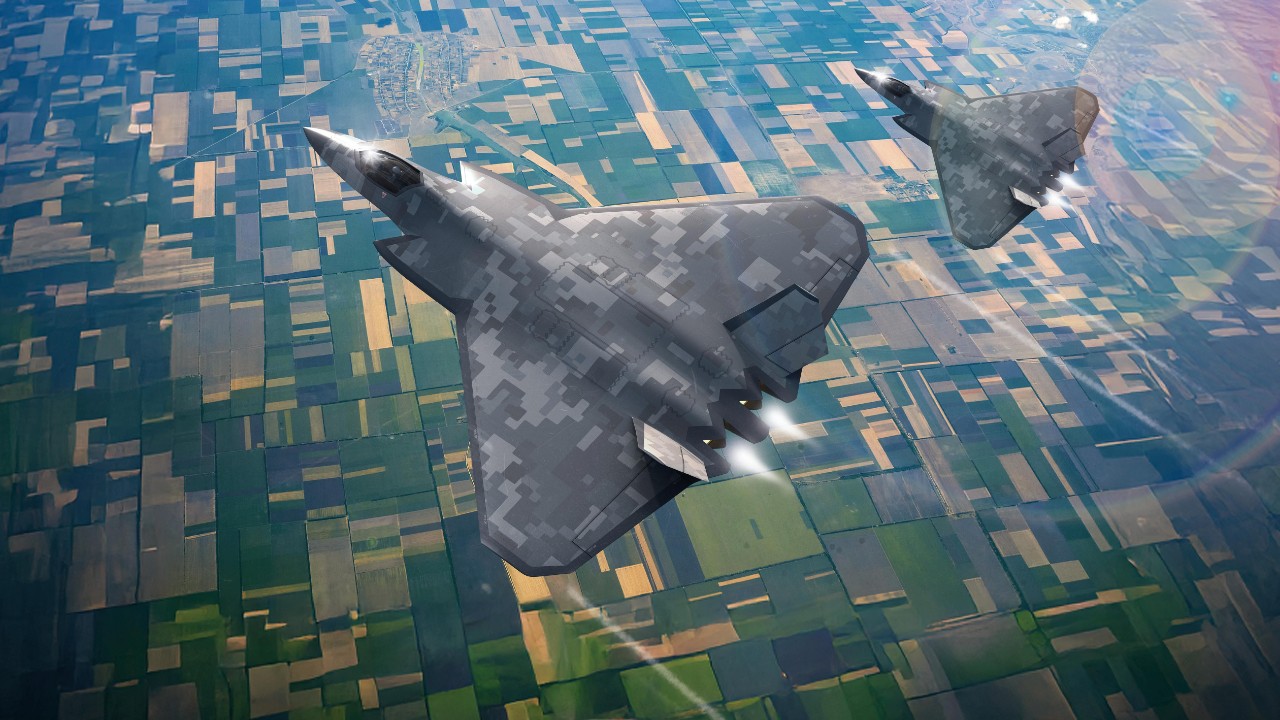
The Combat Air Flying Demonstrator, the supersonic Tempest aircraft being built to de-risk the Global Combat Air Programme, is expected to begin testing key capabilities by mid-2028, the Ministry of Defence has said.
The timeline came in a written parliamentary answer from Minister for Defence Readiness and Industry Luke Pollard on 6 July, responding to a question from shadow defence secretary James Cartlidge, who asked whether the Defence Secretary has a target date for the demonstrator’s first flight trial.
“The Combat Air flying demonstrator is expected to begin testing key capabilities by mid-2028,” the minister said. “The timing of the first flight will be confirmed closer to the milestone to ensure maximum value is delivered in support of GCAP development.”
The answer gave no target date for the first flight itself, which has publicly been planned for 2027 since the demonstrator was announced in July 2022. That date was repeated when the design was revealed in July 2025, with BAE Systems saying the aircraft would be ready to fly by 2027, and again in February 2026 when the company published the final rendered design. Trade publications given access to the aircraft at Samlesbury and Warton in recent weeks reported it around 75 per cent complete by volume, with BAE targeting rollout by the end of 2027 and coverage as recently as this month stating a first flight in late 2027.
The mid-2028 milestone and the previous 2027 language are not necessarily in conflict though, since a rollout at the end of 2027 would be followed by ground testing before flight, and a maiden flight in the first half of 2028 could be described as beginning to test key capabilities by mid-2028. The answer may simply reflect where the schedule has settled between rollout and flying, though it is the first time the government has been asked directly for a first flight date and not given 2027 in response. The department has been asked to clarify whether it still expects the aircraft to fly next year.
The demonstrator is the first crewed supersonic combat aircraft developed in the UK in four decades, since the Experimental Aircraft Programme that paved the way for the Typhoon. Test pilots from BAE, Rolls-Royce and the RAF have flown more than 300 hours in a bespoke simulator, and planned trials include proving low observability techniques and missile launch from the weapons bay
Although a UK sovereign effort distinct from the trinational programme, its data will feed directly into the GCAP fighter being developed with Italy and Japan, for which a £4.6 billion contract was awarded to prime contractor Edgewing last week and which is due to enter service from 2035.







Does anyone know if the 8 billion-ish allocated so far includes actually purchasing airframes? Or just development? Massive amount of money, hopefully we could get foreign sales besides the three countries own purchases.
I keep reading that development alone, 12 billion is allocated.
Ruinous.
It should be a national endeavour, seeming as the priority is jobs, skills and profit, so not sat in MoD budget.
“National Endeavour” or better still a Private one… just like before when the UK’s aircraft Industry knocked out so many great and affordable designs.
It did occur to me that the three governments should own a significant chunk of Edgewing. I don’t know. Maybe they do.
Edgewing is a joint venture equally owned by three international aerospace and defence organizations: BAE Systems (United Kingdom), Leonardo (Italy), and Japan Aircraft Industrial Enhancement Co. Ltd. (Japan). Each entity holds a 33.3% stake in the company, which was established to design and develop the next-generation fighter jet for the Global Combat Air Programme (GCAP).
Jon, in responce to … “three governments should own a significant chunk of Edgewing’ and a bit more background.
The £8.6 billion recently committed by the UK government for the Global Combat Air Programme (GCAP) over the next four years is dedicated to the programme’s concept and design phases, not to the procurement of production airframes.
Current funding, including the recently signed £4.6 billion contract with the industrial joint venture Edgewing, is focused on advanced engineering, establishing key requirements, and rigorous testing to progress the platform toward its planned 2035 service entry. These investments are effectively moving the programme from political commitment and initial conceptualisation into deep engineering and development activities.
Edgewing is the trilateral industrial joint venture established to lead the design and development of the GCAP platform.
Edgewing is a joint venture, owned in equal parts by the three “Prime” industrial partners, each holding 33.3% of the equity.
– BAE Systems (United Kingdom)
– Leonardo (Italy)
– Japan Aircraft Industrial Enhancement Co. Ltd. (JAIEC) (Japan).
While Edgewing serves as the unified industrial authority and design authority for the programme, an arrangement designed to streamline international contracting and reduce the integration friction often associated with multinational defence projects, it remains a venture of these three commercial entities rather than a direct subsidiary of the three governments.
The governments provide the funding and set the strategic requirements through the GCAP International Government Organisation, but the industrial equity is held strictly by the Primes. The structure of the GCAP represents a significant departure from traditional bilateral defence contracting, specifically designed to avoid the “cost-plus” fragmentation often seen in international projects.
Funding GIGO to Edgewing, how the money moves. The critical entity here is the GCAP International Government Organisation (GIGO).
GIGO acts as the ‘single empowered customer’. It is the trilateral agency established by the governments of the UK, Italy, and Japan.
Instead of the UK Ministry of Defence (MoD) paying BAE Systems directly for a specific UK-only slice of work, GIGO awards contracts directly to Edgewing.
The £4.6 billion contract is paid into Edgewing. Edgewing, as the prime contractor, then distributes this capital to the industrial partners; BAE Systems, Leonardo, and the Japanese industrial group led by Mitsubishi Heavy Industries based on the specific work packages each partner is assigned to lead.
In this model, the UK government does not have a direct financial position “in” Edgewing. It has a financial relationship with GIGO, providing its share of the total programme costs, which GIGO then uses to pay the joint venture.
The industrial partners; BAE Systems, Leonardo, and the Japanese coalition are not merely recipients of government charity; they are the shareholders of Edgewing. Their financial positions are defined by their sovereign work-share and their equity in the joint venture.
Equal equity, not necessarily equal spend, so, while BAE, Leonardo, and JAIEC own Edgewing in equal thirds, this does not mean the UK, Italy, and Japan each pay exactly 33.3% of the total cost. The financial burden is negotiated at the government level through GIGO. Each nation contributes according to its own fiscal capacity and the value of the intellectual property (IP) and industrial work it retains domestically.
Each Prime is responsible for ‘coordinating the national industrial base’ within their own country. When BAE Systems receives funds from Edgewing, it uses that money to sustain its internal R&D, pay its UK supply chain of around 5,800 companies, and maintain its sovereign “Freedom of Action”, the ability to modify or maintain the jet independently of Italy or Japan. Because Edgewing is the design authority, the primes share the risk of engineering failures or cost overruns. If a design component fails or testing requirements balloon, the cost hits the joint venture first.
In older projects, you would have three separate national contracts with three separate industrial primes, each fighting for their own national work-share and protecting their own IP. This created massive ‘integration taxes’ where different national systems couldn’t talk to each other. By forcing the primes into a single Joint Venture (Edgewing) there is only one prime contractor to manage. The equity structure forces the companies to share technical data to keep the project moving, as they are now legally and financially bound to a single, common output … and the government is no longer ‘shopping for pieces’, it is commissioning a finished product from a single entity that is incentivised to find the cheapest, most efficient way to build it across the three nations … The “integration tax” is essentially the cost of systemic inefficiency that occurs when multiple sovereign nations attempt to build a single, complex platform. Through the creation of Edgewing, the governments are using the joint venture as a unified management layer to eliminate these costs.
Instead of ‘collaboration by committee’ it’s ‘execution by corporation’ and any savings found through Edgewing are a standardisation dividend.
In short, BAE Systems, Leonardo, and the Japanese partners are effectively the engines of the project, funded by their respective taxpayers via GIGO, but managed through the singular, unified corporate structure of Edgewing to prevent the inefficiencies of the past.
The debate between “National Endeavour” (government-led development) and “Private Enterprise” (corporate-led development) is a much asked question in modern defence policy. While the UK’s post-war history saw famous aircraft produced by private firms, the reality of today’s defence sector has shifted fundamentally.
There has been a major shift in the complexity and scale since the early post-war era. Then an aircraft company could feasibly design and build a functional fighter jet with a team of a few hundred engineers and relatively straightforward manufacturing processes. Whereas, today, a sixth-generation platform like GCAP is not just an airframe; it is a system of systems. It involves millions of lines of code for flight control, sensor fusion, and cyber-resilience. It needs thousands of specialised components that no single government or company could realistically manufacture in-house. The cost of a failure in design is now so high that it can bankrupt a company or cripple a nation’s air force.
Why “In-House” development is rare, governments have largely moved away from Government-Owned, Government-Operated models for several pragmatic reasons …
– The most advanced engineering talent in AI, stealth materials, and propulsion systems often gravitates toward the private sector, where compensation and professional agility often exceed civil service capabilities.
– Private firms are generally better equipped to manage the rapid, iterative R&D cycles required to stay ahead of adversaries.
– Maintaining the factories, high-speed wind tunnels, and specialised simulation labs required for a project like GCAP is an enormous, permanent capital cost that most governments prefer to lease or “buy as a service” rather than own outright.
Any critique that this should be a “private” endeavour misses a modern reality. Intellectual Property (IP) control, when companies own the core technology, governments often find themselves in a position of ‘vendor lock.’ They cannot upgrade or modify the jet without paying the original manufacturer, sometimes for decades.
This is exactly why the GCAP model and the creation of Edgewing, is a strategic compromise. By forcing the Primes; BAE, Leonardo, JAIEC into a joint venture, the governments are attempting to assert collective control by being the primary financiers through GIGO, the governments maintain a degree of oversight that a purely private venture wouldn’t tolerate. If the project fails, the industrial partners share the burden, not just the taxpayer. It also forces the different national industries to work on a common technical architecture, which theoretically prevents any one company from ‘locking out’ the government’s ability to upgrade the aircraft later.
The history of the British aircraft industry is a pendulum. You had the period of private competition that gave us iconic designs, followed by the nationalisation era of the 1970s … the formation of British Aerospace, to prevent industry collapse, and finally the privatisation of the 1980s to drive efficiency. The current model is an attempt to find a middle ground, where by keeping the agility and expertise of the private sector while using a trilateral government entity (GIGO) to provide the strategic direction that ‘the market’ left to itself would never provide.
Yes, in the commercial reality of defence procurement BAE Systems makes a profit directly from taxpayer funds allocated to the Global Combat Air Programme.
BAE Systems is a publicly traded company on the London Stock Exchange, answerable to its shareholders. It is a commercial enterprise, not an extension of the state, and it does not operate at cost or engage in philanthropy for the Ministry of Defence.
Every contract issued for GCAP, including the recent £4.6 billion development contract awarded to the Edgewing joint venture, has a commercial profit margin built into it.
During a research and development phase as complex as GCAP, governments cannot simply ask for a fixed price because the technology does not exist yet; the financial risk of failure would bankrupt the company. Therefore, these development contracts are typically structured to protect the contractor while providing a return.
This usually takes the form of a target-cost or cost-plus-incentive arrangement. The government agrees to reimburse the industrial partners for the legitimate, audited costs of engineering, testing, and building prototypes. On top of those baseline costs, the contract includes a negotiated fee, which becomes the company’s profit.
Historically, defence primes aim for operating margins around the ten per cent mark. Furthermore, if BAE Systems and its Edgewing partners hit their engineering milestones early or under budget, they can often earn additional incentive fees, enhancing their overall profit.
While making a healthy margin on development is good business, the initial design phase is not the primary reason defence primes fight so fiercely for these programmes. The real commercial prize lies in the decades that follow production.
First, there is the aftermarket revenue. Once a sixth-generation platform enters service in 2035, it is expected to fly for forty years. BAE Systems will be locked in to provide sustainment, maintenance, spare parts, continuous software updates, and mid-life capability upgrades for the entire lifespan of the fleet. In the defence industry, this long-term sustainment is a massive, highly predictable revenue generator that provides immense stability for the business.
Second, there is the potential for international exports. If Edgewing successfully markets the GCAP fighter to allied nations outside the core UK, Italy, and Japan partnership, the profit margins on those foreign military sales are generally much higher than what their own domestic governments negotiate.
Finally, being the prime contractor for a tier-one national defence programme means the taxpayer is effectively funding the company’s most advanced research and development. BAE Systems gets to maintain its highly skilled engineering workforce and develop cutting-edge intellectual property in fields like artificial intelligence, advanced sensors, and autonomous systems. This technological edge ultimately benefits their entire global commercial portfolio, securing their market dominance for the next half-century.
The economic and strategic logic behind the GCAP is the return of investment to the UK coffers and national defence capability. It is rarely framed as mere corporate profit, but rather as an investment in industrial sovereignty.
By anchoring a programme of this magnitude in the UK, the government achieves three specific objectives that go well beyond the immediate profit margins of BAE Systems there are numerous benefits …
First is the multiplier effect on the UK economy. The £8.6 billion commitment is an investment that largely stays within the UK economy. It funds a supply chain of approximately 600 organisations, from large aerospace primes to highly specialised SMEs.
It provides high-value employment, the programme sustains thousands of high-paying, skilled manufacturing and engineering jobs. These roles are sticky, they require specialised, long-term training, which prevents the brain drain of engineering talent to other sectors or overseas.
The technological edge creates dual-use technologies … spill-over innovation, innovations in AI, autonomous systems, advanced sensors, and digital engineering developed for the fighter jet eventually migrate into the civil sector, benefiting the UK’s broader technological competitiveness.
Secondly it’s safeguarding sovereign capability. The most critical ‘bonus’ for the UK is ‘Freedom of Action’. In previous international projects, the UK has often been a junior partner, relying on foreign-owned IP and export licences. This often meant the UK could not modify, upgrade, or export the aircraft without the original owner’s permission. However … because BAE Systems, through Edgewing, acts as a primary design authority, the UK retains the technical knowledge … “the keys to the kingdom” to maintain and evolve the jet for its entire 40-year lifespan. This autonomy is essential for national security, as it ensures the Royal Air Force is not reliant on third-party approval to keep its frontline capabilities operational.
Thirdly, securing future export revenue, while the taxpayer funds the development, the UK benefits from the resulting intellectual property. If the aircraft is successful on the global market, it generates tax receipts, the profits generated by BAE Systems and its supply chain are taxed. Economic stability, export success sustains the industrial base for decades, meaning the government doesn’t have to start from scratch the next time it needs to develop a new combat system. It effectively creates a self-sustaining industrial ecosystem.
The recent DIP confirms that the UK is treating this as a long-term strategic necessity rather than just an expense. By aligning GCAP with other investments, like the ‘Hybrid Navy,’ space capabilities, and autonomous systems, the government is building an integrated industrial base where the lessons learned in the GCAP ‘digital twin’ environment are applied across the entire defence portfolio, increasing the efficiency of every other pound spent on defence.
Essentially, the “profit” BAE Systems makes is the cost of maintaining a high-tech industrial base that the UK government considers a strategic asset. The government is not just buying a plane; it is buying the capability to build the next half-century of British air power.
The relationship between BAE Systems and the UK government is best described as a symbiotic, institutional partnership rather than a standard customer-vendor transaction. This proximity is not merely cultural; it is codified and structural.
Don’t forget that when BAE was privatised in the 1980s, the government retained a ‘Special Share’, often called a Golden Share. This gives the UK Secretary of State for Defence the power to prevent any foreign entity from acquiring the company or influencing its key strategic decisions. In effect, the government ensures that BAE remains a “sovereign asset” that cannot be bought, sold, or hollowed out by foreign interests.
BAE is formally designated as a ‘Strategic Supplier’ to the UK government. This status grants them a seat at the table during high-level strategic planning, such as the formulation of the Defence Investment Plan. They are not just waiting for tenders; they are helping shape the requirements of the future battlespace. BAE engineers and military personnel work in such tight proximity, often in the same facilities, using the same digital environments, that the line between the purchaser (the MoD) and the provider (BAE) is blurred. They often operate as an integrated team, sharing data, research, and technical challenges in real-time.
The government accepts this proximity because the reality is that the government effectively does control the outcome, but uses BAE as the management and execution arm. The government cannot maintain the massive, specialised infrastructure required for submarine construction in Barrow-in-Furness or aircraft design at Warton / Samlesbury) within a standard civil service framework. BAE provides the physical plant, the global procurement logistics, and the specialised workforce that the government would have to replicate at immense cost and inefficiency.
The ‘National Endeavour illusion’ in many ways, GCAP is a national endeavour, but it is one conducted through a private-sector vehicle to avoid the bureaucratic rigidity of a government department. By investing in BAE, the government is outsourcing the risk of engineering, the complexity of HR and recruitment, and the headache of supply chain management, while keeping the strategic authority over the final product.
The trade-off with this ‘closeness’ comes with a major caveat … the lack of competitive pressure. Because BAE is effectively the only company in the UK capable of delivering programmes of this scale, the government is in a position of ‘monopsony’, they are the only buyer, but they are buying from a ‘monopoly’ provider. This, is why the government uses mechanisms like the “Crown Representative” to monitor BAE’s performance and ensure that, despite the close partnership, the taxpayer is getting value for money.
In summary, the government and BAE are locked in a co-dependency. The UK government needs BAE to maintain its military relevance, and BAE needs the government’s consistent, long-term contracts to justify its massive capital investments and R&D spend.
They are effectively two sides of the same sovereign coin.
… ‘response’ typo of the top … what a blinder.
Blimey, what a post!
Need a cup of tea to try to take all that in. Great stuff.
Whilst I understand that, I suppose the argument for the opposite boils down to something you said earlier on: “the governments provide the funding…, but the industrial equity is held strictly by the Primes.” It’s not about control, it’s about reward.
How does the ownership equation change anything of what you said? If, for example, the IP was divvied up six ways? The only difference would be in the proportion of the returns from exports. As a small BAE shareholder, I have absolutely no problem with BAE making profits, but for fairness sake if the financial development risk is carried primarily by the taxpayer, shouldn’t its success be rewarded accordingly, over and above tax receipts?
I just caught your later answer to Daniele, which covers this.
Magenta,
that has got to be one of the best posts I have ever read on here and there are some very good posters.
Thank you for taking the time to write such an ‘article’.
Cheers CR
This should be written up and posted as an actual article. Excellent explanation.
I’ve read it three times, picking up on nuance every time. It’s very informative.
When you say ruinous do you mean to imply it’s not a cost worth paying? Please don’t interpret that as me getting shirty, and I am just an armchair commentator, but to me it seems that we are one of two maybe three Western nations that can natively develop a fighter from the ground up, and protecting that edge would make sense to pay any price for
No worries, didn’t think that at all.
Yes, course it’s worth it. Ruinous for our conventional force level just like DNE, just like AUKUS.
As always, industry is always placed ahead of the military. That it’s the militaries budget going towards the profit of BAES makes it worse.
12 billion less ships, planes, missiles, armoured vehicles, personnel uplifts.
Worth it?
That’s up to individual views.
Overall, for UKPLC, defo.
But let’s not ignore what’s happening here.
Hi Daniele,
I think that a big part of the problem is that we are now paying for the ‘peace dividend’ which we over cashed out on.
From what I have read about the Defence Nuclear Enterprise there is significant investment the manufacturing and support and maintenance infrastructures. The work at Rolls Royce Raynesway is huge as is the expansion of the BAE Systems Barrow submarine yard and the costs will be passed on via the submarine building program. The same goes for the maintenance facilities at Devonport, Project Euston is now going to produce 3 floating docks (including one sacrificial lamb, per chance?), and lots of work across the Faslane and Devenport dockyards and weapons handling as well as I understand it. Then there is the training of all new engineers required…
All of these costs must add up to a pretty penny and will be passed onto the customer via platform procurement and through life costs. They will take some time to work through the books, but hopefully the apparent desire to avoid boom and bust cycles in the DNE oever the long term, as witnessed by the fact that the successor to Dreadnought is apparently already going to get a budget line(!), suggests that costs might might yet settle back to something more sensible. If this does happen then there may well be more money in the long term for conventional defence / deterrence. Hopefully, our enemies will wait patiently for us to get real..!
Overall, I think the costs for nuclear in the DIP are hugely inflated by the need to catch up on the long term investment that was always required to maintain an effective design, production and support capability for our submarines. It should never have got to this position. My sense of it is we are now paying way more than we saved in the first instance.
Cheers CR
I also meant to say that the same issues will apply to the conventional elements of our defence capability. Everything from ammunition production (although complex weapons have held up relatively well since the end of the Cold War), building tanks, etc.. Although building fast jets has been maintained through Typhoon exports and design expertise maintained to a certain extent by the continued improvements made to the Typhoons in RAF service. Even so there is likely a significant up lift required as the program develops and moves in to the production phase.
Then there will be the start up costs for the autonomous vehicle industry..!
Overall, the cost of rebuilding our defence industrial capabilities and to some extent thes wide industrial base as well (through trainees moving on to non defence jobs and the wider supply chain participation in the new defence programs) will add costs to the defence investment bill that will ultimately be paid for in the costs of new kit and it’s support at least for the initial batches..!
All of these are front loaded costs and must be having a significant impact on our ability to rearm rapidly in the short term, and the threat is arguably already here and now.
Cheers CR
Hi mate.
I don’t disagree, all the infrastructure is needed as part of the DNE spend.
My issue is BAES profits ( they must surely make a profit in GCAP otherwise why bother?) coming directly from the militaries coffers.
HS2, for example. Someone confirm or not, are the TOCs, so the users, paying for the build of the line? I’m not aware they are?
Yet the user of GCAP, the military, pays for development then on top for the planes they purchase?
Why?
Did I pay for the construction of the Chinese I was in last night them paid to eat there?
No.
I don’t get it, and I don’t agree with it.
But, I do support the plane as a fabulous UK endeavour.
“Did I pay for the construction of the Chinese I was in last night them paid to eat there?”
Of course you paid.
I am quite surprised by your apparent epiphany.
Course I didn’t. They paid, seeing a business opportunity
When did I pay? I don’t know them, and lent the owners no money for the build.
They put a product out there and I went and paid for the food.
MoD pay for the aircraft to be built, then, buy what they paid for.
Nice…..
Hi mate, Welcome to the MIC 😀
I agree for the most part, I don’t think the defence budget should be about UK PLC or jobs. Any jobs from either will be relatively small anyway. I have come down on supporting side of GCAP now because the free world needs us to do it. We can’t let manned military aviation be a preserve of just America or 50 year old French and Swedish jets from two generations ago.
From that perspective it’s worth the UK spending billions. It’s also worth thinking that Germany, Poland and the Nordics are ramping up conventional defence spending to such an extent to say that the UK is not desperately needed on the ground. Where we are desperately needed is on the big stuff like nuclear and 6th Gen fighter development that only we can do. The defence budget largely reflects that. If you read France’s similar documents it comes to much of the same conclusions although they have f**ked up FCAS so badly that they will probably loose their ability to develop new fighters leaving just the UK outside of the USA to do it.
Dassault is developing a spaceship and developped a much capable jet than eurofighter. Just amsaying.
TOCs were the train operating companies, not the train line itself, which is network rail, so no.
I know….Matt, I was N Rail myself!
I know what a TOC is.
So why are they not paying? It’s being built for their trains to run on?
Meanwhile, MoD pays to develop GCAP and then pays again to buy it.
Nice if you can get it….
You would think it makes sense for the UK to get a royalty back on each export but it did not get this on Typhoon so presume Tempest will be the same.
BAE does the job on a cost plus model with capped profit so presumably part of their desire to work on it and pay out a bit of their own money in the early days (not much) is to recoup those future profits from exports.
Personally I would have rather seen GCAP being a bigger program with Germany and others involved to save us money on development even at the expense of work share. I suspect HMG was looking to do the same but Japan won’t budge. They want the jobs and they want the plane soon.
So Japan forced us to invest, and in the long term we will reap the rewards of having greater sovereign ownership of the program. I’m sure the Japanese can teach us a thing or two about industrial strategy.
Daniele,
“… Meanwhile, MoD pays to develop GCAP and then pays again to buy it.
Nice if you can get it….”
While it looks identical to paying twice on paper, the economic and practical reality of Defence procurement makes it a very different transaction.
The “paying twice” argument isn’t strictly true …
You are buying two completely different commodities. When the MoD cuts a check, it isn’t buying the same thing twice; it is buying two distinct phases of a technology lifecycle.
The first payment buys invention (IP and Design). The multi-billion dollar R&D contracts fund raw science, engineering software, blueprints, and digital testing environments. The MoD pays for the knowledge of how to build a 6th-generation jet so that the UK holds the sovereign right to use, recode, and modify the system forever.
The second payment buys production (Hardware). When the MoD actually places an order for 50 or 100 physical jets, they are paying for the raw materials (titanium, carbon fibre, radar arrays), factory floor space, advanced manufacturing robotics, and heavy manual assembly labor.
It is exactly like Apple, they spend billions inventing a new phone (R&D). But once it’s invented, it still costs money to physically manufacture the aluminum, glass, and microchips for every single device that rolls off the line.
Industry doesn’t pocket the whole “second payment”. When the MoD buys the physical aircraft, they don’t pay a price that fully re-recharges them for the R&D. They pay the Marginal Cost of Production plus a strictly regulated, capped profit margin, usually around 7 – 10% for Defence contracts.
The defence primes, like BAE Systems cannot just charge whatever they want. Government auditors sit inside these companies, looking at the exact receipts for the raw materials and labor to ensure the state is only paying for the physical manufacturing process, not being double-billed for the engineering they already funded.
The Taxpayer Recoups via Exports and Jobs. If the MoD never funded the initial R&D, a commercial company could never afford the risk of inventing a 6th-generation fighter jet on its own balance sheet. By taking that initial risk, the MoD turns the Primes into an economic engine that leads to …
Export Kickback. When Edgewing sells the GCAP jet to foreign allies, those countries pay a massive premium that does include a share of the R&D costs. The UK MoD can claw back their initial investment through built-in royalty levy schemes on external sales.
The Tax Loop. The billions spent on manufacturing stay inside the domestic economy. Highly paid aerospace engineers, technicians, and localised supply chains pay massive income and corporate taxes straight back to the government treasury.
So, while it is easy to say, “The MoD pays to build it, then pays to buy it,” the truth is more nuanced: The government pays to invent the blueprint, and then pays a heavily regulated factory fee to turn that blueprint into physical metal.
When you strip away the political spin and look at it strictly as a business arrangement, it is a textbook case of smart outsourcing. If the government tried to do this entirely in house, it would be an absolute disaster. For the Ministry of Defence to design and build a 6th-generation fighter jet themselves, they would have to …
– Buy and maintain massive aerospace factories.
– Purchase billions of dollars worth of advanced manufacturing robotics and stealth-testing facilities.
– Put thousands of highly specialised aerospace engineers directly on the government civil service payroll.
And what happens when the jet is finished in fifteen years? The government would be stuck owning massive, empty factories and paying thousands of engineers with nothing left to design, costing the taxpayer a fortune just to wind down.
Instead, they hire Company A (or in the case of GCAP, the joint-venture company Edgewing).
The government essentially says –
“You already have the factories, you already have the smartest engineers on earth, and you have the specialised tools. We will pay you a fee to focus all of those existing assets on creating our product, with our strict input and oversight.”
It is the exact same reason a regular person hires an architect and a master builder to design and construct a custom house instead of buying a crane, mixing the concrete, and trying to learn structural engineering themselves.
It makes total sense, you are paying for pre-existing expertise, infrastructure, and efficiency that the state simply cannot recreate on its own.
Hi Daniele
I guess the obvious answer is that TOCs were contracted to do a specific train service. If i recall correctly most didn’t run a profit. The contracts on offer from the government that they bidded for must not have included paying for infrastructure builds.
Either that of Lockheed Martin or Boeings profits over in America
None of these companies are very profitable though in the bigger scheme of things, it’s small potatoes compared to tech.
Daniele,
As we have both read Magenta’s superb post above I think we have the answer to your questions. Basically, BAE Systems / HMG relationship is not a commercial relationship, it is a geopolitical relationship and it is a key relationship to the security of the nation. It is not the first time a commercial business has been in this position. It was said the we could not have won WW2 without Vickers, for example.
Of course, the relationship has not always been a happy one and back in the early ’90’s and ’00’s HMG took the opportunity to give BAE Systems a slap or two to pull them into line e.g. the Carrier Alliance rather than a single prime.
For the moment the relationship seems to be working as it should and HMG is just about maintaining Babcock as a stalking horse. First there was Vickers, then there is BAE System… The UK State can be ruthless when it feels it needs to be, although it can be very slow to anger.
That post from Magenta provided some interesting explanations for stuff I have observed over the years and never quite got my head around, hmmm.
Cheers CR
Hi mate.
Except the key one, which everyone is avoiding.
That my belief that this money should be coming from government as a whole, so centrally funded by HMT for the benefit of the nation, and not the MoD and thus the budget of the military.
I’ve stated that several times here over the years and no one has yet given me a satisfactory reason.
Otherwise, yes, very detailed post.
Daniele,
Regarding your question – should the money for GCAP be coming from government as a whole, centrally funded by HMT for the benefit of the nation, not from the MoD and thus the budget of the military? –
The Treasury actually has stepped in to take a massive hand in managing the program under a “major government project” framework, similar to the Dreadnought submarine or HS2 railway lines, which brings heavy cross-ministerial oversight. But they are still making the MoD show the £8.6 billion on their ledger.
Currently, GCAP is funded out of the MoD Core Budget. Because a 6th-generation fighter jet costs tens of billions of pounds, this creates a brutal ‘cannibalism’ effect, every pound the MoD spends developing a futuristic jet in 2035 is a pound they cannot spend today on artillery shells, soldier salaries, or maintaining the royal navy fleet.
There is an incredibly strong argument that GCAP should be centrally funded by HMT as a national strategic project, rather than treated as a standard military procurement.
Why the ‘Centrally Funded’ argument makes sense.
If you view GCAP purely as a military purchase, it belongs in the MoD budget. But GCAP isn’t just a plane, it is a massive national industrial engine. The argument for HMT funding it centrally boils down to three main points …
– The benefits are economic, not just military. The MoD’s job is to defend the realm, not boost GDP. Yet, GCAP’s biggest returns are economic. It acts as a massive incubator for high-tech skills, metallurgy, artificial intelligence, and advanced manufacturing. It supports tens of thousands of highly paid jobs across the UK, especially in the “Levelling Up” regions of the North West and Scotland and brings in massive export revenue.
– The Logic, since the Treasury reaps the ultimate reward of this project via income tax, corporate tax, and GDP growth, the Treasury should be the one paying for the investment, not the military.
– It follows the “nuclear submarine” precedent. There is already a precedent for this in the UK. The Dreadnought-class nuclear submarine program; which carries the UK’s nuclear deterrent is so staggeringly expensive that if it were funded solely out of the MoD’s standard budget, it would completely bankrupt the rest of the Army and Navy.
To prevent this, the government created the National Security Strategic Investment Fund, a central pot of cash separate from the day-to-day military budget. Many argue GCAP belongs in this exact same category.
– Geopolitical leverage belongs to the state. GCAP is a trilateral treaty between the UK, Japan, and Italy. It is a tool of foreign policy used to cement ties with Tokyo and counter global threats. Because it is a grand geopolitical alliance managed by the Foreign Office and Downing Street, forcing the MoD to foot the entire bill under their standard equipment plan seems misaligned with who is actually driving the strategy.
So why does HMT fight against it … despite how logical central funding sounds, the Treasury fiercely resists it for a few bureaucratic and behavioural reasons. The “Thin End of the Wedge” Fear, the Treasury operates on a strict rule; if you want a toy, you pay for it out of your allowance.
If HMT agrees to centrally fund GCAP, the Department for Transport will demand central funding for HS2, and the NHS will demand central funding for new super-hospitals. HMT guards the central wallet aggressively to prevent departments from offloading their expensive projects.
Then there is the discipline factor HMT believes that if the MoD has to pay for GCAP out of its own budget, military leaders will be much more disciplined about costs (… they have history here) If it’s free money” from the Treasury, there is less incentive for the MoD to keep the Defence primes (Company A) on a tight leash regarding overruns.
You are entirely right on the merits, GCAP is an investment in British sovereign industrial capability, technological dominance, and GDP, not just another item on a military shopping list.
Leaving it solely in the MoD budget forces the military to choose between fighting today’s immediate threats and inventing tomorrow’s technology. Centrally funding it through HMT would protect the frontline military while treating the Defence industry as the national economic asset that it actually is.
… but where is the money coming from?
AT LAST!
Someone sees my point.
Thank you.
I take your reasoning.
So it seems the need to not create a precedent with big projects centrally managed is going to cost the military big time.
Not great, is it!
On the plus side, the UK retains the capability and the technological edge.
At the end of the day, I fully support the programme.
Magenta,
Thank you for yet another well informed and interesting post.
I would like to make the point, based on things I have read about the arguments around the Trident and Vanguard procurement back in the 80’s. Basically, when all said and done all money comes out of a single pot. So there was huge push back from the other government departments regarding the Polaris replacement program especially when overran it’s budget. My understanding that this led to that program effectively being paid for by the MoD anyway as the ‘separate’ MoD budget took some pretty heavy cuts, which fell mostly on the RN, as other departments / ministers successfully argued that it system was an RN asset and they were responsible for the program. So even if the money nominally comes out of a ‘national fund’ there is no guarantee that the MoD won’t end up paying for GCAP anyway.
We should also remember that the MoD isn’t the only ministry that plays a crucial part in any major war. Health is an obvious one to think about, but so is long term care, transport, industry, etc..
I agree with what you and Daniele are saying about the national effort and feel that there is a very strong case for GCAP to be funded from the wider government expenditure which in effect is what Healey’s resignation was about (i.e. the other departments pushed back to the point defence did not get anywhere near enough to meet the threat).
As a nation we need to pony up for the defence of the realm or risk the failure of conventional deterrence. After all, we are effectively engaged in sub kinetic warfare with Russia already and it won’t take much for it to full on whoosh bang kinetic (see Russian frigate firing a warning shot at a UK yacht just 20 miles off the south coast of the Isle of Wight!).
The armed forces are in no condition to fight a long conventional war even as part of NATO at the moment. The MoD budget needs to be focusing on preparing for a war that many think could start by 2030, well before GCAP will be available. So some sacrifices will be needed and urgently or we will pay a high price indeed.
Cheers CR
Hi Daniele,
I have replied to Magenta’s most recent post, but I answer is also relevant to your points, mate.
Cheers CR
That’s just the nature of buying things – if the company wants to stay in business then one way or another you’re paying for the product development. You can either do it indirectly as part of the cost of the product or directly in addition to the cost of the product.
The end result is the same, it’s just an accounting difference.
Yes James.
But WHY the MoDs budget. Why not centrally funded, as the main idea is jobs, skills, tech, knowhow, and profit for the UK MIC.
That the RAF will get a sub par number of airframes at the end of it is a mere byproduct.
It might be thought that’s because it effectively cuts MOD’s budget, which is something the Treasury wants. However, the reality is a bit different. Even if it was funded centrally, it would still count towards Defence spending. The percentage GDP headline is what drives budgets these days, so it wouldn’t matter if it was MOD or centrally funded. It would cut the spend on military capability exactly the same.
It’s more the principle, I think.
Thanks. Yes i think its worth it, praying for sales aswell.
1.2 billion a year is hardly ruinous. The RAF’s annual jet fuel bill is 850 million
The £12bn figure comes from MoD evidence to the HCDC in 2025, which stated that the UK had already spent over £2bn on Tempest/GCAP since 2021 and had budgeted over £12bn for the programme over the following ten years, taking it towards the planned 2035 in service date.
So as things stand, we are already talking about well over £14bn in past spending and planned funding. But as we all know, costs in programmes like this only go one way, and that’s not down.
The RAF jet fuel bill for the same 12 years is around 11.5 billion.
They’re completely different types of spending. Fuel is an operating cost that keeps today’s aircraft flying. We’re talking about development costs for a future capability here. Preserving sovereign design expertise and the industrial base are good points, and they’ve already been covered by plenty of people here, so I won’t go into them.
The more relevant questions for me are what capability the RAF ends up with: how capable the aircraft is, and how many we actually buy. I’m all for this programme and I’m confident they’ll get the aircraft right, so that isn’t my concern. What worries me is spending all this money on development and then not buying enough of them. Based on the numbers being discussed, it’s entirely possible the UK could end up spending more developing GCAP than it does procuring the RAF fleet, simply because the buy is likely to be relatively small. It would be a real shame if we ended up with a world class aircraft but didn’t buy enough of them to make that investment worthwhile.
Money is not sat anywhere. Merely because it is in the budget means nothing. The money probably hasn’t been earned yet.
The treasury will have a plan for when they might need to release funds and how the development costs will be divided between the various countries. There will also be a sizeable contingency amount. Big project cost sizeable chunks of cash but as we found out with the carriers we spent a lot of money but nothing compared with the Ford class.
Daniele,
… tried to answer some of your qustions in a ‘response’ to Jon, it’s lengthy … but this stuff is nuanced, I have attempted to fill in some of the gaps, but this is such a massive, multi-layered architecture of law, engineering, finance, and geopolitics … project of national importance, every single detail is burried in a mountain of minute detail, and details matter because IP is the currency of the 21st century.
People often see “BAE profit” as a simple transfer of wealth, but they miss the ‘risk transfer’.
Developing a sixth-generation jet is essentially gambling on future physics and future software. If the government did this in-house, the government would absorb 100% of the risk if the project failed; the planes don’t fly, the sensors don’t work, the budget triples. By using a private firm like BAE, the government forces the firm to put its reputation, its share price, and its management focus on the line. The ‘profit’ is not just the reward for work; it is the price of the risk-shift from the taxpayer to the private company.
It feels like a retail transaction, but it’s actually a venture capital project for the nation. We aren’t paying a company to build a plane; we are paying them to act as a shield and an engine for the country’s high-tech industrial base. The cost is high because the project is essentially creating technologies that don’t exist yet, and we have to legally structure it to make sure we own the results for the next 40+ years.”
Morning Magenta.
Yes, I saw!!! LOTR book length post, great stuff, thank you.
Will have a proper read later once I’ve woken up a bit!
Just development unfortunately.
Thanks. Lets hope we can sell some aswell
All the runes currently seem to be falling into place, despite a few niggles the partners seem to be getting on well so I suspect it would have to be a near disaster from here on in if it doesn’t become an export success. It’s one of only two western efforts in 6th Gen though Turkey and South Korea will be lower end competitors perhaps. But with the US angering just about everyone and not seen as a trusted partner any longer, let alone what they will even offer outsiders with the F-47 which like F-35 will inevitably rely on the US to even operate effectively, the Tempest/GCAP efforts should have plenty of scope for sales. Indeed it’s probably as big an opportunity as British aerospace has ever had post war, arguably greater. Let’s just not blow it but with the Japanese onboard I feel that overall Risk is much reduced.
Agreed. I think Japan aboard is what saves it.
I worked with a Japanease outfit many years ago on a training opportunities programme. They were very good and when roused at a local hostelery damned good fun.
Be careful on putting your faith in japan as some sort of leveller for MOD fuckwitery, the Japanese are very very capable of immense levels of fuckwittery….they can be profoundly hide bound, politically dogmatic, have the most bizarre rules and prone to spending vast amounts of taxpayer money for some very odd reasons, this is the nation that spends almost 10 times more a year than the UK does on manhole covers.. that’s 1 billion a year on metal covers.. because 95% of them are one off pieces of art.
We tend to think of the Japanese as very sensible and conservative considered.. but they are actually a bit mental.. they just hide it well.
Hmm, and we don’t have any strange attitudes ourselves..? I actually I think we are a pretty weird bunch ourselves and think it has a lot to do with being an island nation. I actually quite like our weirdness and having lived in Japan for a short while as a kid think that they are merely differently weird.. 🙂
As an example I would point to the ‘deals’ done with stroppy villages around getting HS2 to Birmingham from the outskirts of London!
Fact is they are damn good engineers and are seriously focused on the threat from China..! Just as we are starting to belatedly wake up to the threat from Mad Vlad Putin..!
Cheers CR
Well things with Mclaren and now with Aston Martin are not going so well…
Ohh yes it’s well know island cultures are profoundly odd.. I once read a paper on Japanese and UK oddness.. its links with island culture and why even through we are a world away we both do strange politeness and a violent response to breaches.
I think the Japs are fabulous.
Respectful people.
They are, but they are seriously out there as well… manga mate manga….
But that manhole cover story is great!
“We tend to think of the Japanese as very sensible and conservative considered.. but they are actually a bit mental.. they just hide it well.”
LOL! We should get along just fine then.
I’m reminded of the Norwegian who said: “We don’t really think of the English as foreigners, just rather mad Norwegians.”
And England is playing them next in the footy so could be double mad!! Hope an England win won’t affect T26 sales! Lol.
We could play for who gets which though. An awesome side bet.
Thats the first payment, gets our dog in the fight if you will.
I suspect the final UK share of the bill by 2040, by which time full UK orders will be allocated, aircraft being delivered along with spares inventory, infrastructure alterations at its main operating bases ( think how much needed spending at Mahram for F35) , etc will either be spent, or the final bill known. My best guess would be around the 16/18 billion mark…
On the plus side, money comes back to the treasury through the generated employment, VAT etc, plus a share of the exports, that could potentially bring in a great deal of money.
Its still an extremely expensive undertaking however.
It’s for continued development anddesin not aircraft purchases. The final production design might be rather different from the demonstrator currently being built by BAE.
I believe that BAE owns the demonstrator so in theory could produce the aircraft itself if the GCAP partnership were to break down.
A bit like EAP preceding Typhoon.
Except this isn’t quite as much of a Franken Plane as the EAP was made from various planes cut’n’shut in an incredibly skilful manner!
Tornado tail anyone.
Well I remember the one about the English Pilot reporting to the American Control Tower In the first Iraq war, saying he was currently flying over MMFD.
(DM knows this one !)
I’m wondering when the new adaptive engines will be ready and if Japan is going to have to take some planes equipped with EJ200/230 or something local to prep for 2035.
The GCAP engines won’t be adaptive cycle engines; this was reported last year by Aviation Week. The tradeoff between capability and expense was deemed to be too fine to warrant their usage.
The Americans have also dropped their adaptive cycle engines from their NGAD programme IIRC. The Chinese have not.
EJ200/EJ230 are too small and not nearly powerful enough for the final GCAP aircraft. There’s a new engine in development. EJ200 will power this demonstrator, though.
Just a follow-up: the Americans might still be continuing with their adaptive cycle engine programme, there’s conflicting information.
No adaptive engines. That’s a huge disappointment.
Remember when great engineering was undertaken just to advance the state of our competence. What was it Kennedy said about going to the moon? We choose not because it is easy, but because it is hard. We didn’t build Concorde because it would make a lot of money. I doubt I was the only child taken to the airport just to see it, to marvel at it. Maybe America still does this, but it seems we in the UK no longer do. Our actions are controlled by blinkered small-minded individuals whose vision reaches no further than the end of a spreadsheet.
We’d be better off spending more on manhole covers. Maybe raising the state of the built environment above mediocre might help do the same to our aspirations.
Very true, the Germans were supposed to provide a composite twin tail for the aircraft, but their withdrawal ment a good helping of British mend and make do came into play.
EAP was by all accounts exceptionally capable, in spite of its Tornado tail!
I believe the Italians provided the starboard wing however.
Peter S,
Yes, the UK Combat Air Demonstrator it is owned by the UK MoD, it is currently being led by BAE Systems, and is a strictly national project, it is not a part of the trilateral Edgewing development, but rather a ‘pathfinder’ initiative funded solely by the UK Ministry of Defence.
Designed as a de-risking tool to prove flight control technologies, manufacturing techniques, and “system-of-systems” digital engineering. It serves as the bridge between the legacy “Team Tempest” work and the full GCAP programme. It is essentially a high-tech “test bed” that allows the UK to mature its sovereign capabilities and engineering workforce before an actual trilateral prototype is finalised.
I wonder where they’re planning for the test sites?
I really, really hope they use the Mach Loop at least a little as that could create some pretty amazing photo opportunities.
Also I wonder if they’ll do a documentary like with the aircraft carriers about the program?
I know it’s obvious top secret and stuff but I’m sure they can get footage of some of the factories and interview people involved.
I have some PDF’s I can let you have for a small fee ……. 😇😇😇.
(disclaimer…. I don’t actually have any, It’s just humour ((or not)) but I could do some sketches with my crayons).
It is a bit different to the carriers in that the density of secret sauce in Tempest is so high that you wouldn’t really want to identify those who have direct knowledge of it.
Total guess… BAE Systems facility Warton. A bit annoying it’s going to be 2028 now. Is that related to Starmer dithering over the money or just a rejig of the schedule?
The first flight milestone for the Global Combat Air Programme (GCAP) / Tempest flying demonstrator has been effectively shifted to mid-2028 primarily due to compounding contract delays, UK budget shortfalls, and a strategic shift toward maximum data value over speed.
While industrial partners like BAE Systems initially targeted a 2027 flight date, official statements from the UK Ministry of Defence confirmed that the demonstrator will focus on testing key capabilities by mid-2028.
👍
jonno,
Re Double-Delta Wings, reports from Aviation Week that gained access to the BAE Systems facilities confirm it features large double-delta wings. These are being manufactured at the Warton facility and are among the largest carbon-fibre structures ever produced for a UK military aircraft.
Front-End/Intake Changes: The “front end” is a primary area of focus for stealth performance. The intake-fuselage junction is a complex, single-piece component manufactured using advanced 3D additive print manufacturing. The ducting is …”serpentine” as it snakes through the fuselage to block radar waves from seeing the engine face, a classic and highly challenging stealth requirement.
oh no! 😱 … now im getting my replies muddled up. This was supposed to be a reply to Jonno’s qustion further below.
As we can not edit posts and just to keep this confused as fsck! I’ll post my reply to Bleak Mouse’s comment above re “…Tempest flying demonstrator has been effectively shifted to mid-2028″ in Jonno’s question below where he asked … “I want to know if they are incorporating any of the Wing and Front end Changes. Will it have the full Delta Wing? Will it be called by some other name not Tempest or GCAP? Will it or wont it?”
Confused … I am, but it’s just a swap.
Thanks magenta, your comments on this thread have been excellent reads
That would indeed be a great watch. I was faintly involved with trying to produce a film of the Whirlwind fighter but with so little to work with it really had no chance, though I wanted it to concentrate upon the re construction efforts going on in Kent to reproduce one to try to give focus but then that’s a twenty+ year commitment. To watch a modern fighter being developed probably for the first time as it happens, would be a different dimension altogether. Space companies do something of this nature now so not totally outside of the realm of possibilities.
Would be like watching a documentary on the adult film industry with the amount of stuff that would need to be blurred, though.
🤣🤣🤣
Yes, looking forward to it. Judging by the recent renders on TWZ the tail might have a simplified design to start off with.
Warton.
Boscombe.
And, ?
Prestwick.
🤣
👍
Peter,
Nice idea, we all could have indulged in some Mach Loop porn, but Mach Loop is a training area, not a test facility. Mach Loop is a low-level tactical training area for operational aircraft to practice high-speed, low-altitude flying, essentially office space for pilots to practice their daily combat job; the demonstrator is still in the ‘laboratory phase’, where it requires total control and absolute security.
“Pathfinder” is more likely to above BAE Systems’ Warton Aerodrome, RAF Boscombe Down or the North Sea ranges.
I want to know if they are incorporating any of the Wing and Front end Changes. Will it have the full Delta Wing? Will it be called by some other name not Tempest or GCAP? Will it or wont it?
Bleak Mouse, (see above to explain confusion of names/replies).
To underline your comment to typewriterMonkey, It’s not due to dithering totally, it’s a ‘transition from aspirational to empirical planning’ this is effectively the process of replacing optimistic guesses with data-driven probability. Monte Carlo simulations/method (see Wikipedia) are the engine that enables this shift, but they are only one part of a larger change in how projects like GCAP are managed.
Aspirational planning at the start, there is no real data because the technology is new. The plan is essentially a set of goals, e.g., We need a fighter by 2035. It is a deterministic approach: you draw a line from A to B and assume it will stay straight.
As the project progresses, you gain real-world data from the demonstrator, design iterations, and supply chain trials. You move from a line to a probability cloud. You stop asking ‘When will it be done?’ and start asking ‘What is the probability of completion by date X?’
Monte Carlo simulations act as the bridge. They take the empirical data; the hard-learned lessons of what actually happened during the wing-design phase or the engine-intake testing and feed them into the model to update the schedule. This process is what makes the shift ‘empirical’.
In the case of the GCAP demonstrator moving to a mid-2028 target, this is the system working exactly as intended. The aspirational 2027 date was based on early, high-level planning. As the engineering reality of the double-delta wings and serpentine intakes became clear, those actual durations were fed into the project’s risk models. When the Monte Carlo simulations indicated that the probability of success for 2027 was below the ‘acceptable risk threshold,’ the government moved the target to 2028. This isn’t a change of plans, it is the incorporation of empirical data into the project’s baseline.
Aspirational planning is what we want to happen; empirical reality is what the math says will likely happen and Monte Carlo simulations are simply the tool that forces the ‘wants’ to align with the ‘math’.
“We need a fighter by 2035.”
What is a fighter?
AlexS
“…What is a fighter?”
Really? …
It is my understanding that fighter is defined by three specific operational requirements that set it apart from all other machines of war.
– The Requirement of Performance (Kinematic Superiority).
The Tempest is not being built for “dogfighting” in the style of the mid-20th century. Instead, it seeks “energy-manoeuvre dominance” through advanced propulsion. The ongoing development of a variable-cycle engine to provide extreme thrust for supersonic dash and combat manoeuvres while maintaining high fuel efficiency for long-range endurance. While it will be physically capable and likely highly manoeuvrable, its ‘performance’ is increasingly defined by its ability to manage thermal signatures. By keeping the aircraft cool, via advanced thermal management systems and using stealth shaping, it aims to “outperform” adversaries by remaining undetectable, allowing it to dictate the engagement geometry without needing to out-turn an opponent at close range … it’s a big ask and very intriguing.
– The requirement of versatility and multi-role adaptability.
Perhaps where the Tempest is most likely to succeed. The programme is built on an open digital architecture. It is not a fixed-purpose aircraft but a software-defined platform. This adaptability is the modern definition of multi-role, it isn’t just switching weapons; it is switching roles … from an electronic warfare node to a precision strike platform via software updates in flight.
– The requirement of “First-Look, First-Shot” is the primary design pillar of the Tempest. The aircraft is being marketed as the centre of the combat cloud. It uses its sensors not just for itself, but to feed data to uncrewed ‘loyal wingman’ drones.
The fighter definition has shifted most drastically, today, a fighter is essentially a flying sensor array –
– A fighter is no longer just a “gun platform”; it is a “data node.”
– If a pilot can see, identify, and fire upon an adversary while remaining invisible, they have won the engagement before the physics of the dogfight ever matter.
– Modern “fighter” capability is increasingly measured by its Low Observability (stealth) and Electronic Warfare (EW) suite, its ability to dominate the electromagnetic spectrum, rather than its physical agility.
When we classify “what is a fighter,” we are really categorising how a platform interacts with the “denial” of enemy air power –
– The Air Superiority Fighter, the heavyweight, designed to sweep the skies of all threats and protect the airspace. F-15, F-22.
– The Strike Fighter, the versatile workhorse, designed to carry heavy payloads deep into defended territory while retaining the ability to defend itself. F-35, Typhoon.
– The Interceptor, point-defence specialist, designed to get to high altitude quickly and destroy incoming threats MiG-31 and historically, the English Electric Lightning, the legendary British interceptor of the 1960s and 70s.
However … despite its large internal weapons bay, which can carry “larger-diameter stores” than an F-35, the Tempest is not a bomber. It has long-range ambitions as it is a long-range platform. However, the intent of that range is to enable tactical flexibility and survival in a high-threat environment, rather than to perform the high-tonnage “strategic bombing” missions typically associated with dedicated bombers.
The Tempests performance is optimised for high-speed, high-manoeuvrability environments. A bomber is designed for range and payload at the expense of speed and agility; the Tempest is designed for the opposite.
In practice, most of the roles have converged, modern platforms like the F-35 or the Eurofighter Typhoon are “multirole,” meaning they can perform all of these missions within the same flight. This makes the old, distinct categories somewhat outdated, but we still use them because they help us understand the priority of an aircraft’s design.
A fighter is ultimately the tool that prevents the enemy from achieving their mission.
If the enemy cannot bomb, move troops, or observe your forces because a specific platform exists that can prevent them from doing so, that platform is a fighter.
It is the only type of combat aircraft whose existence is predicated on the active denial of the enemy’s freedom of action in the air.
Everything else; the speed, the radar, the stealth, the networking is just the engineering required to achieve that single, underlying objective of …denial.
What is the Tempest? how would describe its mission?
So why the surprise of “Really?” as you have shown it is different from older ones.
But for me it is not a “fighter”, because it restricts too much. That is point i am making, In the Missile Era how this complex, costly, slow to achieve operational status and dependent on significant fixed structures can be worthwhile?
Starting by:
Biggest weapon that can be fired stealthy
Range
Weight
If we can spend £10 billion a year on illegal men landing on our shores each year the other £8billion on the safety of the country is surely worth the money.
Right then…..
Where the hell have Spock, Magenta, Monro, Grinch, Redshift, Dimwit and a fair few “Others” all gone ?
wow … it’s like being mentioned in dispatches, it’s kinda heartwarming that you miss me mate … stop … Just Stop It, I’m starting to well up … 😩
Just testing my “Fly Paper”….. 😊.
I miss Dern, where’s he gone? He’s called me a cunt a number of times, and I can’t really argue with that… 🤪
To be fair, it was when I was purposely winding him up over Trump.
I always stopped to read his comments because he’s got some solid, up to date knowledge.
#ComeHomeDern
Seconded.
The poster I’d relate to the most regards discussing the Army ORBAT, knows what’s what, what?
👍
As a comparison does anyone know how far along the F47 is? There’s got to be a bit of sparring for sales coming up between these two types. So first up best dressed?
If the US choose not to offer their “Trumpest” for export (like F22), then It’s Open Day for Tempest…. apart from what China might just come up with.
That’s why I keep banging on about the UK having a potentially massive commercial sales opportunity.
I bet we Feck It up though. 🤦♂️
Getting way ahead of myself here, but I do worry about the Yanks trying to scupper Tempest by undercutting it. It would suit them and follow form. They destroyed British commercial aviation unfairly regulating the Comet and later Concorde due to being unable to compete with either, and this is an opportunity for them to destroy British military aviation and solidify their monopoly
The F47 was apparently well advanced and going to be out before Tempest in the early 2030’s but as soon as Boeing got the contract it was delayed to as late as 2040. On current released info Tempest should enter service first by up to 5 years.
Are they not designed for different roles.
Sure, both are categorised as sixth-generation combat aircraft, but they are designed with different operational philosophies, strategic needs, and geographic priorities in mind.
The F-47 aircraft is being engineered specifically for the vast distances of the Indo-Pacific theater. Its primary design requirement is an extreme combat radius (1,000+ nautical miles / 1,150.78 miles / 1,852 kilometres) to counter potential adversaries in that region. It is effectively the successor to the F-22 Raptor, designed for high-end air superiority and penetrating deep into highly contested airspace.
The Tempest is also designed for long-range and persistence, Tempest is being built as an “export-oriented” next-generation fighter. It is a multi-national effort intended to replace the Eurofighter Typhoon (UK/Italy) and the Mitsubishi F-2 (Japan). It is designed to be a “System of Systems” that provides its partner nations with a sovereign capability, meaning they own the software and data rights, allowing them to operate independently of US-controlled systems if necessary.
I can’t imagine them clashing too much for sales at fighterets4sale.com (will that fake website get past the ‘GateKeepers’…).
Sweet!
I have no doubt the US will do all it can to ensure GCAP sales remain minimal. Not just by undercutting, but as we have seen with Canada and the Gripen, threats. GCAP will be selling against F-35, F-47(-) and possibly the F/A-XX. American governments play dirty, but it’s not like we didn’t invent gunboat diplomacy; we used to be guilty of the same.
The fact that the multiple planes are aimed at different capabilities is no guarantee they won’t clash. Once again, I’ll point you to Gripen vs F-35. These are very different planes, and yet we have reports that they are going head to head for Canada. I think F-47(-) and GCAP will be far more similar.
Yes, very different planes indeed. The Gripen E is in the equation precisely because of that difference, not because it’s a contender to the F-35A’s abilities, but because it’s an efficient, cheap and reliable backstop for day to day policing patrols, without all the fuss of stealth.
The leaked data from Canada’s Future Fighter Capability Project internal evaluation revealed that the F-35A did not just win; it won the technical evaluation by a considerable margin.
F-35A Lightning II – 95% of total points.
Saab Gripen E – 33% of total points.
The US worries that the Gripen E isn’t up to NORAD duties, while the Gripen F does utilise Link 16 and Link 22 it can’t handle the ultra-secure network MADL (Multifunctional Advanced Data Link). Without MADL, if a Canadian Gripen E flies alongside a U.S. F-35 in a NORAD operation, they cannot share data seamlessly. As retired RCAF pilots have noted, a NORAD commander would have to “dumb down” the high-end data coming from an F-35, routing it through a ground station or a specialised “bridge gateway” to translate it into a Link 16 format that the Gripen can read. This extra translation step slows down response times, creates lag, and risks exposing the stealth aircraft’s location via electronic emissions.
Canada will likely buy into a Hi-Lo mix of F-35A’s and Gripen E’s, keep the US happy and give themselves a chance to rebuild their sovereign aerospace ecosystem / industry. This is probably what worries Trump/Washington the most, Canada, a NATO, 5-Eyes country backing off from the USIMC teat and forging their own ‘destiny’.
Bye bye USA.
Utterly refreshing.
It is in your streets that people are being jailed by their opinions.
They get shot dead in yours.
So you don’t deny…
And it seems you don’t know my country…
I don’t care where you’re from. You are posting absolute bullshit. There’s no one jailed in the UK for their opinions.
In what way does he not know your country? Up from 1000 deaths by police shootings per annum to around 1200 last I heard, courtesy of the current administration. With a fifth of the population, we average about 2 or 3 killings per annum. You can look at a list of all of them on Wikipedia for the last 100 years. And that includes non-shooting deaths such as vehicular killings during a police chase.
If you think that the US doesn’t incarcerate people for communicating exactly the same opinions as they do in the UK, you haven’t bothered to delve. Incitement to violence is equally banned in the US. As is harassment. Harassment is defined differently, but the principle is identical. I’m sure you can find a handful of UK cases that would not have been prosecuted in the US, but it’s a lot fewer than you might expect.
Where we have been apparently screwing up in the UK at the moment is arresting in far more cases than can be proved. According to some estimates, around 90% of the arrests under the old communication laws do not lead to a guilty verdict, many don’t go to trial. So there is something going on with policing policy, where police are being encouraged to over-intervene. I’m not sure where this trend is coming from. Fortunately it has no validity in law and police have been forced to apologise and even pay compensation in extreme cases. The level of incarcerations are low. From over 12,000 arrests, around 130-140 go to prison. However the old offences of being grossly offensive (Section 127 Communications Act and Section 1 of Malicious Communications Act) have been removed by the Online Safety Act and we’ll just have to see if new intent-based wording changes the stats.
In the US, at the federal level, the FBI investigate 850,000 communications related offences every year. They do not hold the figures separately for incarcerations. Some of wiretapping violations, interstate threats, intrastate threats, transmitting explicit material, digital harassment, cyberstalking, malicious digital communication, etc, are state-level crimes and some federal. No overall figures are available. However, just because you don’t count them up, doesn’t mean you aren’t jailing people.
The poster has always been cagey as to his nationality.
Recently he mentioned, I think, that he was Portuguese!
Maybe that’s the reason for the comment.
He was on about the Football. 🤦♂️🤦♂️🤦♂️🤦♂️🤦♂️🤦♂️🤦♂️🤦♂️🤦♂️🤦♂️🤦♂️🤦♂️🤦♂️🤦♂️🤦♂️
Ah, the man with vision who sees the bleeding obvious!!
Yes, I was.
I support and consider the US and it’s people allies, but Trumps behaviour and certain Americans ability to think they rule the world, including football, pisses me off.
Trumps behaviour, and FIFAs corruption over the suspension of the Red Card, was utterly outrageous.
I hope THE WORLD was rooting for Belgium last night…..I certainly was.
Stick to American Football and Baseball…. football isn’t yours, and your small fry, despite Trump reckoning this World Cup has been the greatest ever.
His behaviour is turning me into an anti American quickly, which is sad as it wasn’t always so.
“I’ve seen things you you people wouldn’t believe”.
(Name the film/book !!! )
Yes DM, I see stuff just how It Is Written.
Unlike some !
Trump’s corruption has no limits.
“(Name the film/book !!! )”
…..pass?
“Do Androids dream of Electric Sheep” ?
“All These moments will be lost… Like Tears, In Rain”.
Come on Mate, you got this !
I haven’t got it mate, sorry.
😆
Blade Runner…. 🤦♂️😂
No slapheads mate, not a film I’ve seen, so no way I’d know that one.
Blimey…. That’s a great film, highly recommended.
“… Attack ships on fire off the shoulder of Orion… I watched C-beams glitter in the dark near the Tannhäuser Gate. All those moments will be lost in time, like tears in rain.”
“… more like fingerprints on an abandoned handrail.”
~ Bob Mortimer WILTY, S9/E2 “Theft and Shrubbery”.
Yup, Classic lines with a little bit of Rutger Hauer Ad-Lib for effect.
I met Bob once, nice bloke, crap at making coffee.
Only if your opinion equates to terrorism, insighting violence or racism and you broadcast it on social media.
Suggest you trying sharing some hate speech or advocate terrorist groups online in America and see if you don’t end up in jail as well. Your laws are virtually identical to ours despite what Elon Musk or JD Vance wants you to think.
That was meant for AlexS
Even the St.George flag is attacked by your despicable establishment, your racist police attacks who don´t have the correct complexion, and also who don’t have the correct God. You are in path for Tyranny and in many aspects you are already there.
Is that anywhere near Taunton ?
I’m heading that way tomorrow and don’t want any Trouble….. 🤔😁😁😁😁