

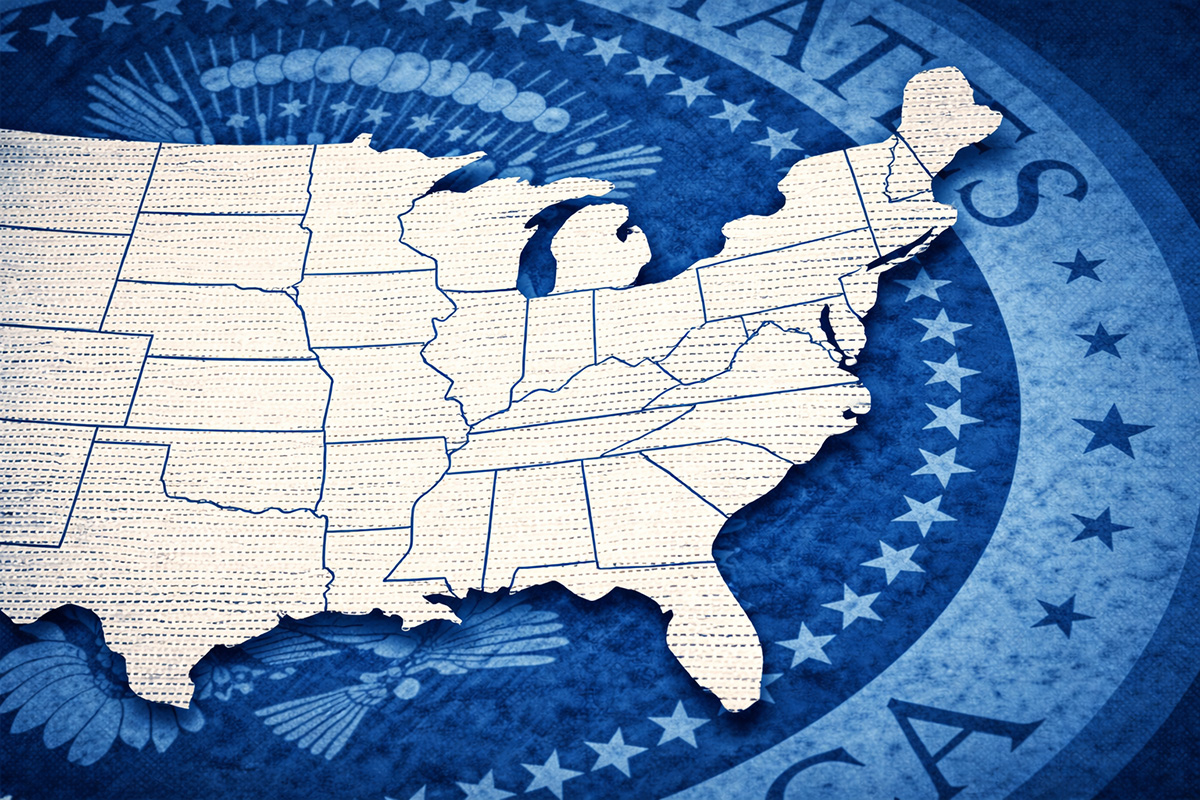
We live in interesting times. Although, whether we are cursed to be is a debate for another time.
The new US National Security Strategy (NSS), published in December last year, signals that, for the White House, our shared endeavour has ended. That much of what the world has taken for granted about America’s role in it is over. And, in some ways, the rest of the Western alliance has only ourselves to blame for that.
This article is the opinion of the author and not necessarily that of the UK Defence Journal. If you would like to submit your own article on this topic or any other, please see our submission guidelines.
The review refers to the ‘so-called “rules-based international order”’. By putting the phrase in quotation marks, the intention is clear. It delegitimises and negates its value.
In many ways, Vice-President JD Vance had flagged the way things were going as early as February 2025, when he spoke at the Munich Security Conference. There he argued, forcefully (albeit unconvincingly), that the real threat to Europe did not come from Russia, but from within. From those censoring free speech and suppressing political opposition (for this, read suppressing ‘nationalist’ politicians). All of which undermined the vision of European democracy that the US has, even if we have a different perspective. Capping it all was his criticism of the ‘leftist liberal network’, parroting the use of that phrase in the US as a term of abuse.
He also criticised the multilateral organisations that have, effectively, kept the world the safest it has been since the end of the Second World War. An order which, incidentally, has been central to US policy goals and desires. Look at the role of the United Nations (UN) and NATO in Afghanistan and Iraq, for example.
He made the US’s disdain for such organisations crystal clear:
‘The world’s fundamental political unit is and will remain the nation-state … We stand for the sovereign rights of nations, against the sovereignty-sapping incursions of the most intrusive transnational organisations…’
It was an astounding attack on the US’s oldest allies. Maybe we did not quite believe it at the time, and maybe we failed to see what it foretold. Finally, the NSS got to the crux of what is clearly now the Trump Administration’s fundamental belief:
‘The outsized influence of larger, richer, and stronger nations is a timeless truth of international relations.’
Or, in simpler language all of us can better understand: ‘Might is Right.’
What does this mean for the West, for Europe, and for the UK? What we are seeing is a return to an earlier era, a pre-Second World War era.
The period since 1945 has been one of unparalleled growth and prosperity for most of the world. It has seen more resources committed to economic development rather than military development, leading to inventions that we could only dream of, at a speed which is sometimes beyond belief. I am 54 years of age, yet I was born in the pre-Internet era. And yet look where we have come from then.
Part of the reason why that speed of development was possible was the focus on economies. No, we did not stop spending money on defence, especially in the Cold War period (and there is a very strong argument that we should have spent more since then. President Trump is right about that). But the relative peace of the period allowed more resources to focus on peaceful developments.
In retrospect, we were only living in a temporary age of American leadership, benevolence, and support. It was clearly an aberration, and recent US policy shifts, linked to President Trump, have seen us revert to an earlier age. An earlier age of imperialism, threats, and cajoling. President Trump has returned us to that era, one which we thought we had left behind. Sadly, that was not the case.
One only needs to look at the US approach to the Caribbean, where it plucked Nicolas Maduro from Caracas in an audacious military operation. That, plus its actions in restricting visas to several Caribbean countries, are examples of a Monroe Doctrine 2.0 (or the Donroe Doctrine, as some are calling it).
The US always was resentful of UK influence in the region. It is why it supported Venezuela in the 1890s when it claimed two-thirds of the territory of the then British Guiana (now Guyana). This led to a border agreed by treaty in 1899, a treaty which Venezuela now claims is ‘null and void’, but which, for the moment at least, the US says it supports.
Even in some of our darkest days at the start of the Second World War, when the UK stood alone against the Nazis, the US forced every concession out of the UK, ensuring access and oversight within UK territories in the Caribbean in return for Lend-Lease support.
Or consider US language about Greenland, a country which falls under the NATO defence umbrella, but which President Trump has said the US must have at all costs, and that he is considering any means to get it, including, he provocatively announces, military force.
The UK, and many of our allies, have always assumed the US would be there and on the side of right. That meant we became complacent and lazy. And now we are reaping the consequences of that.
One thing President Trump has been completely right about has been the failure of the rest of NATO to spend what it should on defence since the end of the Cold War. We blithely assumed the US would always be there. That they would pick up the slack of our failures. We are now living with the consequences of that. Our eyes have been truly opened. At least that is one silver lining.
So what do we do?
Well, President Trump and his Administration seem to think they hold all the cards and that they can do whatever they want without question. Hitler no doubt thought the same when we acquiesced in his takeover of Austria and Czechoslovakia. Yet he was surprised when we went to war over Poland. He had gone too far.
I am not saying we will go to war with the US, far from it. What I am saying, however, is that we will get to a point where we say ‘enough is enough’, where we draw a line in the sand, where we remind the US of the debt we hold, and the economic consequences us dumping that would have, and of the significance and importance of US bases in Europe. We are at that point now.
President Trump only respects strength. We must therefore stand strong and stand for what is right. Show the President that we mean business and that there are limits. And figure out, between us all, what that means.







I am confused by this article, you blame Europe for the rise of Trump and America isolationism, as somehow EU nations spending less than 2% of defence is the reason that the Democrats lost and the Republican Party imploded.
Then you want us to threaten America with pulling its debts to keep it providing European security guarantees.
It’s pretty incoherent.
Nothing changes. We lived in world where we played along with America’s rules because we had to. Before that the world largely played along with British rules. Now that the US is a declining power they have given up enforcing those rules. At some point in the future we may have to play along with the CCPs rules. It’s a mistake to think that the US led order was any different to any other, except perhaps that it was both hard power and the ’empire of the mind’ as Churchill put it. Belief in the US led order means that a person is still a subject of the US ’empire of the mind’. The UK is amazingly the second largest owner of US debt after Japan. I think we own about $900 billion. I’m guessing that’s in commercial banks in the City of London, so its not something the government could use as a bargaining chip. If the US decided not to pay its debts that would probably be the end of the City of London as we know it.
European Nato long ago stopped doing what they needed to do. Its way past time America said enoughs enough. Every single person on this site knows the situation with our own defence in this country for the last 30 years. America has every right to react as they have. Its time for us to shit or get off the pot. You cant run a first rate military on fresh air.
surely with respect, the British government [all of them] should get of its lazy back side, and bring our military back up to scratch, re-arm until we can defend these islands ourselves without help, thus having allies when you need them, and vis versa. instead of of us depending on others for our full defence.
but with left leaning and net zero robbery, stammer and the Chinese takeaway we have no chance. ? apparently stammer is actively considering entering this defence pact with the all mighty EU. god help us.
just my humble opinion , feel .I could be totally wrong.?
Pax America caused great wealth and peace ( in Europe). Now, with out it, UK and Germany is in recession and France almost. The military spending of 5% is a drain on the normal economy but a blessing for the war economy. It is money that no one has, it is added to the nation’s debt. The back breaking Pentagon budgets at 1.5 trillion and many other Extravagant spending is causing Wall Street to refer to it as the debasement trade. The rest of the world, especially the BRICS, are buying less Treasuries but instead buying tons of gold. UK, Japan, Cayman Island and the Fed Reserve must increase the purchase of Treasuries. So, keep watching gold blow pass 4000 and go up to 7000 as 0ld Donnie takes his National debt to 40 T next year.
I thought the Internet was originally a US military invention?
Britain has already regressed to an era where “might makes right”, which can be seen in its violation of its own laws. We dress it up in black humour and British sarcasm but the truth is that gross injustice happens every day on the streets of Britain. Why worry about upholding the “rules-based international order” when you can’t even uphold the rules-based national order? So save your moralising about the US, Mr Quinn. Why beholdest thou the mote that is in thy brother’s eye, but considerest not the beam that is in thine own eye?
Sort your own borders out, mate. Then talk about what the US is doing.
G Quinn, you are right about Stand strong, Stand for what is right. PM Carney says the same. UK and the rest of the world must not cave in to the imperial demands of the old senior. He and his Maga also wants the US society to be more like the 1930s where white males ruled, others had no rights. Just like the Confederate era.
What a load of BS
That might have been one of the dumbest articles I’ve ever read..