

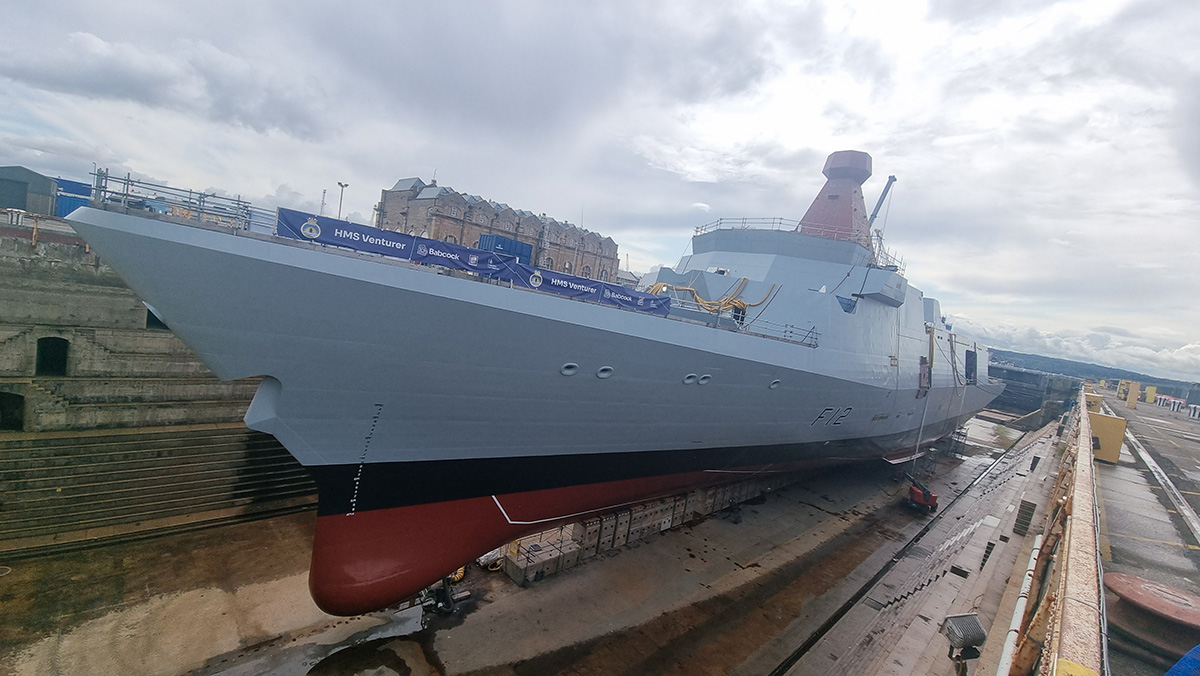
The Type 31 frigate programme continues to face schedule challenges linked to its ambitious build timeline and the integration, testing and assurance of ship systems, the Ministry of Defence has said.
Defence Minister Luke Pollard set out the position in response to a written parliamentary question from Conservative MP Ben Obese-Jecty, who asked what challenges remained following references in the National Infrastructure and Service Transformation Authority’s Major Projects Annual Report 2025 to 2026.
Pollard said the MOD was continuing to work with Babcock, the prime contractor for the five-ship Type 31 programme, to keep the build aligned with Royal Navy requirements and the planned delivery timetable.
He said: “The Ministry of Defence (MOD) continues to work closely with Babcock, the prime contractor, to ensure the Type 31 programme meets all user requirements to deliver a maritime security capability at a value for money price, in a timescale that is competitive with other international warship procurement programmes.”
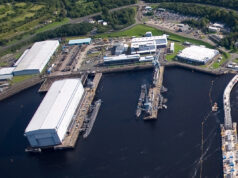
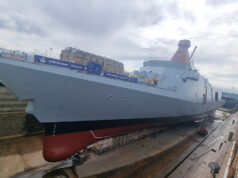
The programme is based around an intentionally fast build schedule, with Babcock constructing the frigates at Rosyth using a repeatable production approach intended to support a steady flow of ships through assembly, integration and completion.
Pollard added: “Challenges can be expected when delivering a complex warship against an ambitious build timeline. Working closely with Babcock enables us to resolve any issues that may arise, alongside maturing the design and progressing construction, ensuring the build programme is stable and repeatable going forward.”
The minister also pointed to the complexity of bringing together the ship’s combat, communications, navigation, propulsion and other onboard systems while keeping testing and assurance aligned with the wider programme schedule. He added: “The complex nature of this work can present challenges, however all activities are subject to ongoing oversight by the MOD to ensure successful delivery to the RN.”
Readers should note that this answer does not identify a specific new delay or single integration issue affecting the programme, but confirms that schedule pressure remains tied to an ambitious construction plan and the need to complete ship-system integration, testing and assurance without disrupting the pathway into Royal Navy service.
Type 31 is intended to provide the Royal Navy with five general-purpose frigates, replacing part of the Type 23 fleet and increasing the number of modern surface combatants available for maritime security, presence and other tasks. The ships are being built by Babcock at Rosyth, with the programme also intended to demonstrate a more repeatable approach to warship production that can support future export opportunities and maintain shipbuilding activity across the yard.


T31….“a maritime security capability at a value for money price”. Sheer poetry 😂
An accurate description if there ever was one.
On the one hand there is something to be said for Lidl ships to increase mass. On the other hand will always be a case of polishing tyurds if not prepared to pay the bigger monies.
Not to say expensive ALWAYS equates to quality (… veeerryyyy easy to spend a lot of cash on a Mr. Hankey). It’s just you are limiting yourself from the off if not prepared to pay and/or buy the ‘correct’ equiptment in the first place.
But yes. There is value to be found in the T31s I guess – even if they are cheap. Moreso than I probably initially estimated.
A budget ship might work for some customers even if it is a compromise.
Having a few more of these ships might help enormously too. More availability more presence possible. Might complement the ATSs nicely too. Five seems a very lean figure even of its based on the past number of GPs.
Any further news on Denmark or New Zealand? And out of curiosity did the UK offered this design to the USN for their light frigate program?
Soo… how these improve the ASW bastion concept without even a sonar?
Not their purpose as well you know.
I suspect the lack of a sonar will bite them. Just how long is it going to be before cheap sub drones are becoming the norm and these ships become a sitting duck. Drug smugglers from South America are already using drone subs after all.
Dedicated platforms only work if you have large numbers of ships to have them working in fleets or pairs. Doesn’t work when the ships will have to spend their entire service life operating alone.
Oh I don’t think it having sonar will be an issue at all.
I doubt they will ever get sonar. Might need a few extra bits and pieces to adapt but I suspect that will be nothing too serious.
“Not their purpose as well you know.”
I never understood their military propose. It do not make any sense.
I suspect that the original propose for the T31 was politics. It was for RN say to the politicians that it has 13 frigates instead of 8, so they cannot go lower.
This “plan” was somewhat thrown out when the drone navy appeared but the number of hulls to stick to politicians still matter.
The military purpose is to get something big, cheap and expandable. Then to expand it. It’s a statement of faith in the future. If they just wanted a patrol frigate, they’d have selected the smaller Leander.
Some claim the other purpose was to keep BAE honest when it came to the price of the second batch of Type 26s. I don’t rate that explanation particularly.
There is nothing expendable in a Royal Navy frigate. That do not happen in Democracy and even with some Dictatorships. For example a River is also not expendable. It would need a war for survival for that to be considered valid.
My opinion is they went for the cheapest frigate possible to have more hulls and then stick to politicians next time replacement will be 1:1.
Expandable (ie can be expanded to fit new roles) not expendable (can b thrown away).
Oh, my mistake. You are correct, thank you and apologies to Jon.
It’s always somewhat amazing to me when people don’t get the concept of a high-low mix, which is extremely common in Navies all around the world.
There is definitely an element of truth with your last paragraph. The MOD’s view of BAES is that are overpriced and think of the MOD as a cash cow. Which I feel is the main reason that the Ascod2 was chosen over the CV90 for the Ajax program. As it had to be anything but BAES made. Bringing Babcock into the picture has been a good move, as like you said it is making BAES more honest. They had next to no funding for infrastructure or training in place for the T26 program. Yet as soon as Babcock started building their build hall in Rosyth, BAES sank a load of funding it to Glasgow. The amalgamation and sucking up of British defence industry into one conglomerate, has led to BAES becoming complacent, as they were the only gig in town. Bringing competition into the market has started to change that complacency.
‘The military purpose is to get something big, cheap and expandale. Then to expand it.’
I think that statement sums up what the T31 is all about. The RN needs a much larger number of capable, war-fighting frigates, not ‘patrol frigates’ or ‘light frigates’ that would be of limited use in a peer war. But the naval budget could never stretch to a full, fat GP frigate, while simultaneously building a class of £1bn T26 ships. So the Navy has done the sensible thing of building a large hull that can accommodate the installation of additional or alternative weapons and sensors in the future, if the money can be squeezed out to do so.
What else could they do? Pre- and post-rationalisation stuff about patrol frigates is just a recognition of the realities of what you get for under £400m. The main flaw is not having a hull-mounted AESA sonar for ASW duties, which reduces its combat value and makes it vulnerable. It would be an expensive can-opening job to install retrospectively.
The right answer would be to follow the T31s with an upgraded version – let’s call it a T32 Boris class – with a good ASW capability, so rafted engines, sound reduction measures, hull-mounted sonar and TAS. Then put the T31s in the mothership role to control all these whizzy unmanned thingys.
There is a role for a modern light/patrol vessel and it lies in a well-armed corvette, rather than an OPV with a pop gun. Along the lines of the 3,000 tonne EPC being planned, but with a capable SAM, ASW and anti-ship weapons fit out. Nothing too fancy, but enough to handle the constabulary role but also act as a wartime escort if required. It is time that the RN got over its aversion to corvettes, which they fear would be counted as frigates by the men in pinstriped suits. A frigate is a major warship. A corvette, like an OPV or MHC, is a minor warship. Even the folks round the CDS or Treasury tables can be encouraged to understand that.
You seem consistent with the politics angle. In fact it seems like your only angle. The actual answer is more obvious.
Which is?
A Diplomatic Frigate? that is the only other option?
Originally to cost £250 million each as opposed to the £1billion a type 26 was costing…. That’s your answer….
AlexS,
Always assumed this would be a significant deficiency of the class, however, may ultimately be compelled to revise opinion. There is at least a theoretical possibility of development of viable, autonomous ASW systems during the next decade, perhaps under the auspices of AUKUS Pillar 2. Stranger things have occured before in history. 🤔🤞
Not a dig at you but your ‘new’ frigates are going to be bullet magnets and the US can afford to equip them properly.
We do things on the cheap – not. These ships are underarmed and not equipped for the 21st Century but your new frigates are going to be appalling.
DW,
Absolutely agree w/ your assessment. Have been advocate for USN acquisition of the River Class for several years. Unfortunately, relationship significantly strained w/ northern neighbor until at least Jan 20, 2029. Extremely doubtful Canadians are in the mood to assist USN w/ possible design/build of a truly impressive class during the interim. Another near term opportunity for pan-NATO co-operation squandered. Meanwhile, the CRINKs celebrate internal NATO disputes and dissension. 🤔🙄
I would suggest Carney is too cultured to make a distinction between Dumf and the American people.
To boot, Canadians would not spurn the US and the US would get another shipyard (or more), within 5 eyes, that would increase their production capacity and alleviate the shortage of labour in US shipyards and give them excellent ships.
Just needs a President with leadership ability and not a convict.
FormerUSAF, too green tech, i doubt that will be possible and the underwater communication issue is still a problem, besides speed.
I also do not understand how that is related to the T31, as mother ships? they have no space for that.
AlexS,
Understand the scepticism re timeline for autonomous ASW, but remain convinced Pillar 2 will begin yielding benefits more quickly than most observers appreciate. Combination of AI/Autonomy, Quantum Tech and especially “Undersea Capabilities” (writ large) coordinating trilateral AURAS research initiatives will ultimately yield impressive results. Will T-31 ever become a an ASW asset equivalent to T-26? Possibly/probably not, but it may transition from being passive prey for CRINK SSNs, into at least a marginal predator. That would be distinctly beneficial for both singular patrol and potential convoy duties.
Re organic support facilities, won’t the T-31 have 3 boat bays capable of deploying USVs/UUVs?
Even additional 1-2 T26s and a few more P8s might be worth it at this time for projecting real presence and supporting helo/uav ops. More above and surface platforms to support on and below surface including drones. How many drones do they truly need for Atlantic Bastion? No need to answer (lol). I wish they’d get out of this “19 ship box” fleet size and get more strength in real ship numbers, then add drones.
Or put together five decent sets of the hull mounted sonars from the retiring Type-23s. It may not be good enough for a class leading ASW frigate now but it will still be more than adequate for a GP frigate.
Pointless exercise and expense. Type 31 is not designed with a quiet hull for subhunting. Their own noise will drown out the much weaker sounds they would be listening for. Their best hope is to be paired with drone units carrying sonar that can operate at a distance from the host in less noise polluted waters.
I am aware, but that didn’t stop them putting a bow mounted sonar on the Type-45s and they are supposedly very noisy. I agree that a USV with a thin line array or possibly even two of them would be a better combination but that is more expense there than recycling the bow mounted units from the Typ-23s. Of course we could always do both. The Type-31 can be fitted with a bow mounted sonar, we just chose not to. It will probably be interesting to see just how much noisier an un-silenced Type-31 is compared to a now very old tech Type-23 that was built for silence. Neither I suspect will be anywhere near as quiet as Type-26 but I have a feeling that the Type-31 might surprise people.
I have no doubt the Type 31 will be quieter than the older Iver Huitfeldts, as engines get quieter over time, but Type 23 is a CODLAG, with isolated diesel engines. I can’t see CODAD T31 comparing. The mechanical gearbox will be far worse and it’ll probably have noisy variable pitch propellers.
A more interesting noise comparison will be T31 against a post-PIP T45 running on diesel. T45 pre-PIP was notoriously noisy, but with new Rolls Royce diesels, I think that might no longer be the case.
Did they take the opportunity to raft the PIP RR Diesels?
@Jonno I don’t know. That’s why it would be an interesting comparison. It’s unlikely they’d have gone for a full acoustic lock-down — I think we’d have heard (no pun intended) — but I believe new MTU 4000 engines typically come with an inbuilt level of rafting and engines aren’t just bolted to the deck. What’s more they can come with their own acoustic housing. The question is, what standard did the RN go for? They were fixing the propulsion. Would they have spent even an extra penny on maximising the use of the T45’s IEP to make the ship more quiet too? My gut feel is they’d have gone with a smaller level of isolation rather than the MTU “double resilient” mounting.
An interesting comparison is with T31s cousin, the Polish Wicher class. As they will be using the same CODAD propulsion arrangement, along with variable pitch propellers. Yet are fitted with a bow sonar along with the CAPTAS 2 towed array. So if they have the same propulsive arrangement as the T31. How will they be an effective ASW asset? I have yet to read whether the gensets, gearboxes etc will be rafted, but I suspect they won’t be. As they’d looking to keep costs down as per the T31.
The base Iver Huitfeldt uses the same CODAD arrangement, yet also comes fitted with a hull mounted sonar. Which it itself based off the Absolon class, that Denmark rebadged as ASW frigates. Where they have a hull mounted sonar along with a towed array sonar, again using the CODAD arrangement. Have they rafted the engines etc for the Absolons, I have my doubts.
Will the Absolon be as effective as a T23, again I very much doubt, but will it be good enough? So if it is good enough, could our T31s also be retrofitted with a tail and hull mounted sonar, to make them good enough?
Two things – (a) The Sonar on the Type 45 is very basic,and has been Inactive for some time now AFAIK.(2) The Type 45’s Noise Levels seem to be a subject of differing opinions,some say they are in ‘Bags of Spanners’ territory,some say they are OK,post PIP there is no reason they should not be quite discreet when Sailing.
19 ships was a con idea several years ago. IIRC 32 was always the number needed for the tasks and availability, just as 12 nukes was a number proffered for many years and yet – they were supplemented by Oberons but today, our contributors will rubbish the idea of diesel boats.
Of course, money is the current issue and there isn’t any; Burnham had a point that we need a strong society to create a strong defence, unfortunately spaffing money on any and every welfare cause is just draining money that the country can ill afford and then there is the NHS which is just burning money as the nurses, porters et al walk along the hall ways and the supervisors manage them and the managers manage the supervisors ad infinitum.
The country needs a reset but can not bring itself to reset – I will lose money! Was life always about money – the xbox, the Iplugs, the car, the brands must have for my children and myself, the social life, and the ”I have to take my kids out to eat once per week” (Politics on Sunday, this morning) – I can remember chicken once per month, having a bicycle, walking and talking.
Has life got better?
Without Defence, we are shafted and the electronics bereft of electricity, the brands meaningless and get used to eating grass – how will we cope?
Heard but on the money point, Pensions are I believe part of the biggest benefits too. And I note that private companies are benefiting from a subsidised workforce in the UK because more and more of their workforce are also on benefits just to survive. So cost of living and salaries private companies provide are an issue — while I get your point and back it in principle — that’s the annoying grey we have to contend with.
I was speaking with a builder, our boys on average aren’t taking up the crafts we need at high enough rates. Recent report on our boys poor performance in school, we deffo need a strong society for what you want but we should be clear eyed on our arguments and the real underlying impacts that create bottle necks system wide so we can get where we want to be
TLDR; While our benefits bill is absolutely worth focus, I don’t believe that’s the biggest expense or impact. I suspect we’d need a mix of reducing cost of living and potentially reshoring parts of many industries we have offshored previously for the benefit of recapitalisation in a national sense, meaning companies should be expected to do more with the benefit of a more resilient long term base ensuring their profits (and tax) and protected long term. Because these multinational and private companies benefit invest here for more reasons beyond how much tax they pay in the short term (our corporate tax rates are still very competitive – especially regionally – which is highly relevant for what our power base really is)
It’s an interesting and quite deep topic imo that is relevant for us militarily. Just some food for thought
It depends..
Couple of ways..
1) actually get the T9x ASW drones built.. then it becomes a sensor and processing command hub.. but a Merlin in hanger and a ASW airborne torpedo drone or some rocket delivered torpedoes and it becomes the home of the ASW strike capability..
2) pair it with a T26 or T23 as an ASW surface action group and it gives an extra large flight deck and hanger for another Merlin as well as providing more AAW survival and ASuW capabilities.
3) if it’s part of a CBG it does the same as 2…
In the end not every ship needs to be an ASW asset.. a good number of the Burkes are completely pointless ASW assets as well.. not having a towed array or a hanger for another ASW helicopter and being exceptionally loud.
I was very sceptical about T31 from the start and still think a bit more money spent on basic quietening and a half-decent sonar, or at least a FFBNW space for one would have been well spent but… Times are changing. If we are going to have multiple uncrewed vessels with sonar operating in the area then having a ship that can operate a Merlin and/or some ASW UAVs and will have a Mk.41 VLS that could launch a UK/European ASROC/Ikara successor would be very useful. I appreciate ‘If’ and ‘could’ acre doing a lot there.
Using this strategy is the best way forward. What is under scrutiny is the method of driving faster, quality production in quantity.
There will be problems along the way but they will learn with each issue.
The key indicator will be not the initial speed of production of the first ships but the increase in speed of subsequent ships.
Ideally they should be able to perfect the whole process producing ships in months rather than years.
In the 1960s and 70s we were building LEANDER class GP frigates at a rate of one every 18 months , seem like no one in the UK knows how to build ships any more
If you ever went aboard those you’d understand why: they were simple ships. Wired and plumbed like a house: very little systems redundancy.
Simple systems that could be fixed at sea.
False.
Japan Mogami frigate Oct 2019 laid, Apr 2022 commissioned
FREMM EVO for Portugal 2026 order, 2030 commissioned – this one will be interesting to follow if they can achieve that.
And does Mogami have a dual redundancy?
I’ll save you looking it up: it doesn’t.
Yeah, Mogami is famously a fragile ship.
Haha
So the T31 was built to a price rather than to a specification and initially will always compare poorly with a ‘full, fat frigate’. For what it’s worth I think there is still a valid need for the original patrol ( maritime security) frigate version; effective constabulary and a more credible deterrent presence than a River 2. I also think that the RN had a good idea budgets would be tight and made a very smart move to base T31 on the Arrowhead 140 hull. It’s growth potential makes T31 a more attractive export offering; e.g. Poland, Indonesia and probably Denmark. And it makes it a good option for the CCV to ‘replace’ T45. Smart decision. Not saying you shouldn’t upgrade them…Captas, NSM and more Ceptors make a credible budget warship. Very flexible hull – add a side loading door, Mexflote, lift to flight deck and you recreate Absalon – a lot more useful for NZ than a Mogami?
The length of time it will take to build one of the ‘toy navy ‘ ships will probably be, depending on size, maybe the same time as producing the hull of a T31. The whole ‘toy navy” idea is ridiculous. These toy’s decisions will be made from a porta cabin in North woods car park
I think these Mogamis and french frigate designs maybe a bit over hyped being a bit too compact . I think the T31 has much more potential for future upgrades and flexibility at a much quicker pace in the future. Unfortunately the uk T31 will not be at their best because of uk very poor budget constraints . But a nation with money can do a great jib on them . If there was ever an upgrade for a future batch of shios . The t31 worth building on . New diesal electric engine config and an improvement on asw config and suddenly the T31 becomes an excellent design for however one would like to configure it
Which is why I was surprised to find both the Polish and Indonesian versions still keep the original CODAD arrangement. Poland and Indonesia are fitting their ships with either 32 cell strike length VLS, or 64 respectfully. However, both ships will also be getting a hull mounted sonar, along with a towed array. So it shows what the T31 could become. Both country’s ships are keeping the CODAD, so it must be good enough. The question is how good?
On subject of the T45 it puzzles me why towards the end of their lives, we don’t have what is basically a reserve squadron for the 200 miles EEZ and to cover the dockyards etc. rather than sell them all to Brazil.
Good idea. Sadly its all down to money…same reason we are disposing of Typhoon T1, old Chinooks, army Wildcats. It’s like an old car, there comes a point where the repairs and servicing are more than a new car….depending on the finance deal of course.
The Danes designe, configured and operates the design and are more than happy with the layout and configuration of the huitveldt ships are they wrong g ? Or is it us the armchair MO that is wrong?
Exactly. The Arrowhead decision has given the RN real options versus the alternatives that were on offer at the time, which were stretched OPVs and corvettes or untried frigate designs. Compare our situation with the US Legend class ‘frigate’.
They don’t really deliver any capability. No sonar. Missiles for self defence only. They float and move. That’s about it. They are cheap because they can’t do anything.
They are getting nsm missiles and mk41 silos so you are wrong there.
The first two ships will be FFBNW until the early 2030s
Yes, maybe even the 3rd ship too. Anyone expecting them to hastily retrofit the missing capabilities simply don’t know how the slow MoD is. That was just a rumor that Navy Lookout started but it wasn’t confirmed.
Type 45 are still missing their anti-ship missiles despite being promised NSM back in 2023. 5 Type 23 were supposed to received NSM too, but only 3 did and Richmond got retired since then (just a year after receiving NSM, what a waste of money) so only 2 frigates are equipped with them.
Or there’s the Sea Ceptor upgrade for Type 45 announced in 2022: only one ship (Defender) is equipped and it’s still not operational yet.
But even CAMM has a anti-surface capability.
With a 10kg warhead and 25km range its not ideal for that role.
Modern enemy ships are more likely to have a much longer reach and a bigger punch.
It’s still a guided weapon with a surface attack role and slamming into a target at Mach 3 does dump a lot of kinetic energy into something, enough to mission kill it.
If you can reach the target. You would have to get within 25Km of it.
Most frigates and destroyers would have detected you and fired volleys of their longer-ranged weapons before you even got close.
The RN version of the Type 31 will initially not be fit for peer to peer surface engagements against other Frigates and Destroyers. And how they are supposed to detect and defend against saturated subsurface attacks, who knows?
MOD/RN/Treasury has cheaped out again.
Compare the weapons/senso fitout of the Indonesian and Polish versions.
Again, always amazing how people don’t seem to grasp a high-low mix.
Remind me, besides the Type 31’s what does the Polish Navy consist of?
T31 has always been intended as a low end, patrol frigate, ala OHP class.
It’s not my fault if you are stubbornly refusing to understand that budgets are a thing that navies have to plan for and overall force structures give context.
I think the concept of ‘patrol frigate’ is flawed and a cop out of spending money on giving these ships the capability they need to be a serious deterrent.
Why do you need something the size of the Type 31 just for patrol duties?
If it is a Frigate, then arm it like a Frigate, Geez there are 1800 -2500 ton corvettes that will be better armed.
Huh guess every Navy in the world is wrong and BoF has it right. There’s absolutely no reason to have a lighter version of fleet assets to operate in comparatively low risk areas and hold down important tasks while the expensive fleet unit’s focus on the main combat roles.
Boy guess the RN had it wrong for, *checks notes* it’s entire history.
And yes, there are corvettes that are better armed. I suggest you think about what the job of a corvette is. Hint: it’s a very different job from a patrol frigate.
Type 31 is defined as a general purpose frigate
here:
https: //des.mod.uk/what-we-do/navy-procurement-support/type-31
quote:
“The five T31s are replacing the five general purpose T23 frigates as they come out of service. They are specifically designed to fulfil a general-purpose role,”
Nice try to shift your goalposts except if you knew what you where talking about you’d know that a GP Frigate is what the RN calls a Patrol Frigate.
“a GP Frigate is what the RN calls a Patrol Frigate.”
What a load of BS …. I provided you with a link from the MOD, stating the T31 is a GP Frigate, and you still want to argue the toss.
You just like trolling ….. look how many other threads you are shoving your opinions into, and what’s more, you enjoy insulting an belitting anyone who dares disagree with you.
So is English just not your native language? Because I didn’t disagree with the link, and am happy to accept that the Royal Navy describes the Type 31 as a General Purpose frigate. Personally I prefer the term Patrol Frigate for the same role because it’s more clear and people generally understand it better.
Sorry you got upset that I pointed out that you randomly lurched your goal posts to GP frigate instead of the subject in hand, but it’s not my fault you got your panties in a twist.
Btw last I checked this is a comment section that I’m allowed to comment on wherever I choose. Don’t like it, your free to mind your own buisness, but if you can only deal with being shown to be wrong by crying troll then again, that’s your problem. Grow up.
No most frigates and destroyers would not.. the likely radar horizon for two frigates is about 25km.. so they will see each other at about the time CAMM will be in range.. there is a reason that the RN was happy with its 1970s and 1980s frigate heavy ASM having only a range of 25 miles…. Because it was well beyond the radar horizon of Russian surface vessels.
There is very little information on how CAMM will be used to attack a target. My presumption is that it will do so quasi-ballistically rather than a cruise missile like profile. As the weapon won’t do a lot of steering corrections, it should reach further than its published range, especially when used ballistically. It would be interesting to see the damage CAMM could inflict on a ship, when its diving down on to the target at Mach 3+, even if it has a piddly warhead and will be weighing less than 99kg (after burning off its fuel) when it started, its going to do a lot of damage to unarmoured target?
“maritime security capability at a value for money price” = e facto OPV
Can you name any OPV’s with a SAM VLS and SSGWs?
Yes, HMS Venturer and HMS Active. Both will enter service witout those things you mention.
Type 31 frigates will get those only after 2030, mark my words.
Wow, okay so basic English is beyond you it seems.
1) You saying “I think the T31’s are OPVs” and me challenging you to name some OPVs with SAM VLS’s you can’t then say “the Type 31’s”
2) Venturer and Active are both entering service with a SAM VLS and SSGW, it’s just proprietary CAMM modules, not Mk41.
“Venturer and Active are both entering service with a SAM VLS and SSGW”
Prove it with official sources, not hearsay.
Until then, they’re OPVs whether you accept it or not.
https: //www .mbda-systems. com/sea-ceptor-protect-royal-navys-new-type-31-frigates
Here is MBDA announcing signed contract for T31 getting CAMM.
https: //www .navylookout. com/a-guide-to-the-type-31-frigate/
Here is Navy Lookout describing the initial fit out of the Type 31 as having a CAMM VLS until a later Mk41 insertion when refits happen.
https :// ukdefencejournal. org. uk/what-weapons-will-be-fitted-to-the-type-31-frigate/ here is UKDJ reporting on a written answer to Parliament by the then minister for defence procurement stating that T31 will be built with CAMM missile systems.
The plan, if you’d have been paying attention, has always been to launch the T31’s with a CAMM VLS farm, you are getting your knickers in a twist because you are thinking that without the Mk41 insertion there will be no missiles, and that it won’t be possible to have any without it, which is not the case. The core weapon fit out that the RN put out to industry back in 2017 was for a ship armed with a Medium caliber gun (57mm), close in weapons systems (40mm’s) and a defensive missile armament (CAMM/Sea Ceptor), with options for heavy Anti-Shipping missiles and a 76mm+ gun. That has never changed. Sorry you haven’t paid attention to the procurement process for these ships over the last 10 years but some of us have.
Well, not really. T31 is 2-3 times the displacement and crew and nigh on twice the length, capacity and endurance of a typical OPV, say something like the Protector class. Typical OPVs don’t normally carry a MCG capable of firing programmable ammunition, local area AAW missiles, SSTD and a Chinook sized flight deck. Neither do they typically have the range and speed to keep pace with a carrier task group or the ability to host and insert several dozen RM. It’s hard to put T31 into a standard warship category. I see it as the UK equivalent of Italy’s new PPX idea – a basic hull that you can relatively turn into what you need fairly cheaply by adding weapons as technology develops over the lifetime if the ship.
Tbf it’s not really hard to put T31 into a category, it’s a light patrol frigate.
Well, yes, I suppose so, at least in its inaugural incarnation. Perhaps global light patrol frigate. I wonder if what the US, as the other global power needs is a global ‘heavy’ patrol frigate. 🙂
The US had an amazing Patrol Frigate, it was so good there’s a few floating about now. It had a mix of 40 SM-1’s and Harpoons in it’s magazine, a 76mm and a CIWS, and a 5,000nm range for a price point low enough that the USN bought 70 of them. But they sold them or scrapped them all between the late 90’s and 2015, and every attempt to replace them has been a failure so far.
Maybe that’s thinking with the Legend initiative. Back to the future.
I mean that was the objective with the LCS, Constellation, Legend…. They’ve all tried to replicate the low end Patrol Frigate that was the OHP class, but LCS had their very, very long list of issues and arguably a flawed concept from the word “go”, Constellation grew into a mini-Burke, and Legend is at the moment an over correction as the USN now just needs cheap hulls in the water, and the baseline Legend makes the Inspirations look heavily armed.
Germaine comparison. The Polish T31 which has flat face main radar and TSA is replacing their OHP frigates. Pity there wasn’t one in service when the Constellation was chosen.
Yeah, patrol frigate is far and away the best term for it. Something equivalent to the French Lafayettes.
I think it has potential for having future hypersonics like the Russians; at which point it has considerable potential as a strike Frigate.
MOD says T31 is a general purpose Frigate
https: //des.mod.uk/what-we-do/navy-procurement-support/type-31
Different words for the same thing.
Is it really?
You strongly argue it’s ok to commission these ships without NSM and MK 41 VLS, because they are only ‘Patrol frigates’ and not GP frigates, and therefore won’t be expected to get into combat with other Frigates and Destroyers.
Please point out where I said “They are Patrol Frigates not GP Frigates.”
I said “GP Frigate is what the Royal Navy calls a Patrol Frigate.” Maybe try actually reading what I write instead of getting butt hurt and inserting your own fantasy?
You do understand that different organisations use different words for the same thing right? This isn’t a difficult concept.
Again, from the Royal Navy website:
“the Type 31 general purpose frigate will undertake missions such as interception and disruption of those using the sea for unlawful purposes, intelligence gathering, defence engagement and providing humanitarian support.”
Which is essentially what a Patrol Frigate does.
So a glorified OPV.
There aren’t any “local area AAW missiles” yet. They will come later but won’t be availabke when the class enters service. I see what you mean about the PPX but I don’t think the comparison is adequate. The problem is that the RN needs to bridge the gap between the inadequately armed River-class Batch 2 and and the Type 26. Hence the Type 31.
But their reasoning is flawed. From the very beginning (so not influenced by the current geopolitics), the Type 31 should have been a GP frigate similar to the Italian PPA light+ (Thaon di Revel-class) so with AAW, ASuW and ASW capabilites (but not as developed as specialied destroyers and ASW frigates) while a Batch 3 River-class should have been built with similar capabilities to the Italian PPX OPV (57mm gun, 2x 30mm RWS).
Ah and now we see why you labour under this delusion because when someone points out that they are being built with a SAM system and provides recepits you just ignore and move on. Explains a lot.
(Side note PPA Light + is equipped with with 16 Sylver A50’s for Aster, 2 medium calibre guns, 2 20mm’s and FFBNW 8x Teseo SSGW’s, and torpedo launchers, while T31 is equipped with 12 CAMM, a medium calibre gun, 2 40mm’s and FFBNW 8x NSM and a 32cell Mk41… so yeah, they are very similar. )
I don´t think you can call 127mm is a medium caliber gun in todays naval guns,
Medium Caliber is a historical designation, generally large caliber is 203mm/8in+
In context of DP guns 127 is an hvy caliber.
But if you go by naval guns historical designations then you should use 57 as a light caliber and 76 likewise. Not medium.
No, because in naval gun designations light guns are 40mm and below. 56 and 76 are both medium caliber. It’s also funny that you say “in the context of DP guns” because, as a general statement, being capable of DP roles is a defining feature of medium caliber naval guns.
So, shift your goalposts all you like, but you *VERY* much can *accurately* describe a 127mm as a medium caliber gun, because that *is* what it is classed as in the real world.
“No, because in naval gun designations light guns are 40mm and below. 56 and 76 are both medium caliber.”
That is false.
Medium caliber guns start on 4″ 102mm to 6″,
From 8″ were heavy guns,
Below 4″ they were light guns.
FYI Leonardo considers the 127 to be a medium caliber gun:
“According to Leonardo (formerly Oto Melara), the 127/64 LW – VULCANO is a state of art medium caliber gun suitable for installation on large and medium size ships and intended for surface fire and naval gunfire support as main role and anti-aircraft fire as secondary role. The compactness of the gun feeding system makes possible the installation on narrow section crafts.”
https: //www .navalnews. com/naval-news/2020/05/leonardo-confirms-selection-of-its-127mm-naval-gun-for-spains-f-110-bonifaz-class-frigates/
And although not a direct line from BAe, Navy Lookout considers their 127/5inch gun to be medium caliber too:
“Unfortunately, its calibre [4.5in] is a dead-end and does not benefit from wider advanced munition developments, while NATO is standardising on 5-inch for its medium calibre naval guns.”
https: //www.navylookout. com/in-focus-the-127mm-mk-45-gun-that-will-equip-the-type-26-frigates/
So? in naval gun historic classification 127 is a medium gun, it is the 76 and 57 there are not.
In context of today DP guns, the 127 is the heaviest gun, there is nothing bigger, so a slide in classification helps granularity. 127 heavy, 57,76 medium, 40 a bit iffy maybe light and below.
CAMM is a local area air defence system.
It’s even described as such on the RN’s website, where CAMM where the Inspirations are listed as being equipped with “This includes a ‘state of the art’ surveillance radar, high-tech electro-optic equipment and automated 57mm and 40mm gun systems that utilise programmable ammunition. The Sea Ceptor missile system provides a local area air-defence capability. ”
and then goes on to point out:
“The Type 31 Class is inherently adaptable, providing capacity to accommodate future capabilities including the planned Mk41 Vertical Launch System, which is capable of launching a variety of missile types.”
It has 12 25km+ range anti air missiles.. that’s better than a number of frigates.
“the ability to host and insert several dozen RM”
Agree with most of your comments but this one is still debatable. The B2 Rivers can carry 50 marines, and while Navy Lookout and Wikipedia imply that Type 31 can carry around 65 to 70, the Navy’s own website says the Inspiration class is being built for 40. Others say 80. We’ll have to wait and see.
Oh, what a surprise.
“alongside maturing the design” Anyone else worried by this? I thought the design was supposed to be frozen during the build: probably the best decision about the T31 process. All changes to be done as a capability insert. That doesn’t seem to be what we’ve been hearing of late.
Weren’t the later hulls meant to get the MK41 in build rather than as an insert into the early hulls?
No – Navy Lookout claimed that, but there was never any evidence, and the claim has been left out of subsequent articles.
Exactly, everyone keeps repeating that but it has never been officially confirmed.
Now Navy Lookouts is usually well informed.
I think it’s also a an internal conflation with the French FDI, which are integrating from ship three onwards.
All we know about the T31 Mk41 is that they’re funded. Other than that, nothing.
Wasn’t the original T31 ISD 2026? It seems to have slipped by a couple of years already. Have to hope that the MOD is not fiddling about with the spec or the payments schedule, for which they have form.
Originally (Nov 2015), it was 2023 for the first ship. That supposedly held even when in mid-2018 the competition was suspended and we knew it had become impossible. After contract signing in 2019, Babcock was promising first launch (in the water) by 2023 rather than in service. Not long after (Jan 2020), the in-service date officially slipped to 2027. I can’t recall a 2026 date, but it could been floated at some point.
For what it’s worth, as I recall back in 2020, we still expected the first Type 31 to come earlier in 2027 than the first Type 26, which was promised toward the end of 2027. A couple of years after that, Glasgow officially slipped to 2028, putting a full year between them.
Continuing shambles. More like 2030 before we see one in service……
It’s a shame they didn’t apply this rigorous scrutiny to the Ajax programme. A couple of years slippage esp with covid etc looks quite good against the 10? Year delay AND not even having a useable product at the end of it.
Add a Captas and NSM to it…job done.
AA
Excuses time, some thing else that has problems like most things to do with the MOD, delay, delay, phase every thing out while still awaiting a replacement. Standard form.
Yeah that’s right, you clowns monitor, where anyone competent would be acting!
They mean the schedule of when each will be sold to Brazil….
I wonder how much the slowing down of payments from the Treasury has contributed to the delays. I suspect it’s the number one factor.
I’m sure you are right. Starmer and Reeves came up £4.8b short on even the reduced DIP number. Lots reprioritisation going on. Order for SSNs delayed to 2028, T83 killed, panic cuts to army training, pushing on with scrapping Typhoon T1, older Chinooks and army Wildcats, review and re-approval of CR3 program; an overspend on the Astrae program I think. T26s and the T9x seem to be protected, as is FSS and the T45 upgrades; and apparently and we are ‘open’ to offers for 2 more E7s. My guess is that Chancellor Healey will come up with that £4.8b in the budget and we will see some orders for armoured vehicles and the Norwegian replacements for the batch 1 Rivers.
“Norwegian replacements for the batch 1 Rivers.”
Please, please, let that be true.
Bound to be a reciprocal part of the T26 deal I would have thought. Received wisdom seems to be that one or two of the B2 Rivers will replace the B1s as they are taken out of service but if they go one at a time after 2028 we might see their gradual replacement a mix of B2 Rivers and the Norwegian built ships. Recent language is non committal but the T31s should surely start to enter service after 2028
The deal is for three Norwegian-sourced vessels.
Current thinking is that these are Standard Vessels, but they could be modded OSVs.
No news on a B1 replacement, though. The Norwegian vessels are for the MCMV replacement.
The B1 replacement is the B2’s unfortunately. That was the og plan and it was just pushed back a few years.
Yeah, I thought that’d be the plan. TBF, the UK had functioned on fewer OPV and more frigates prior to the 2010s, and now we’re moving back to that, I expect that OPV numbers will settle back around 5.
Perhaps, if the geopolitical situation were as cosy at it appeared in 2005 before we sold three Type 23s to Chile, we could still be okay with 20 frigates, 12 destroyers and fewer OPVs. However, it isn’t cosy at all. Also we only have 6 destroyers and 5 frigates with that number set to fall even further over the next two years. It may be the plan to increase frigate numbers back to 13 but we are probably a full decade off reaching that, depending on the Norwegian split.
So, we are not returning to some pre-2010 norm when we sell off the B1 OPVs unnecessarily and without replacement. We are moving into whole new territory. TBF.
Thx. The larger 96m Standard rather than the inshore one?
I think in the end the number of MCMV may in the end go up, as 3 is just to few crewed vessels.
Paul.P, I think you are right on the money there. I recall we were told before the DIP that the services had to make some considerable ‘in-year savings’. Can’t remember the figure but it was several billions.
Not a surprise really, the services were pitching for an extra £27bn which, however desirable, would have meant taking an axe to the rest of government expenditure, up with which the British public would not put. HMG have stumped up £10.5 bn so far and I agree that Healey will likely find the missing £5 bn in the forthcoming budget. Half a loaf is defo better than nothing.
The cuts we are seeing are the ‘in-year savings’ required over the next 4 years. The services are having to rein-in their spending to fit their budgets, which every Whitehall department has to do. We can grumble away about axing some aged Chinooks, taking Wildcat AH1 out of service, replacing T83 with a CCV frigate etc, but that alas is the price to pay for new Chinook ERs and AW-149s, 13 new frigates, Typhoon upgrades, Resurgent FSSS, unmanned equipments etc.
To pay for everything the services want and need right now would require the defence budget to be more than doubled, to 5%+ of GDP, as the Defence Nuclear Establishment is now devouring half of the entire procurement budget for the three services. For example, the RN surface fleet procurement budget is something like £1.8 bn a year, the DNE budget is set at £16bn a year for the next 4 years – nearly ten times as much.
As the FT described it, the DNE is ‘an expensive luxury in exchange for status as a global power’. Some may wonder whether that is a price worth paying, as it is decimating our conventional forces.
From what i can make out Indonesia and Poland are doing a great job building their T31s on schedule after starting later than babcock UK. These are pretty decent designs . Would like to see a few mor ordered and better still a T31 upgrade to allow for better asw .
To much going on at Rosyth..! Building,Decommissioning, And Refits are simply a Nightmare to Coordinate…!
Any excuse in a storm
Indonesia is putting a 64 silo VLS on theirs, as well as hull sonar
Indonesia is also building theirs as their top-of-the line surface combatants. Indonesia also operates a hi-low frigate force with many of their frigates having no more than 12 vshorad SAM missiles for defence.
Is what is needed right now is a large training programme for ship building. This is a big opportunity for young people. We need this to renew the RN. preparations for another 5 T31b’s should be put on notice so all the bits are readied for next year. These will need a revised power train and sonar. The race is on for economical ASW with GP Frigates- Mother ships and Drones. This would bring conventional Escorts up to 24 which is the absolute minimum necessary with the twin threats Argentina and the New USSR (Russia). We should be commissioning escorts at least one per year going forwards with the capacity for two or more.
I think you are right and if we signal our interest and ability to buy, Babcock, BAE and Navantia will provide the training. Other areas we need to complement that are maintenance facilities with labour, also operations, which includes training sailors in excess of the crew required to operate the ships. We have to get out of the destructive habit of selling off the ships we can’t crew.
No enemy is going to ever say, “oh it’s only a T31 patrol frigate, I’ll go easy on it” They will just take an easy kill & destroy them, losing the RN a vital precious few escorts. We’re fooling ourselves otherwise. We will be hard pressed to find escorts needed & these will be put wherever needed because we haven’t faintly the numbers in our fleet for any luxury to choose the best fit. Basic ASW is an essential part of any frigate, even the tiny Visby corvettes have it. A light magazine of SAMs or AShMs will just result in early losses against most opponents. We have far too few & a dire emergency to regenerate escort fleet numbers before a hot war, most likely an existential world war, breaks out.
T31’s could be better configured & we can’t afford treasury lame excuses for underfunding them in the face of Russian, Chinese & insane US neo-imperialism & treacherous insanity. Argentine aggression is also possible. We need as many new frigates ASAP, preferably starting 10 years ago. But let’s not delude ourselves we can afford 2nd rate escorts when the escort fleet is under half the numbers we need even for benign peacetime.
It has worried me in the past that our most expendable frigate(T31) should have a heavier MG capable of NGS, but with drones & missiles now able to take that task & remove the risk of a warship being so close to shore I no longer think it necessary.
No enemy is going to ever say, “oh it’s only a T31 patrol frigate, I’ll go easy on it” They will just take an easy kill & destroy them, losing the RN a vital precious few escorts. We’re fooling ourselves otherwise. We will be hard pressed to find escorts needed & these will be put wherever needed because we haven’t faintly the numbers in our fleet for any luxury to choose the best fit. Basic ASW is an essential part of any frigate, even the tiny Visby corvettes have it. A light magazine of SAMs or AShMs will just result in early losses against most opponents. We have far too few & a dire emergency to regenerate escort fleet numbers before a hot war, most likely an existential world war, breaks out.
T31’s could be better configured & we can’t afford treasury lame excuses for underfunding them in the face of Russian, Chinese & insane US neo-imperialism & treacherous insanity. Argentine aggression is also possible. We need as many new frigates ASAP, preferably starting 10 years ago. But let’s not delude ourselves we can afford 2nd rate escorts when the escort fleet is under half the numbers we need even for benign peacetime.
It has worried me in the past that our most expendable frigate(T31) should have a heavier MG capable of NGS, but with drones & missiles now able to take that task & remove the risk of a warship being so close to shore I no longer think it necessary.
Apologies for posting twice. Tried once & nothing happened, so waited then tried again. Now there’s 2.
With the confirmation that the T31’s will be fitted with VLS Mk41 and NSM, they have become major combat vessels. Back in 2019 we were told that they were would cost £250m each, I suspect that final cost will now be at least double that in real terms, say £800m in 2029 money. One result is that there is now no chance that that they will replace the River B2’s on forward deployed duties, although sending one to the Arabian Gulf makes a lot of sense. We can but hope that that MOD may yet find the money to order a few River B3’s, we can could probably get 3 or 4 for the cost one T31.
If they’re going for 4x mk41s vls will this take an insert for the standard CAMM? Seems like a waste of 7m+ strike length vls for CAMM unless they do a “double stack” type cannister? Or will they go for a hybrid mix of 4×6 CAMM farm and mk41s like with T26s? They should be able to make room for that if they rearrange the NSM into series layout or as others have said to utilise the bay spaces? Can CAMM be added forward or further backwards? Like either side of the rear 40mm?
Might be a silly suggestion but if they added a second radar even a NS200 paired with the NS110 and all the vls and NSM will they even need the T91 and T94s? Order a few more T31s instead.
Please stop being silly QuentinD63, everyone and his dog wants drones, they’re the future don’t you know and the first Sea Lord is a man of the future.
Plus it means no more pensions just the MIC share prices rising as it gets funded by taxpayer cash and former senior braid getting directorships in the self same MIC… Now, please be sensible and get with the programme.