

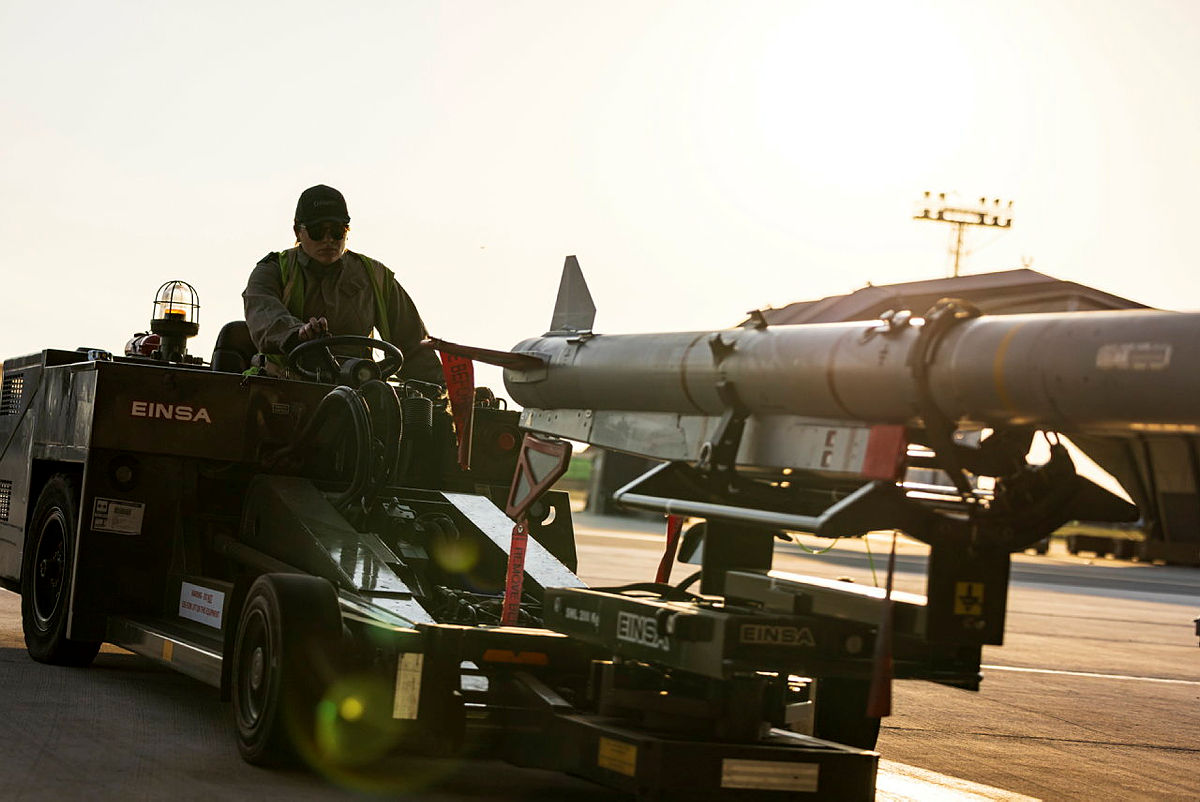
The United Kingdom and France have signed an agreement to begin studying a next-generation air-to-air missile to succeed Meteor, one of Europe’s most advanced beyond-visual-range weapons.
The Memorandum of Understanding commits both nations to a 12-month joint study examining future air combat threats and the technologies required to maintain air superiority in the decades ahead, according to the UK government.
The work will explore new missile concepts and set out a potential development roadmap, forming part of wider efforts under the Lancaster House 2.0 treaty to deepen defence cooperation between the two countries.
“In a new era of threat we are increasing co-operation with our friends and allies,” said Defence Minister Luke Pollard. “This agreement is a significant step forward… demonstrating the strength of our UK-France defence partnership.”
Meteor, which entered service in 2016, is currently operated by six European nations and is in frontline use with the Royal Air Force’s Typhoon and the French Air Force’s Rafale. Developed through multinational collaboration, it is widely regarded as a benchmark for long-range air-to-air missile performance.
The new study is intended to build on that model, with an emphasis on aligning industrial effort and avoiding duplication across European defence programmes.
“We are strengthening NATO’s capabilities and European security by working with France on the next generation of air-to-air missiles,” Pollard added.
The initiative also forms part of a revived “Entente Industrielle” between the UK and France, aimed at improving efficiency in complex weapons development and strengthening NATO’s edge in high-end air combat.
As part of this effort, a joint Complex Weapons Portfolio Office will be established to coordinate missile programmes and align national priorities, while also opening the door to wider participation from partner nations.









Thought UK was working with Japan on such a capability.
As I recall, the Japanese cancelled JNAAM a couple of years ago. Both countries were looking to use the data from the project to progress their own projects. Whatever the heck that means.
Hopefully this work will stop France claiming Meteor as a French missile. 😀
It’s a real pity the meteor missile we were developing with Japan fell through.
Having an AESA radar with low probability of intercept will make meteor absolutely lethal. Imagine a high speed, high energy weapon with a massive range and no escape zone and you don’t even get a radar warning when it locks on to you.
.. and imagination is all we will have to go on. Any missile from this agreement is 20 years away at best.
Wow. Nice one, George. I actually believed it. Signing an agreement to begin a year-long study at some indefinite time, leading to a potential road map. It sounds just like the kind of thing the MOD would do rather than agreeing to build it.
What form can this actually take apart from a component refresh, though?
Meteor is already one of the longer ranged AAMs and Stratus RS will fulfil the ultra long range anti-HVAA role. So any improvements would be to make it more effective against fighters, not the arms race for an ever larger AAR exclusion zone that the US and China are engaged in.
Those improvements could be managed by giving it an AESA or even dual mode seeker, reducing the detectability of data links through various means, or improving the performance of the motor. Why a new missile? Making it any bigger would size the new missile out of F35B, which is an important consideration.
Unless they are planning to move away from the typical tube missile? A lifting body or flattened shape might produce range and speed improvements, perhaps.