

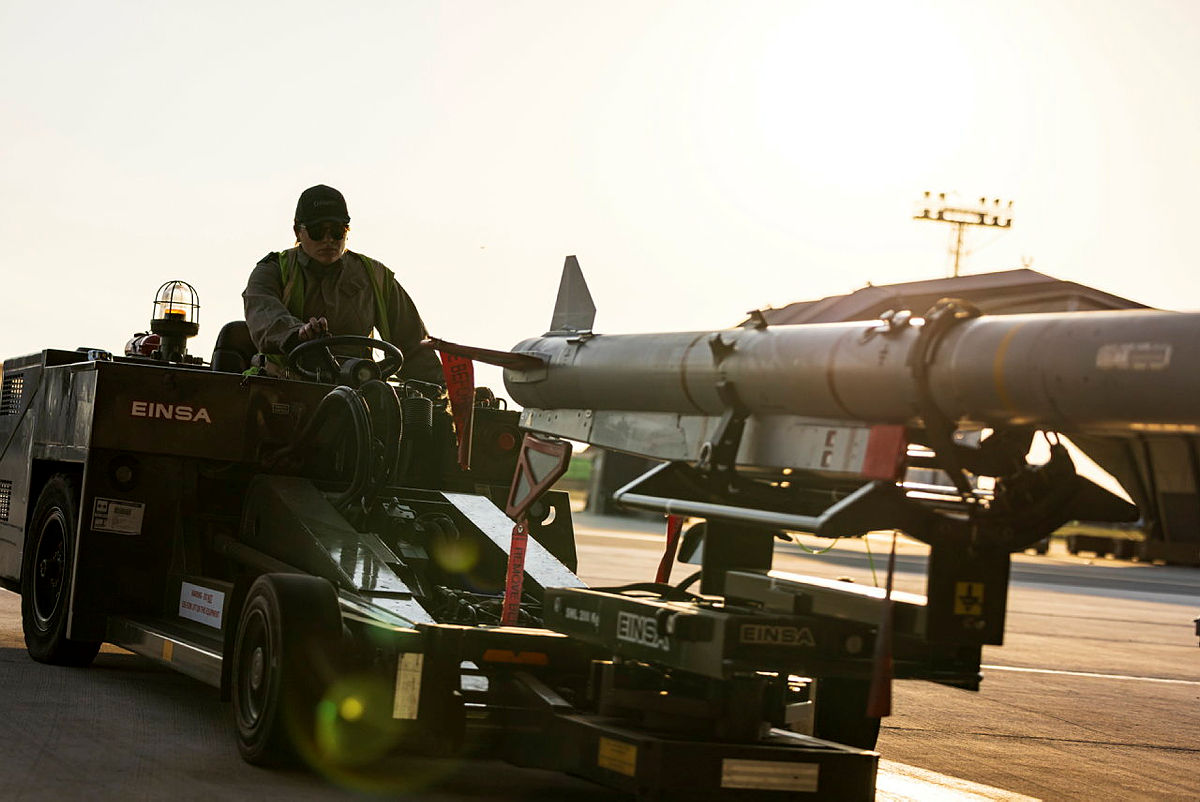
The United Kingdom and France have signed an agreement to begin studying a next-generation air-to-air missile to succeed Meteor, one of Europe’s most advanced beyond-visual-range weapons.
The Memorandum of Understanding commits both nations to a 12-month joint study examining future air combat threats and the technologies required to maintain air superiority in the decades ahead, according to the UK government.
The work will explore new missile concepts and set out a potential development roadmap, forming part of wider efforts under the Lancaster House 2.0 treaty to deepen defence cooperation between the two countries.
“In a new era of threat we are increasing co-operation with our friends and allies,” said Defence Minister Luke Pollard. “This agreement is a significant step forward… demonstrating the strength of our UK-France defence partnership.”
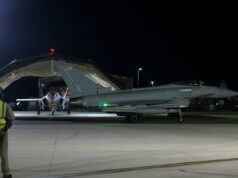
Meteor, which entered service in 2016, is currently operated by six European nations and is in frontline use with the Royal Air Force’s Typhoon and the French Air Force’s Rafale. Developed through multinational collaboration, it is widely regarded as a benchmark for long-range air-to-air missile performance.
The new study is intended to build on that model, with an emphasis on aligning industrial effort and avoiding duplication across European defence programmes.
“We are strengthening NATO’s capabilities and European security by working with France on the next generation of air-to-air missiles,” Pollard added.
The initiative also forms part of a revived “Entente Industrielle” between the UK and France, aimed at improving efficiency in complex weapons development and strengthening NATO’s edge in high-end air combat.
As part of this effort, a joint Complex Weapons Portfolio Office will be established to coordinate missile programmes and align national priorities, while also opening the door to wider participation from partner nations.







Thought UK was working with Japan on such a capability.
As I recall, the Japanese cancelled JNAAM a couple of years ago. Both countries were looking to use the data from the project to progress their own projects. Whatever the heck that means.
Hopefully this work will stop France claiming Meteor as a French missile. 😀
It’s a real pity the meteor missile we were developing with Japan fell through.
Having an AESA radar with low probability of intercept will make meteor absolutely lethal. Imagine a high speed, high energy weapon with a massive range and no escape zone and you don’t even get a radar warning when it locks on to you.
.. and imagination is all we will have to go on. Any missile from this agreement is 20 years away at best.
France has never claimed that
The French claims manifest differently in the industrial and media sphere. Within the French BITD (Base Industrielle et Technologique de Défense), the Meteor is frequently marketed as the long-arm of the Rafale. Dassault Aviation and MBDA France highlight the missile as a key component of the Rafale’s omnirole capability, often omitting the multi-national workshare from Swedish, German, or British partners in promotional materials. This has led to a recurring industrial friction where French media sometimes presents the Meteor as a success of French engineering.
French Exceptionalism tends to hide the fact that the Meteor is a British-led European cooperation, the political reality is that France requires and promotes it ‘brand’ of independence to sustain its status as a global power. In 26′, the French are trying to build the infrastructure of a multipolar world where the European Pillar is controlled by the f’n ‘Hexagon’, not the f’n Pentagon. … Thank god for the Northwood Declaration.
It’s quite something to bring up ‘French exceptionalism’ on a British defence forum.
France has never claimed that the METEOR was its missile, never. That’s just your paranoia.
Time to grow up ?
Hermes, there is nothing wrong with exceptionalism per se, whether it’s French, British or any other country as every country sees it self as ‘special’.
Do you believe France not to be ‘Exceptional’?
I never said that France had claimed the Meteor as theirs. Read my text carefully.
I’m not paranoid, besides, as the voices is in my head say … “just because one is paranoid doesn’t mean that they’re not out to get you”.
Wow. Nice one, George. I actually believed it. Signing an agreement to begin a year-long study at some indefinite time, leading to a potential road map. It sounds just like the kind of thing the MOD would do rather than agreeing to build it.
You say that but if you read it then I am sure you will have noted that it isn’t tagged at the end as an April Fool where the other traditional jokes were. I suspect this is just the MoD having predictably poor timing. I mean after all they formed the RAF on April 1st.
Thanks Ian. That was my attempt at humour.
Oops I meant Iain. Not got my glasses on at the moment.
No, this is real. It’s on the DES page on the Gov site.
What form can this actually take apart from a component refresh, though?
Meteor is already one of the longer ranged AAMs and Stratus RS will fulfil the ultra long range anti-HVAA role. So any improvements would be to make it more effective against fighters, not the arms race for an ever larger AAR exclusion zone that the US and China are engaged in.
Those improvements could be managed by giving it an AESA or even dual mode seeker, reducing the detectability of data links through various means, or improving the performance of the motor. Why a new missile? Making it any bigger would size the new missile out of F35B, which is an important consideration.
Unless they are planning to move away from the typical tube missile? A lifting body or flattened shape might produce range and speed improvements, perhaps.
If we consider the advantages of ramjets vs rocket motors. A ramjet in a missile such as Meteor, which is dimensionally similarly to the rocket powered AMRAAM. Will always have a range advantage over the rocket powered AMRAAM. As the fuel it carries doesn’t have to hold oxygen, unlike a rocket propellent. So you will have a greater volume of fuel as you use the oxygen supplied by the air from the readily available atmosphere. However, a rocket motor has better initial impulse and overall acceleration than a ramjet. So there is a performance and requirements trade off. A key requirement today and in the future, especially where 5/6 gen jets face off against each other. Is who can see first, launches first and hopefully gets the kill first. A key parameter here is time to target. You really want the least amount of time from the launch point A to the target B. Which is why people are thinking more along the lines of using rocket motors again.
But a rocket motor, generally only has enough fuel for a 5 to 10 second sustained burn. Where a ramjet, such as Meteor can throttle its fuel usage, to keep some in reserve until it get much closer to the target. Then use that fuel to increase its velocity again, making it harder for the target to evade. Whilst the rocket powered missile by this point is a glider and slowing down considerably. This problem led to dual pulse rocket motors being developed. Which are basically two propellent tanks in sequence, with a timer in the middle. Where the first (rearmost) tank is used to accelerate the missile to its terminal velocity. This tank runs dry and the missile now coasts to the target whilst loosing speed. At a predefined point the second tank will be ignited again to re-accelerate the missile. The second boost helps raise its speed and therefore its chances of achieving a kill over a single pulse rocket motor. This is how the later versions of AMRAAM can reach over 100km in range.
Clearly you can make the missile longer and/or fatter to hold more propellent. But pretty much all western jets are sized for AMRAAM dimensionally. Therefore anything bigger won’t be able to fit in weapons bays (F35) or semi-recessed locations (F18, Typhoon, KF21 etc). They will have to go under the wings, as per the F18 with the AIM-174.
Changing the shape from a classic tube to more of a lifting body, is what they’ve done with Status-RS. Again there is a caveat. A tubular body is easier to stack together in a weapon’s bay. There has to be a minimum distance between each weapon, so when they are dropped or pushed out of the bay, they don’t interfere with each other. Having a body that is wider, may mean you know only have room for two weapons, whereas with a tubular weapon you could fit three.
Dual mode seekers, I would say will be the next big thing. Especially when you have expendable countermeasures like the active RF Britecloud. By giving the missile an imaging infrared (IIR) seeker. Depending how cleaver the missile’s ECU is. It might be able to determine the difference between the target and the decoy, by comparing what the radar and IRR sees.
So what can they do?
Perhaps moving the integrated booster to a proper booster stack so the missile gets up to a high speed initially, then using a shorter ramjet as a sustainer? That would offer the best of both worlds and be consistent with the two stage BVRAAMs a lot of other countries are doing.
I think if you look at the AIM-260, which is supposed to replace AMRAAM. By all accounts it has similar dimensions, but is expected to be capable of intercepting targets at 200km plus. Which is a lot further than the current D version of AMRAAM. How can they significantly increase the range and allegedly its terminal velocity, in an airframe similar to the legacy AMRAAM?
Apparently, it uses a dual pulse rocket motor like AMRAAM. The secret sauce is the propellant, which according to some is 1.5 times more energetic. The main requirement was it had to fit in the F22’s weapons bay. So had to be similar in size to the AMRAAM, but have a longer range so it could outrange the PL15.
By all accounts the long range engagement weapon that’s also being developed, will be under wing mounted. As it’s much bigger and longer than AMRAAM. I believe it will use a two stage rocket motor. Where the first stage drops off, thereby ridding the parasitic weight and drag.
There’s a lot of merit in combining a bigger rocket booster with the ramjet. Especially if you can accelerate it up to Mach 5-6. As that would mean the Ramjet should be able to maintain at least Mach 5. I think the main thing is that the rocket motor accelerates it to Mach 5 or above.
Keeping the missile above Mach 4 is key. As it means it reaches the target with more energy and less time. Especially if the target is over 150km away. There’s a definite case for a bigger rocket motor combined with the ramjet.
Brring on the Rotating Detonation Ramjet … sooo much potential.
Yes, agree, with a potential 25% increase in efficiency in both fuel burn and thrust generation. There’s even talk of using it withing a gas turbine combustor with the same predicted efficiency increase.
It might not help MBDA, but perhaps concentrating on producing enough of the current State of the Art BVRAAM would be a good start.
Can Europe afford to design an even better missile and build enough of the one it already has? Or has it actually got enough?
Maybe I am mis-reading this, perhaps it is only ‘studying’ the ‘Art of the Possible’ for a future development.
Totally different departments within MBDA. Future concepts have nothing to do with the production team.
Better make sure it can track and engage F22s and F35s the way things are going.
A beast mode Meteor would be unstopable. Make sure its F35 compatable.
Sounds legit but i’m 50/50 on wether UKDJ simply forgot to add the april fools disclaimer at the end 🤔
Meanwhile, Australia is the first export country for the AIM-260.
Could be the US locking Aus in so others can’t get in with their latest missile offerings. Be interesting to see if Aus ever shows interest in Tempest or sides with the US F47.
Interested to see what the design will be.
With wider adoption of stealth rockets seem to be back in as the quicker reaction time helps when the difference between detecting eachother may only be a couple seconds. At the same time, ramjet is a much bigger NEZ, better for shooting non stealth, and particularly useful against hostile AEW where they are beginning to be able to outrange some of the radar. Maybe a 2 stage will be adopted to accelerate the missile quickly before the ramjet takes over.
Size is also a question, we currently size all the fighters for AMRAAM but Tempest will have a much larger bomb bay than previous fighters so is it worth making this new missile the new size standard, as a bigger missile with more fuel is the easiest and cheapest way of increasing range. Continue to use meteor, maybe make an upgraded version at some point, for existing fighters like the F-35 and just have the replacement as the new standard all fighters accommodate.
Some of the new Chinese missiles like PA-15 are getting high ranges and they have just taken the larger missile option. At some point with the speed their tech is advancing they’ll manage to catch up in technology but also have the larger missile so outrange western equivalents. So is it better to call it quits on the AMRAAM size, let it slowly phase out in favour of a new bigger missile?
Most air forces are splitting their missile fleets with some ULRAAM ‘telephone poles’ for anti-AWACS but also retaining the AMRAAM sized weapons (Meteor and PL-15 are slightly bigger). In the RAF the ultra long range role will be fulfilled by Stratus RS, which is a ramjet cruise missile with an active seeker. I’ve seen range estimates between 300km and 500km in the anti-High Value Aerial Asset role, which is what MBDA are calling anti-AWACS.
Because of stealth I think it is assumed that fighter on fighter engagements will be at shorter ranges where a smaller missile doesn’t have a big disadvantage.
This is possibly another reason why GCAP is likely to be F111 sized rather than Typhoon. As it means having a bigger nose area, there’s more space for a larger AESA antenna array up front. But due to the size of the aircraft, I would predict it will have side arrays as well. Thereby giving the aircraft potentially a field of view of around 240 degrees in the horizontal plane. The larger the array the larger the amount of power the array can generate. But also makes the antenna array more sensitive when receiving. So hopefully as its kicking out a lot more power, it can overwhelm another aircraft’s radar absorbent material (RAM), before another aircraft can overwhelm its RAM when transmitting. Or due to a more sensitive receiver, be able to detect an opponent’s emissions far earlier from further away.
GCAP will still want to use long range BVRAAMS like Meteor or the son of Meteor. As the more powerful/sensitive radar, should allow it to stand-off more from a target/threat.