

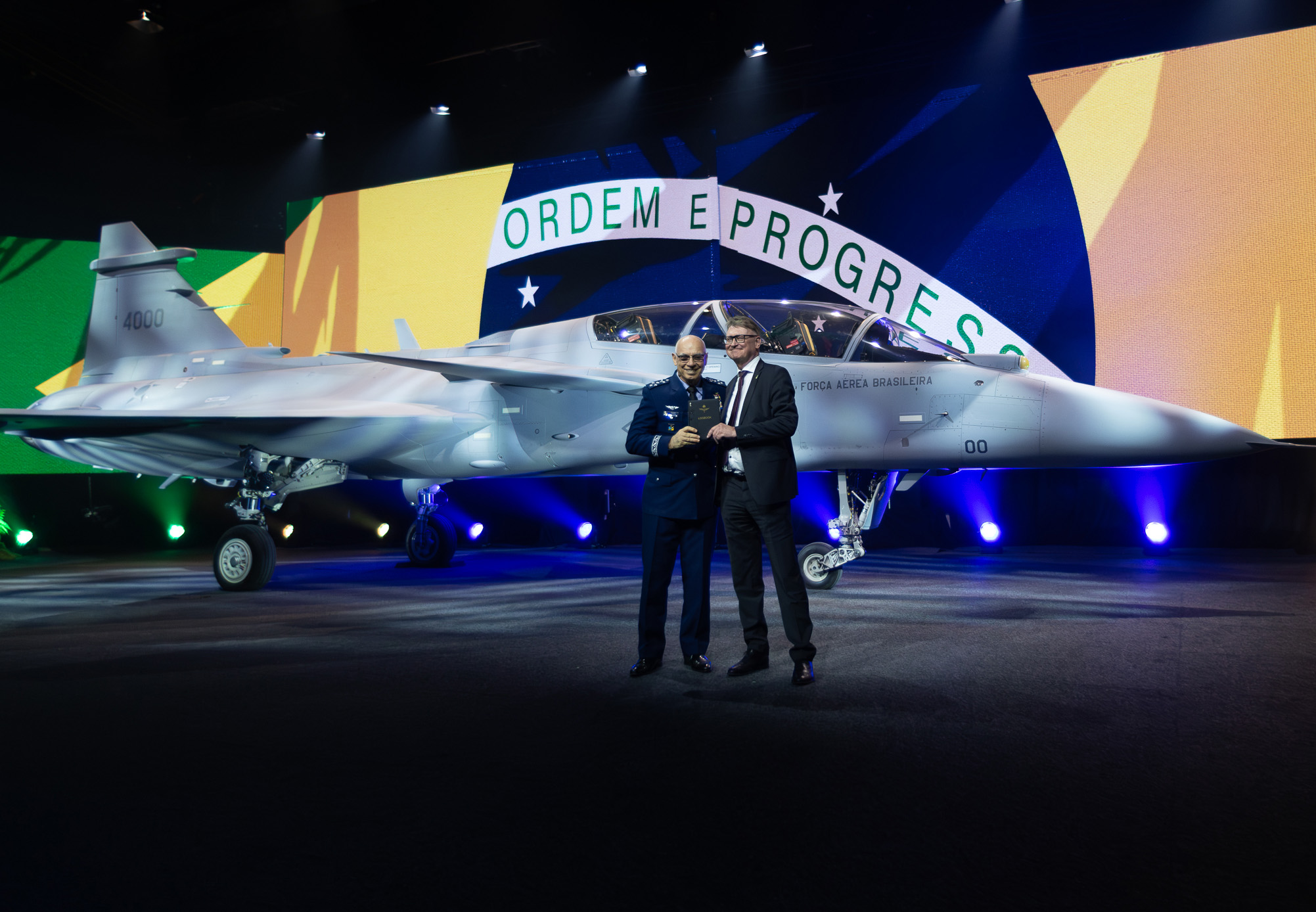
Saab has rolled out the first Gripen F, the two-seat variant of its Gripen E fighter, at a ceremony for the Brazilian Air Force held at the company’s facilities in Linköping, Sweden, on 2 June 2026.
The Gripen F combines conversion training and combat capability on a single platform, adding a second cockpit to the single-seat Gripen E. Saab said Brazil, as the launch customer, had taken an active part in co-developing the variant, with direct industrial involvement and an extensive transfer-of-technology programme under which the company said hundreds of Brazilian engineers and technicians had been trained and the country’s design and development base strengthened.
Lars Tossman, head of Saab’s Aeronautics business area, framed the rollout as a product of the long collaboration between the company, Brazilian industry and the air force. “The rollout of Gripen F represents a shared achievement between Saab, Brazilian industry and the Brazilian Air Force, reflecting the deep trust we have built together over many years,” he said, describing the aircraft as both a capable fighter for Brazil and the result of sustained joint development.
According to Saab, the Gripen F shares the performance, sensors and architecture of the Gripen E, with the second cockpit operating independently so that an instructor can guide missions in a fully operational fighter. The company said this allowed trainee pilots to fly under realistic live mission conditions, accelerating pilot conversion and preparatory training while improving effectiveness in high-threat environments through shared crew workload.
The aircraft will now be transferred to Saab’s Flight Test Centre in Sweden to begin a dedicated flight test campaign before final delivery to the Brazilian Air Force.
The two-seat variant stems from Brazil’s 2014 contract with Saab, which covers the development and production of 36 aircraft, comprising 28 single-seat Gripen E and eight twin-seat Gripen F. Deliveries began in 2020, and Saab said 11 aircraft had been handed over to date. The company said it had also received Gripen F orders from Thailand and Colombia.








I’ve gained $17,240 only within four weeks by comfortably working part-time from home. Immediately when I had lost my last business, I was very troubled and thankfully I’ve located this project now in this way I’m in a position to receive thousand USD directly from home. Each individual certainly can do this easy work & make more greenbacks online by visiting
following website—.,.,.,.,.—>>> JobatHome1.Com
I’ve gained $17,240 only within four weeks by comfortably working part-time from home. Immediately when I had lost my last business, I was very troubled and thankfully I’ve located this project now in this way I’m in a position to receive thousand USD directly from home. Each individual certainly can do this easy work & make more greenbacks online by visiting
following website—.,.,.,.,.—>>> JobatHome1.Com
So Canada goes for Gripen for two thirds of its fighter force, retaining only a core F-35 force to stop Trump exploding and making their contracted 18 viable, sensible in my view. Also likely that Canada will become a GCAP observer, so now what with frigates, air surveillance and likely submarines too, Europe is very much becoming Canada’s supplier of choice for its military expansion both now and well into the future. Well done Island USA your loss is Europe’s (and others) gain. Oh well LM can carry on with that mythical twin engined version I guess, Musk seems to be doing well in fleecing the US tax payer after all with mythical technology and never arriving deadlines.
Please tell me what are the mythical european weapons and sensors in Canadian frigates?
Now, Canada has two logistics and pilot training lines to support. Canada would have been better off with the Super Hornet, Eagle 2 or the Eurofighter Typhoon. All combat proven aircraft.
Gripen is pretty much a lightweight fighter. Its max takeoff weight is about 7,000 kg less than that of the Typhoon.
Cheers Mate – is the Grippen option a done deal for Canada? I wonder if a joint F18F and F35 was the better option like Australia.
Not a done deal yet. The only thing for sure is 30 F35s have been ordered by the RCAF.
cheers Mickey
UK should join Canada to pay for 2 squadrons (30) of F35A and have a joint RAF/RCAF F35A force for the NATO nuclear strike force. This will allow for cost sharing in both acquisition and operations. This is cheaper for the UK rather than going out and purchasing 24 F35A for their nuclear strike role.
In my view the F35 as it is currently developed is a bust and the UK and Canada, like other NATO members, should put caps on their current purchases and stay away from that aircraft. Lockheed Martin has decided that it is going to squeeze as much money as possible from all its customers that purchase the aircraft, and that includes the USA taxpayer. The USA armed forces (Air Force, navy and Marine) are all generally disgruntled with the aircraft that has only a 50% availability rate (per USA Congress reports). The only people who appear happy with the F35 are the Israelis and that is simply because they don’t have to pay for its purchase or upkeep, because the USA taxpayer pays for it in the annual grants that the USA government sends over to Israel, and in addition they have been allowed full access to the innards of their aircraft (Software and hardware etc.) so they can make their own repairs and modifications without having to wait for Lockheed Martin to send technicians.
f35 is probably a fantastic stealth 5 th gen fighter. however software updates come from LM usa am i correct to think they could be switched off? software sovereignty is important when the white house is unpredictable
This might be a two part question. Can LM/USA activate a software kill switch in the F35, so it can’t fly? This is feasible but not practical, as whose to say it couldn’t be hacked and used against US F35s? The second part is what happens if LM/US stop sending us software updates? Not a great deal, as the aircraft is flying to its full envelop, so the software updates will be bug fixes, increased efficiency updates for the aircraft’s mission system, flight computer and engine computer. The problem will come if there’s a new weapon we want, which requires a software update. Without the update it makes it very hard to integrate the weapon.
Well Europe have been fleecing US taxpayers without their consent since Cold War while supporting a supremacist cultural view…
UK lost the capability to develop/build artillery guns(now supposedly being recovered), individual weapons, and tracked vehicles . France also lost the capability to develop individual weapons and tracked vehicles…Italy also lost the capability to develop tracked vehicles…
This assertion that the Europe has fleeced US taxpayers doesn’t make any sense when you look at the actual spend figures. I only have those for 2024 o hand but these already give lie to this assertion (and the relative picture in 2025 will have improved as European defence spending increases).
So, a comparison of how much the USA and Europe spend on the defence of Europe against Russian aggression can be calculated as follows:
US defence spend:
– Total budget $886bn for the US military’s worldwide operations (Europe, ME, Asia etc). Nb. this figure also includes unique spend on things like social welfare for veterans which European defence budgets don’t).
– Total spent is estimated at $4.2bn (comprising direct spend in NATO region/Europe of $3.6bn and formal contribution to NATO Common Budgets of $0.6bn. This $4.2bn is only 0.005% of total US defence total (and will be less in 2025)
– However, if we wish to be generous we could even bump our guess of US defence allocations for European defence and specific security missions (including provision of specialist capabilities) to $40bn–$50bn which would be 4.5%-5.6% of total US defence spending.
Now $50bn is a lot of money but even that only a tiny fraction of the total US spend (and $4.2bn is minuscule).
And it is also a tiny fraction of how much Europeans spend on deterring Russian aggression (the whole point of NATO), which is estimated at $400bn (see explanation at the foot of this note).
You can reasonably argue that the US shouldn’t be spending anything at all on defending Europe from Russia but you can’t argue that Europe is – as at least as far as spend is concerned – free-riding on the US.
Even if US spends $50bn, this is eight times less than Europe’s $400bn (and the relative positions are likely even more lopsided given the changes in 2025/6).
Of course, Europe needs to spend these large sums much more wisely and in doing so close a small number of very significant capability gaps but this is all doable with focus and a consistent multi-year increase in spend, all of which seem to be finally happening.
So, excuse me if I’m not hugely sympathetic to MAGA concerns. The US can leave NATO if they want to save this $50bn (or $4.2bn) but a lot of Europeans will reasonably argue that the US should also lose access to the bases in Europe. In short, why should US forces have access to these bases if it is no longer part of NATO? That withdrawal will do a lot to stymie the US power projection into the ME and Africa but frankly with friends like MAGA American, who cares?
For reference, the $400bn spend figure for Europe is made up of:
1. European defence spend on Russian deterrence:
– Total defence spend for Baltic states, the Scandinavian states, Poland, Bulgaria, Romania, Slovakia, the Czech Republic and Germany : $200bn (it will be more when big German military spending kicks in 2025).
2. European defence from other countries on Russian deterrence (Belgium, Netherlands, Britain, Italy, Greece, Spain, France and Turkey): $200bn, this assumes 60% of defence spending is for Russian deterrence.
What you did not include in your fine analysis is that fact that annually for the past 8 decades since the end of WW2, Europe (NATO members) annually spend nearly 50% of its defence expenditures with the USA. This amount in recent years has average US$150-180 billion annually. That is over 3 times your estimated USA spend of US$50 billion per year on NATO (European area defence) activities.
A modern two seat airplane is very interesting, now when the Gripen are flight testing unmanned aircraft fighters that are not going to be just an average slow expandable drone with a missile or two attached to them but high end fighters with AI assisted teaming there will be a need to have a second pilot controling/monotoring them while the main pilot is flying the Gripen who acts like a command node. That would be a game changer, the Gripen E has already been using AI and its AI system is able to outperform experienced pilots in dogfights, but imagine a single Gripen F controlling 2 supersonic wingman drones with Meteor missiles and EW payloads and decoys at the same cost as a F-35 who still has fully mission capability rate figures in single digits and are decades behind schedule.
Hawk replacement right under our noses.
RAF could do with something with low cost per hour and our meteors could do with a decent radar.