

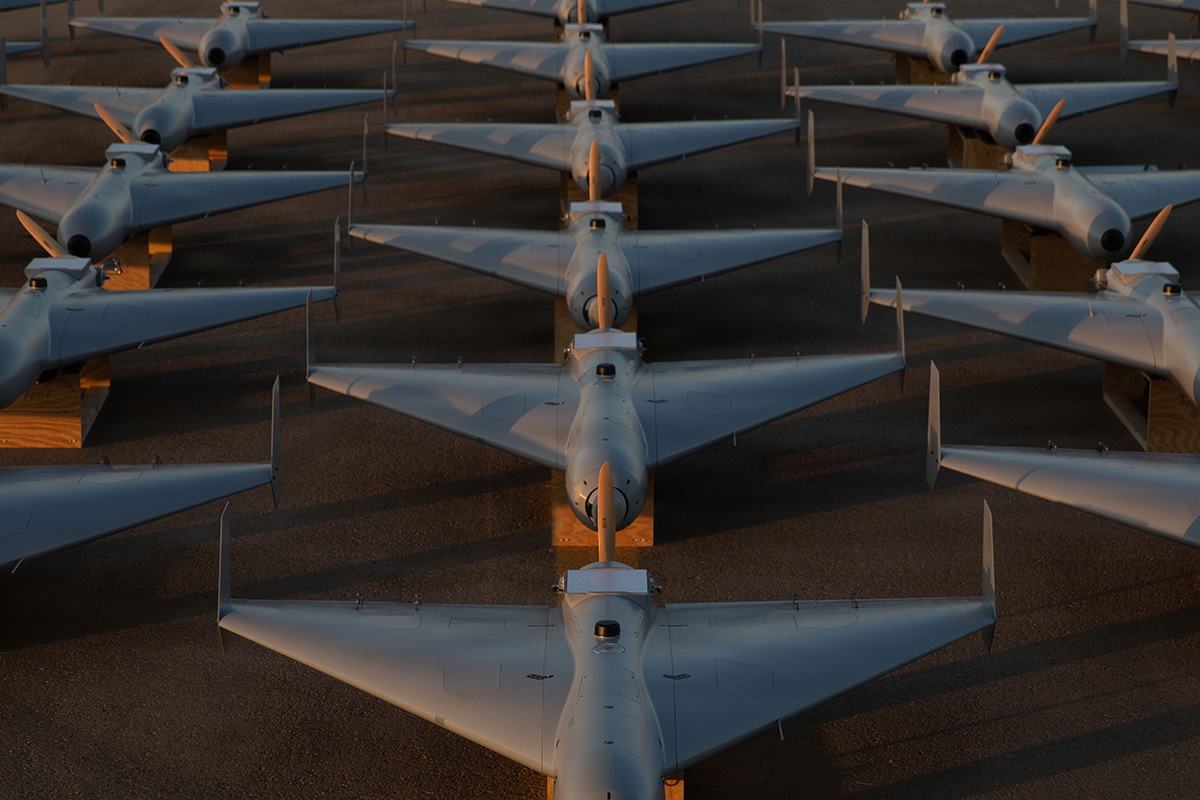
The Ministry of Defence understands the scale of drone production that a future conflict would demand and is working on the ability to manufacture them en masse, Defence Minister Luke Pollard told the House of Commons.
The Labour MP for Widnes and Halewood, Derek Twigg, asked whether the department grasped the sheer number of drones and counter-drone systems that would need to be produced at scale, now and in the future, should a conflict break out, and sought an assurance that this was understood within the MoD. Pollard, who holds the readiness and industry brief, said it was.
He said learning the lessons of the war in Ukraine was one of the central pillars of the Strategic Defence Review, and that the work on autonomous systems went beyond continued investment in high-end capabilities such as intelligence, surveillance and reconnaissance and one-way attack drones to the question of how to deliver mass effect. Pollard argued that the rapid pace at which drone technology changes meant it did not always make sense to hold large stockpiles. “Having the ability to produce millions of drones while recognising the shortages in the supply chain, especially around motors, magnets and cameras, is the way that we can enhance our capabilities and our deterrents,” he said, telling MPs the department was actively working on the issue.
This is a shift in thinking that the war in Ukraine has driven across NATO militaries, where small uncrewed systems have been produced and expended in very large numbers and where designs change from month to month in response to countermeasures. That tempo has led planners to favour the capacity to manufacture drones quickly over holding fixed reserves that risk being obsolete by the time they are used, an approach sometimes described as keeping a warm production base rather than a full warehouse.
The supply-chain constraints Pollard identified are widely recognised across the sector. Small drones depend on components such as electric motors, permanent magnets and camera modules, supply of which is concentrated in a small number of countries, with China dominant in the processing of the rare earth materials used in high-performance magnets. Reducing that dependence, and building domestic or allied sources for the parts, has become a focus for governments seeking to scale up uncrewed systems production without relying on potential adversaries for critical inputs.
Counter-drone capability, which Twigg also raised, has become a parallel priority as the threat from cheap uncrewed aircraft has grown, with armed forces investing in the means to detect, track and defeat hostile drones alongside the systems they field themselves.








You can’t test the capability to manufacture a million drones, iterating the design every few weeks, just by planning. You have to actually manufacture to those timescales. We have to be prepared to spend some serious cash just to test our capability. It’s not a matter of stockpiling. It’s about preparing and testing the supply chain at scale. Besides, that level of manufacture for Ukraine to Ukrainian-approved designs would not be out of place right now.
I’ve gained $17,240 only within four weeks by comfortably working part-time from home. Immediately when I had lost my last business, I was very troubled and thankfully I’ve located this project now in this way I’m in a position to receive thousand USD directly from home. Each individual certainly can do this easy work & make more greenbacks online by visiting
following website—.,.,.,.,.—>>> JobatHome1.Com
Thank the gods we don’t have a million Pollards. Another clueless politician spouting sheet daily.
Do a million drones secure the Atlantic? Or power project abroad to defend our interests? Or hold ground in Estonia? Or enable the Field Army to deploy from Garrison to Eastern Europe? Or to be airlifted to where they’re needed?
These politicians are using this to divert from a lack of conventional assets in my opinion.
Soundbites mate. From political scum.
👍
The clown blocked me on X when I called him out on his nonsense.
Him and John Healey are incompetent idiots.
Really?
I must try harder!
Can’t be critical of one of Two Tiers socialist appointments can we?
He is right in this, but is not all that there is.
Drones cannot be seen as Jeune Ècole XXI century shortcut to fight on the cheap.
I don’t see how you can suddenly manufacture motors, batteries and cameras at scale without having a stockpile of these things.
Everything else..fibreglass or cardboard…whatever…likely exists on quantity in the country.
The other thing is, what producer is going to want a wartime size facility empty, existing on the prospect of massive production but being sustained by nuggarly small orders from the mod?
We should have sufficient hard and soft kill weapons however, and perhaps a good size stock of cheaper long range stuff to disrupt the Russian supply chain.
AA
Pointless Pollrad strikes again. Daft idea that will never happen.
It seems we shouldn’t read too much into the tactics used by Russia and Ukraine. The minute we drop down to that type of combat we’ve lost.
We need enough precision guided munitions and launch platforms (survivable manned and unmanned disposable) to win a war, suppress UAV productions and destroy logistics.
Having drone production is clearly going to be important to saturate defences and therefore we do need huge production capacity but as a means of high-low cost attack.
The UK is uniquely exposed, our armed forces distinctly lack radar guided guns, GBAD, ECM/ ECCM units to nullify the drone threat in adequate numbers by that I mean hundreds of GBAD units not the few dozen available.
Exactly Mr Bell. Some decent GBAD to protect the country and all its bases, assets, people and manufacturing base would be sensible and maybe some greater base dispersion of air and naval assets. Everything everywhere is pretty much an open target. Obviously any attack would cause an allied response but you don’t have to wait to be hit first if adequately armed. And in this day of nukes our adversaries are not likely to play “nice”.
Kicking the can down the road again so we have to build them during a war, brilliant.