

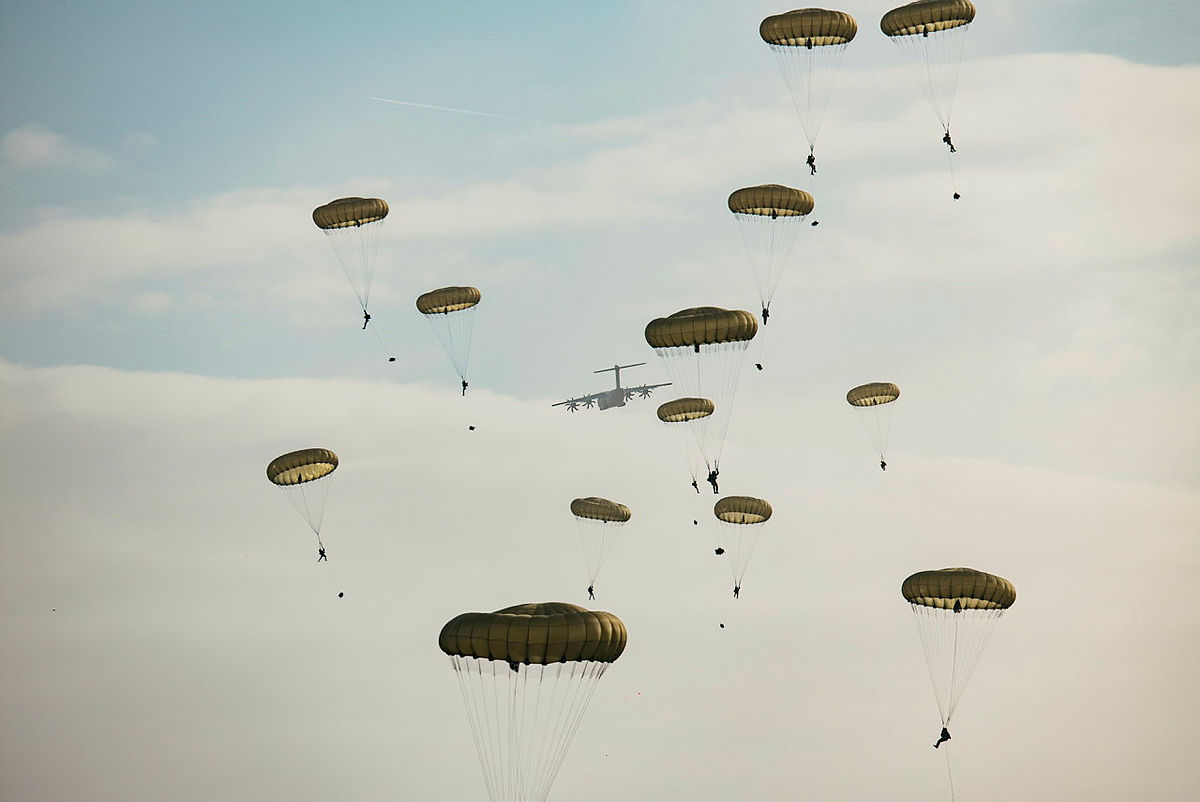
The British Army and Royal Air Force have carried out the largest military parachute exercise in the UK for more than ten years, with around 270 troops dropping onto Salisbury Plain.
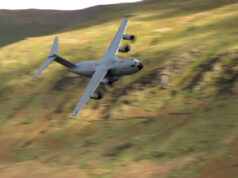
Paratroopers from 3rd Battalion, The Parachute Regiment jumped from three RAF A400M aircraft flying at around 800 feet, while a fourth aircraft dropped 24 tonnes of equipment and supplies needed to sustain operations on the ground, the Ministry of Defence stated.
The exercise, launched from RAF Brize Norton, was designed as a proof of concept for the Joint Airborne Task Force, a high-readiness capability combining 16 Air Assault Brigade and the RAF’s Air Mobility Force to respond rapidly to global crises, from humanitarian emergencies to combat operations.
For the scenario, troops were deployed to reinforce a NATO ally facing a potential invasion, with soldiers moving off the drop zone to establish defensive positions after landing, supported by equipment including Javelin anti-tank missiles and 81mm mortars.
Brigadier Ed Cartwright, Commander of 16 Air Assault Brigade, said: “Parachuting is the fastest way to put troops almost anywhere in the world. It combines the speed and reach of air power with the unavoidable requirement to put soldiers on the ground to respond to crises or defeat our enemies.” He added that the Joint Airborne Task Force represents a renewed air manoeuvre capability, offering “choice to policy makers and commanders” and highlighting the close relationship between the Army and RAF in delivering rapid response forces.
An RAF Air Mobility Force squadron commander described the exercise as a demonstration of the ability to deliver a “concentrated force package to a drop zone by low level parachute”, adding that mass parachuting remains a key capability in an increasingly uncertain security environment.
The drop marks the largest such exercise in the UK since 2015, when around 200 troops parachuted from C-130 aircraft, with the A400M Atlas now fully taking over that role following the Hercules fleet’s retirement in 2023.





Corrections….
“Renewed air manoeuvre capability”
No, reduced air manoeuvre capability. But it remains, which is the main thing,
“C130 Hercules retirement.”
No, cut.
Good to see, anyway, after the hulabaloo earlier that this might be dropped completely.
Just posturing by our pm, to confirm that we are not ready to protect our boarders.
Watched it on BFBS, absolute pants, numerous runs, 40 seconds between each Atlas on the pax runs, single sticks, no sim sticks, 1 x Atlas dropping just small pallets of food/ammo/stores, no heavy drop platforms, just x 3 rifle Coys with a few attached arms! Yes its a start but more akin to a desperate attempt to try to justify keeping the capability as opposed to a real lead taskforce drop. Its a capability we still need but as discussed previous, one which is (sad to say for me and others) however is quite expensive, time orientated and logistically unrealistic in todays operational environment. However, good to see and at least a little experience of what we used to do for the lads in the job at the moment.
Mate.
On heavy drop, I’ve read on X a few times there is an ongoing programme to reintroduce that with new pallets?
Probably is mate, as the old MSPs were bloody old when I was in! JATEU will have trialled them and maybe Atlas specific? Not sure if there will be many, as I can see the actual heavy drop on any lob being the first to go, as the concept is no more than Coy group to jump nowadays (as you know) with the rest air landed. We will see. We still need the capability, as with other capabilities, even if it is most likely not used, it will be something our prospective future enemies have to include in their planning considerations.
Parachuting still relevant? equipment yes, but personal?
Eh, not sure how that works, if the kit is dropped then where are the blokes to use it?
Or even secure it on the ground ? We used it in Afghan to resupply remote PB’s to some effect as I’m sure you are aware. Also 270 bods is heavy weapons is enough to secure a remote airstrip plus follow through with TALO to bring in the rest of the Brigade?
Apols should read ‘ with’ heavy weapons – not ‘is’ .
Deffo enough to secure an airstrip etc once PF have marked it, ready for a TALO, just got to get there. It’s a capability we need, even if it’s just the threat of it, but once/if it goes I guarantee within a short period of time some shitpit in the world will require a parachute insertion 😂 cheers
Să nu uităm de Cipru din 1974 la invazia de către turci. Au fost în număr mult mai mare decât 270 de parașutisti.
Having done a number of jumps, both military and civilian, I know, who’d want to jump out of a perfectly serviceable aircraft right? But paradrops do if planned correctly with the element of surprise can be a game changer if you need take an area quickly, more so than a heli-insert. The jump above just illustrates one part of that capability. As by the looks of it, it was conducted from 1500ft. Which is a pretty safe height, as it gives you plenty of time to sort out twisted lines or deploy the spare. What it doesn’t show you is the other options of a paradrop, i.e low level < 500ft, high altitude high opening (HAHO) and high altitude low opening (HALO). Both HAHO and HALO were used by the "Sneakies" in Afghan.
But it does like heli-inserts, have its risks. Russia's invasion of Ukraine on the 24th Feb 2022 is a very good example. Russia believedThat it would take two weeks to pacify and control Ukraine. Where the Russian Spetznaz and VDV (Airborne) forces would be the spearhead of the invasion. The key Russian goal was to overthrow the current Government in Kyiv and replace it with a more Russian friendly one. Ultimately bringing Ukraine back under Russian control. Two key sites around Kyiv were chosen for airborne assault, Antonov (Hostomel) airport north-west of the city and Vasylkiv airbase to the south of the city. These two airfields after capture would then have the rest of the Airborne divisions flown in by transport aircraft. With the aim of holding the airfield until ground forces linked up with them to relieve them then surround the city forcing a blockade.
However, it didn't go as planned, Ukrainian National Guard forces put up a spirited defence of Hostomel, but were eventually pushed back by the Russians who then tried to occupy the nearby town. Russian forces were preparing the airfield to receive the main division transported by IL-76s. But Ukraine kicked off a counter offensive. That eventually drove the Russians away from the town, back to within the airfield, then ultimately forcing them to retreat north. Meanwhile Russian armoured units invading south from Belarus kept to the main roads in long convoys. Thereby making it really easy for the Ukrainians to ambush. With a combination of Javelin and NLAW, along with TB2 drones dropping guided weapons. The convoys were smashed and in some cases routed. Thereby not being in a position to force their way through to Hostomel let alone Vasylkiv.
From online sources, the Russian VDV forces involved with the airdrops suffered nearly 80% losses. Allegedly two IL-76s were shot down by MANPADS on route to the airfields. But depending on which source you read, nearly 20 to 30 Mil-8/17s, Mil-24s and Ka-52s were shot down during that period of fighting that were supporting the VDV assaults. From a devil's advocate point of view, I guess the Russians never researched Operation Market Garden and believed the Ukrainian forces would be a walk over. Russia failed spectacularly in strategic surprise, as the huge exercises they held with Belarus a month earlier, forewarned Ukraine to mobilise its forces. National Guard units did just enough to hold up and stall Russian VDV advances, giving the main Army units time to organise and coordinate counter attacks. The lessons here is that yes an airborne assault can with tactical surprise take key targets, but if contained and not relieved will loose, in Russia's case dramatically.
But an article: ‘The Parachuteless Regiment’ dated 9 Feb,2026 showing that MoD is planning to axe the parachuting so can save £15 million a year in chutes and specialist training. And in future Paratroopers can only take landing by helicopters!