

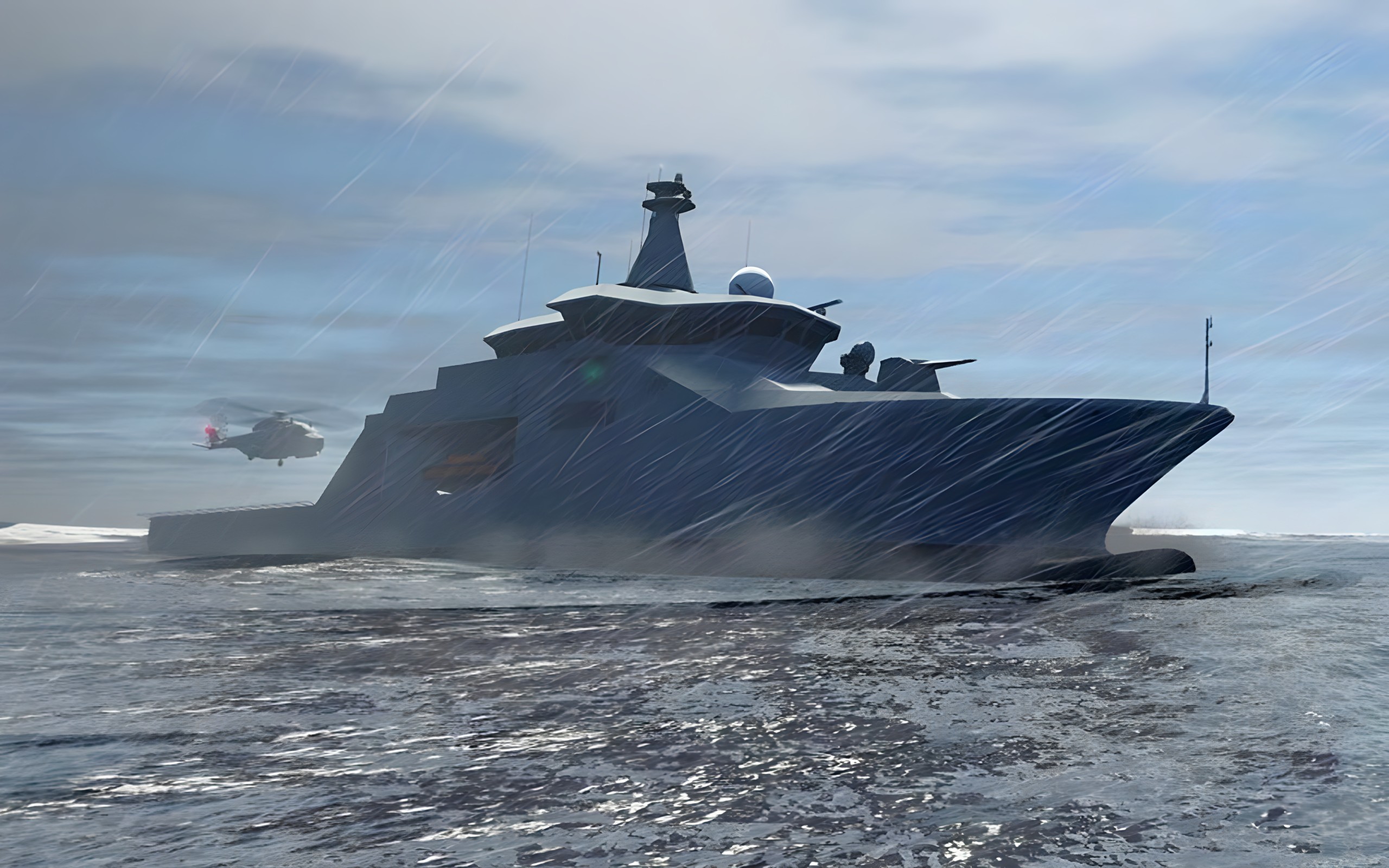
Britain has confirmed it will buy three Norwegian standardised vessels as motherships for the Royal Navy’s uncrewed mine-hunting systems, with the first due in 2031 and an option for three more, according to the Ministry of Defence.
Wes Streeting, the Defence Secretary, and his Norwegian counterpart, Tore O. Sandvik, confirmed the commitment at the Atlantic Future Forum in Oslo on Thursday. The agreement sees Britain join Norway’s P1118 Standardised Vessel Programme, with the ships, known in the Royal Navy as Offshore Support Vessels, delivered through the government-to-government Maritime Capability Partnership Framework between the two countries.
The MoD says the globally deployable ships will make the detection and disposal of sea mines safer, quicker and more effective, keep sailors further from danger and support anti-submarine warfare on NATO’s northern flank. An additional £90 million was set aside in the Defence Investment Plan for the purchase, and the deal forms part of the Type 26 export agreement with Norway.
Streeting said: “This deal strengthens our ability to protect freedom of navigation, which is critical to our security and our economy.
“By using the biggest sustained increase in defence spending since the Cold War to put the latest modern technology in the hands of our Sailors, we are helping to keep them safe and ensuring they have the tools to protect our shores.
“This agreement also shows how the UK-Norway partnership helps both our countries, and our allies, meet the challenges of a more dangerous world.”
Sandvik said: “The United Kingdom’s procurement of Norwegian Standardised Vessels will further strengthen our strategic partnership, rooted in the Lunna House agreement. Operating similar platforms will enhance our navy-to-navy cooperation and further improve our ability to operate seamlessly together, protecting and safeguarding NATO’s northern flank.”
The Royal Navy’s ships will be drawn from the same family as Norway’s future fleet, after the Norwegian Defence Materiel Agency picked Kongsberg Defence & Aerospace and Salt Ship Design earlier this year to design up to 28 standardised vessels for the Royal Norwegian Navy, replacing more than ten existing classes with one common, modular platform, and Norway has also agreed to deliver standardised vessels to Lithuania.
Alongside the deal, the MoD announced an £8.8 million contract for TKMS ATLAS UK to maintain and repair the Royal Navy’s autonomous mine-hunting systems, including the underwater and surface vessels and their command and control equipment, for an initial three and a half years, sustaining around 40 UK jobs.
The MoD said the threat from sea mines has been brought into sharp focus by Iran’s illegal mining of the Strait of Hormuz, which has caused major disruption to global energy trade. Norway agreed its £10 billion purchase of Type 26 frigates in December 2025, Britain’s biggest warship export by value, which the MoD says supports 4,000 jobs across the UK supply chain, including more than 2,000 at BAE Systems’ Glasgow shipyards.
The UK Defence Journal reported earlier that Britain had joined Norway’s mine warfare mothership project and planned to buy three, and Kongsberg has joined the bid to build Norway’s new vessel fleet.







Why from 2031? What do the RN do in the meantime?
All good stuff, but 5 years! Are they T26 in disguise?
Backloading budgets.
New government will come in and annoyed these were all unfunded.
Five years also gives plenty of time for lots of “if only we could add this” from The Good Ideas Committee.
Obvs we have to be ready to fight in 2030….using a TARDIS to port capability back in time….
Norway are only getting their first in 2030. If construction on the first begins next year, is four years for ours really that long to wait?
I took these to be simpler types, based on north sea / arctic support vessels, so the build time surprised me with build starting next year.
I also don’t have a clue about Norways current MCM capability, but assume, unlike us, they’ve not thrown the bulk of it away chasing short term savings.
So have something to use beyond a handful of Hunts and the first RNMB USVs with no deployable mother vessels. Maybe they have?
Navy Lookout gives a good impression what these will look like though, good stuff.
2 x mine hunter and 2 x mine sweepers, they also have a “Mine countermeasure command vessel” which is really a ex Coast Guard ship.
Thanks. Our remaining few Hunts are gone by 2031, we really think these will be in service by then and no gap incoming. I don’t. 🙄
unless the autonomous mine-hunting systems are deployed from other ships in the meantime it would seem to be an issue
Yeah, that’s fair. The image had me thinking these were going to be more like small warships.
The Vanguard variant the RN had on their website was a sort of hybrid, it had an OSV type working deck but enclosed. A good arrangement, better than either an open deck or the amidships mission bays with less capacity.
“The same thing we do every day. Find ways to save £100m.”
That is then spaffed away on Hamas aid…
Shh, don’t upset the terror supporters, they’re everywhere now including in government.
What absolute contrived nonsense.
Says Labour Party Central
Clearly they are exceedingly stealthy.
Sadly the Norwegians are not planning to sign the contract for construction until late 2027 with vessel one commissioned in 2030.
Mate, I imagine we can say goodbye to HMS Stirling Castle, so in effect this will be an increase of only two MCM Motherships. This seems pretty thin IMHO, I predict they’ll fund these buy cutting back on future River class OPV’s replacements.
They’d bloody better not mate, it’s already farcial, talk of spending and bits of the military dropping with no replacement.
My understanding was that Stirling was for UK waters and the 3 mothers deployable.
I thought the point of Stirling Castle was that it was an experimental testbed for these technologies whereas these new OSVs will be employing technology that will be mature in 2031.
Hopegully that would mean that Stirling Castle would then be testing whatever the latest technology is at that time.
Cheers Mate. Do refer to DM,s comment above – it seems Stirling Castle will still be around.
DM,
2031 is the deadline for retiring the Royal Navy’s last five 1980s-built Hunt-class minehunters. The new motherships are timed to arrive just as those older hulls bow out.
Until 2031, the Navy is bridging the gap with a mix of platforms, HMS Stirling Castle handles home waters and drone trials, RFA Lyme Bay acts as an expeditionary stand-in for high-risk overseas missions like the Strait of Hormuz, and the remaining Hunt-class vessels cover local duties until they phase out.
I don’t understand your T26 in disguise comment, these are mine hunters, not sub hunters.
Morning M.
Yes, fully aware, another reason the 2031 date concerns me, gaps incoming if these are not built and in service as our handful of Hunts go.
The T26 comment? Ha. My original angle as explained in my conversation with Leh, I thought these were essentially commercial types militerised from long standing designs that would be quick to build.
The T26 as we know, 9 years and counting for a single Frigate.
Thus the T26 remark.
You know the answer mate, no money to fund them. The first Sea Lord is talking the talk, as is the government, both know their hybrid Navy, Norway Naval pacts etc are effectively unfunded, with fingers crossed, hopeful for 3% ish, one day, possibly, maybe…
So we keep seeing ‘from 2030’, when it won’t be their problem. I do genuinely worry for the Army, because even at 3%, the wholesale rebuilding and modernisation of the RAF and Navy will be exquisitely expensive, I can see the Army being very much the underfunded partner out past 2035, with it’s plans cancelled, deferred and watered down.
We will start seeing a lot of ‘ Capability X, introduced from 2035’ regarding the Army, as it’s funding is redirected.
Agreed.
Absolutely John. The army has a mountain to climb to fill the many equipment gaps but nothing like the procurement budget to do so over the next decade, let alone 1,000 days. It constantly seems to be the sacrificial lamb when th3 defence budget is shared out.
Given the likelihood of needing boots on the ground in Eastern Europe in the not-too-distant future, versus taking on the decrepit and outnumbered Russian Northern Fleet, we seem to have our warfighting preparations and strategy ar*e about face. I think we really need a ‘Save the British Army’ website as a pressure point, to match the RN’s skilful and successful public and private lobbying efforts.
The Navy has one simple advantage: the politicians and senior civil servants can count up to and weigh a fleet of 52 ships and subs. I doubt that one of them has a clue about our airpower requirements, and not a scoobys about army organisation, firepower needs, CONOPS and fighting a land war.
The stop the Rot and rebuild requirements across the armed forces need 3.5% right now, even then it’s not enough, probably a sustained 4% through to 2040 is actually what’s required.
The SDSR should have been written with that in mind, instead, this ‘transformative’ review, was written and underscored with a 2.1% budget that was also carrying a huge overspend deficit!!
It’s a piss take…
We are in a shocking state accross the board as far as i can determine mate. The sheer number of capability gaps that we have allowed to proliferate in our forces structure is beyond concerning. Very few of these look likely to be closed by 2030, let alone enhanced upon.
For me, the Navy still needs to be prioritised and we need to start treating the security of sea trade lanes more seriously. That said, the Army could well be asked to step up by the end of the decade and there is much needed kit, and judging by discussions on this site, doctinal changes before we start asking them to mix it up in Eastern Europe. You then look at the RAF and there can be no argument that airframes are required accross the board. It’s an utter shambles……
I think John has hit the nail on the head. 3% is an improvment, 3.5% is a laudable long term sustained budget, but the reality is we need to front load a lot of spend in order to get to a condition that is anything like suitable warfighting/defensive capability. As such we probably do need to be spending 4% for a prolonged period to get there.
Three? Were an island with global commitments, you’d think we’d be having 12 or something.
Let’s hope we don’t drop the options for the other three.
It’s good to see some forward momentum, though very disappointing to see long timescales and small numbers.
I love a good confirmation confirming what HMG has previously confirmed though. Have we actually ordered them or confirmed that we will?
We have “confirmed the commitment.”
Hope we order 3 more of another type to replace the Rivers.
Though that’s not happening with these, just re reading NL and it’s confirmed that Norwegisn vessels will not replace the Rivers.
Not ordered yet as the construction contract is for the Norwegian government to sign and they are not signing that till late 2027.. essentially though the government has committed to a 3+3.
Agree with you. Having 3-4 new Opv for B1 replacements for UK regional would give more visible presence and utility and could even support drone and helo/uav patrols. Free up even the T31s and B2s! Keep the B2s doing what they’re doing out in the world and build on presence with T31s. They’ve got to be good value and providing soft power and humanitarian aid.
I do think the new unmanned AA/ASW hull should be lean manned , to allow them to be used as suitably equipped armed Corvettes when required.
A highly automated, lean manned (12 ish) crew would make the proposed complex AI automation unnecessary.
Not the T94 though, I wouldn’t suggest manned midget Submarines!!!
3, with an option for 3 more. Still not great but the MCM USVs can operate over the horizon, they can work over a much larger area than our current systems. Can’t be in two places at once of course but we tend to operate MCMVs in groups anyway.
So Norway needs well over twenty but we only need three to six. Am I missing something.
Yes, you are missing something!
The Norwegian order will currently be for 6 P1118s. 4 for their coast guard, 2 for their navy. The rest of the initial order is 3 for the UK and potentially 2 for Lithuania, if they can afford them. So the initial orders are for 9-11 ships.
There are options for another 9 in the future, 4 for Norwaya, 3 for UK, 2 for Lithuania.
So if Lithuania finds the money and everyone takes up their options, there could be 20 ships some time in the future. Right now, the confirmed order book is 9.
So, these ships will assume the role that was intended for Lyme Bay in the Hormuz strait, right?
Maybe. It depends on the armament and survivability, to be honest. The RN might still feel more comfortable loading the drones onto a Bay, or in the future an ATS, and moving them that way.
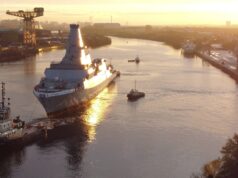
Well if they turn out to be anything like the ship in the image then at least it would seem that they are going to have a semi decent gun.on the front so will also have a useful secondary constabulary role or at least be able to defend themselves too a degree of we choose to send them somewhere tasty like the Gulf . A BAE 57mm would get my vote but I’d also be happy with a Bofors MK4. For once some genuinely very good news I believe.
The early concept pictures from Norway have a 57mm and NSMs.
I think Norway are holding a competition. The Ulstein offerings are inverted x-bow designs based on their offshore support vessels.
All these purchases are whittling down the T26 sales income…
Norgie masts
Norgie NSMs
Norgie boats
What have I forgotten?
I know, it’s mental. I would’ve rather we’d not bought anti-ship missiles for our ships. And come to think of it, I’d rather we didn’t buy masts for our ships either.
Ho, ho, ho, nice wind up. FAIL.
The point is that much lauded defence contracts detailing billions in Industryvewrning income are not clear cut and worth nowhere near as the headline price.
Because we then spend that money on other capabilities? I’m sorry, but this seems farcical.
Dimwit,
… Name confirmed.
The financial scale is extremely one sided in the UK’s favour and two of those three items were bought for separate operational reasons long before the t-26 deal was signed.
The t-26 frigates sold to Norway is worth roughly £10 BILLION … £10 BILLION … £10 BILLION to the uk economy and supply chain. Did I mention its value of £10 BILLION? the planned P1118 motherships bought from Norway is worth £90 MILLION … roughly 0.9% of the t-26 deal.
NSM’S bought back in 2022 for roughly £200 MILLION roughly 2% of the t-26 deal, three years before Norway selected the t-26, because the Royal Navy urgently needed an interim replacement for its obsolete Harpoon missiles.
The composite masts were contracted years earlier as a commercial sub-component for the Royal Navy’s own t-26 frigates because Norwegian firm Umoe Mandal is a specialist in lightweight stealth-composite naval structures. Composite superstructure modules are a relatively small structural subcontract compared to the roughly £7.9 billion combined build cost of the eight Royal Navy Type 26 frigates, typically measured in the tens of millions of pounds across the full class rather than hundreds of millions. And with Norway ordering at least five t-26 frigates of its own, Umoe Mandal will also build the composite masts for Norway’s ships as part of its domestic industrial share.
When a country spends £10 billion on foreign warships; Norway’s largest defence purchase in history, its parliament almost always demands industrial cooperation or offset agreements so that some economic value flows back to its own defence industry. Without agreeing to buy Norwegian equipment in return, BAE Systems in Glasgow would almost certainly have lost the t-26 contract to German or French competitors. Even after factoring in the £90 million P1118 mothership order and other industrial partnerships, Britain still comes out billions of quids ahead, while getting specialist equipment the Royal Navy genuinely needs.
… I should add that the total cost for a P1118 is considered at around £75 Million per hull. The entire 3 hull acquisition is estimated at roughly £330 million (£110 million per hull). Subtracting the UK’s own post-delivery naval fit-out, sovereign communications, training, and initial support package leaves roughly £200 million to £250 million payable directly to Norway for the 3 baseline ships, of which the UK’s newly announced £90 million covers the 2026-2030 down payments. Represents roughly 2% to 2.5% of the £10 billion Norway is paying the UK for its Type 26 frigates.
Play the ball, not the man.
… ya kidding right? You posit a vacuous idea and expect it to sit unchallenged. I played the ball, the timeline, the contract dates, and the £10bn-to-£250m ratio are all right there above. Feel free to address any of them, though I notice that you didn’t.
I made a quick play on your self-deprecating handle, I consider that fair game, especially when presented on a silver tray.
Take 5 mins to assess your thoughts … a 5 minute search before posting would have saved you the trouble.
Well tosser, I took your advice.
According to OSINT, approximately 33% of the T26 contract is from foreign suppliers which means that the figure you keep repeating – ad nauseum does not make it right – is not quite the truth. Now on add on that contract for motherships and the percentage goes even higher.
So rather than jumping in with both feet next time, perhaps you should take a moment. Now please do foxtrot oscar.
Sorry mate been busy out of town bush bashing around Meryla State Forest, Southern Highlands, NSW (look it up ) … we failed on the track; way too wet, a little bit too technical. (fyi ‘bush bashing’ is 4×4 off roading; not a sexist vulgarism 😈)
Anyway… calling “OSINT” on a vague 33% figure doesn’t make the maths work, because you are conflating three completely different things … Global Tier-1 sub-systems, Norwegian industrial offsets, and a separate Royal Navy ship purchase.
Every Western warship uses global Tier 1 equipment. On a Type 26, the non UK content is overwhelmingly American kit, the Mk 41 vertical launch cells, the Mk 45 5-inch gun, and the GE LM2500 gas turbines, which Norway would have bought whether it chose a British, French, or German frigate. Even if you take your 33% figure at face value, that still leaves roughly £6.7 billion flowing directly into BAE Systems’ Glasgow shipyards and 432 UK suppliers, sustaining 4,000 British jobs into the 2030s.
You cannot simply “add on” the £90 million P1118 mothership deal as if it were a cash rebate handed back to Oslo. It comes out of a separate Royal Navy equipment budget and buys Britain three brand-new, physical warships to replace aging mine-warfare support vessels like RFA Stirling Castle and keep sailors out of minefields.
Even if you subtracted every penny of that £90 million directly from the £6.7 billion UK domestic share, you are talking about a 1.3% dent, hardly “whittling down” Britain’s export income!
In the real world, no foreign government spends £10 billion on warships … Norway’s largest defence purchase in history, without two-way industrial cooperation. Getting £6.7 billion of direct UK shipyard work plus three modern mine-hunting motherships for £90 million isn’t a bad deal; it is how major defence exports actually work.
Even on your own maths, Britain still comes out BILLIONS of pounds ahead and gets three new ships into the bargain.
Romeo Tango Bravo…watchkeeper’s worried you’ve lost your bearings.
three is a good number, our MCM capabilities can and will be deployed from land and air. These ships are simply an additional tool to carry them into certain locations. It was also daft trying to shoe horn some river class replacement in to the same project.
Minesweepers are a thing of the past and as we have seen in Hormuz a vessel like the Hunt or Sandown classes are close to useless and a danger to their crews presenting nothing but a target for the enemy both inside and outside port.
Now what the UK needs to get is a nice simple cheap cutter/opv style vessel that can be deployed in numbers to provide the manned component of our patrol requirements and replace the Rivers along side the krakens.
Jim
The Norwegian P1118 vessels are unlikely not become Royal Navy OPVs because they are built for slow moving drone support rather than high speed patrol, and ordering foreign built patrol ships would be politically toxic.
Published Norwegian tender specs show a 90m, wide-beamed commercial style OSV with an 18 – 20 knot speed, designed to hold steady in rough seas like HMS Stirling Castle, rather than sprint at 20- 25+ knots to intercept vessels like a sleek River class OPV. Official concept renders from Kongsberg and Salt Ship Design also show a forward bridge and an open rear deck packed with ISO containers, heavy cranes, and drone launch ramps, rather than the helicopter flight decks and fast boarding boat davits needed for patrol work.
Built “as civilian as possible, as military as necessary”, they lack warship survivability and integrated naval gun mounts. More importantly, the £90m order is strictly ‘ring-fenced’ to replace retiring minehunters from 2031 as a small offset for Norway’s £10bn Type 26 frigate purchase.
Buying foreign hulls to replace British built OPVs would spark fierce backlash from UK unions and MPs, which is why the MoD has a separate £200m pot to look at options for the 2028 OPV gap. With £200 million, Britain is probably not getting three traditional new warships; “plans by capability rather than platform-for-platform replacement”. Instead, I would expect one or two leanly crewed, commercially derived British-built OPV’s, built around boats and helicopter drones, paired with a permanent fleet of uncrewed patrol boats, backed up by shuffling existing B2 OPVs back to home waters when needed and the t-31’s come online and replace the B2’s overseas tasks.
Sorry, that first line should read … The Norwegian P1118 vessels are unlikely to become Royal Navy OPVs … scrub the “not”.
The type 26 offset agreement with Norway is a terrible deal for smaller British shipbuilders like Ferguson marine and Balaena who could easily build vessels the size of the P1118 Standardised Vessel Programme, if it can be built in the UK it should
Ferguson builds T26 blocks. The T26 deal brings them regular, high-level work.
It’s funny Mr Anderson because they ship yards you mention are all building blocks for the Norwegian T26 program.
I actually think we SHOULD be buying foreign (and ideally off-the-shelf) for several reasons.
For starters, a laissez-faire attitude by multiple governments seems to have landed us in a situation where everything is incredibly expensive. Our workforce is so demoralised, so burdened by relentless targets and criticism, there’s so much red tape, that our productivity sucks; I doubt many people here expect a shipbuilding programme initiated here to run on time and within budget. I also suspect corruption plays a far bigger role in cost over runs and poor procurement than we are told.
We need bulk, not everything has to be AAA gold-plated, not everything has to be put off for 10 years, just get some hulls in the water.
(Except our current government has spent the last 2 years calling us vile racists whose flag is a symbol of hatred, so predictably no-one wants to sign up to the military)
Good call, in an ideal world it should make commonality with Norway a common theme, with the T26 etc, however the timeframe for these are yet again too far into the future, with none of the money yet available and very easy to be binned depending on who wins the next election. Jam isn’t even tomorrow its so far in the future the berries haven’t even grown yet!!!
Selecting the Norwegian OSV is a good move.. They have been working up the design and specs to the point of placing the order within a year. They are much further ahead than we would be if we started from scratch with a minor yard doing the building.
Part of the Norwegian plan is that the P1118s can be built overseas if required. Still, I think we are locked into building then in Norway, as a little trinket to offset a slice of the T26 cost.
UK rule: all Royal Navy warships must be built in the UK ..
.. unless we decide different.