

The Ministry of Defence has cancelled its competition to secure a through-life support solution for the Royal Navy’s five Type 31 frigates, according to a contract notice published on the Find a Tender service.
The notice, issued on 22 July 2026, announces the abandonment of the Type 31 Through Life Support procurement, which had been advertised on the Defence Sourcing Portal and Find a Tender in November 2023. The MOD states that the notice is for the purposes of transparency only and does not constitute a request for expressions of interest.
The competition had sought management and through-life support services for the five Inspiration-class Type 31 frigates over a minimum eight-year period, with two additional one-year extension options, run under the Competitive Negotiated procedure of the Defence and Security Public Contract Regulations 2011. In setting out the reasoning, the notice states that “changes to the programme context, commercial practicality, and enterprise support planning mean the assumptions underpinning the current T31 TLS competition no longer hold.” The MOD adds that “continuation is therefore not judged to be in the NA-M DM Contracting Authority’s best interests and a decision has been made to cancel further activity against this requirement.”
The support solution had been intended to sustain the availability and operational service of the Type 31 fleet across a range of tasks. According to the original notice, the requirement covered the management of maintenance, the supply chain, design services, engineering services, support information, and safety, environmental protection and security, alongside overall management of the service. The original description set out that the frigates would sit “at the heart of the RN’s surface fleet, deterring aggression and maintaining the security of the UK’s interests,” working alongside allies to “deliver credible UK warship presence across the globe.”
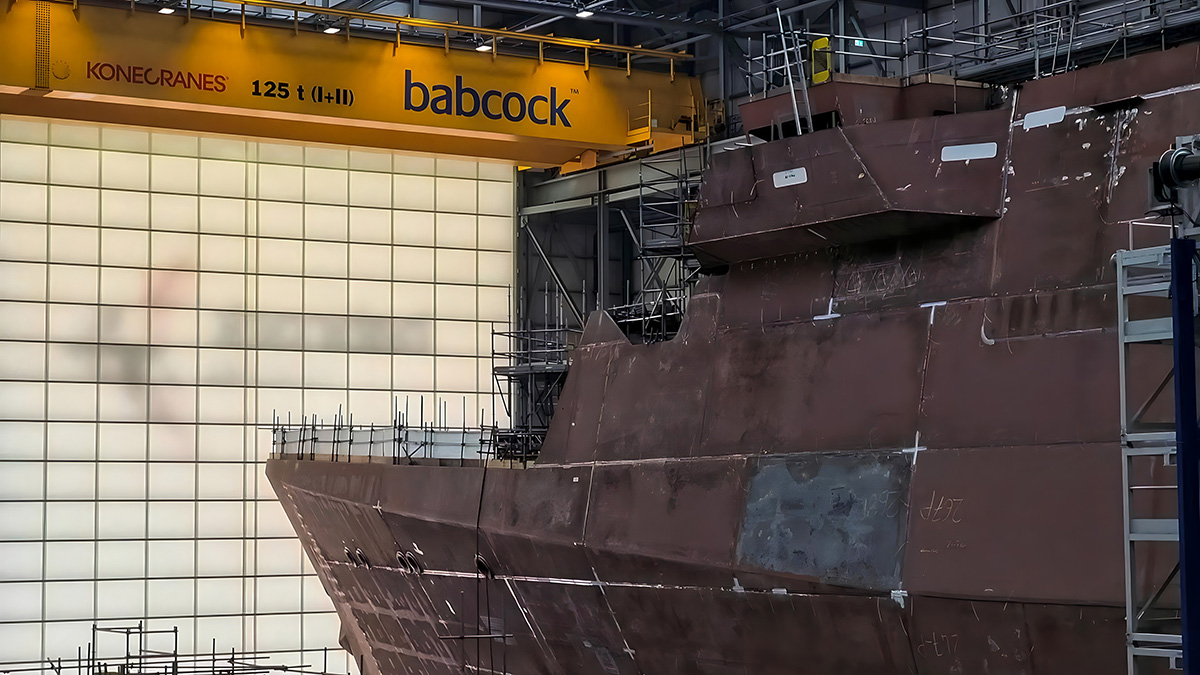
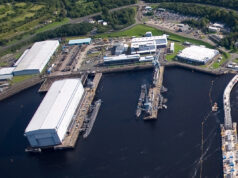
The Type 31 programme is being delivered by Babcock International at its Rosyth facility in Scotland, where the ships are being assembled under a contract awarded in 2019 for a class based on the Arrowhead 140 design, itself derived from the Iver Huitfeldt-class frigate operated by the Royal Danish Navy. The lead ship, HMS Venturer, was floated off in 2023, with the remaining four vessels, Active, Formidable, Bulldog and Campbeltown, at varying stages of construction. The class is intended to replace five general-purpose Type 23 frigates that have served the Royal Navy since the early 1990s.
The notice describes the frigates as flexible and adaptable by design, undertaking missions such as the interception and disruption of those using the sea for unlawful purposes, collecting intelligence, conducting defence engagement and assisting those in need. The abandonment of the through-life support competition leaves open the question of how sustainment for the class will now be arranged, with the MOD having indicated that its approach to enterprise support planning has shifted since the requirement was first advertised more than two and a half years ago.




In other words the Type 31 program is getting canned.
Yet another cut dressed up as a pivot to something nonexistent…
“changes to the programme context, commercial practicality, and enterprise support planning mean the assumptions underpinning the current T31 TLS competition no longer hold.”
Does that mean that T31 no longer sits “at the heart of the RN’s surface fleet, deterring aggression and maintaining the security of the UK’s interests,” working alongside allies to “deliver credible UK warship presence across the globe.”?
Could be wrong but I would read that to mean that the River 2s will stay with their global deployments, will not be replaced by T31s in that role and will not be the batch 1 River replacements. Maybe the first batch of T31s with Mk41 and NSM will be prototype CCVs deployed closer to home?
Could be that they did such a poor job of defining the requirements of the tender that they decided to tear it up and start again. Capable managers and commercial staff are expensive and government in general doesn’t like to acknowledge that reality.
Fair comment. The article does say that the ‘approach to enterprise support planning has shifted’. This could be code for tear it up and start again.
No I think it is simpler than that.
They are expecting the T31s to evolve rapidly over their lifetime thus making it virtually impossible to define what is expected of the contractor.
If they want something done – they will simply request it and probably pay a daily rate.
This also suggests that the procurement rules might also be evolving.
Whilst I can see many on here will expect everything to play out the way it has always done it seems likely that change must come sooner or later. Perhaps this is the start – we can only hope.
The problem with a daily rate approach is the nobody will be trained up and available, because who’s going to take the risk to keep enough people on the books? Instead the smart commercial approach is to keep the minimum number that you are fairly sure will be called on, and overcharge anyway. So when you simply request it and look to pay a daily rate, the simple response might be, we can fit you in around 2 years from now. And that’s assuming there are drydocks available.
Paul.P,
Yep, you are wrong, the t31’s are not replacing the Rivers, they never were. t31’s are replacing the t23’s.
Back in 2019 the order for 5 type 31 was a strange decision.
I know money was tight at the time.
I just don’t get the thinking behind it. If it was to work along side the type 26 and wider extension of a carrier group I get that. Why only 5..
Whoever thought they knew how a carrier group works were totally wrong. A carrier group relying on a type 26 alone doesn’t work carrier group needs more type 31 than a 26 type 31 is a multi use. Frigate in reality you need double the amount of 31 to 26 not the other way around. Minimum requirement for the type 31 has to be 12 especially now the labour government has scrapped the type 32..
Now they do not understand obserlecence how it works you need to have obserlecence any programme big or small so cancel it is totally and utterly wrong.
I have worked in this field and without obserlecence no problems can be solved and extend the life of any product
Frigate numbers fell to 13 when the 4 T22B3 were cut in 2010.
HMG always seems to work to the new low “benchmark” as an acceptable “target size” to get to with replacements, no doubt due to starving the forces of money.
13 GCS were thus required, which became T26.
13 Frigates were promised to Scotland at the same time.
13 T26 was deemed too expensive, so they reduced to 8.
There are your 5 T31, making up the 13.
I agree, by 16 for general tasks as more GP assets leaving T26 T45 to do the core roles.
Not happening with the advent of LUSV.
It might still happen with the LUSV, cos the LUST might turn into very expensive small boats that can’t hack it in the constant mission of the sea to destroy the ship the moment you put it in the water… And without humans abord for maintenance and upkeep… Likely will be accelerated and spend more time in Drydock.
Back in 2019 I think they were simply exploring the concept of getting 5 ships for the price of one.
I’m not sure they know what they would use T31 for ultimately. This talk of drones has clearly got everyone thinking and I’m not sure that the rule book hasn’t been thrown in the bin. New plans are probably being scribbled on bits a paper only to end up in the shredder. We will see.
I suspect you are right. Technology, threats, budgets are all so fluid they are winging it. But that’s ok. The good news is that Arrowhead 140 was a smart decision. We would have fewer options had we gone for the ‘Avenger’ or ‘Leander’ proposals.
I wonder if this means they will be sold when drones arrive. T31 always have been an oddity, armed more like gunboat than a multi mission ship.
I was thinking that. Cash them in and waffle about CCVs, Job done. HMS Obfuscation class lead. They can play this indeterminately.
They start off as patrol frigates. If they get the Mk41s and NSMs as promised, they become an ASuW frigate. Add a second more powerful radar (might need some changes) and they have second tier AAW as well, becoming properly multi-role. I know I simplified it, but the A140 family antecedents are there.
But can an a LUSV smell the coffee as it cruises through the SCS? Maybe but a man with a spanner has his uses. My guess is these remotely based boats will have a small crew of up to 28 men as watch keepers etc. although for high risk missions the will be completely autonomous. They are going to be too valuable to let off the leash alone. if off Somalia or Calais a strange vessel comes close, do they warn and then open fire? No, that would be unacceptable you would have thought.
They might be resetting the tender to incorporate the technicalities of the VLS and other assorted kit, power and cooling, CMS, Magazine and Handling Safety Systems, and Complementary Weapon Pairing systems (NSM). Equipment not accounted for in the original tender request.
The Type 31 is slated to carry advanced surveillance equipment like the Thales NS110 4D active electronically scanned array radar. When you modify a ship to handle heavy strike missiles like the Mk 41 VLS and long-range anti-shipping/land-attack weapons, the combat management system, target acquisition architecture, and cooling/power grids all have to be scaled up to match. Every single one of these capability creep decisions, moving away from a cheap, basic patrol ship toward a heavily armed multi-role frigate, compounds the engineering and logistical headache, which might explain why the MoD’s original support and maintenance framework stopped making sense.
In 2021 these ships were meant to be FFBNW, overtime that has changed.
All these services should be bought back into the Rn rather than private sector leeches looking to get as much as possible for as little input as they can.