

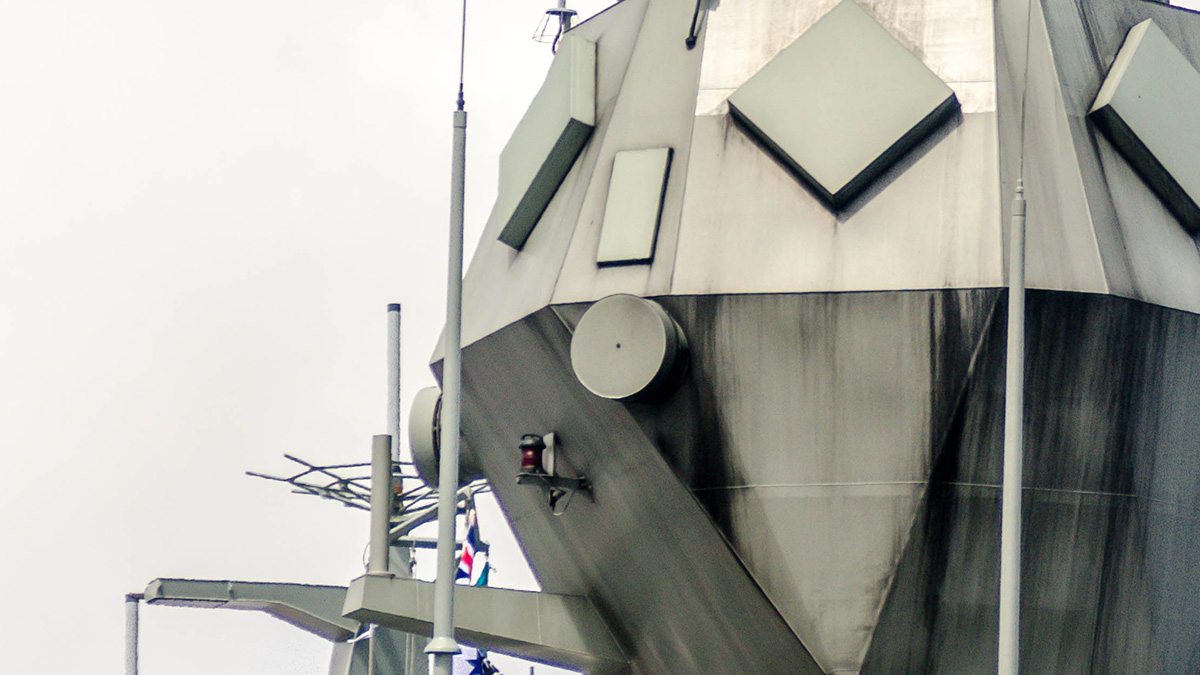
The UK is continuing to explore the potential use of Australian-developed Active Electronically Scanned Array radar technology on British platforms, following talks between defence ministers in London.
In a joint statement issued after the Australia–UK Defence Industry Dialogue on 23 February, ministers confirmed that cooperation on AESA radar technology had deepened since last year’s Australia-UK Ministerial Consultations. The statement noted progress on “exploring the potential of using Australian AESA radar technologies for the UK”, with both sides agreeing to undertake targeted risk-reduction activities to inform future decisions.
While no specific platforms were named, the language signals that the UK remains open to integrating Australian radar technology into future maritime or air programmes, subject to technical assessment and testing. The Dialogue, hosted by UK Minister for Defence Readiness and Industry Luke Pollard and attended by Australian Defence Industry Minister Pat Conroy, was revived as a formal mechanism to drive industrial cooperation and support delivery of AUKUS.
On industrial resilience, both sides committed to closer work on munitions and energetics supply chains, critical minerals and steel production linked to the SSN-AUKUS programme. The statement also highlighted efforts to improve frictionless defence trade, including mobility, security clearances and cyber standards. In relation to submarines, ministers welcomed the arrival of HMS Anson in Western Australia and ongoing work to integrate the Australian and UK submarine industrial bases under AUKUS Pillar I. They also reaffirmed their intent to accelerate advanced capability projects under Pillar II, focused on near-term warfighting objectives.









Not BAE’s future radar sets?
Is CEAFAR really that good?
It’s definitely good enough to be worth considering. I expect that we’ll probably go with BAE long-term, though. This is merely an admission that the option is on the table, not that it has been selected.
We need to go with BAE for this and we need to use the same system of panel based AESA radars for a land based system able to use Aster and CAMM
Its part of the dance for securing work. The reality of integrating an Australian radar not designed to work with the combat system is expensive. You hold talks so Australian politicians have something to announce. Nothing will come of it.
Would it be a more capable option for Type 31 down the line if CAMM MR becomes a thing which might require a more capable radar. As faster missiles enter service will a basic rotating set suffice?
It would be way overkill for that.
If you need better air volume search then the spot for the 1850 remains vacant.
I’d be surprised if we ended sovereign radar development.
The 1850 is software upgradeable as well if my memory serves me, it’s a great radar for its intended purpose.
It is, but it’s still a passive electronically scanned array (PESA), which has its limitations. Thales who make the SMART-L that the S1850M is based upon, have the SMART-L MM, which is now an active electronically scanned array (AESA). The MM version has a substantially better detection range over the PESA version. This is the version the T45s should be getting as it has a much better detection capability against ballistic missiles. The S1850M is still a very good radar, that could be used to increase the capabilities of the T26 and T31.
Thanks for explanation.
I know there is a train of thought that says Sampson is so good it doesn’t need 1850. But for me it does seem to be useful. Would certainly go well with either T26 or 31 & add capability to both I believe
Sampson is a very powerful radar. But it doesn’t have the same detection range that S1850M has. However, its main advantage is that it operates at a higher frequency in the S-band (2 to 4 GHz), whilst the S1850M operates in the L band (1 to 2 GHz). This may not look that different as the S is the following band, but it does mean the S band gets more affected by the atmosphere than the L band. Sampson will also produce a higher fidelity “image” of a target. As its natural beam width is tighter than L band. With AESA there’s also additional techniques you can do to make the beam even tighter. But in general, the higher the frequency the narrower the beam.
The S1850M is very good at volume searching. Yes Sampson can do the same. But the issue is when you find a target and want to get a better idea of what it is. Of particular of Sampson is still doing searching. The amount of signal processing resource allocated to working on the target is reduced. Whereas using the two radars in combination means Sampson can utilize its full resource to get a better “image” of the target. This is especially critical when dealing with small radar cross section targets.
This is why the two complement each other so well, similar reason the carriers have artisan and S1850Ms.
Thanks for explanation.
I know there is a train of thought that says Sampson is so good it doesn’t need 1850. But for me it does seem to be useful. Would certainly go well with either T26 or 31 & add capability to both I believe
Will we be getting the upgrade under Sea Viper Evolution? I hope so.
There are smaller versions of CEAFAR like the ones on Anzac; I’m not sure how powerful they are, though. The BAE pipeline is definitely the best option as they have some interesting stuff coming down the line, but it’s useful to be able to hold CEAFAR over their heads to avoid complacency now that the ‘buy Aegis’ threat is mostly off the table.
The picture in the article is an old CEAFAR 1 radar form a RAN Anzac frigate. The current RAN Anzac radar (not sure if all have been upgraded yet (BAE is doing the upgrade)) is the CEAFAR 2 which includes “L” band (CEAFAR 1 is S ( the diamond shapes) & X band (rectangular shape)). CEA state that theirs is scalable from corvette to destroyer (Hunter class having their destroyer type version). It is ASEA & usually six faced if fixed. T26/T31/T23 can’t get close to even the Anzac CEAFAR 2 radar. T45 is likely better in S band (dual faced rotating) due to height. Falls well short in L band (rotating PESA). Everyone thinks X band is all about semi active missiles, but it also appears that it has a place in ballistic missile defence (hence Hunter class appears to have upward pointing X band panels).
In short CEA a high end radar. Then again most high quality radar manufacturers have a range of radars. Thales T31 radar is far from one of Thales best radars. It’s the best that they could convince MoD to pay for. BAE do appear to have a rather constrained radar portfolio compared to other similar manufacturers (SAAB, Thales, LM, NG, Mitsubishi, CEA, Hensolt etc). BAE is one of those companies, that if pushed, can rise to the occasion. If left alone, it tends to under perform.
I would contend that CEAFAR vs S1850M is not a simple cut and shut case. On one hand you have a modern AESA (GAN based) array and on the other you have a mechanically rotating single sided PESA array. Both operate in the L band (1 to 2GHz/ 30 to 15cm wavelength)) and are used primarily as a volume search radar. Where the goal is to detect objects over 400km (250 miles) or further away.
One of the key metrics for radars that use an antenna array for beam forming, is its surface area and shape. As this in part governs the gain of the antenna, i.e. how much it can amplify the signal being transmitted or received. The larger the area the greater the amplification. But it also determines the overall shape of the generated beam. CEAFAR uses a squared diamond array, whilst the S1850M is a rectangle. To make the beam more circular, you need an equal number of antenna elements in both the X and Y planes (conversely also in the diagonals). As the equal number helps to squish the beam evenly. So in this sense the CEAFAR should generate the more circular beam. Whilst the S1850M will generate a prolated beam (think rugby ball placed on its end). Which means the more circular beam will contain more concentrated energy, whereas the S1850M’s will be more spread out in the vertical plane. As the atmosphere attenuates the signal as it passes through the air, having the majority of the signal concentrated should extend the range.
As far as I’m aware a CEAFAR2 L-band array is made up using 8×8 modules, arranged with 6 panels on a hexagonal mast, that then is used in 60 degree sectors, to cover the 360 degree field of view. I believe the modules will be bigger than the 30cm square S-band module, probably closer to double the size. Which as a rough guess would make the surface area around 23 square metres per panel.
The BAES/Thales S1850M based on the SMART-L, has a antenna array dimension of 9.2 x 4.4 x 3.7 m (according to the data sheet, some publications say its bigger) which gives a surface area of at least 40m squared.
Without going into the efficiency advantage that AESA gives you, the S1850M should be able to transmit a lot further than a single CEAFAR2 panel, as it uses an array with a much bigger surface area (nearly double). But does CEAFAR use cooperative panel beam forming? Normally for this to work the panels have to be about half a beamwidth apart, i.e. 15 to 7.5cm. But all the images shown, show that the panels are a lot further apart. So I’ll leave that option open. But what CEAFAR2 does allow you to do, is transmit and receive simultaneously in 6 independent compass directions. Whereas, the S1850M can only transmit in the direction the antenna is pointing at any given time.
But its not as simple as that as you have the time equation (T=D/S) to consider. Where D=400km and S=c (speed of light in air), which equals 1.33 milliseconds. Scaled up to 600km equals just over 2 milliseconds. But we also need to factor in the speed of the object and the distance travelled between each radar transmission. An object travelling at Mach 3 (1029m/s), is roughly covering a kilometre every second. At Mach 6 (2058m/s), just over 2 kilometres per second. If the object is detected at 400km and is covering 2 km/s. In a minute it would have covered 120km. In 3 minutes 20s, the object will have reached the radar.
As the transmission takes 1.33m/s to reach the target and another 1.33ish m/s to return. The S1850M rotates fairly slowly at 12rpm, so rotates once every 5 seconds. But as the transmission and return only takes 2.66ish m/s, at this distance the antenna’s rotational speed is not a major factor. But as the object gets significantly closer, then it becomes a factor. As the slow sweep of the antenna exacerbates the radar’s dead zone. But then on a T45, it uses two Sampson AESA arrays placed back to back, that rotates at 30rpm or once every 2 seconds or as its using two faces the field of view is updated once every second.
I’m not sure using 6 smaller fixed arrays has a significant advantage over a rotating array. When the main requirement is to detect objects that are 400km or more away. By concentrating the array into a much larger rotating panel, you can transmit further and detect much weaker signals. However, when needing to track objects that are much closer and determine what they are, to generate a missile solution. A higher frequency radar, using fixed AESA panels will have an advantage. Because you want to maintain the track and constantly update it, in case the object does evasive manoeuvres, deploys countermeasures, or deploys child objects. A rotating antenna will always have a following dead zone. Where a computer uses predictive software to maintain where it thinks the track is heading, which then gets updated every illumination. Sampson does to a degree mitigate this problem. as it can steer the beam left and right on each panel, effectively narrowing the dead zone. But not completely removing it!
Thales already have a longer range version of the NS110 radar used on the Type 31, the NS200. It would be the lowest risk and most straight forward upgrade, and a rotating single panel is cheaper, less power hungry and lighter than a multi-panel system, which is important when you’re trying to mount it as high as possible. The downside of course is that you can never have true constant 360° coverage, there is always a blindspot behind the radar.
this prevents BAE from getting too complacent. There is an alternative
Yeah, that’s one angle of it. Prevents BAE for robbing the MoD.
That was part of the thinking in giving Babcock the T31 too.
Dare we mention Ajax in this argument.
No argument here 🤷🏻♂️ …though there was a rumour that this was why GD’s ASCOD was chosen over BAE’s CV90.
I’m just waiting for China to turn off the AESA production button and make everyone buy their radars..
I find it bizarre in the extreme that essentially the west and especially the US has let itself become totally dependent on China for a core technology.. fundamentally modern radars don’t function without Gallium and China produces 93%+ of the worlds Gallium… because it produces most of the world’s aluminium.. the US produces exactly zero primary Gallium and has to import 15 metric tons a year from China.. China produces 94 metric tons a year and Japan, Korea and Russia 10 metric tons total.
One thing the EU has done which is massive is develop it own gallium production.. so as of next year Europe should be producing 5-10 tons.. lucky because Greece still has a large
But the massive removal of aluminium production from Europe and the US to China ( 48 million tons) and Russia ( 4 million tons) means that the US only produces 600,000 tons of aluminium and Europe 1 million tons… China produces 94 tons of gallium from its 48 million tons of aluminium production.. the maths is easy.. the lesson hard..
Defence is utterly dependent on heavy industries.. out source and destroy them and you destroy you ability to defend yourself…
There’s a massive difference in signal processing between Chinese and Western radars. Building large numbers of not very good radars doesn’t actually make something competive.
Yeah, but being able to cut off all the competition does tend to make your radar fairly competitive, which I think is what the guy above is getting at.
Seems that the US is pissing if everyone who provides it with vital raw materials, tungsten from Canada is another example. Canada and Australia seem to be working together now to hang the supply of vital raw material supply over US heads while prioritising Europe and others, that sort of thing is only going to get worse now that threats have predominantly had the opposite effect to that planned by Trump.
I was not really suggesting that we should consider Chinese radars I was pointing out the the west had put itself in the position that china could cut a critical raw material an essential stop western production of radars until we had rebuilt both aluminium and then gallium production.
In recent years Australia has taken stock of what rare earths/energy metals we do have and the results are, quite a lot. In fact, heaps. The hard part with most of them seems to be the cost of refining, and mechanisms are beginning to be put in place to support this for various miners and producers. We’ve now got increased access to US capital markets after agreement with US, and our PM has floated a critical minerals stockpile as a bargaining chip in international negotiations.
Yep most places actually have plenty of Gallium the issue is only really China and Russia have big enough aluminium end to end production to make Gallium refining economically viable and because China produces 93%ish of the world’s supply it can essentially manufacture the price to make it unviable for others to start refining unless they are willing to take the risk of China collapsing the market..so essentially a nation would need to invest in gallium refining at risk so creating it as a nation security and sovereignty asset and not an economic one and as yet western nations have all been running on neoliberal economics.. which has allowed China to scragg western strategic industries and critical extraction while building its own…
China actually has relatively low-grade domestic bauxite reserves, about 700 million to 1 billion tonnes. Because their own “dirt” is running low or is poor quality, China actually imports the vast majority of its raw bauxite from Guinea and Australia.
But now, Australia, with 3.5 to 5 billion tonnes in the ground and approximately 2.7 billion to 3 billion tonnes of bauxite residue (red mud) sitting in storage ponds. is now running two different businesses at once. The “Bulk” Business. Where we still ship millions of tonnes of raw bauxite to China. This keeps the Australian economy moving and ensures China’s massive aluminum factories stay fed.
And in parallel a “Boutique” Business, this is the new part. Australia is now siphoning off a portion of that bauxite to be refined at home into high-purity alumina and gallium. This “premium” stuff is being ring-fenced specifically for the US, UK, and Japan.
The New “Strategic Reserve” Rules. Through the launch of the $1.2 billion Critical Minerals Strategic Reserve. The Australian government now has the “right of first refusal” on the gallium and other rare minerals produced here. This means that while the Bauxite can still go to China, the Gallium is effectively banned from being exported to China. It is being diverted into government-owned stockpiles to be sold exclusively to allies for radar and missile projects.
However China is “Breaking Up” with Australia as well. China isn’t just waiting for Australia to stop selling to them; they are actively trying to stop needing us. In 2025, China’s imports of Australian bauxite actually dropped by about 6%.
They are pouring billions into Guinea in West Africa to build their own “sovereign” mines there. Their goal is to reach a point where they don’t have to rely on Australia for the raw materials they need to run their military industry.
While Greece, even with its recent 2026 modernization push, aims for a peak of about 2 million tonnes per year, Australia produces over 100 million tonnes a year, which is about 25% of the entire world’s supply.
greece expects a production target of 50 tonnes of gallium per year by 2028. To give you an idea of how much that is, the entire European Union currently consumes about 40 to 50 tonnes annually. So, Greece isn’t just looking to “help out” … they are looking to cover 100% of Europe’s current demand using their own domestic bauxite.
If we assume an average of 50 grams of gallium per tonne of Bauxite red mud, those 3 billion tonnes of waste contain roughly 150,000 tonnes of gallium. To put that in perspective, the entire world only uses about 700 to 1,000 tonnes of gallium a year. So, Australia’s “waste” piles alone contain enough gallium to power every AESA radar and 5G tower on the planet for the next 150 years. The $1.2 billion ‘Critical Minerals Strategic Reserve’ kicking in recently, the government is providing the cash to build the chemical plants needed to “leach” the gallium out of that mud.
That’s the thing, rare earths aren’t particularly rare. It just requires digging up and processing vast amounts of earth via strip mining which creates huge environmental destruction and only countries which either don’t particularly care or don’t have much of an environment to destroy are happy to do it.
Nope it’s all about the industry and you need to have that.. it’s pure self destruction in the end.. the west allowed china to dominate the markets and have essentially paid to create the Chinese industrial base while wasting away and disinvesting in their own.. now they can this and that all they want and suddenly start throwing money to try and rebuild their own sovereign industrial capacities back.. but you cannot change the past and go back and you cannot change the present… and the true is China controls the market on such things as gallium.. which has given it an unlimited supply for itself and a restricted supply for everyone else this has lead to supply issues and very high market costs ( more money to the Chinese war machine)… so the west pays a fortune for its gallium and the CCP will essentially be getting it for cost.
I worked for Vereingte Aluminium Werke back in the 80s and they were producing a fair amount of 6 nines pure gallium even back then.
And yet now Vereingte Aluminium Werke produces no Gallium at all and has zero refinery capabilities.. primary aluminium production in Germany in the mid 1990s was close to 800,000 tons it’s now down to just over 100,000 tons.
Ah, thanks I had no idea. Very disappointing.
Yep we in the west essentially outsourced all our primary aluminium production to China.. it now produces 60+ % of the world’s Aluminium at about 45-50 million tons any 93% of the world’s Gallium at 95 tons ( Russia produces about 5% and Korea, Japan and Europe 5% between them).
Maybe to replace 997 on the 26s? 997 just isn’t good enough for modern missile defence. It holds sea ceptor back.
I reckon ATRISAN NG is enough for the Type 26s and the Batch 1 T-31s (if they get the 32 Mk.41). This would be a great option for a Batch 2 T-31 or T-32 Drone mothership though, having a powerful AESA Radar with missile barge XUSVs would be one hell of a capability for a reasonable investment.
T-32 ?
That Goose has flown !
The goose has neither flown nor landed until someone opens the lid on the DIP box.. at the moment the T32 exists in all states…
You missed the “Goose” link to “AliGoose” then ?
Please don’t ever take anything I say, seriously J, I’m only here for the Comedy opportunities that infest this site !!!!
Too many people here think their opinions are taken seriously by anyone with any actual Influence but actually, It’s just like any other comments section on any other Internet based Site.
People refference NL all the time, I look there and see the same old names, hurling their ego’s around, playing fantasy this and that and It makes no difference whatsoever.
Good fun playing though. 🤗
It always makes a difference because it’s fun.. and that is all that matters.
Jeesh. “Throwing their ego around” describe you to a T.
“Hurling”,
Anyway, I thought you weren’t going to ever reply to me ever ever again ? 😁😁
I sense hate and frustration.
Weak
Schrödinger’s Goose
Does It have Crispy Skin ?
Please George give us reactions or a like button!!!
It might be enough, but it’s far from the best available. Just about every major naval radar manufacturer can do better. Even BAE can do & has done better. Artisan NG could have been done years ago but they (BAE) thought they could get away without spending the money.
It was a two way door. BAES didn’t develop the replacement for Artisan or Sampson as there was no UK Government demand. But then you could also say, BAES were overly reliant on the UK for sales, instead of pushing to export.
Ahhh, Upside down thinking.
(that’ll fly past most !)
Schrödinger’s DIP, it both exists and yet does not exist or may exist in many forms.. the universe does not know until a subatomic particle passes or goes not pass through the gestalt intelligence which is the treasury triggering a cosmic event which has been labelled “publication of the DIP”.
The weird world of quantum mechanics. There is so much that is not understood, yet seems to be true…
🙂 CR
J,
Quite amused by your comparison of the DIP to Schrodinger’s Cat thought experiment. Excellent! 🤔😁👍
The CEAFAR is good but SAMPSON is better in terms of power and range it is a better choice for an air defence destroyer.