

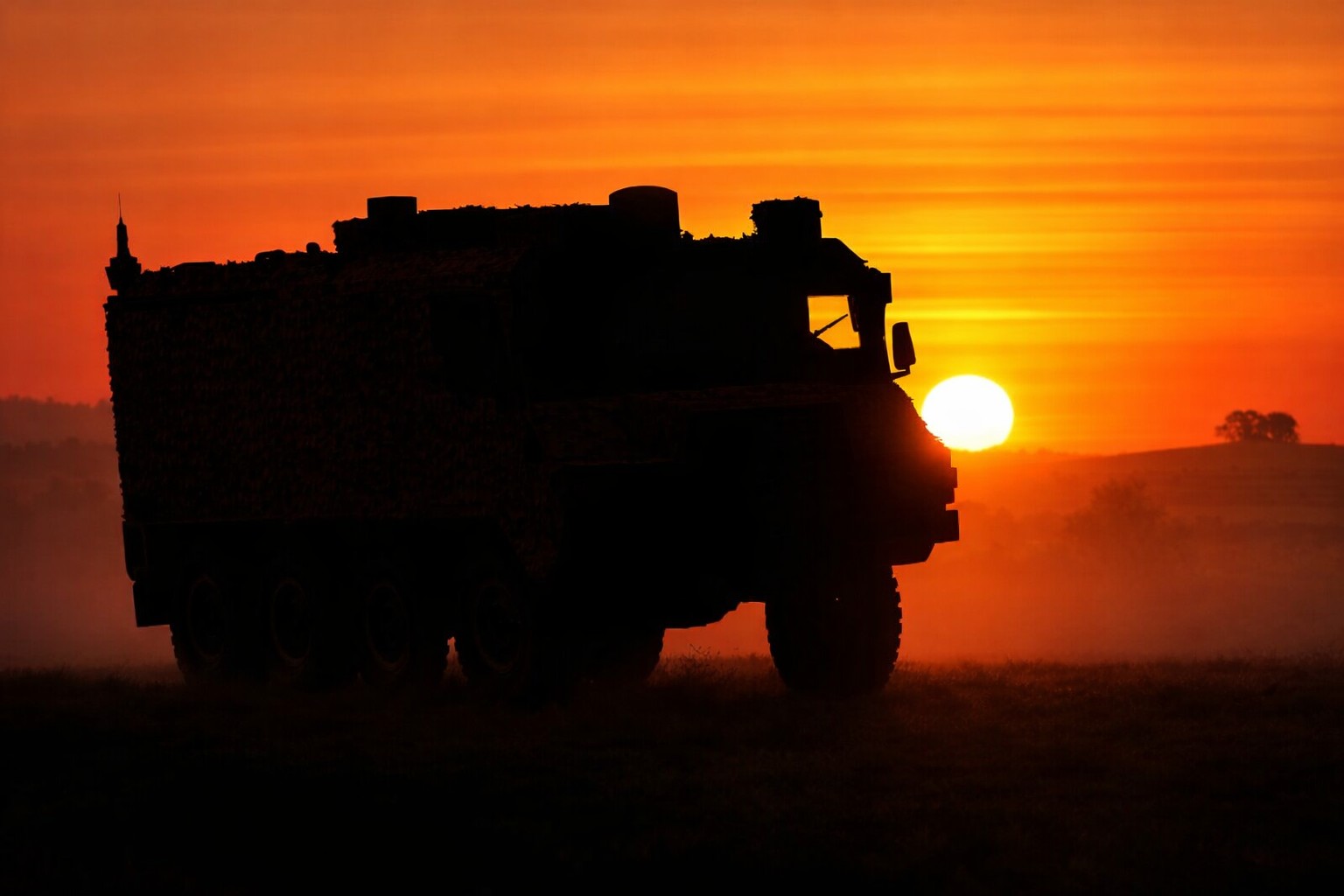
The Ministry of Defence has issued an updated preliminary market engagement notice for its Light Mobility Vehicle (LMV) project, a procurement effort expected to be worth up to £900 million including VAT.
Published by Defence Equipment and Support (DE&S), the notice outlines the Army’s intention to modernise capability currently provided by vehicles such as the Land Rover and Pinzgauer, with the LMV programme expected to deliver multiple vehicle options under a “common base platform” approach.
The project aims to provide “a wheeled utility platform to modernise capability in roles currently filled by Land Rover and Pinzgauer with a Common Based Platform delivering warfighting roles across the Joint Force.”
The contract is currently expected to run for six years, from 30 April 2027 to 30 April 2033, with the MOD listing the procurement as a goods contract. The estimated value is stated as £750 million excluding VAT, rising to £900 million including VAT. The engagement notice was updated on 17 February 2026, with DE&S confirming that following an industry Market Interest Day held on 15 January 2026 at Warminster Garrison, the programme team has now issued an initial Request for Information (RFI) to gather further insights from industry.
The MOD said it welcomes input from industry partners either individually or as part of a group, and has made the RFI available through an online form. Responses are requested by 17:00 on Tuesday 3 March 2026.
As part of the engagement process, DE&S has also released parts of its User Requirement Document, including Part 2 of the Key User Requirements and Part 3 of the URD, through the Defence Sourcing Portal. The department stressed the material is being provided for guidance only and does not represent a commitment to proceed with procurement as currently described.
The MOD stated that it retains the right to change “any or all of the details or features” contained in the document, but is inviting comments through the RFI process. The notice also confirms that further early market engagement activities may take place throughout 2025 and 2026, including supplier briefs, RFIs and supplier forum meetings, as the department develops its contracting approach.
DE&S also said the preliminary engagement does not formally signify the start of a procurement process, and that a formal competition would only begin with the publication of a Tender Notice.






Thank god we got part 3 of the URD, I would not want to buy an armoured vehicle off the shelf without one of them
This is why we can’t have nice things 🤦♂️
Still having Land Rover and Pinzgauer in service after the lessons of Afghanistan/Iraq says a lot and even more so post Ukraine where unarmoured supply vehicles have been deliberately targeted by both sides.
A military job is to fight wars and in wars bullets will be flying, whether your on the front lines or far behind it, you need to be prepared to be attacked.
Thinking their country could be over run at any moment in time severely limiting their ability to deliver, and in a similar vein their priorities could switch to the home front in the event of a major offensive, again, severely inhibiting their ability to deliever.
Whilst the logic is fair and reasonable, the irony is funny, considering the armies ability to deliver anything outside urgent order deliveries.
I cant believe they have included Ukraine on the list of banned countries for the Market Interest Day, citing security concerns and capacity constraints
WHY…
That’s an odd one.
What do all those big words mean, when will we buy some vehicles then? just looks like a lot waffle with not much substance like most things from the MOD.
The situation on the ground in the Ukraine shows anyone with eyes to see with that the era of mechanised manoeuver warfare as we know it – a form of conflict that has dominated for a century or more – has become either impossibility costly, or even just plain impossible now thanks to modern drone, targeting and communication technology. This profound and quite unprecedented revolution in war – and note we are only at its relatively primative early stages as yet – seems I fear to have been inadequately accepted or comprehended by western armed forces who risk falling into the trap of preparing for the last war rather than the next.
What is the point I wonder in investing so heavily in so-called ‘protected’ vehicles (of all types) when it’s plain to see that even the most heavily armoured MBT’s stand little chance of long surviving on this incredibly lethal 21st century battlefield? I suspect that today’s automatic protection systems will prove to be inadequate when either veritable ‘swarms’ of drones overwhelm their capabilities, or inexpensive UAVs direct accurate guided fire on to these very expensive targets. Experience shows us that electronic warfare technology appears to offer only partial protection at best and even directed energy weapons may not provide a practical solution either given their power requirements.
So why exactly should NATO forces not find themselves in the very same situation those now engaged in the Russo-Ukraine war do? Their armoured and logistical vehicle fleets decimated and surviving infantry resorting to hiding in the ruins of devastated settlements awaiting near certain destruction should they dare emerge? To ignore all this and assume that our forces are somehow immune this lethality smacks of arrogance.
I say finding effective ways to adapt to this revolution in warfare must come alongside – or even BEFORE – we spend our limited resources on vehicles and weapon systems that just won’t survive long enough to justify the investment they absorb. The ‘Future War’ of modern science fiction has moved into the real world people – and we better either accept that reality or face the (appalling) consequences.
Except none of that is actually borne out by the reality of the Ukraine war, let alone maps directly to UK forces. Even in Ukraine, armoured vehicles are hugely important parts of the force mix. They’re not being used the same way we used them in the Gulf War in ‘91 or ‘03, but they’re still being used effectively. Drones are certainly a major threat, but not in the all-encompassing way you describe. Mines, both AP & AT are big threats too, and require protection against. Also, an armoured vehicle is far more likely to protect its occupants against a drone threat. Drone netting functions a lot like anti-RPG cages, aiming to either avoid triggering detonation or at least making it detonate at a distance.
It’s worth noting that dispite the lack of armoured vehicles, mine clearers, engineering support and air superiority, every time Ukraine, or even Russia, have had succesful offensives that have moved the frontline (Kharkiv, Kursk, even to a degree Kherson, the initial invasion etc) it has been a mechanised force breaking through and getting inside the oppositions decision making cycle and ability to react.
I disagree..
After the defending forces recovered from the initial onslaught and for 3 or 4 years now warfare in the Ukraine has been characterised by its largely static nature – this is quite obvious I think. In many ways this conflict resembles the trench warfare of the Great War more than the mobile mechanised style war of later wars – we can even see the reappearance of that devastated wasteland known as ‘no mans land’ that historians of WWI will instantly recognise.
Vehicle vulnerability and resulting attrition rates have become so extreme now (thanks to UAVs and other guided weapons) that even Russia – with it’s once allsubstantial fleet of modern and additional vast reserve of old Cold War era armoured vehicles – has depleted those stocks and resorted to imported Chinese golf carts, clapped out Ladas and even mules in some instances. Again, why would NATO forces be immune to this effect we seem to be doing so little to prepare for it?
I say the combination of relatively new technologies that we might loosely describe as ‘Drone Warfare’ is not some relatively trivial change that we need only make a small tactical adjustment for and carry on as before. No, what we see now is rather a fundamental turning point, akin perhaps to the impact of the English Longbow on the armoured knight during the Hundred Years War or early artillery on the medieval castle.
Until we adapt to this new paradigm then NATO armoured brigades, as currently equipped and organised, look about as relevant as those stone castles and armoured knight of old.
You are Arnold Terminator Schwarzenegger and I claim my £5 🙂
We are going to make this as difficult, complex and expensive as possible ending up with a fleet of complex nearly perfect expensive vehicles for every role. The popping down the shops and general tooling around done in Landrovers will still carry on so that requirement is a no brainer just buy Toyota pick ups and when the invasion starts just mount huge guns on them, that seems to work clear across the world.
So the babcock plan? A modified Toyota?
I disagree..
After the defending forces recovered from the initial onslaught and for 3 or 4 years now warfare in the Ukraine has been characterised by its largely static nature – this is quite obvious I think. In many ways this conflict resembles the trench warfare of the Great War more than the mobile mechanised style war of later wars – we can even see the reappearance of that devastated wasteland known as ‘no mans land’ that historians of WWI will instantly recognise.
Vehicle vulnerability and resulting attrition rates have become so extreme now (thanks to UAVs and other guided weapons) that even Russia – with it’s once substantial fleet of modern and additional vast reserve of old Cold War era armoured vehicles – has depleted those stocks and resorted to imported Chinese golf carts, clapped out Ladas and even mules in some instances. Again, why would NATO forces be immune to this effect when we seem to be doing so little to prepare for it?
I say the combination of relatively new technologies that we might loosely describe as ‘Drone Warfare’ is not some relatively trivial change that we need only make a small tactical adjustment for and carry on as before. No, what we see now is rather a fundamental turning point, akin perhaps to the impact of the English Longbow on the armoured knight during the Hundred Years War or early artillery on the medieval castle.
Until we adapt to this new paradigm then NATO armoured brigades, as currently equipped and organised, look about as relevant as those stone castles and armoured knight of old.