

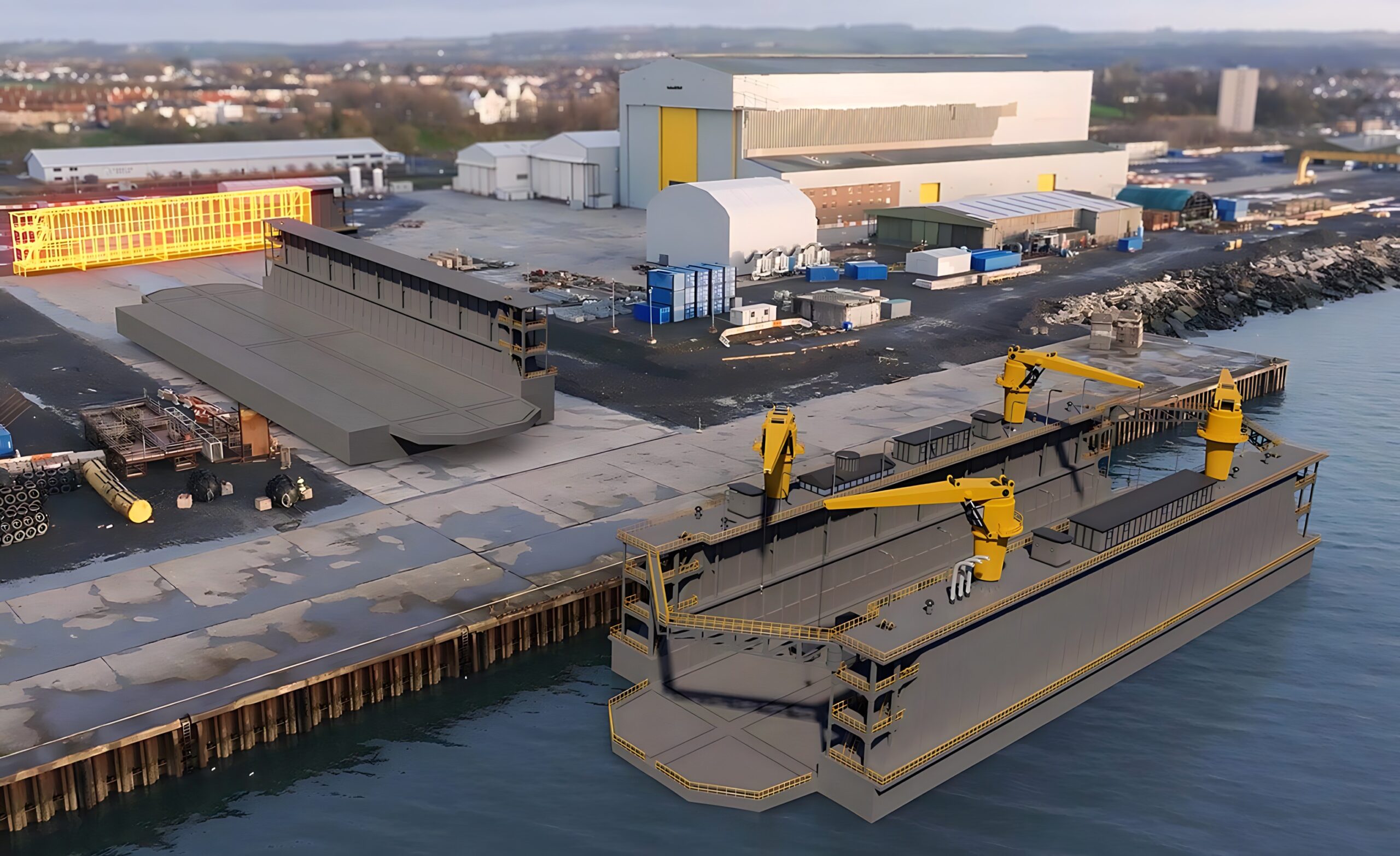
The Defence Investment Plan commits to three floating docks and new infrastructure at Faslane under Programme EUSTON, one more than previously planned, easing the out-of-water maintenance shortage behind the submarine fleet’s availability crisis.
The United Kingdom will acquire three new floating dry docks and supporting infrastructure at the Faslane submarine base, giving the green light to a long-stalled plan to ease the shortage of facilities for taking nuclear submarines out of the water for maintenance, the Defence Investment Plan said.
The plan committed to “acquiring three floating docks and infrastructure at Faslane,” which it said would enable resilient out-of-water engineering for all submarine classes, the work carried out under the Royal Navy programme known as EUSTON. The number marks an increase on the two docks the Navy had previously been planning, and the commitment moves a project that had sat in its concept phase for years, without a firm date, towards delivery.
Faslane, on the Clyde, is the home of the United Kingdom’s nuclear deterrent and, since the attack submarines moved north, of much of the rest of the boat fleet too, yet it has long been desperately short of the docks needed to lift a submarine clear of the water for deep maintenance, relying for years on a single ship lift whose failure at one point left no docking capacity at all for the Astute-class boats. The consequences have been severe, with submarines such as HMS Artful and HMS Ambush spending the best part of two years alongside while they waited for a dock, a bottleneck that has been one of the main drivers of an availability crisis in which the Royal Navy has at times been unable to put a single attack submarine to sea.
A floating dock is a mobile structure that can be flooded down, manoeuvred around a submarine and then pumped out to lift the boat clear of the water for work on its hull, and three of them would give the Navy the resilient out-of-water engineering capacity it has lacked, able to support the Vanguard deterrent submarines, the Astute attack boats, the Dreadnought class now entering the fleet and, in time, the SSN-AUKUS boats to come. Taking a submarine of seven or eight thousand tonnes, complete with a nuclear reactor, out of the water for weeks or months is a far more demanding task than docking an ordinary ship, which is part of why the capability has been so constrained, and the First Sea Lord, General Sir Gwyn Jenkins, has said plainly that “submarine maintenance throughput needs to drastically improve.”
Where the docks will be built is already a live question, since unions including GMB Scotland have pressed the government to place the work in the United Kingdom rather than overseas, pointing to yards such as Navantia UK’s site at Methil in Fife as candidates and warning against a repeat of contracts that have gone abroad.
The docks form part of a broader effort to rebuild Faslane for the decades ahead, sitting alongside the Clyde 2070 infrastructure programme and a new Trident training facility, all of it aimed at sustaining a submarine force that is being asked to do more as Russian activity beneath the waves increases.


I wonder if they ship lift is in worse state then we thought so the third dock is to replace it?
I also wonder how hard is it to have roofs on these docks? I’ve not done much research but I’ve never really seen a floating dry dock woth a roof.
The ship lift will be life expired soon and a floating dry dock is probably a better facility. They can also be moved should we find ourselves in need of forward deployment or leaving Faslane one day.
I wonder if they might lock the ship lift in an upright position then put one the docks infront the shed. Then use the docks to lift the subs out the water and roll them into the shed. Kind of like what they do at barrow to get the subs out of the hall but in reverse.
Ivery ntresting idea of Roof..!.
.has several benefits as well as being Weather orientated, Anti Drone and Satellite photo Intrusion come to mind…! Would also Produce a stronger Dock Structure and allow a containment area to be formed….!
I belive There were corrosion issues associated with the Ship lift at the Start…!
Wonder over what time span will the three floating Docks be expected to enter Service…
These should have been ordered months ago (years ago ideally! ). It didn’t take a long delayed plan for the future for it to be bloody obvious they were critically needed!
The design life was up 10 years ago. Gordon Brown as PM should have ordered it.
10 years ago was 2016. Labour left power in 2010.
This didn’t need to be part of the DIP… It should have been done already.
Single point of failure.
Who’s going to build them..?
Basic question with no easy answer..!..
Do we have the Capabilites to build what could potentially be the most Complicated and Sophisticated trio of floating dry Docks (Nuclear Certified ! ) ever built…!!
Its All very good Unions pushing Scotish build but it’s not that simple….!
Discussed as an urgent need for years yet not ordered, even with there being no A class boats readily available at the moment it seems time still is not a concern. These shouldn’t even need to be in the DIP, something this important should have come directly from Treasury reserve funds considering the role both classes of subs should be performing daily. Now they’ll take a year or two to decide where to build them, due to the severity of the situation it should be who can deliver in the shortest time frame at the standard required, even if that is a foreign yard, Sub deployments are far more important than a small number of jobs.
100% agree it is an utter joke , how the h**l we prevailed in two world wars beats the hell out of me.
The complexity of designing a Floating Dry Dock that’s ‘Nuclear Certified’ will come from the Definition of what does a ‘Nuclear Certified Dock’ actually mean and look like.. And then designing the Docks around any of those Parameters… This could take some time in its Self in this modern Health and Safety (Nuclear Handling) Snails pace World ..
And long before any Contract Tendering takes place..!
Does thsi increase the chances of 12 AUKUS boats?
Not a chance, we will be lucky to get six.
DIP says 12
My bet it will be 12 simply to keep Barrow’s workforce at full Production….Whether we’ll Actually operate 12 is Another Question..?
Some Dockside Paperweights as we have Now…?
Long stalled, LONG STALLED!!! That sums up the MoD. You would think the fact we have no Fleet boats available would merit some action. That they are all tied up awaiting dry dock time. The fact we know the Russian are sniffing about our undersea infrastructure would merit some alacrity on resolving this infrastructure issue. Does it, does it f**k.
The climax of Carry on up the Kyber was made in the 1960s. It sums up the British government attitude to defence. “ what are we going to do, absolutely nothing, until it is too late”
The Russians must be p***ing themselves with laughter.
This is great news for SSN availability. Build them in the UK, we now have several yards well equipped for automated fabrication.
Namaste 🙏,
Yes the Royal Navy needs new Floating Docks, the question over where they should be built, is not just a British Political between London, Edinburgh and Belfast firstly?
Then secondly between the British Trade Unions and British Shipyards plus their British and European Owners and Operator too, as well as between the Scottish Parliament, North Ireland Assembly and UK Government too.
When the UK Shipyard owners and operators or their British Employees and Trade Unions, do not have the knowledge, expertise or experience of building Very Large Ultra Heavy Life Repair and Maintenance Floating Dock’s with their built-in infrastructure cranes and bouyancy and flatation systems.
To handle the likes of the Royal .navy existing two classes of Nuclear-powered Astute SSN’s (L; 97 m, B; 11.3 m, D; 10 m, W; 7,800 tons) 7 submarines and Vanguard Nuclear-powered SSBN’s (L; 149.9 m, B; 12.8 m, D; 12 m W; 15,900 tons) 4 submarines.
Let alone the new Dreadnought Nuclear-powered SSBN’s (L; 153. m, B; 12.8 m, D; 12 m, W; 17,200 tons) 4 to 5 submarines, or the New Nuclear-powered Next-generation Fleet SSN-AUKUS (L; upto 150 m, B; between 11.5 to 12 m, D; between 11 to 12 m, W; upto 11,000 tons) 8 to 10 submarines too.
Or should these New Royal Navy Floating Docks to be built, be requires to handle all Royal Navy present and future surface combatant vessels, Type 45 Destroyers, Type’s 26 and 31 Frigates, or the New class of between 4 to 6 Off-shore Patrol Vessels (OPV’s), or New class of 2 Mine Warfare Mother Ship (MWV’s), or the New class of Seabed Underwater Operations and Security Vessel’s (SUOSV’s) or the Newclass of 6 Class Amphibious Assault Ships (LDP’), maybe a New class of 1 or 2 Ice-reinforced-hull Offshore Patrol Vessels (IOPV’s) too
Also the 6 new Combat Common manned Vessels, plus these New class of upto 6 Type-91, or new class of upto 6 Type-92 and new class of upto 6 Type-94 Uncrewed Surface Drone Vessel’s (using a similar hulls), as well as new class of upto 6 Type-93 ELUUV too
Maybe not capable of taking the the two Royal Navy Aircraft Carriers, though equally to handle all all present and future Royal Fleet Auxiliary Support Vessel’s, or most of them too?
Which raises a few interesting questions,?
Question one; how many of these New Floating Docks does the Royal Nay actually need?
Question two; how big should these new Floating Docks be?
Question three; where should these New Royal Navy Floating Docks, be positioned?
Only positioned these New Floating Docks in Faslane?
Or should one of these New Floating Docks be positioned in Portsmouth, another one positioned in Devonport, a third one positioned in Rosyth, plus a fourth in Faslane too?
Or maybe two more Floating Docks should be purchased, to have one positioned in Gibraltar, while another is positioned in the Falkland’s Islands,
Maybe each of these overseas Floating Docks, then having with them their own Multi-purpose Submarine and Surface Warship / Drone Repair / Maintenance and Weapons Resupply Tender Vessel’s too, to provide extra overseas capabilities
However, maybe there is another issue over who can build these new Floating Docks, that being open to International tender which the UK has agreement, with the European Union Countries and Nato Member Countries Governments and Shipyards, or involving UK International Western Allies or Commonwealth Member Countries Government’s and Shipyards too?
Especially when British Marine Aerospace Defence Industries, want to bid for growing European and Nato, plus Commonwealth Nations and International Western Allies defence contracts, it has to be a two way trade here, between the UK and its international trade partners?
Plus the Japanese, South Korean, German’s and other European Shipyards, have more knowledge of, expertise and experiences in building Floating Docks, especially in Modular (take part and reassembly) Floating Docks, for international transporting of Modular Floating Docks around the world.
Also the use of a Floating Docks, which comes in Transportable Self-supporting Independent Floating Dock’ Modular-section’s (TSIFDM’s), which can be assembly to any length, depending on the size of vessel or submarine to be dry docked?
Gives clear advantages and flexibility to the Royal Navy, over repairs and maintenance operations, so saving money!
Also a Modular Floating Dock section are quicker and easier to build in the first place, as well as can be built in more Shipyards at the same time, plus built by smaller Shipyards to a single design too!.
Then any damaged Modular Floating Dock section can be disconnected from other Modular Floating Dock sections, plus easily replaced, by another spare Modular Floating Dock section too.
While the damaged orvin need or repair Modular Floating Dock section, can be transported to be repaired or under goes its routine Maintenance Periods too.
Which other FModular loating Dock section are still fully operational, so no lost of down time because the whole very large single built Floating Dock, is out of use as a result.
Equally transporting these Module Floating Dock sections around the UK coastline to different Naval Bases or ports, or taking them even overseas is a much similar process, needing one or two Coastal or Ocean going Tugboats.
Not towed and escorted by a small fleet of Tugboats, which would be needed for transporting very large (160 to 180 m long by 20 to 30 m wide) single built very large Floating Dock by sea too, especially if these Floating Dock’s were to be built in the Far East or even built just in European or Canadian shipyards too!!
So there a few questions Defence Secretary and Defence Ministers, or the MoD and Royal Navy, needs to answer over buying at least three New Floating Docks, just over their design to start with, or their full size and weight lifing capacity too?
If these Floating Docks are NATO compliant ..
Ie..Able to accommodate up to Columbia Class American subs in an Emergency I would think 190 × 40 max
As for AUKUS later VIRGINIA Cass VLMs suggests
up to 130mtrs length… 10/ 11.3 mtrs beam…..
Nuclear Certification ! could be the fly in the Soup as far as Simplified Production… Remember last thing you’ll want is an accident with a Nuclear Sub on Board.. we really don’t Know what Nuclear Certification Entails even if it’s incorporated in the Faslane Certification…
Seems likely at least 2 probably all 3 of these Dock will be based in Faslane…! Suggested INCHGREEN as the maintenance Dock…!
These New Floating Maintenance, Serving and Repair Dock’s, that are fully usable all the year round and in all weather conditions, plus 24-hours a day, 7 days a week and 52 weeksa year too!
Also theynshould be able to deal with most types of of Royal Navy warships, either Offshore Patrol Vessel’s, Mine Countermeasures Vessel’s, Corvette’s, Frigates, Destroyers, as well as all types of SSK’s, SSN’s, SSGN’s and SSBN’s, maybe even the New Class of Amphibious Logistic Assault multi-roll Ship too!
Maybe the Royal Navy actually needs not just three of these of New Floating Maintenance, Serving and Repair Dock’s, maybe as many as six of them instead.
With one based in Portsmouth, one based in Devonport, one base in Rosyth and one in Faslane too, maybe one based in Gibraltar, lastly one base in Mare Harbour down in the Falkland Islands too, or they can be moved between them maybe too?