

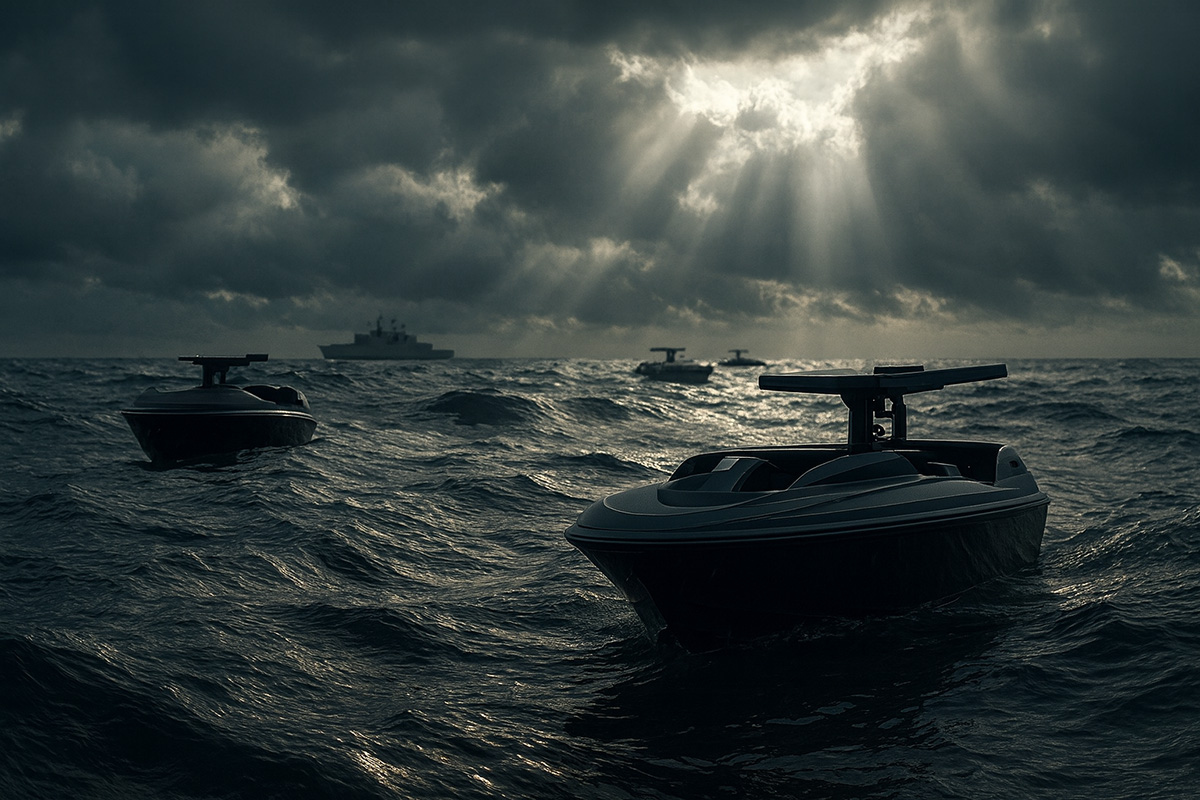
Britain will begin rolling out a new suite of undersea surveillance and counter-submarine capabilities under Atlantic Bastion.
The project links autonomous vessels, AI enabled detection networks and existing naval and air platforms, the government stated.
Defence Secretary John Healey unveiled early work on the programme during a visit to Portsmouth, framing Atlantic Bastion as part of the Strategic Defence Review’s push to accelerate maritime modernisation. Healey said “People should be in no doubt of the new threats facing the UK and our allies under the sea, where adversaries are targeting infrastructure that is so critical to our way of life.” He added that “This new era of threat demands a new era for defence, and we must rapidly innovate at a wartime pace to maintain the battlefield edge as we deliver on the Strategic Defence Review.”
Healey described Atlantic Bastion as “a blueprint for the future of the Royal Navy” that “combines the latest autonomous and AI technologies with world class warships and aircraft to create a highly advanced hybrid fighting force to detect, deter and defeat those who threaten us.” The announcement follows a rise in Russian underwater operations, including activity by the intelligence ship Yantar around UK waters.
The government says the programme will allow the UK to track and, if necessary, respond to hostile submarines across wider areas of ocean. UK Defence Intelligence has assessed that Russia is modernising its fleet with the aim of holding cables and pipelines at risk. Atlantic Bastion is intended to counter that shift through an integrated network of ships, submarines, unmanned platforms and AI powered acoustic sensors.
Industry engagement has been significant. The Ministry of Defence stated that fourteen million pounds in seedcorn funding has already been committed with private investment matching public money at a four to one ratio. Twenty six companies have submitted sensor concepts and twenty firms are demonstrating early systems. Selected technologies are expected to enter water trials next year.
The First Sea Lord, General Sir Gwyn Jenkins, is expected to outline how Atlantic Bastion fits into a broader vision for the Royal Navy at the International Sea Power Conference. He is due to say “We are a Navy that thrives when it is allowed to adapt. To evolve. We have never stood still because the threats never do.”
He will also argue that “The SDR identified the maritime domain as increasingly vulnerable and that maritime security is a strategic imperative for the UK. It is time to act.” According to his prepared remarks, Atlantic Bastion is “our bold new approach to secure the underwater battlespace against a modernising Russia” and “a revolutionary underwater network” that is “more autonomous, more resilient, more lethal and British built.”
Jenkins will add that “We’ve already made rapid and significant progress with delivering Atlantic Bastion. A force that keeps us secure at home and strong abroad.”
The programme also showcases capabilities under development by UK based and international defence firms. Dr Rich Drake of Anduril UK said “The government has called upon industry to create the modern warfighter. We have designed Seabed Sentry in the UK in partnership with other British companies to deliver for our Armed Forces and protect allied waters from increasingly hostile actors.” He added that Anduril is investing in “British talent, British technology and Britain’s tomorrow.”
Scott Jamieson of BAE Systems said “Autonomy represents a transformative opportunity to redefine how operations are conducted above and below the waves.” He highlighted the firm’s Herne extra large autonomous submarine and its control system, Nautomate, which he said “deliver enhanced tactical flexibility, enable data driven mission decisions and scale operations in ways that were previously unimaginable.”
Helsing’s Amelia Gould said the company views the UK as a leader in maritime defence innovation, adding “Through self funded development and UK based trials of SG 1 Fathom and Lura, we have demonstrated the power of advanced AI and autonomy to change the game in the underwater battle space.” She said Helsing stands ready to “create a sea drone wall to protect NATO.”
Officials argue that Atlantic Bastion reflects early delivery against the Strategic Defence Review and could support skilled jobs as part of a growing hybrid navy sector. The government says the project’s success will depend on integrating naval, air and digital assets into a single system capable of detecting threats at speed across the North Atlantic.




Amazing, even the BBC have this on their main page !!!
“It’s like putting lipstick on a pig” says Prof Peter Roberts. The UK “neglected it’s post World War 2 responsibility” and “Is trying to find a way to look credible” and “The UK doesn’t have the ships”.
So nothing we don’t actually know then.
Russia only has three modern SSN’s in the Atlantic and we seem to already have the ability to track them.
How much of this is an over reaction?
Which part ?
Are you saying we are daft to do this then ?
Or that we have enough ships ?
Maybe this whole “Atlantic Bastion” push is not really needed ?
It’s early, I’ve yet to find my normal humour !
I don’t think it’s daft to put autonomous sensors in the North Atlantic, it’s a very sensible idea, however a total restructuring of UK armed forces around building a defensive perimeter in the Atlantic against a largely no existent Russian submarine threat would be a mistake. Given the small sums being devoted to this it seems HMG probably agrees.
We should be chasing Russian submarines in their Barents Sea bastion
Lol, and what do we have to chase them with
I read it as protecting our Infrastructure as much as hunting Russian Subs, I follow your comments a lot and thought you had grave concerns regarding our undersea comunication networks and the recently (highlighted) increase in dubious Russian activity ?
The BBC thing is quite good, it’s very unusual for such a niche defence matter to be big news.
On a wider level there has been much more press interest in defence over the last few months than is usual. Hopefully the extra pressure has persuaded the government to take some action, or am I a hopeless optimist?
Hope is good TJ. I’m reminded of the stages of project change curve: shock-denial-frustration-depression-experiment-acceptance-decision-integration.
The ‘project’ is to change our culture. The RN have been in the experiment phase for a while – Patrick Blackett. Big decisions have been taken – the frigate builds, the Norway agreement. As the frigates come into service the UUV drone experiments mature we will move into integration – fulfilling the Bastion vision.
I though this was a treat of a comment from the BBC that did not hold back
Prof Peter Roberts, an expert on contemporary conflict at the Royal United Services Institute (Rusi), says the Royal Navy’s new strategy looks fine on paper but “feels like putting lipstick on a pig”.
He argues the UK has “neglected” its post-World War Two responsibility to be the guardian of the western Atlantic, and now the Royal Navy is “trying to find a way to look credible” in addressing a threat that has been “steadily increasing for the past 20 years… but still ignored by the government and Navy”.
“The Royal Navy does not have the ships to do this job coherently or credibly and is looking to address it with drones as they are cheaper and can provide coverage of the geographical areas for which the Royal Navy is responsible in lieu of new ships,” Prof Roberts adds.
“Russia so far is going unchallenged in much of UK water space and this strategy is playing catch up long after the fact.”
Yeah, I just “Cherry Picked” but also thought It was rather refreshing to see this on the BBC’s main news page.
Now then, Having this capability, combined with our new T26/T31’s and “Wedgies” P8’s, Astutes and all manner of other stuff being discussed, I feel we might just have the right combination to actually safeguard our Seas. especially against the 3 active Russian SSN’s and their other surface ships with their disruptive capabilities/Intent.
Just got to stop poking China in their back yard/front garden !
It would be good to know how this stuff interacts with the existing IUSS network and other NATO ASW assets that feed into/off of it.
I also suggest that they highlight this due to the lack of real warfighting assets, such as Prof Roberts already pointed out.
ASW capability on T31, more P8, More MROSS. Current lack of tailed T23 as HMG dismantled the fleet by not ordering new promptly or just cutting assets.
So we highlight our alliance with Norway.
So, rant incoming, I love picking holes in what HMG say.
“Delivering on the SDR.”
More Healey waffle. Anyone is welcome to go and attempt to read that document and tell me exactly what HMG is going to do regards actioning it….ships, subs, Drones, helicopters, numbers, how much, when. It is vague beyond belief, which is by design.
Jenkins has also caught the disease, being a CDS.
“Secure at home and strong abroad.”
SECURE AT HOME.A
So secure, we refuse/cannot secure our borders.
Our undersea infrastructure which we know intimately as we ourselves place bugging devices inside it for GCHQ, both undersea and in the Cable Landing Stations, has a single ship, Protest, to watch and see what enemies might do with it.
So secure, that I myself happily drove into one of the most critical locations because I could. Open gate, no security evident.
And what If I’d been a terrorist group with Aks rather thsn me and the wife our for a drive?
We cannot defend against Drones save a small unit in the RAF Regiment, which cannot cover the hundreds of sites that neee something.
Our GBAD for home defence is virtually non existent.
We line our aircraft up in rows as it’s neither efficient or possible it seems to disperse them given the shortage of RAF personnel.
Anarchists can break into some sites at ease, and film themselves doing so.
The MoD Police have been cut so much they’ve had to withdraw from many sites they previously had an armed presence at.
Our assets at home sit alongside waiting to be maintained as none of it was updated for decades.
The RAF ASCS force, while comprehensive, reportedly has gaps and a lack of QRA aircraft.
Our assets at home are so secure that capabilities of every kind are clustered in one or two locations as it is cost efficient to base them that way. Example, Brize, single point of failure.
This was grandstanded by HMG years back as “super bases” and “centres of excellence.”
What waffle, our forces could just as easily be excellent spread over more locations if you’d spend money.
STRONG ABROAD.
So strong, that RAF Akrotiri and the other bases in Cyprus, 3 of which are amongst our most vital real estate, are devoid of GBAD of any kind.
So strong, that the British Army has a Battlegroup in Estonia. Not a Brigade, a Battlegroup.
On the positives column, our intell agencies remain first rate, as is our CT Police Network, but those alone are not enough.
Atlantic Bastion itself might be super high tech, it should not be a cover for failure and lack of warships, which I suggest it is being highlighted for.
“Always with those negative vibes” !!!!
Oddball 😁
If you want to play film quotes, I’m up for that!
It’s “negative waves” BTW. 😉
Why can’t you say something beautiful, and righteous, for a change?!”
Lol,
“It’s my Manner
Sir”
“It’s a mother beautiful Bastion…and it’s going to be there…”
Nah, you got me ?
I’m still on Oddball! Mother beautiful bridge..?
Ahhh, I did wonder If you changed a word or two, Yes, Classic lines from a great film.
Positive thoughts !
And an an even better fim.
“What do I have to be grateful for….Captain? You’re tolerance? You think just because you, and Colonel Brant, are more enlightened thsn most officers that I hate you any less?”
Cross of Iron ?
@Half.
Spot on mate! My fav war film.
Realistically, now it’s open season for everyone to bash Britain and apparently you’re a racist bigot for wanting to stand up for it (cheers Keir), we’re going to need to rely on AI and autonomous wargear. Our universities have spent years “educating” people about how evil Britain’s past is while airbrushing or glamourising everyone else’s: what effects do you think this will have on military recruitment? “I’m not defending this evil empire!”
Combine this with recent drives to exclude the only people applying (white men) in favour of bringing in those who are NEVER going to give their lives for Britain, and oh my God, it’s just a complete nightmare isn’t it?
Even if we get leaders with real backbone, it’s going to take decades to undo the damage to British national pride, and by that point the demographic will have changed so far we might not be Britain any more…
Look at London. 1970s 95% white British I thought the figure was that I read recently. Now, 35% or something?
I mean, the third world moving to the first world is one thing, the emphasis the article had was on the short time frame it has taken.
Yeah but the choice of food is amazing.
Phal incoming.
Or Outgoing If those 50 Bangladeshi’s made it back to France !!!