

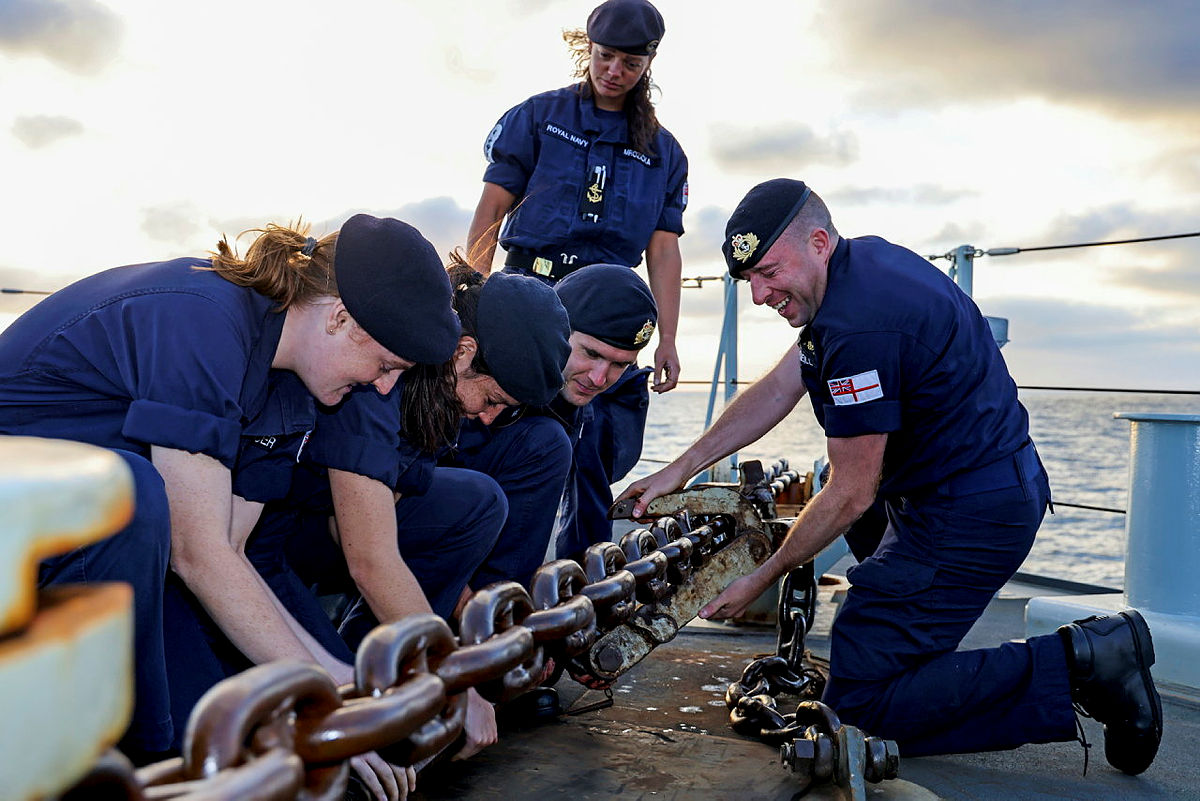
The Ministry of Defence has confirmed initial participation numbers for its new Armed Forces Foundation Year Scheme, as part of plans to launch the programme in early 2026, the department stated.
The scheme, described as a military “gap year”, is intended to offer young people the opportunity to experience service life while developing skills and leadership. Details were provided in response to a series of written parliamentary questions from James Cartlidge, Conservative MP for South Suffolk.
Responding on behalf of the department, Parliamentary Under-Secretary of State Louise Sandher-Jones said the first intake, known as Tranche 1, will consist of 150 participants across the three services.
“The first participants will be apportioned at 20 each for Royal Navy and Royal Air Force respectively with the Army offering the remainder (110),” she said.
The minister confirmed that the initial cohort will be used to shape how the scheme develops in future, with no retention targets currently set for how many participants are expected to remain in the armed forces at the end of the year.
“The lessons of the first cohort (Tranche 1) will inform future practices for the Scheme,” she said.
When asked whether the department had established an annual target for participants who go on to full military service, the same response was repeated, indicating that retention outcomes will be assessed after the first cohort completes the programme. The Ministry of Defence said the longer-term ambition is for the scheme to expand significantly if demand supports it.
“The ambition remains that the scheme will expand to over 1,000 participants subject to interest,” Sandher-Jones said, adding that further details would be published in due course.
The Armed Forces Foundation Year Scheme was announced by the government in December 2025 as part of wider efforts to improve recruitment pathways and provide alternative entry routes into military service.









Good idea, more young people that can be made interested in the military as a career is alwas welcome.
I agree, its an idea that has legs. If it works and gets ramped up as planned and say 40% decide to remain, it could provide a very useful recruitment boost in the long term.
Its a good start to getting more in to the military, lets hope the DIP helps by getting the kit so that all can benefit and fix a few issues that may be are hitting retention etc.
Small numbers, but you have to start somewhere. Good to see that the expansion ambition is there from the get go.
Initial target numbers are riseable. 20 for the RAF and 20 for the Navy. Hardly aspirational and why no target for retention beyond the gap year. Also what is the split officer to other ranks or is it all ORs?
Initially it’s all OR from what I read.
Thanks for clarification. At these numbers just window dressing as all three Services struggle to recruit to need, particularly the Army.
We need to go back to conscription as our volunteer force is just too small and very expensive. Just look at the cost of military pensions for instance.
More pathetic thinking. Another more of the usual experimental dribs and drabs effort. You need at least 2000 right now, then 4000 in 2027, 8000 in 2028, 16000 in 2029, 32000 in 2030 and 64000 in 2031. That should be a counterweight to the other invading army.
I have nothing but contempt for our politicians.
Sorry 64,000 single year hires. No. That’s a nightmare for the Armed Forces.
Why should anyone join when you might be ordered to slot a terrorist and then 40 years later be charged for murder?
Bin this ridiculous policy and the people will come.
Course it could be that you slotted a British citizen who was just randomly walking on a British street.
For centuries, our laws have been designed to err on the side of preventing unjust overreach. Furthermore it is well-known that tyrannical regimes use the excuse of protecting the citizenry in such cases to enact laws that allow them to exert totalitarian control and to unjustly and selectively prosecute their enemies. There are ample examples of this, yes even in recent history. In this case, it is clear not only that there may be an opportunity for unjust prosecution decades after the fact against British soldiers, it is also clear what are the cases they will be used for. The ones proposing the law have not at all been shy about its purpose. It would be yet another in a long series of, to put it most kindly, self-defeating unforced errors that will inflict more harm on Britain than on its enemies.
All well and fine Matt C. But what if its a “tyrannical regime” headed your way NOW, with 1/2 million cannon-fodder conscripts?
Purely logically? It would mean that soldiers are expected to make their own decisions in such a scenario whether to fight or not. If the British Government appends a caveat to their orders stating, in effect, that it reserves the right to prosecute individual trigger pullers for “murder” on the hearsay of former enemies 40 or 50 years down the line, then what would be the point of following orders. Would YOU ever obey any order from your boss if it came with the “T&Cs apply” that fifty years later he has the right to sue you for carrying them out, having changed his mind after all these years?
The only possible people who could want such a policy are people with a vested interest in destroying the army and thus the nation. It would have been extremely profitable, for example, if in 1940 we could have convinced the Wehrmacht that in future we would sign a treaty with Goebbels et al who would then prosecute them for shooting British soldiers. No Wehrmacht soldier with an ounce of reasoning ability would have dared to pull the trigger.
Well, 150 is a small number, but it’s a start. 150 sailors could crew a frigate, for example (I know that’s not what these people will be doing, just making a point).
This really needs to be backed as a small first step towards a new mind-set in this country as to what life is about and for. I wish them well and hope the media get behind it.
Given some of the issues the cadet forces have had in funding and people wouldn’t that make more sense to invest in as it’s already established? Considering training how much actual time out of that yea will these young people be putting I ?
I think its a great idea with some good potential to increase recruitment in boh full time and reserve roles. Probably better for increasing the reserves as it appeals to people who would not want to commit to full time military careers but would suit reservist life.
The structure would need to be changed to increase the number.
12 week courses
500 for RAF
500 for Navy
1,000 for the army
If you run four cohorts per year (48 weeks) you would have 8,000 people trained. The ones that pass can go on to choose if they wish to continue and get a full time career or reservist. The ones that dont drift back off into civilian life but form part of the strategic reserve for 5 years.
The ones that dont pass will have at least gained some life skills and may wish to try and join at a later date.
In 12 weeks you could learn a lot of skills that would make you useful in a war situation and would not need a great deal of upskill to turn you into a regular or reservist.
Perhaps there could be resources for a pivot of resources to more UK-focussed buildup when the Ukraine War eventually comes to a close.
AIUI Operation Interflex is now up to supplying around 3,000 person years (36,000 person months, 432,000 person weeks) of training contact per annum. That is 22k trainees per year through a 7 week course on my crude calculations for 2024.
Just 10% of that, again using a crude equivalence, would be 43,000 person weeks. That is a lot of time.
This is another excellent step for rebuilding engagement and then capability taken by this Government.
I’m sure we would all like to see it move more quickly, but it is perhaps better to make the mistakes on a small scale.