

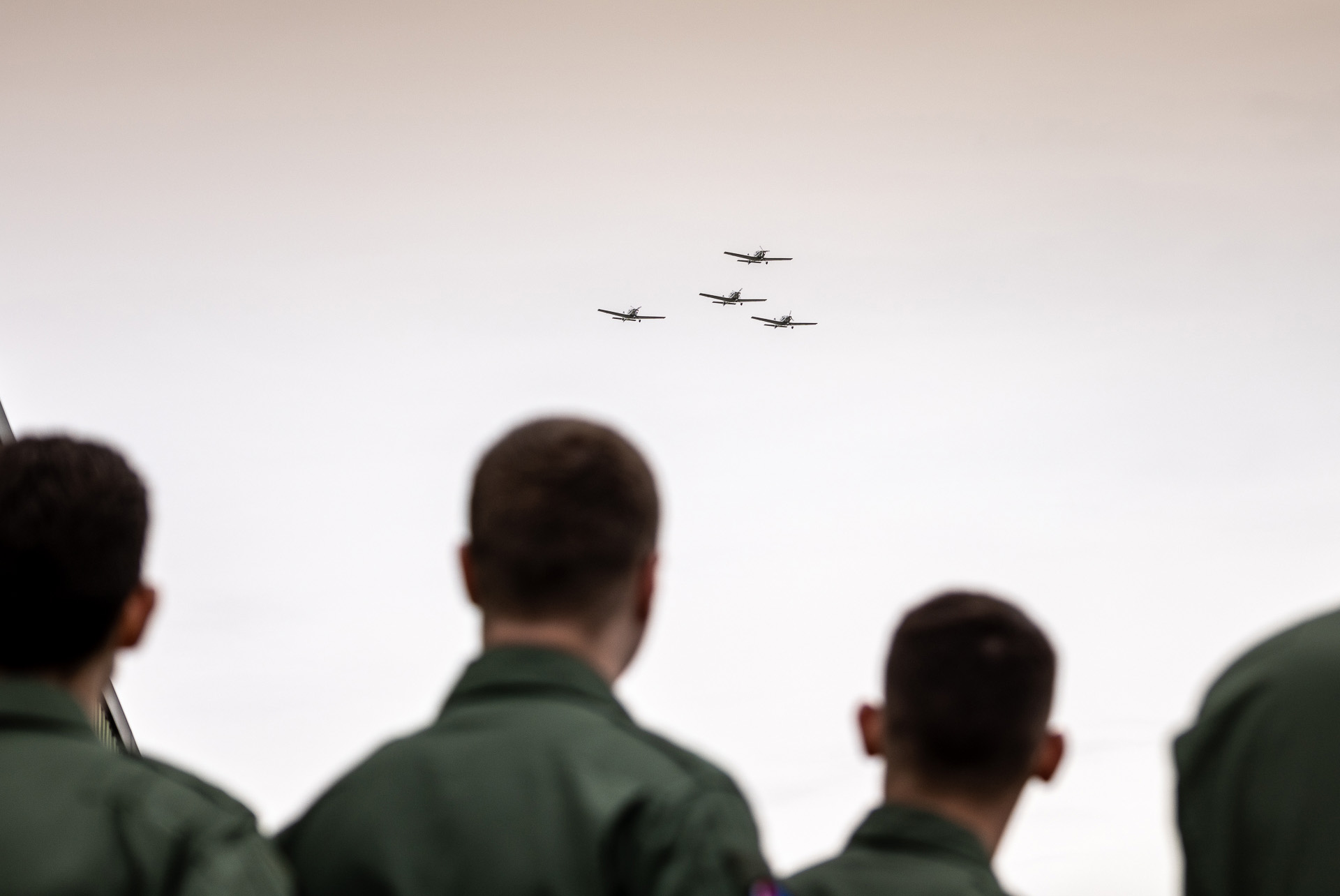
Britain is regularly examining NATO and international military flying training schemes as it looks at the quality, cost and output of training new fast-jet pilots, according to a parliamentary answer.
The work was set out in response to a written question from Labour MP Luke Akehurst, who asked what analysis had been carried out of training systems operated by NATO allies to identify opportunities to improve value for money and pilot output within the UK Military Flying Training System.
Armed Forces Minister Louise Sandher-Jones said the UK regularly assesses opportunities through three multinational training arrangements.
She said: “The UK undertakes regular analysis of NATO flying training system opportunities via participation in the NATO Flying Training Europe High Visibility Project, the Euro-NATO Joint Jet Pilot Training system and the International Flying Training School.”
NATO Flying Training Europe is intended to increase cooperation between allied countries over military aircrew training, while the Euro-NATO Joint Jet Pilot Training system provides multinational fast-jet pilot training. The International Flying Training School is another route through which the UK can examine training approaches used alongside international partners.
Sandher-Jones said the results from those arrangements are assessed against several measures before being considered against the requirements of the UK combat-air force.
She said: “Output is reviewed for quality, safety and value for money to ensure the Combat Air requirement is met for new Fast Jet Pilots.”
The answer indicates that the UK is not assessing its flying training system solely against domestic arrangements, but is using participation in multinational programmes to compare the way new fast-jet pilots are trained and the results those systems produce.







Think ukdj reported some time ago we were sending some pilots to India am I mis remembering? Still can’t get past buying f35A as jet trainers as one supposed use for them.
Hi Simon, the idea is that the active F35A from an order of 12 ( probably 8) will be used as F35 training assets to allow the OCU to reduce its number to 2 ( probably) F35B and 8 F35A.
Redirecting limited ‘B’s back to the front line.
Thats the official reasoning….
Unofficially, its the RAF getting what they have wanted all along and this order for 12 will be the fist of a larger fleet of the type, ( 60+) hopefully to operate alongside a larger Tempest Fleet.
It’s in effect, the 21st Century replacement for Tornado GR4.
“It’s in effect, the 21st Century replacement for Tornado GR4.”
Storm Shadow and Brimstone are back on the menu then?
Wouldn’t they be nice options, sadly not.
That said, F35A would give the RAF first day of war, deep strike capability against a peer enemy.
Despite the issues of the Orange Oaf, less than ideal availability and endlessly delayed upgrade pathways/weapons integration, nothing else currently available gives the level of capability it offers.
Nothing even comes close quite frankly.
Surely first day of the war capability will now actually be a mix of long range strike assets – ballistic missiles and one way attack drones in massed strikes?
Why risk a £100m asset that can’t be replaced within 5 years and a pilot that takes six years to train? You can cause more damage, at lower cost and very low risk. It doesn’t stack up anymore. The only possible reason is that you want to have PID visually… but we know from 25 years of ops we can achieve that with unmanned assets. I’ve come round to believing that fast air might be “relegated” to air defence and close air support.
From the June 2025 US Gov CBO report availability accross F35A, B, C doesn’t look much different. I’m not buying availability for training as a reason for stumping up the cash these. The RAF just want a variant they have full control over. With the funds being taken from the nuclear deterrent budget it’s like Christmas.. . It’s amazing the RAF have got their way. Surely supporting these A’s will cut into Tempest numbers? Is it a reasonable assumption that Tempest will be “nuclear capable” very soon?
Hi Mike, absolutely, all valid questions.
I personally think the RAF would quite happily forget Tempest, (currently a paper project) and order 150 F35A, its real, it exists and it does everything the RAF want to be able to do from 2030 onwards.
None of us buy the OCU argument, or the equally flimsy tactical nuclear argument.
It’s about the RAF getting a foot in the door with the F35A.
Will Tempest be nuclear capable one day, possibly, I’m sure clearing it for B61 ( or equivalent) wouldn’t be a hurdle.
Let’s hope we actually see 3.5% gdp by 2035, that would theoretically allow for an expanded RAF with F35A and GCAP, add a really capable loyal wingman and you would have a world class line up.
RAF have some motive for requesting F35a at best they resent the navy. F35- Jet trainers: don’t buy it, free fall bomber: don’t buy it. but is there opposition to tempest? Hopefully not, goes against sovereign ability to produce and have control of our aircraft.
Hi Simon, there are 2 sides to the coin, one regards the national ability to produce world class weapon systems domestically, like GCAP as all important.
Then you have many in the RAF that just want the tools to do the job, quote frankly they dont give a toss who builds them.
Like the rest of the armed forces, they now have little confidence in MoD procurement, the MIC, and their ability to provide world class equipment in a timely and cost effective manner.
Donkeys years and a vast amount of money to fit new radars to just 40 Typhoons is a typical example of piss poor procurement decision making.
So absolutely, if you offered the RAF 150 F35A, or 80 odd Tempest for the same money, they would snap your hand off.
I’m not personally anti GCAP, I hope it succeeds I really do.
But I hope the RAF dont pay the price for an ‘exquisitely expense’ Tempest and only end up with a tiny number as a result.
JC understood, not in full disagreement. Would argue UK has to be equal partners on these multi national projects. The f35 is amazing but UK is very junior and treated as such, even the raf would like to deploy all available weapons we would hope.
“It’s in effect, the 21st Century replacement for Tornado GR4.”
Storm Shadow and Brimstone are back on the menu then?
oops 🤦♂️
Still got the digital sssssstutter Tomartyr!