

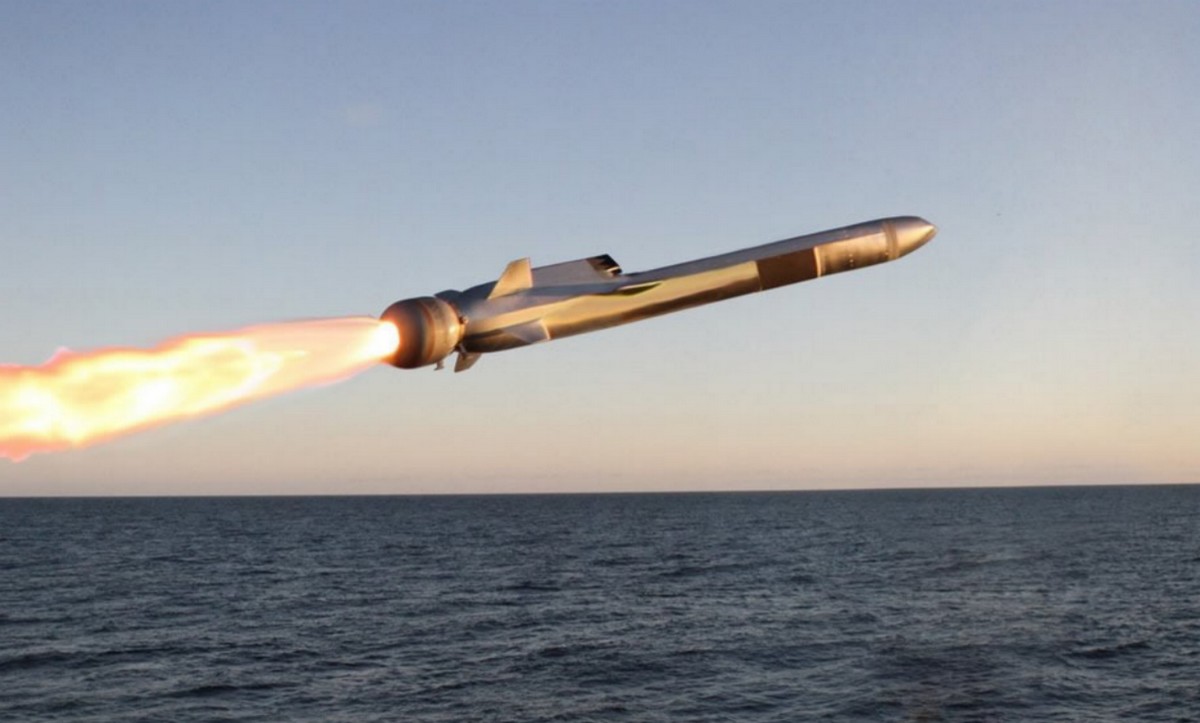
The Ministry of Defence has declined to say how many Royal Navy warships will be fully fitted and cleared to deploy the Naval Strike Missile by the end of 2026, citing operational security, despite having previously confirmed the size of the programme and named the ships fitted with the weapon.
The refusal came in a written answer from Defence Minister Luke Pollard to Liberal Democrat MP James MacCleary, who asked for an estimate of how many Type 26 frigates and Type 45 destroyers will be fully fitted and cleared to deploy the missile by the end of the year.
“For reasons of operational security, the Ministry of Defence does not routinely provide detailed forecasts relating to the integration and deployment readiness of specific weapon systems on individual classes of vessel. The Royal Navy continues to progress the integration of the Naval Strike Missile in accordance with approved capability plans,” Pollard said, as quoted in the answer.
The answer is in a bit of a contrast to the department’s earlier openness on the programme. When the purchase was announced in November 2022 as the interim replacement for the retired Harpoon, the MoD stated publicly that eleven Type 23 frigates and Type 45 destroyers would be fitted with the Norwegian-designed weapon, and in June last year Defence Minister Lord Coaker confirmed in a written answer that HMS Somerset, HMS Portland and HMS Richmond were the ships then fitted, with Richmond deploying to the Indo-Pacific with the Carrier Strike Group carrying the system.
The Royal Navy has also publicised each fitting milestone, from Somerset’s first loadout in Norway to the first British firing of the missile at the Andøya range during Exercise Aegir 25.
The fitted force has meanwhile moved backwards as well as forwards, with HMS Richmond among the ships formally retired this week alongside HMS Iron Duke, meaning one of the three vessels publicly confirmed with the system has now left service, and the question of whether her launchers and missiles transfer to another hull is one the answer leaves untouched.
The 400 kilogram missile, in service with Norway, the United States and Poland among others, skims the sea at speeds approaching Mach 1 and can strike ships or land targets at ranges beyond 100 miles, restoring a surface-launched strike capability the fleet lost with Harpoon’s retirement. Integration is being carried out in collaboration with the Norwegian government and Kongsberg, and while the approved capability plans the Minister references remain on foot, the pace at which launchers are reaching ships, and the size of the force able to deploy the weapon at any one time, now sits behind a screen of operational security that parliamentary questions have so far failed to penetrate.






Surely there is enough to go round for every ship now. I recall we bought 11 systems.
5 23’s 6 45s 2 26s and 2 31s for starters (15 not 11). I’m assuming T31 T26 are fitting or fitted already.
We dont have 5 seaworthy T23s.
I am guessing the rollout has been delayed by discovery of the poor condition of the T23 fleet, but that doesnt really explain why no T45 has it yet. NSM was intended for T23 qnd T45 only; never read any comment about fitting it to T26 or T31..
There’s an UKD article linked above regarding T-31.
Why can’t they buy for all the T45s, T31s,and T26s , 19 sets, call it 20 and if they’re worried about usage the spares can be used in a coastal battery for the Channel? Even the B2 Rivers could be upgraded to take 2×2 NSM if needed.
I agree, the coastal protection shops are being asked to do more and more. Being armed with harsh words is good enough for fisheries policing but not what they are being asked to do now and in the future.
Would guess the river2 would not have the radar and command system required for missile operations. It’s a shame that the marlet mounted on the gun trial failed, as that seemed like a cheap way to significantly upgrade the rivers.
As for the rest of the escorts, just seems odd. If your already buying the missiles and some launchers, surely it can’t be that much more expensive to buy a few more launchers.
Probably none then!
I’ve told you millions of times not to exaggerate 🙂
👍🙃
Isn’t HMS Defender supposed to have NSM fitted when she comes out of her refit here in the next month or so?
Yep its the first one. Daring don’t think will and unsure which one is next to finish and become into service.
Dimond
Dont over arm our Warships please. She’s already fitting with CAMM which is ground braking if that’s phrased correctly.
HMS Richmond got it ahead of CSG 2025, now we’ve just had it confirmed that she’s being retired.
I think we have 11 NSM systems, and 11 escorts now (6 T45, 5 T23). So surely they’ll all be getting it, unless we’re expecting more retirements before they are fitted? Or less likely, one of the new Frigates brought into service? I suppose the fitting rate has been glacial though.
If Stratos is late why not a backup for the T26s? Like Aust, Canada and Norway are, why the same for RN? Free up the mk41s for more ASW stuff and a load of CAMM-ER/MR? Common sense isn’t it?
*why not the same…
It makes sense, but so do a lot of things that the MoD and navy could do. The question is, is it worth taking money away from something else to fund a supplementary weapon on the T26?
I’d argue there are a lot of higher priorities; arming the carrier air wing with weapons other than guided bombs and inferior air-to-air missiles, procuring the drones that are supposed to be replacing the capabilities we keep retiring, I’d even suggest converting the army Wildcats to a maritime standard if I thought it would ever happen
Would make sense if all T45s got them and all T31s
T-26 will have to wait for Stratus – high-end ship gets the high-end weapons
T26 can have NSM too. Same as Australia, Canada, Norway. Not sure if Sratos will be cannister or vls launched but why not be able to have both?
Get it on all type 45s and 31s how long will the type 26 have to wait for the new system?
Fitted for but not with as only operational ships actually have weapons onboard. Those in refit etc are unarmed. So at best there may be 3 or 4 hulls with the weapon actually onboard. T26’s and T31’s long way off before they get anything that goes BANG. RN in very sorry state currently and the future may have some light in it, but no longer a major player on the High Seas.
All totally irrelevant. We are talking about the ships which will receive this weapon long term.
Personally I think 1 T45, T23 or T26 makes us a major player. The US and France for example seem more than comfortable with us escorting their carriers. Just because we have some ships retiring (& in re-fit) doesn’t mean the replacements won’t be excellent. Yes on this site everyone pushes for more & better – that is not surprising and actually part of the strength of the British military but we are far from giving up and being overly negative.
Ah, the T23. Remind me how many were built compared to how many T26’s have been ordered and when they will be built and enter service. I will wait for your answer, but 2040 isn’t too far away.
Being built now since 2017.
Hopefully be under RN command in 2027 for a full service in 2028.
Vessel 2 isn’t that far behind now either and prob only be 12 months behind
First type 31 should be same time frame now. However the other 4 are not far behind her whatsoever
Come 2030 – 2 x 26s 3-4 31s plus an extra 1-2 type 23 if they last
We had 13 T23s if you ignore the ones that went abroad.
Planned are 8 T26s and 5 T31s to replace them. All of which will be better than the T23s obviously.
Not sure what your point is here. Clearly the T23 should have been replaced by now.
That said we will be shifting to drones etc. for the RN. The exact format of that is yet to be decided.
I’m not defending the Government. I do however have a reasonable amount of faith in the new kit when it arrives.
Could always do with increasing the numbers.
Anti ship missiles on warships?
Nah, can’t be having that! Someone might get hurt?,
🙂
NSM fitted for but not with a frigate….
And when T23/T45 ships go over to Norway for visits and still come back with no NSM fitted. What a wasted opportunity to do an upgrade. They want more lethality and want to stuff drones with all sorts of stuff, how about fixing the ships up first, then do the drones.
Next time the RN is down in Aus they can get some locally made NSM here and maybe some JSM for F35Bs. Nearest port is Newcastle.
Remember, it is “built for, not guaranteed to be fitted with”. The MOD is starting to look like the con merchants you see on Westminster Bridge with the cup and ball con. There may be six cups, but there’s only one ball under a cup.
That seems to have been the set up in 16 RA for aome time.
There’s a Regiment.
It has 4 Fire Batteries.
Not all of which have the equipment that HMG proclaim that the unit has.
Fitted for but not with.
Due to budget cuts, the launchers will be installed but not the naval strike missiles themselves.
(Sarcasm)
That would be a massive leap forward. At least then we can cadge some off our allies at short notice.
Very few, very slowly and very expensive, money better didn’t on benefits, immigrants, asylum centres (formerly known as British military bases) and ensuring Labour MPs remain in post with tiny majorities!
Didn’t? WTF rum fingers and predictive txt, bad combo should say “spent” 🤣
Spot on assessment.
Standard.
MOD using the secrecy excuse again. Making sure the public doesn’t know how little defense infrastructure we have. Where do all those tax pounds go.
Are our political elite setting us up for a fall.
Most of them would have gone to the same public schools as Burgess and McClain!
Not to mention Universities😇.
Most of labour MP are from public schools, they aren’t the traditonal elite of the likes of farage/Boris from push private schools.
I do however agree it’s stupid to hide this, as it’s going to be known pretty quickly as pictures will come out of the ships with and without the launchers. If the missiles had been in the silos then it could have been kept secret but they aren’t.
This Government is going undercover and lockdown. For the protection against the far droit and its poor 70+ ladies.
Shouldn’t be difficult to guess, what do we have 2 or is it 3 ships Thant might occasionally work and a rowing boat or two
Honestly who’s running the show 🙄
The Husband.
I cann’t find any evidence that 11 ship sets were ordered. From memory and I can’t remember the source so I can’t verify that only 3 sets have been ordered which correspond to HMS Richmond, Portland and Somerset.
I don’t accept the “we cann’t tell you for security reasons which ship have been fitted with NSM” It’s pretty obvious when ships leave port whether they have NSM fitted or even just the mounting plates to fit the canisters.
I find it depressing that at the current time, that all our escorts (especially those in maintenance periods) haven’t been fitted with NSM which would increase their lethality many times over for relatively very little money. In fact, I consider it corporate negligence MoD sending ships to sea without the necessary weapons to defend themselves.
Agreed wholeheartedly, this whole show is just that, comedy. Hard to take anything at face value. At some point the lying has to stop.
The problem is not the missiles.
It’s the ships.
They don’t know the availability of Type 23s as they’ve been retiring them earlier than hoped due to their decrepitude. Which then means they don’t know when/if they can spare to have a Type 45 unavailable while it’s having NSM being fitted.
It’s plate-spinning to keep enough escorts available.
The time taken to fit NSM is comical – fitted during a couple of weeks alongside during routine maintenance is perfectly doable
The think of note on most ROYAL NAVY Vessels is the lack of fire power down the years …
Foreign Vessels seem to pack a bigger Punch consistently ..!
Perhaps our moto should be …
FITTED FOR BUT NOT WITH..!