

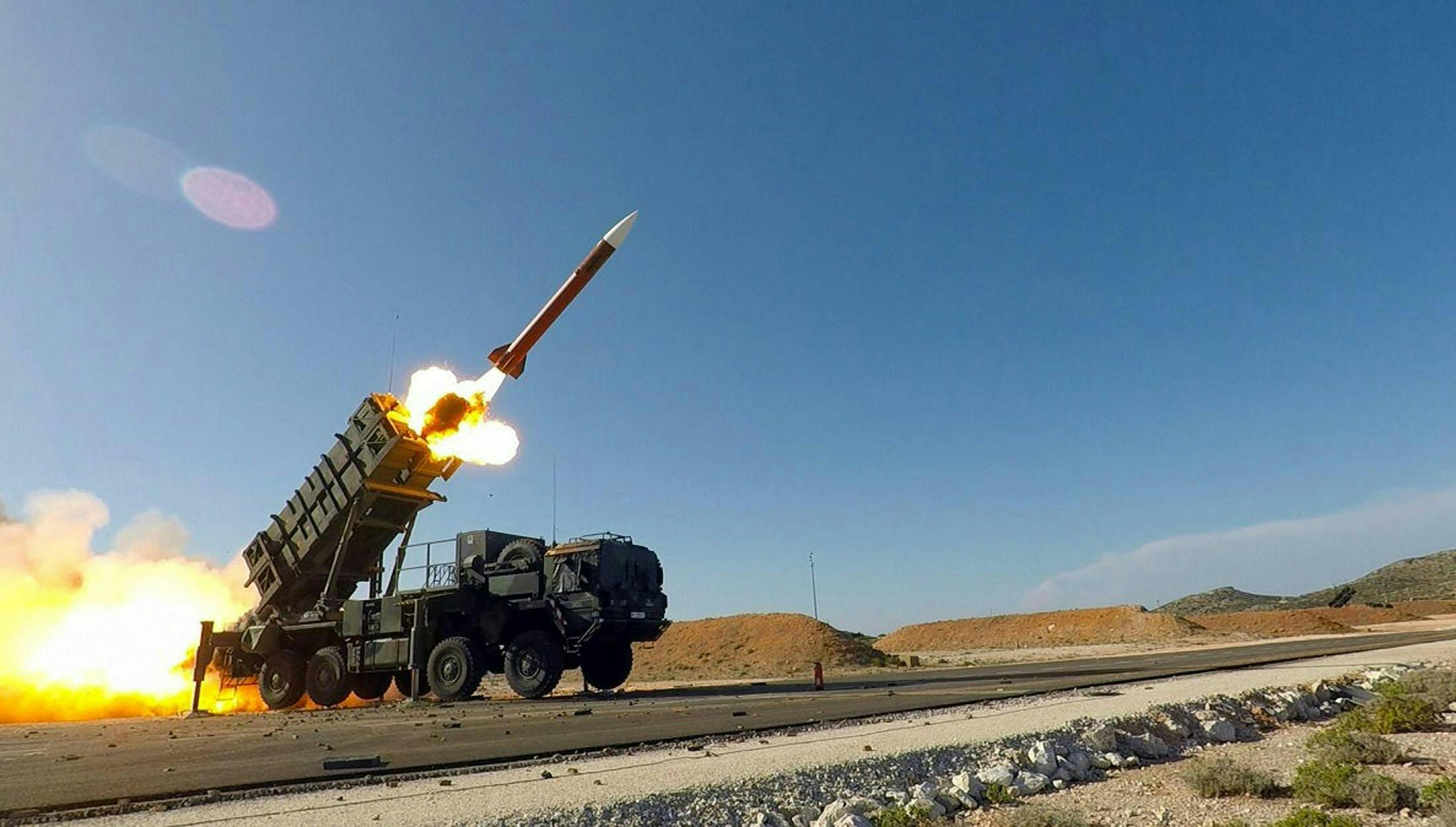
Ukraine has asked allied countries to provide 300 Patriot interceptor missiles from their existing stocks as Kyiv attempts to strengthen its air defences before another winter of Russian missile and drone attacks.
Ukrainian Defence Minister Evgeniy Khmara set out the requirement during his first appearance at the Ukraine Defence Contact Group, alongside requests for 500 air-to-air interceptors capable of engaging cruise missiles and $2 billion in funding for drones.
Khmara said a recent Russian attack had involved cruise missiles, ballistic missiles and jet-powered Shahed-type drones. Ukrainian air defences had intercepted 31 of 32 cruise missiles, he said, but ballistic missiles were proving more difficult to counter because of shortages of Patriot ammunition.
He said: “Our air defence managed, among other things, to intercept 31 of the 32 cruise missiles, but the situation with ballistics is much more difficult, and that difficulty is precisely down to the lack of Patriot missiles.”
Ukraine is already contracting around 1,000 Patriot missiles with support from partner countries and through European Union financing, according to Khmara, but most of those weapons are not expected to arrive immediately.
He therefore appealed to countries to transfer missiles currently held in their own inventories, saying: “we ask that you supply us the missiles from your stockpiles today, in exchange for future improved missiles from our contracts.”
Khmara also warned that Ukraine faces a substantial defence funding gap. He said €70 billion in security assistance had been promised this year, with around €62 billion currently expected from bilateral assistance and European funding.
That leaves €8 billion of the earlier commitment outstanding, while Khmara put the wider Ukrainian defence funding shortfall at €23 billion, equivalent to around $27 billion. He asked partners to take the necessary funding decisions by November so that equipment could reach the battlefield during the winter.
Drones also featured prominently in the Ukrainian presentation. Khmara said: “Up to 90 percent of our success in the battlefield is down to drones.”
He said Ukrainian companies were developing lower-cost methods of intercepting jet-powered Shahed-type drones, with some interceptor systems already being tested in combat. Khmara also said Ukrainian assessments indicated that Russia was planning to mobilise around 300,000 additional personnel on top of existing recruitment and could seek a similar mobilisation effort in 2027.
He argued that Moscow was attempting to turn the conflict into a competition over manpower and resources, while Ukraine intended to rely increasingly on technology, drones and rapid battlefield adaptation.





Pac 2 which are basically useless.unless they think they can target the real planes bombing the black sea ports.
What happened to the f16s and migs they still have
Still being used but a shortage of AAM means they are having to resort to guns with the risk of collateral damage when those rounds hit the ground!
The PAC2 GEM-T is ABM capable isn’t it?
I take it SAMP/T wasn’t up to snuff then.