

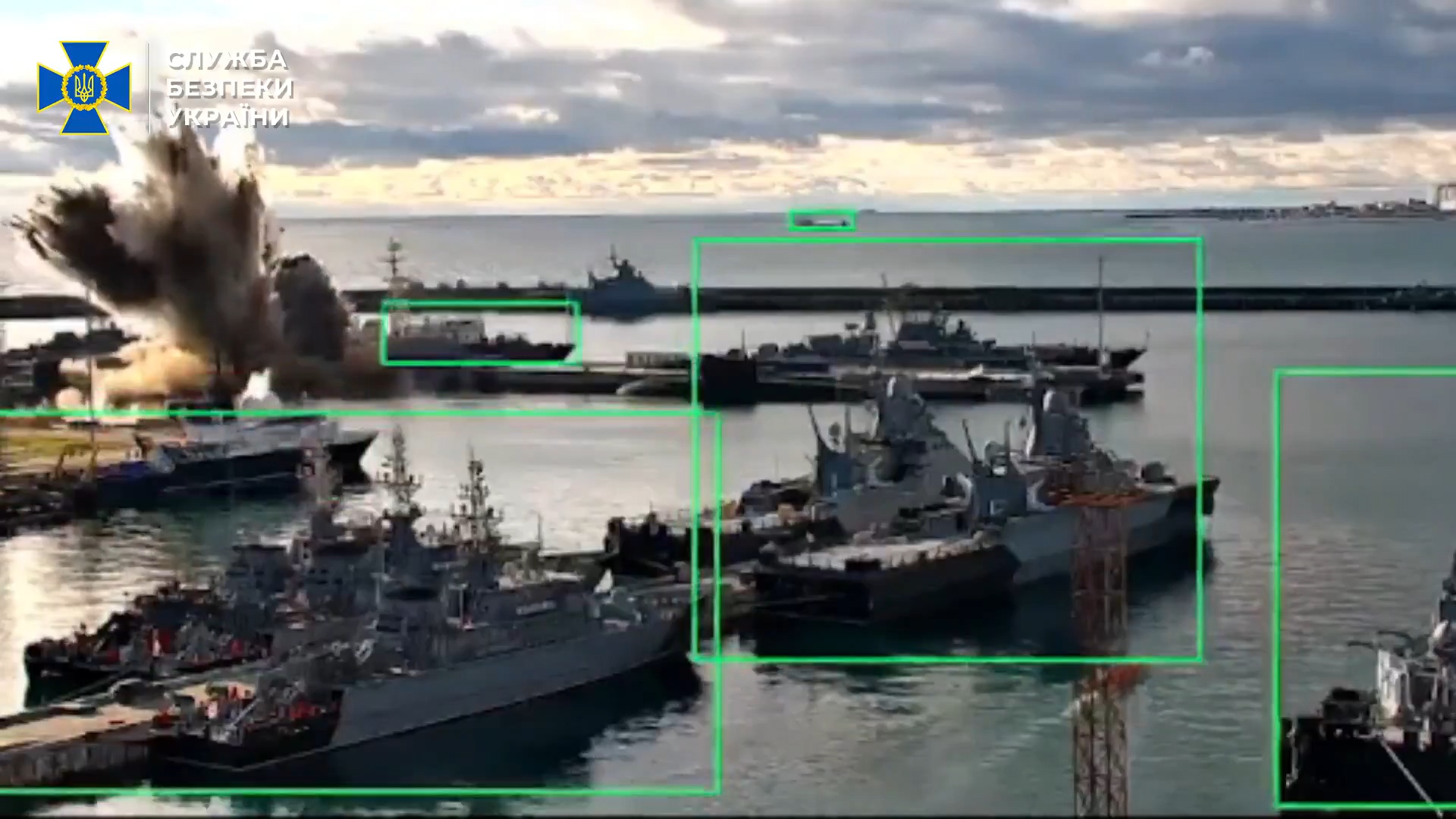
Ukraine says it has carried out the first recorded anti-submarine combat strike using underwater attack drones, targeting a Russian Navy Kilo-class submarine at the Black Sea port of Novorossiysk and leaving the vessel critically damaged and out of action.
According to Ukraine’s Security Service, the SBU, the operation used domestically developed “Sub Sea Baby” unmanned underwater vehicles to strike a Project 636.3 Varshavyanka-class submarine, known in NATO as the Kilo class. These diesel-electric attack submarines are among the quietest in Russia’s fleet and have been a central element of Moscow’s naval strike campaign against Ukraine.
Ukraine says it has used underwater attack drones in combat for the first time, hitting a Russian Kilo-class submarine in Novorossiysk and putting it out of action. The strike points to how quickly uncrewed systems are changing naval warfare, this is a huge deal. pic.twitter.com/QL9IwmeRjw
— UK Defence Journal (@UKDefJournal) December 16, 2025
The SBU said that “as a result of the explosion, the submarine suffered critical damage and was effectively put out of action”, adding that the operation was conducted jointly by the SBU, its military counter-intelligence directorate and the Ukrainian Navy. Footage released by Ukrainian authorities appears to show a large underwater explosion alongside a submarine moored in harbour, followed by visible blast effects near the hull. The video has not been independently verified.
Russia has denied the claim. Alexei Rulev, head of the Black Sea Fleet press service, told state media that “the enemy’s attempt to carry out sabotage using an unmanned underwater vehicle failed to achieve its goals”. Moscow has not released imagery or technical details to support that assertion, nor has it confirmed the condition of any submarine at Novorossiysk.
The Varshavyanka-class boats targeted by Ukraine displace nearly 4,000 tonnes when fully submerged and measure roughly 74 metres in length. Powered by a diesel-electric propulsion system, they are designed for stealth rather than speed, with a submerged velocity of around 20 knots and an operational endurance of up to 45 days. Russia has long marketed the class as extremely quiet, earning them the NATO nickname “Black Hole” submarines due to their low acoustic signature.
Each submarine typically carries a crew of about 52 and is armed with six 533mm torpedo tubes capable of firing torpedoes, laying up to two dozen naval mines, or launching Kalibr cruise missiles. In the Black Sea conflict, those Kalibr missiles have been repeatedly used to strike Ukrainian cities and infrastructure from standoff range, allowing submarines to fire while remaining concealed.
Ukrainian officials say the submarine struck at Novorossiysk was equipped with four Kalibr missile launchers. Disabling even a single boat would therefore remove a platform capable of launching multiple long-range strikes, while also imposing a substantial financial cost on Russia. Ukraine estimates the value of a Kilo-class submarine at around $400 million, with replacement costs potentially rising to $500 million due to sanctions, supply chain constraints and production delays in Russia’s shipbuilding sector.
Ukraine has already forced much of Russia’s surface fleet to retreat from Sevastopol through repeated strikes using missiles, surface drones and special operations. The use of underwater kamikaze drones would extend that threat beneath the surface, challenging traditional port defences designed primarily to counter divers or surface-borne attacks.
Novorossiysk has become increasingly important to Russia as a fallback base after repeated Ukrainian strikes on Crimea. The port lies deeper inside Russian-controlled territory and has been portrayed by Moscow as more secure. A successful underwater strike there would suggest that no Russian naval facility in the Black Sea can be considered fully protected.
Confirming submarine damage is inherently difficult, particularly when vessels are struck in port and moved quickly for inspection or repair. It remains unclear whether the submarine was fully operational at the time of the attack, whether it was preparing for deployment, or whether any personnel were on board. Ukraine has not claimed casualties, and Russia has not addressed the issue publicly.





“the enemy’s attempt to carry out sabotage using an unmanned underwater vehicle failed to achieve its goals”
Well, I’m convinced!
It appears that either the bow or stern took the hit and there also appears to be debris coming out of the blast suggesting that something was definitely damaged. Assuming it was the sub and not something else being damaged then the image would suggest that either the sonar, torpedo tubes and possibly the weapons handling systems are damaged. If it is the stern that is damaged then the prop., rudder and aft dive planes, shafts and possible motor room have all got to be candidates for significant damage. Oddly, the Kilo class do not have a cruciform rudder dive plane arrangement. They have a single downward rudder so there is nothing protruding above the surface to indicate which is the stern in the images.
My guess is that boat is seriously damaged and could even be a right off…
There is a good article and set of cutaway drawings of the Kilo class on navygeneralboard.com.
Cheers CR
From the video (available online) it looks as though it’s hit in the stern section. If so it will be out of action for some time, perhaps even unrepairable depending on stresses on the hull.
And then I see the video in the article itself, durrr
Interesting analysis, thank you.
That was a not insignificant blast right next to the bow/stern of the submarine or indeed against the bow/stern… it’s unlikely to be a failed attack.
Pity they only snuck one into the harbour. Now the Russians are going to be on the watch for submersibles now.
Seems like a waste, Ukraine could have had their own pearl harbour moment that day
For a country without a navy, Ukraine is remarkably good at naval warfare. We could learn a few things from them.
Herne or Excalibur type subs could carry a LOT of explosive inside them into Murmansk, this could be an interesting addition to our long range strike options.
Alternatively use them like the old X-craft with saddle charges so that multiple targets can be hit, though that would reduce range.
It would take those two a fair time to get there and the whole area, you would Imagine, was rather well guarded given It’s strategic Importance but as this attack proves, even the best guarded places are vulnerable.
Heaven forbid we don’t destroy any of the “up to 200” special containers at Saida though.