

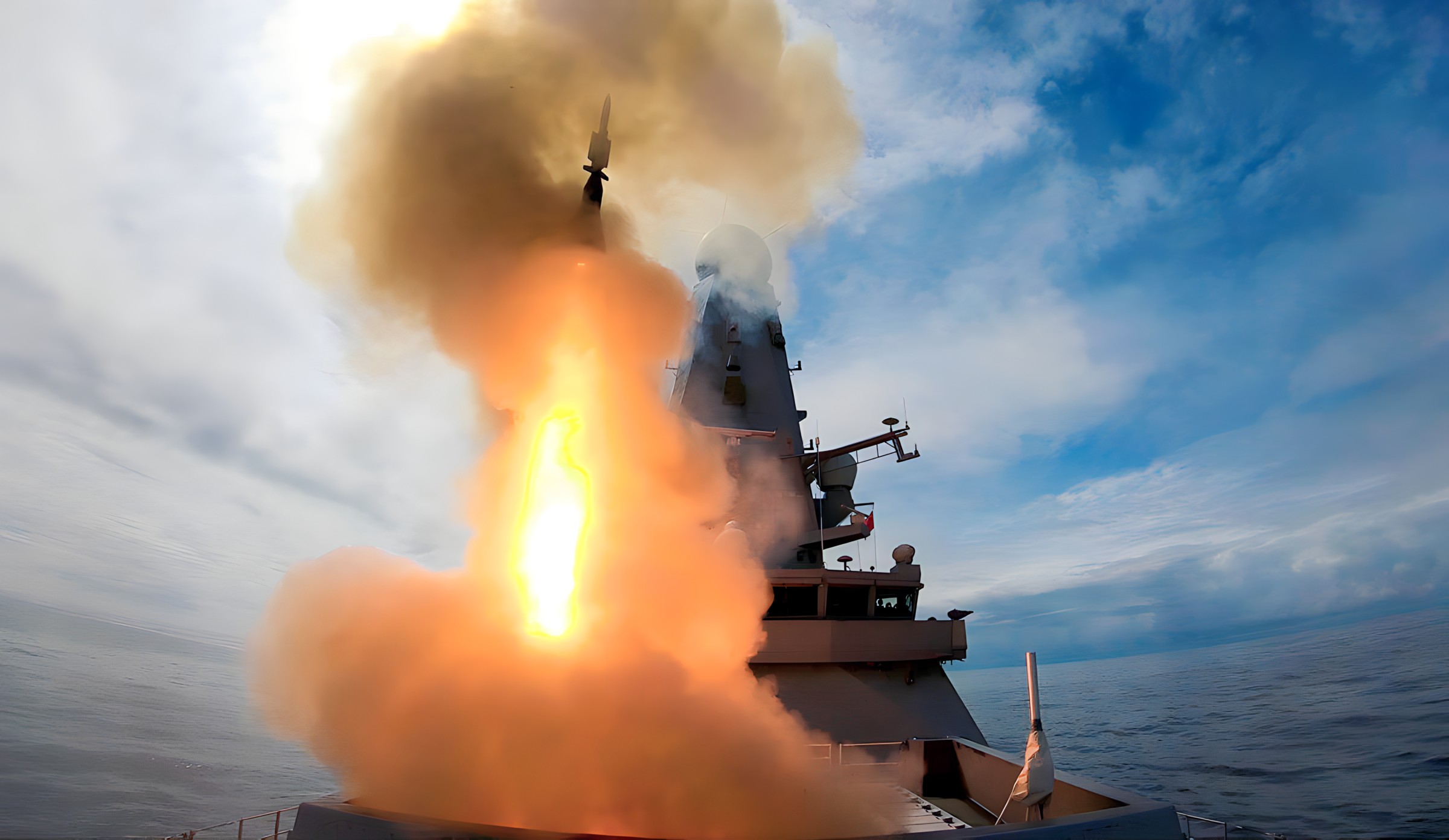
The Sea Viper Evolution programme for the Type 45 Destroyer fleet is expected to deliver an initial ballistic missile defence capability in the early 2030s, according to a new parliamentary answer.
In a written response to Conservative MP James Cartlidge, Defence Minister Luke Pollard said the programme remains split into two separate capability tracks, each at a different stage of development.
Pollard said that Capability One, described as the Royal Navy’s entry-level ballistic missile defence capability, is expected to reach Full Operating Capability in late 2032. “Both Sea Viper Evolution Programmes continue to make progress,” he said. “Capability One, the Royal Navy’s entry level Ballistic Missile Defence Capability, is expected to provide Full Operating Capability in late 2032.”
The second strand, Capability Two, which would provide theatre-level ballistic missile defence, remains earlier in development.
According to the minister, this element of the programme is still in the assessment phase and is intended to inform future decisions on capability design and investment. “Capability Two, providing theatre level Ballistic Missile Defence, remains in the Assessment phase to inform future capability and investment choices,” Pollard said.
He added that this work is being shaped by wider changes to the Royal Navy’s force structure. “This is particularly important where the Royal Navy’s pivot to a Hybrid Fleet will enable new and novel approaches to ballistic missile defence.”
Pollard cautioned that continued progress across both strands of Sea Viper Evolution remains dependent on the forthcoming Defence Investment Plan.
Sea Viper is the principal air defence system fitted to the Royal Navy’s Type 45 destroyers and has been operational for more than a decade. The system comprises the Sampson multifunction radar, command and control architecture, combat management system and Aster missile family.
The upgrade programme was formally confirmed last year, when the Ministry of Defence announced a £405 million package of enhancements following the combat deployment of HMS Diamond in the Red Sea. During that deployment, the destroyer conducted multiple live firings of Sea Viper missiles while defending international shipping against aerial threats, marking the system’s first operational use in combat conditions.
The initial phase of the upgrade focuses on improving the system’s ability to counter more advanced threats, including anti-ship ballistic missiles. This includes upgrades to the Aster 30 missile, along with improvements to the Sampson radar, combat management system and command architecture across the Type 45 fleet. A later phase of Sea Viper Evolution is expected to examine the potential introduction of the Aster 30 Block 1NT missile, which is being developed collaboratively by the UK, France and Italy. The missile features a new seeker designed to enhance ballistic missile interception capability.
The Ministry of Defence has previously said the upgrade programme will support around 350 UK jobs, particularly in high-skill roles at sites in Stevenage, Cowes, Bristol and Bolton, alongside wider industrial activity involving MBDA and BAE Systems. Sea Viper currently provides area air defence for Royal Navy task groups, with the ability to track hundreds of targets simultaneously and engage threats at ranges of tens of miles, depending on threat type and profile.








Early 2030s, that’ll be 2040 at the earliest then…
No? theres just a number of upgrades to do.
Nice to see some optimism and realism in the comments section. It’s always dominated by the doom mongers and self proclaimed comedians who all think the job of politicians is easy.
Oh those poor politicians…said no one ever.
They’re lying, gaslighting traitors.
Grow up. If any of the negative commenters became politicians, they would be accused of exactly the same things in no time. It’s an impossible job and you know it. The easiest thing in the world is to be an armchair general and act like you would be able to magically come up with more destroyers and frigates. It’s really easy to just moan and whine all day in comments sections but it does nothing and I doubt all the moaners are happy to pay more taxes to improve the military.
I would have thought theatre level ABM defense would be better off land based??
It’s needed at sea to combat the modern Chinese anti-ship ballistic missiles.
It also offers a cheaper way of doing a home BMD network. Pay for a fewer sensors by relying on ship-based radar on the Type 83, then distribute barges, USVs, frigates around the northern coast as a distributed network of sensors.
Less capable, of course. But cheaper, because you can press the established carrier escort networks into service in home waters.
Ship based missile defence is also much easier to protect since it’s constantly moving. From what I can see in Ukraine they’re constantly moving their land based systems around which causes a lot of down time and risk.
The UK is quite fortunate that it can make effective use of a ship based missile defence around the island.
Yeah, it’s an advantage that should be used to greater effect. It’s not the best solution for capability, but balancing cost might make it appealing.
Six destroyers gives 2-3 operational at any one time, ideally. One with the CSG, one deployed abroad and one in home waters should be feasible. If those destroyers are essentially going to be massive radar and communications nodes, you could theoretically operate one ship, in coordination with three-five smaller arsenal drones, as a poor man’s version of a national BMD screen.
It wouldn’t require any investment beyond what is already sketched out, and it could theoretically be rapidly deployed to cover an area like Cyprus, or Singapore, for example.
One with the CSG is only sufficient in peacetime. In wartime something so critical needs two. Using scarce ships to defend the homeland is wasteful.
I agree. That said, the majority of time is peacetime, and so cost will always be a factor. Using existing naval vessels for the role would be far cheaper than investing in land-based defences.
A warship and the crew is mostly not the missile system, whereas a truck based system mostly is and therefore much cheaper to own and operate. Most airbases and training areas are easily big enough for parking.
If we need say 10 systems to protect the country then we need to own and operate 10 systems 24/7 because an enemy missile is likely to arrive well before we’ve deployed something based on an intelligence assessment. A bit like those paint spraying activists recently. Not even having 4 soldiers walking round to prevent that was negligent.
Our 6 T45s can’t do 24/7 home defence, only the forward cover role they’re designed for.
I’m not arguing that it would be the best solution. I’m saying it would appeal to a financially-struggling MoD to utilise existing (and therefore paid for) assets to fill the role.
I’ll add that if/when the Type 26 frigates receive their newer radars, we might see a less pressing need for a pair of destroyers, now our frigates can be armed with medium-range interceptors.
Theres no plans to arm T26 with medium range interceptors, far as we know theyll only have CAMM
That’s because the medium-range interceptor that would fit doesn’t actually exist as a finished or integrated product yet.
They have Mk41, theres plenty of interceptors they could use, we just dont plan to get any.
There’s exactly one medium-range interceptor they could use in the Mk41, the SM-2.
Given that the SM-2 is not integrated into BAE’s CMS, you’d have to do that, as well as spooling up a new system for a niche missile.
I’m suggesting that once A30B1NT is integrated into the Mk41, or once CAMM-MR enters service, those interceptors might be ported over to the Type 26.
Weve shown no intrest in Camm MR for us and Aster intergration wont happen till T83 or if it happens for T83 at all.
Current reports from defence industry insiders actually suggest Mk41 integration for the Aster might see initial contracts awarded this year, perhaps as early as February 13th. I’m not sure if you follow Gabriele Molinelli over on Twitter, he has a nice thread about it.
Fitting Camm ER would be a simple fix there, pushing out the air defence envelope to 30 plus miles.
48 missiles on a T26, plus a farm of 24 ‘ish’ on unmanned platforms, gives a substantial capability.
A theoretical CSG, based around a QE Class, being escorted by 2x upgraded T45 and 2x T26, plus unmanned missile platforms, would provide one hell of an umbrella!
If we are also including Dragon fire on all the platforms (hopefully), then air defence will be world class and absolutely ferocious.
Dragon Fire is useless against any swarming threat.
Range too short, power too low
As it currently stands, it can apparently kill a drone in two seconds, before repositioning for a new target at ranges over a Kilometre.
Bare in mind, this is in its mk1 state too. Upgrades and improved range, kill time and repositioning speed will come.
Of limited value against 100 attack drones, but very capable against limited drones, fast attack craft, drones boats etc.
Its just another tool in the box. As it stands, T31’s 57mm and 40mm gun systems are the gold standard in countering drone swarm attacks.
The T26s won’t be near the carrier in a wartime scenario. As they’ll be pushing out the defensive ASW ring and need to be operating in quieter waters. However, ensuring the T26s can defend themselves against anti-ship ballistic missiles (ASBM) is an absolute must. I feel along with the T45s, you may see either one or two T31s acting as the carrier’s goalkeeper. If they have Mk41 along with a CAMM farm, they could add a significant amount of air defence capability, when controlled by the T45s.
Japan doesn’t agree.
Actually that was because people in the local area were concerned about missile debris falling on them.
The Type 45s are mostly in port.
We just have to spread them about.
No, theyre not, theyre increasingly deployed, especially to make up for T23
So they are going to work up to an IRBM level defence.. interesting.
I think the 2032 is the full 1NT and then there is clearly something else in the works beyond that.
As they are the only platform we currently have it is unsurprising that they have a considerable upgrade pathway.
The issue is actually having ships to use as opposed to on the wall or in dry dock being upgraded.
I thought they were going with the standard block 1 first, with NT later, some say the NT will be the phase 2, but in reality NT is a now missile so will be mature well before 2031, we can hope the RN skip the intermediate step and go for NT.. beyond that is block 2 but that is not likely to be ready until the mid 2030s at the earliest..
From what I’ve read the main radar work for both block 1 and NT is being undertaken in this refit cycle with the Full operating capacity of CAMM and the aster block 1 at the same time 2032.. so it would seem they are doing the upgrades to the radar at the same time as CAMM, fiats IOC for CAMM is 2027 and first IOC for block 1 radar upgrade is apparently 2028.
All in all the T45 program seems to be going very very well.. and they will be a very very good set of full capability AAW destroyers.. all they need to do now is pull out that pointless 4.5inch and stick a 57mm in its place.
But what this does prove is the 2035 retirement date for these vessels is a joke, I would lay money on daring kicking about until 2045..
“ All in all the T45 program seems to be going very very well.. and they will be a very very good set of full capability AAW destroyers.. ”
T45 has the power, weight and stability margins to cope with very substantial upgrades as well as hull integrity. Unfortunately T23 had, by contrast, run out of most of those…..
Hi SB, I seem to remember that the T45 design marked a sea change in how RN ships were specified and one of the design criteria was a 15% growth margin for future upgrades. Previous to this one all post war designs were down to minimal margins in terms of space, power and stability which is why modernisations were just so difficult. The Treasury equated size with cost and constrained the designs accordingly, some of the Leander conversions were helped along by removing layer upon layer of RN paint which freed up over 100 tons.
Steel is cheap and air is free is an old adage but one that was cast as-side by bean counters !
Funny thing was pre Washington Treaty all RCNC / Admiralty designs had a board margin built in for future additions.
The CAMM system is lighter than the Sea Wolf system it replaced. Computer boxes are smaller and individual old fire control radars are gone. The missiles are individually a bit heavier but they’re capable of being quad packable. Ship upgrades don’t have to mean more weight or more space.
Aside from the other things I’ve mentioned below, the Type 45 will lack the dedicated ABM systems and true long-range interceptors to be considered a ‘full capability AAW destroyer’. Really, that label can only be applied to the later Burkes, and their Japanese and South Korean equivalents.
Again, the issues of not investing in either indigenous, or European strike-length VLS is rearing its head.
To be fair the job of an AAW destroyer is to defend naval task groups against possible air attack and the longest range Antiship Ballistic missile is about 1500km range so the block 1 NT will defend against any air attack against a naval task group.
Perhaps a couple of years ago, but the current consensus is that they’ve introduced anti-ship warheads for significantly larger missiles.
The information coming out now suggests the DF-27, which is essentially an ICBM, is now being tested with anti-ship warhead for striking US CSGs at absurd ranges.
maritime-executivecom/editorials/china-s-df-27-missile-threatening-pacific-ships-and-the-u-s-homeland
That article contains a useful graphic (add in the ‘.’ between executive and com).
Elongating the tubes to full strike is possible as they are on elevated seatings.
That was briefed out some years ago.
From the political aspect consideration, though, do they bother to do that, when simply investing in Block 1NT would require minimal time out of the water, minimal changes? Especially considering the amount of time they’ve already spent out of service.
1NT can go in the A50 tubes and can cover off the existing A30 role as well.
Be interesting to understand how the short range CAMM option will be covered off.
Tests can be controlled from Cowes or Portesdown.
I know, I’m saying why would they bother adding larger tubes for Aquila, when they could instead invest in the B1NT, which requires minimal changes.
Yeah, it’ll be interesting to see Defender’s adventures when she comes out of refit later this year.
“cover off” – what does that mean?
Probably a redundant amalgamation.. A covers B’s role/capability, B’s role/capability is checked off the list.. cover off.
That’s really good to know. Presumably it means they can be swapped for the longer A70 launchers?
“The ‘MK41 Gym’ on a type 45 destroyer. The new Sea Ceptor silo will occupy the upper portion of this compartment. This spare space was left in the original design to potentially allow the fitting of additional strike-length VLS cells. Incidentally, there is also there is void space under the existing Sylver A50 silo that would allow the fitting of Silver A70 cells or strike-length Mk41.”
NL photo caption from:-
Royal Navy’s Type 45 destroyers – reaching their full potential with addition of Sea Ceptor missiles
Dated: 6th July 2021
To be honest it had not really sunk in that block 2 would not happen, I was only reading about it 18 months ago.
Apparently its cancellation has been common knowledge in France for a while, in much the same way that most people are fairly sure Type 32 has been soft-cancelled (though TBF, the government does occasionally mention Type 32, whereas its been full radio silence on Block 2).
MBDA are concentrating on the Aquila program over the Block 2 Aster. This is a completely new and significantly larger design. As the design goal is to reach well above 100,000ft. Where one of its targets for interception are hypersonic glide vehicles. Which operate over 200,000ft at near sub-orbital heights. So something the size of the SM3 block 2A will be needed.
Yeah, I’m aware of Aquila, though I’m not sure the RN or MoD have committed much to the effort so far.
I think we know it’ll probably be three-stage (though a two-stage design was floated), but I don’t think they’ve clarified whether it’ll be ramjet or conventionally-powered.
Admiral Zambellas, PBUH, felt T45 needed a SLEP to aquire Mk41, they were designed with the silo depth,and moved to higher capability US effectors like SM up to and including SM3
1SL Alan West also wanted Mk41 fitted – he has publicly stated that Des Brown wouldn’t listen to him on the subject.
RN should have developed sovereign VLS and interceptors like the Koreans did when we pulled away from Horizon. We wouldn’t have had the absurd situation of being the largest user of ASTER by VLS count yet not being able to influence the rate at which they are produced, and would have avoided the T26 ‘cells but no missiles’ ridiculousness by having VL-Storm Shadow on T45.
CAMM showed we could do it for the missiles, at least.
Not sure where you’ve got the figure on the RN being the largest user of the Aster by VLS count – the Italians outstrip us there, without factoring in their incoming DDX, FREMM EVO or the upgrades to the existing PPA fleet.
The RN has had 288 ASTER VLS in the fleet since 2013 with 6×48. Depending on plans with Mk41 integration which seems to have been revealed today that may increase as they are used with T31, T26 and eventually T83.
The French have exactly the same number (I forgot CdG) with 32 (CdG) +2(48) (Horizon) +6(16) (FREMM ASW) +2(32) (FREMM AAW). They will shortly overtake us with the FDIs.
The Italians currently have their 2 Horizons plus 8 FREMM each with 16 VLS plus 32 on board Cavour, for 256 Aster in total. Their two PPAs at present do not have Sylver but will be refitted and when they do that and future construction will overtake us.
We have been the main customer for Aster for over a decade, having been involved in the project for a decade before that, and we never once thought to have sovereign interceptor capability.
Am I missing something with regards to the Italians, because I count one carrier, two destroyers, 10 frigates, and two OPV/Frigates all equipped with the Sylver VLS?
Cavour – 32
Doria – 48
Duilio – 48
Rizzo – 16
Martinengo – 16
Bergamini – 16
Marceglia – 16
Alpino – 16
Carabiniere – 16
Bianchi – 16
Schergat – 16
Fasan – 16
Margottini – 16
Montecuccoli – 16
Giovanni delle Bande Nere – 16
Adding all those together gives 320 cells, not 256.
I’d missed a couple of newer FREMM-ASW and 2 PPA Full that just entered service, so they do beat us, you’re right as of July last year.
My point still stands that for more than a decade we were the largest user of ASTER and 6 top-tier air defence destroyers should have been enough for us to have our own interceptor family.
Your point does not stand, 6 ships with the system and a completely sovereign missile, look how that worked out for sea dart.
The first French FDI is in service, as well, right? So they should’ve overtaken the RN by at least 16 cells as well, putting the RN as the third-largest operator.
With this time line in the 2030s you wonder if the T31 CIP can be accelerated to give some more AAW mass to the RN sooner and even to the T26s with mk41 quad CAMM-ER/dual CAMM-MR?
I agree with you, that’d be a good way of boosting air defence capability in the medium term. Especially if Artisan-NG is equipped to the frigates.
Morning Leh, yes forgot to mention the Artisan-NG. Just hooe they don’t go soending mega millions on the aT91s when T26/31 ships need to ge theirs in first and filled. If the current Artisan’s are they still useful maybe they can then be put on the B2 Rivers with a 40/57mm upgrade? And , just to be controversial, lol, the B2 radars and 30mm onto the B1s?
By the time the Artisan NG is in use the B1s will be gone….. and why would we stick artisan on B2
Why would they pull out the 4.5 when it will be the majority main gun at least until 2030, plus theyve already had a ton spent on upgrades.
Because the 4.5 cannot engage air targets and therefore does not support the primary function of a type 45 and as you say by 2030 will be a marginal system and by the early 2030s will only be on the type 45s.. at that point the type 45s will essentially be strapped to a carrier battle group or other AAW duties and the 4.5inch is costing money to little purpose… better to replace it for a system that has a meaningful use to an AAW destroyer and ties in with future fleet logistics and training pipelines… the RN is not going to want to support the 4.5inch into the late 2040s.
But when exactly will they have the time or money to replace them, they need fhe T45 at sea not in and out of drydock, and they’re not going to upgrade the class extensively beyond 2035 as they’ll be approaching retirement by then.
Well apart from the one being finished now between now and 2032 every T45 will being going in for its radar, block1 and CAMM upgrade.. you can do it then.. it’s about 10million a pop for a 57mm.. if you are being cheap you simply cover the deep magazine for the 4.5inch and have a deck mounted 57mm not deck penetrating..unless you want to do the deck penetrating magazine work.
And as soon as the last T23 is out of service you have removed an entire logistic and training pipeline for a whole medium gun system..that saves a lot.
Even without 4.5 were in a logistics mess with
5 inch
57
40
30
20mm Phalanx
Maybe even some 20mm gamboi
Yep and removing the 4.5inch when the last 23 goes is a good start to rationalisation.
It would be quicker cheaper and easier to fix the gun control software to do AAW for drone type targets.
When it was deleted the through process that it wasn’t much use against anything Mach1 or faster. The calculus has changed in that there are a lot of slow moving targets that it could pick off at range including boat swarms.
The ammunition thing isn’t such a big deal and now that the gun is servo controlled, no hydraulics to go wrong and need calibrating, it isn’t the maintenance nightmare that it once was.
Spot on Jonathan, as well as the 57mm, I would replace the two Phalanx with twin 40mm mounts.
Both systems would require a good deal of work, but add a great deal of air defence capability.
The 4.5″ gun is now totally obsolete and about as useful as a chocolate teapot.
Those 40mm mounts should be added to the QE class too.
RN aspiration is to standardise on Bofors 40mm and 57mm mounts on everything.
Only T23 couldn’t take the 40mm Bofors – top weight and arcs
Are you sure that’s the case? Thus far there’s been little indication the T26, QEC etc will be modified as such
BAE’s DSEI ‘ideal T26’ had Artisan NG, 40mm and MTLS so there’s definitely a pipeline available there.
The QEs is strange, there have been parliamentary questions about CAMM but I don’t think any of the MPs actually know enough to ask about upgrading the guns.
But then it’s very likely the 23s will be all gone in 5-7 years so not much point in that really..
“twin 40mm mounts” where do these come from?
Could have just been referring to two separate mounts, a strange way of putting it though.
Twin 40mm mounts, as in one either side, or do you assume all twins are conjoined??
Given you said ‘replace the TWO phalanx with TWIN 40mm mounts’ I think the mistake would be reasonable. Twin mounts, or twin turrets, definitely usually refer to having two guns on each mount.
Most people understood what you meant though given the last twin 40 went out of service decades ago.
It’s a pity the RN haven’t learned from the USN.. Where the USN used the 5″ gun to take out a large number of one way attack drones. The threats and the direct cost of using missiles was the reason why they un-shelved the hypervelocity projectile (HVP) program. As it means the 5″, using guided HVPs will have the ability to engage missile threats as well as drones, but at significant distance (20km-ish) from the ship. The Italian Navy, also demonstrated how effective the 76mm Strales systems was when paired with the DART guided round. Where it was used to take out not only drones, but also Houthis C802 anti-ship cruise missiles.
The 4.5″ could have either the basic anti-air capability using timed HE shells as per the USN 5″, or as both DART and HVP are sabots, a 4.5″ specific version was manufactured. The RN would need to reinstate the AA software for the 4.5″ and would be a significantly cheaper option, that looking to integrate the guided rounds.
I suppose dry dock is harder, but isn’t port quite a good place to fire them from?
Ships in dry dock are fully destored.
That’s why we always needed 12. Having less is just delivering an unviable defence if we faced peer+ adversaries.
Unfortunately Frank, when we ordered them peer warfare was a ‘thing of the past’.
It was all about counter insurgency warfare and terrorism.
The RN was lucky to get 6, im astonished it wasn’t cut to 4 really.
Certainly, re its replacment, the T83, there should be at least 8 and hopefully 9 in the fleet.
They tried to sell off two of those six
Surely 12 or even 15 is better?
I don’t actually think we needed the full 12 as AAW destroyer anymore.. but what we needed was the 12 type 42 hulls replacing..
If you consider the 12 AAW destroyers was a requirement when
1) you needed 4 AAW destroyers for a carrier battle group an even then you would be lucky if they could engage 4-8 targets per engagement between them all.. a fully upgraded T45 with 48 aster 30 and 24 CAMM can in theory engage about 4 targets every couple of seconds and use and engage with every missile it has against 72 different targets within 60 seconds.
2) when the 12 AAW destroyers requirement was drawn up RN frigates had essentially zero AAW capabilities..the vast majority could not even defend themselves effectively against someone trying to drop a free fall iron bomb on them.. a modern RN frigate is probably a better AAW asset than a type 42 AAW destroyer..
This means the need for dedicated AAW destroyer numbers has dropped off.. but at the same time the need for them to be exquisite and be able to defend against very high end ballistic missile threats and hypersonic weapons has increased..
So we need the very best AAW destroyer money can buy but we need very few 1-2 for a Carrier battle group and another for covering a key concurrent opperation somewhere else.. so six will do.. but what we have not lost the need for is hull numbers so we should have replaced those six lost hulls with six GP frigates that has ok AAW self defence and short range area defence ( ok 3D radar.. and 32+ CAMM)..
In the end the peace time navy should be 32 escorts we know that.. but it’s flavour should have changed
6 high end AAW destroyers
9 high end ASW frigates
17 GP frigates ( 36 CAMM, NSM, good guns, ASW rotor capability and the option for a light weight thin line towed array sonar.
Your logic makes sense to me, at least with regards to the nature and number of the high-end AAW and ASW hulls.
As for rounding out the rest of this (fantasy) fleet, I can see why you’ve proposed using GP frigates but I wonder if a 4th type of vessel, one for protection of sub-surface infrastructure and mine-hunting, should be added to the mix?
Apparently, a brave new world of sub-surface warfare based on drones may be upon us…!
Cheers.
Yep but that’s really the EEZ patrol function. The navy set that requirement as well.. about 10 vessels..
First time I have ever seen anything saying the UK is involved in developing Aster 30 block 1 NT. Up until now NT has only been quoted as Italian and French.
I suspect its considering the integration of the A30B1NT into the PAAMS software, which is jointly developed and maintained by all three nations. Aster development and production is almost exclusively the territory of France and Italy.
It all depends on what the original treaty says about being in/out rejoining etc.
It had to have been drafted with French tech leadership tantrums in mind…..:)
And we know they will throw them to the very last..
The UK jumped aboard the Block 1NT, when it became apparent, that anti-ship ballistic missiles are now a realistic threat.
Not quite sure how, though. Aster-30 B1NT offers low-level MRBM capability at best, and it’s the best BMD system that the Type 45 can take without replacing the forward CAMM system, or the main A50 system.
The only way of doing this before the Type 83 is by putting the interceptors on frigates or USVs, and developing a CEC to allow guidance from the SAMPSON.
Type 91 sloop could also do the job
Aster block 2 is planned to be the Same sort of size as a block 1 NT and fit an A50 silo.
No, the Block 2 has been soft cancelled for half a decade at this point. It’s not been mentioned in official circles for some 10 years, and never received any funding from either the French, or the Italians. The Block 1NT was adapted into a partial replacement for that capability, with the much-larger Aquila filling out the higher-end mission. Someone should probably edit the English Wikipedia article to bring it into line with its French and German pages.
Unfortunately, Aquila will not be A50 compatible, it’ll need the larger A70-NG.
My betting is the accelerator is being pushed very hard on developing that.
You’d lose your money, I mentioned it above.
I don’t think I would TBH.
I think the clear proven successes of the ASTER project with T45 etc have lead to renewed R&D spending.
1NT is a lot closer than you might think. If you gave something that works well keep spiralling the family.
No, I mean that plan for an A50-compatible, true MR-IRBM interceptor system has been dead for a while. There’s arguments to suggest it never made it beyond a company-funded concept stage – certainly the French and Italians never provided funding.
They are funding a replacement – the Aquila. But the key issue there is that the Aquila will not be A50-compatible, therefore not viable for the Type 45s.
So, I think you’d be fairly likely to lose your money, betting that a long-dead programme will suddenly produce a viable product 😉
Actually the penny has just dropped.
That is the reasoning behind CAMM in the Mk41 space being cheaply fitted – it can be removed to make way *if* longer tubes are needed.
But
“The company specifically showcased a three-stage rocket design during the Paris Air Show, but at the same time, it mentioned that two-stage concepts are also under consideration.”
My betting is the two stage version is A50 compatible and is the continuation of Block2 – on which a lot of work was done – maybe shorter range just as there is the A15/30 split with the present ASTER family.
They showed images of both the three stage configurations, and the two stage one as well. They were all roughly the same length. None of them particularly resembled the Block 2 (this is available on YT as part of a press briefing).
We also know that the Italians, who are funding and directing part of the development, are fitting their DDX with strike-length tubes explicitly to take future interceptors for hypersonic glide vehicles and ballistic missiles – those being Aquila, and the tubes being the A70-NG.
As to the CAMM tubes, as much as I’d like to believe that the MoD might be being proactive, I think the CAMM tubes were selected because they were far cheaper and easier to install than something larger.
I do think in the end the RN may end up with split AAW capability
1) very high end, including ability to take a three stage booster and exoatmospheric kill vehicle weapon.
2) a direct T45 type replacement
3) the frigate fleet with a wider range of CAMMs to take their ability to hit air breather targets beyond the 50km range.
Because that is how Italy has essentially gone and quite frankly the Italians are probably now the most innovative on getting bang for buck and creating usable mass.
The idea that it is only going to be an non-A50 ABM missile makes very little sense given how many A50 tubes are in service between UK/France/Italy there will have to be something to allow those ships to depend themselves from medium range ballistic missiles.
There need to be a range of missiles to deal with a range of targets.
Well if you look at the European navies they will be spreading the Block1 and Block1NTs across a whole range of platforms..
Italy will have some of its FREMMS offering B1 NT and it’s PPAs offering B1 NT.. on the French side the FDI will be able to take B1 the Greek FDIs will do the same ( and the Greeks have ordered B1 for their FDIs…
So the Italians will have 4 different destroyers and frigates offering Aster based ABM defence if some level or other.. the Italians are now even building amphibious vessels with ballistic missile defence capabilities..
Not really. The Italians are establishing their DDX (and the future two replacements for their Horizons) are their principle AAW escorts, and all of those will carry strike-length systems. Then, the FREMM EVO are equipped with the space to take A70-NG when it arrives, so suddenly, the Italians have six escorts capable of direct hypersonic defence.
The French are a little weirder, but their current FDIs are capable of taking strike-length cells, so it’s not out of the question that they could be deployed there. Similarly, the replacement of the Horizons is not too far away, and that’ll likely carry strike-length cells. Suddenly, the French could have seven escorts capable of lugging around those Aquila interceptors if required.
The Type 45 will get the full capability it should have had at the start, only when it is about to go out of service.
Let’s be real – the Type 45s will be in service well into the 2040s.
Only the americans had that capability in the 2010s
And only on a small number of upgraded vessels…
Yes it’s alway worth remembering that when we slag ourselves off.. it’s a bit of a unique British issue really, because we were a superpower within living memory we only compare and consider ourselves against the premier superpower on the planet.. a nation with 6 times our population and 9 times our GDP..
It’s like the whole SSN thing.. the US with 9 times our wealth has 53 we have 6 and will have 7 soon… that is not actually a bad ratio.
The reality is that we are not at the optimum level of platforms for all the R&D and maintenance/training/basing etc
It is not a linear curve having more of something particularly complicated things. Provided, of course, we can stop modifying the designs….
That is true.. but we have in the past played with to much gold plating on to few platforms.. that’s been the real killer.. I often wonder where we would be if the RN has abandoned the hunt for exquisite ( but on a budget) and instead gone for mass and utility as its guiding light.. we often forget that at its hight the RN rarely had the best ships.. it just had lots and lots of ships that allowed it to be everywhere and practice its craft more than everyone else… in the Napoleonic wars France and Spain had bigger and better ships, their ship design was more advanced. In WW1 the German capital ships were better built and better designed to take more hits, in WW2 the RNs ships were never the best… numbers and utility matters a lot in maritime conflicts or even the maritime element of land wars.
No! No! Too late, we need it within two years if not sooner. No excuses, all stops out and give this programme national urgency. Too many vital defence programmes are being progressed at a snail’s pace, and we have Russia and Iran poised to throw missiles at British interests. Sadly, there are probably too many dozy personnel in critical positions in both the Government and the MOD playing politics with the UK’s safety.
Until someone is actually prepared to seriously increase defence funding, then everything is drip fed from a small pot of money.
It won’t happen under Labour, much like it didn’t happen under the Tories. Its far more important to Starmer, to pour countless billions into welfare, to sure up their core vote.
That million strong fleet of mobility cars and million stong army of under 25 year olds sittingon their arse doing absolutely nothing, won’t pay for themselves you know!
John, you are so right, welfare is the core value of the Labour Party. I remember Starmer announcing a need to increase defence spending in the House last year. It was a sombre affair as the penny had dropped that the World order was changing. The chamber was deadly silent as Labour Back Benchers squirmed in their seats and bit their lips, ‘What Guns Before Welfare!’ It did not last long as we have witnesed with delay after delay on the Defence Investment Plan.
The problem is John we need the jobs.l I support a lot of young men in their 20s.. most of them are on part time temporary contracts in Mac jobs and they are great full for them.. because most of them cannot even get a full time contract working for Tesco.. I’ve coached you guys with first degrees from good unis in the sciences who have taken 2 years to get a science related post.. and have a bin full of no thanks.. employers no longer even bother sending rejection notices and some don’t even inform you if you failed at interview.. most serious Jobs now expect young people to have spent a few years working for free to get experience.. ( because no one will pay to train )…
It’s a big problem our industries have a prediction for only taking on people with experience and they don’t want the bother of developing staff.. but at the same time bitch and moan about not having the trained workforce ( I would have this debate all the time with GP practices.. they would only employ experienced Practice nurses.. and would not pay to train up new staff.. so the practice nurse population dropped and dropped and got older and older and they had to offer more and more money to attract and keep them)…
That doesn’t bode well for me…
Is it a workforce wide issue? I’ve also heard that engineering firms are crying out for graduates so not sure what my position is overall.
It sort of depends.. if your oven ready to be productive you will be Ok.. as an example when I got my degree as a nurse you simply stepped in the job and the ward team and hospital would take the time money and effort to get you to a level of a competent nurse ( it takes five years for a person to be truely fully competent in a complex job).. now NHS trusts put a hard limit on how many newly qualified nurses they will take.. irrespective of their vacancy rate for staff nurses..this has mean there are now newly qualified registered nurses unable to find work as staff nurses.. it’s the same in a lot of industries.. my advice if your offered a gap year in industry take it.
Do the French & Italians have Aster ABM capable in service yet? Thought they were/had developed it but we’d not. Always so reassuring to know our enemies will alway refrain from attacking us until we’re eventually ready!
Yes. They have the Block 1 in service, designed to handle ballistic missiles (BMs) with ranges up to about 600km. This was first introduced on their SAMP/T GBAD. This is also in use with Qatar, IIRC, in a naval context.
They don’t have the later Block 1NT, which is able to intercept BMs with ranges up to 1500km.
I don’t believe the Zubaydah is actually operational yet…so I don’t think Block 1 is actually operational at sea yet.
I remember credible sources anecdotally saying the Marine Nationale might have taken delivery of an experimental batch for testing in the Red Sea, though it was only ever rumour.
Qualification firings of the first batch of Block1 NTs occurred in 24 and 25.. it will be operational on the ground based systems in 26 ( this year ).
In regards to the french and Italian horizons getting Block 1 NT
Andrea Doria is in refit now and will be out in 2027 at which point she will be equipped with Block 1 NT…
Caio Duilio will go into refit in 2027 and be out with NT in 2029
Chevalier Paul Will go into refit in 2027 and be out with NT in 2029
Forbin with be in refit in 2029 and out late 30 or 31..
As to do the french and Italians have block1 on there horizons nobody is saying… so they may just be skipping block 1.. what is very interesting is the Greek navy is ordering block 1 for its Defence and Intervention Frigates its ordering from France. So it’s very likely the French FDI is able to take block 1 as well.
Let’s all not get too excited here.
At best, Block 1NT will allow Sea Viper to engage non crossing IRBMs, it can’t, and won’t, be able to take fast crossing ASBMs – it just ain’t got the legs or the warhead.
We’re polishing a jobbie – it’s the wrong missile – the effector is little bigger than a Sea Wolf.
SM6 is light years ahead and will remain so.
SM-6 isn’t actually that great at ballistic missile defence, compared to something like PAC-3MSE. The SM-6 benefits from frankly massive fuel capacity, altitude and range, which just increases your ability to fire multiple salvoes, making you more likely to achieve an interception.
USN ships also carry far fewer SM-6 and SM-3 (16 and 8 being commonly suggested numbers) compared to what the Type 45 will eventually cart around.
Comparing PAC-3 is like comparing an Escort to a Ferrari.
SM-6 plays in the same arena as ASTER 30 but massively out performs it.
It’s got vastly better range, a much more impressive warhead and it’s fast, really, really fast.
This speed and warhead allows it to take fast crossing targets that are way outside ASTERS capability. ASTER has a tiny kill basket as befits it’s tiny warhead.
SM-6 is a highly capable SAM, ABM and ASM – ASTER has no anti surface capability – strictly a one trick pony.
Kinematically, ASTER is maxed out with no growth room in the design.
Not if you’re comparing actual P(K), in which case you can make a better case.
I’d remind you that the active seeker in the SM-6 is derived from that found on an AMRAAM, and the aerodynamic profile of the missile is derived from the SM-2. So any P(K) benefits from its warhead must be balanced against the performance of its seeker.
The warhead itself is also not ideal. Studies undertaken during the development of the PAC-3MSE showed that a kinetic kill system far outperformed conventional warheads in their ability to actually damage a missile. Both the PAC-3MSE and Aster use a kinetic kill vehicle, and a more advanced seeker, and non-aerodynamic control system, making them both more likely to hit the target, and more likely to destroy the target when they strike it. Modern Chinese developments (you know, the nation with extensive experience in ballistic missiles) also go down the PAC-3MSE pathway with the HHQ-9C.
The SM-6 is fast in certain scenarios. For example, in the anti-ship role, in which it functions as a quasi-ballistic missile itself, it’s been recorded as almost hypersonic. Against a ballistic missile, that trajectory, and therefore that speed, will change. Obviously, the disclosed speed for the SM-6 is about Mach 3.5, though I think it’s probably quicker than that. I don’t think it’s particularly quicker than either the PAC-3MSE or Aster, though. It should also be acknowledged that the way the dual-stage motors function on each of the three missiles is different, which also affects BMD performance.
But overall, the most important aspect is that all three missiles engage in the same envelope. The PAC-3MSE actually has a higher maximum disclosed altitude than the SM-6, which is the metric that really matters in naval BMD. The horizontal range of a system, the advantage that the SM-6 has over the B1NT and MSE, is actually super relevant giving the steep angles that these targets are descending at. Altitude does, however, and both the B1NT and MSE (in particular the MSE) are better equipped to operate at those higher altitudes.
You could quite easily use Aster as an anti-ship missile. Its smaller profile and ability to bounce around using its lateral thrust control might actually be preferable to the SM-6, though obviously the warhead difference matter much more in this role.
SM-6 gets out past M4.5 and has a huge and fully funded development cycle behind it.
Thanks for the extensive and well-reasoned response.
Assuming your M4.5 claim to be true, we also know that both Aster and Patriot can do that as a baseline. In fact, that Patriot is supposed to be able to push well past that.
This is meaningless, because both Aster and Patriot push out past M4.5 anyway, whilst being far more proficient at actually doing the interception and destruction part of the role.
SM-6 is slower than Aster 30. Mach 3.5 against Mach 4.5.
Aster 30 is the more maneuverable interceptor and so should perform better against highly agile hypersonic missiles. Lastly when targeting missiles the warhead size doesn’t really make that much of a difference, a kinetic kill is more reliable, and if targeting aircraft both missiles are more than capable so the extra size and warhead doesn’t apply that much.
If you are using SM-6 against surface targets it’s not completely ideal. LSRAM and proper AShM will always outperforming in this role.
SM-6 is M4.5+ and has far longer legs.
ASTER has to hit any target to reliably kill it – although whether it has enough BANG! To kill a large target is problematic. Putting a large expanding ball of tungsten steel shrapnel near most things will ruin its day – the SM route.
And anti Ship?
Once you get to M5 – the Ke of the missile alone does far more damage than the warhead.
Bast frag warheads do not work in the same way against ballistic missiles. Especially when you move to medium range ballistic missiles and independent warheads that are reentry vehicles.. because a reentry vehicle is simply not a fragile air breathing vehicle, the sort that are very susceptible to bast frag… by their nature they are very very robust, That is why modern anti ballistic missile systems tend to use kinetic kill vehicles… THAAD is a hit to kill system with no explosive warhead.SM3 uses an exoatmospheric hit to kill vehicle.
And why even a standard aster 30 has a useful anti ballistic missile function.. because it has a hit to kill function.
IT’S a pity that we don’t have more Type 45 , still good news I suppose of it gets into service .
It might come as a surprise to some….but Sea Dart was shooting down SRBM in 1987….
Sea Dart was one of those really good systems, massively held back by the initial radars and computer systems.
In an away those two factors massively held back the development curve as the capability of the computers was always a physical limit on how much could be done with the system as a whole.
ASTER isn’t really a Sea Dart replacement, it’s just a very long range Sea Wolf – effector is much the same size.
Sea Dart wasn’t developed, a pity, as it was a very competent missile with plenty of unused strech in the design.
Worth also noting – RN didn’t want PAAMs – it wanted to go down the SM route – T45 and Burke’s are the respective solutions to the same question.
And here we are – fielding a 100nm range air Defence missile (not much more than Sea Dart) in a world were 200 nm+ is the benchmark.
RN did very much want the SAMPSON and PAAMS software – a fortune had been spent on developing it and it has always been out performed other platforms. Ending both those programs would have ended UK sovereign radar development.
SM is unbelievably expensive per shot.
RN wanted some to go into the Mk41 VLS as they wanted TLAM in T45. That didn’t happen for a whole host of reasons the principle one being money and the decision to spend the available money on getting GCS accelerated to replace T23….we all know what Osborne did to that program.
A digital VL-Sea Dart would have been fun, especially if the ramjet got further developed. We can see from Meteor that it was on the right lines, with the necessary addition of an active seeker.
The only issue being that any iteration was a blank sheet design.
None of the tech used was suitable for the form factors under discussion.
So I’m afraid that the *concepts* behind Sea Dart were totally valid but it wasn’t possible to transplant any of that into VL.
BTW the final iteration of Sea Dart was fully digital on the missile as opposed to the initial which was very analogue.
I keep forgetting the T42s only went out of service well into my lifetime, d’oh!
The one development that interested me, was the possible vertical launch version of Sea Dart proposed by BAe, which added a larger 1st stage booster. Would have been interesting to see how the vertical launch cells worked, as BAe had designed a container/launcher for the vertical launch system? It would have had a 150km+ range, making it comparable to Aster 30. Though I believe it would have still be a semi-active radar homing (SARH) missile.
I should really know the answer to that. I’ll sleep on it and see if I can remember…..
I’m pretty sure that it wasn’t ever tested but the canister launched variant was tested which wasn’t at all the same.
I wish there was a DM function on this site…..
If you try searching The National Archives for Sea Dart [an exact match search for “Sea Dart” curiously doesn’t find it] you will find 111 records sets. The files I suspect that you need are BAE ET1/1/7 which are held at Bristol Aerospace.
The Gollum trials, right? An MGM-52 (a roughly 150km-class system) was the target.
With the Viper Aster upgrade – does anyone know if any of this development is feeding into the GBAD network with land based SAMP/T Aster? Potential shared pool of missiles, same with CAMM. And any update on CAMM-ER/MR for the UK?
It’s not been mentioned, nor do I think it’s likely to happen.
Nothing on CAMM-ER for the UK, nor do I think that’s likely at this point. The original Tweet (I think it was a Tweet) is a few years old now, and nothing has come of it.
CAMM-MR is ongoing, with the recent agreement between the UK and Poland probably keeping it secure, though there’s been no confirmation that it’ll be procured for the BA or the RN (though it ought to be for both).
Ironically a statement from D RA years back “confirmed” it was coming, which gives a typical lack of confidence of anything the MoD say.
Zip, zilch, nada.
The senior staff keep telling us the barbarians are approaching the gate, yet they don’t seem to be in too much of a hurry to prepare.
They should change their name to
MoMD.
Ministry of Manana Defence
99% of MOD output is press puff pieces and PowerPoints.
I wonder which ship they’ll put the one missile on?