

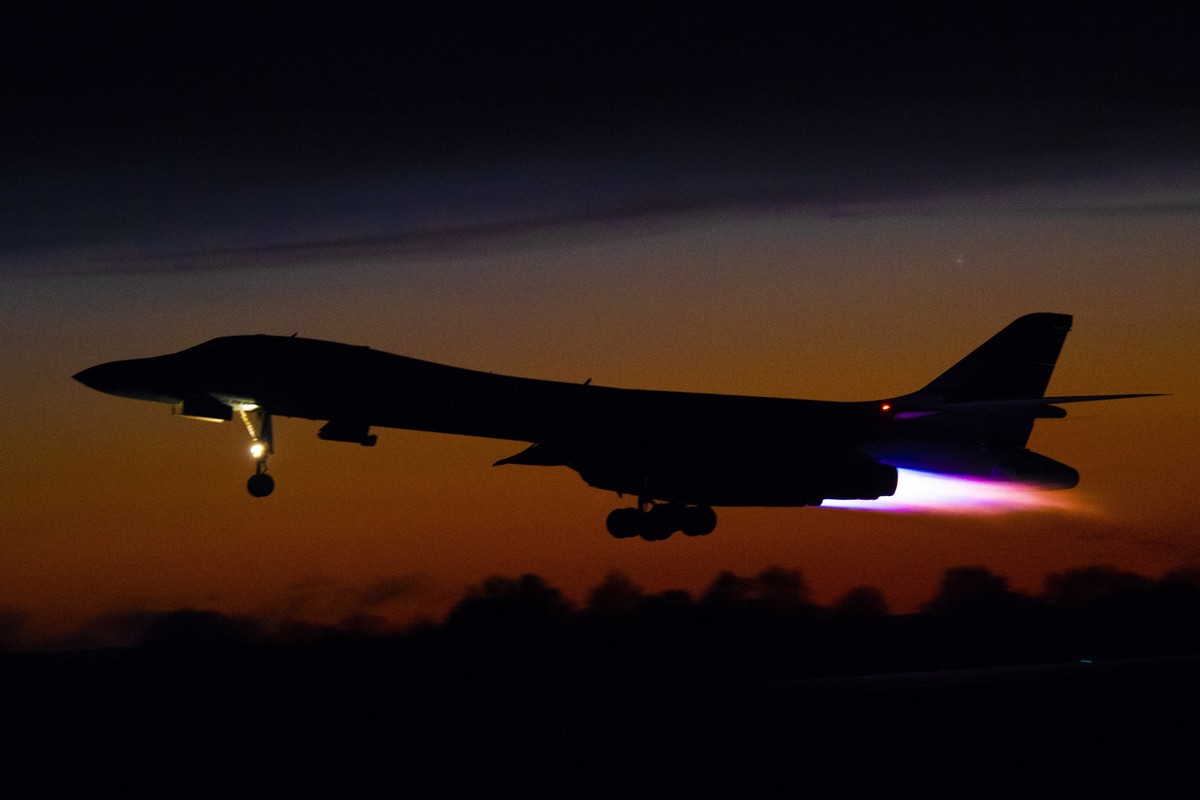
Flight tracking data indicates that U.S. Air Force bomber missions departing from the United Kingdom are avoiding continental European airspace, instead routing along southerly paths toward Iran.
Maps derived from publicly available tracking feeds show aircraft departing the UK, heading west over the Atlantic before turning south and transiting via the Mediterranean and North Africa toward operational areas further east. The image below, captured today from FlightRadar24, shows the return leg of a B-1B avoiding continental European airspace.
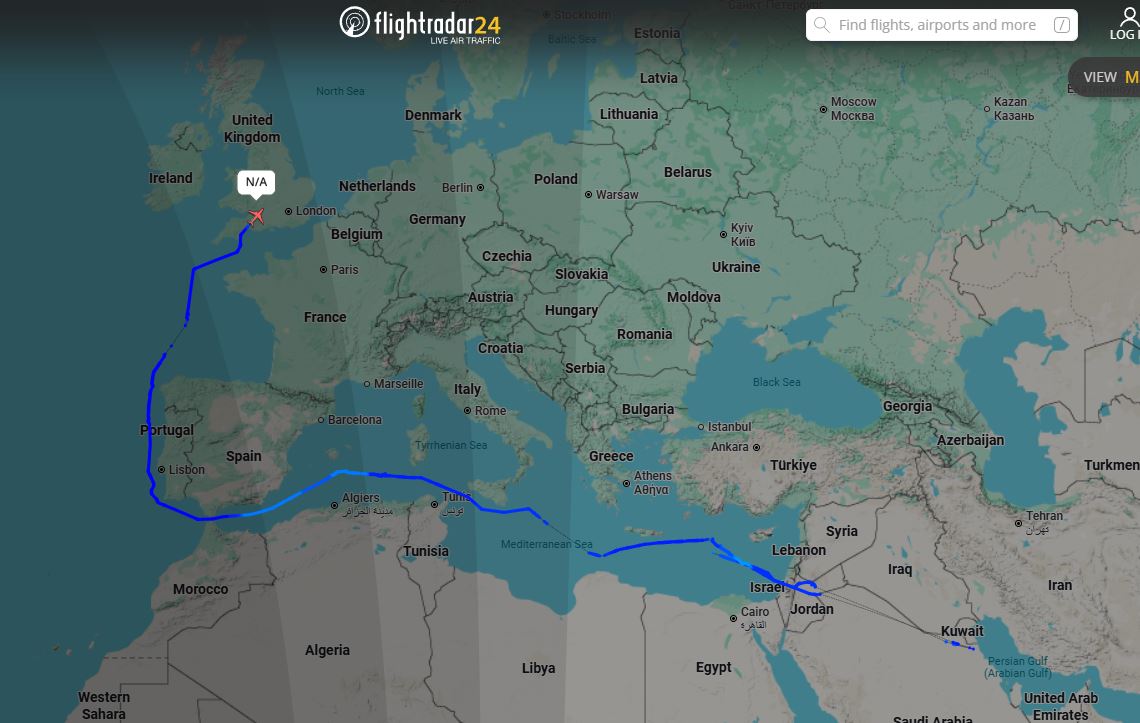
The aircraft are B-1B Lancer bombers, long-range strike platforms regularly deployed forward to support operations linked to U.S. Central Command. Tracking of these aircraft remains inherently limited as the B-1B does not routinely transmit ADS-B signals, meaning its position is not directly broadcast in the same way as civilian aircraft. Instead, tracking is typically derived from multilateration, using ground-based receivers to estimate position, which can produce incomplete or intermittent tracks.
B-1 bombers do occasionally appear on open tracking platforms such as ADS-B Exchange and similar services, but this is inconsistent and depends on how the aircraft is being detected rather than deliberate transmission. Flight routes are, of course, determined by a mix of diplomatic clearances, access to airspace, threat assessments and specific mission requirements. While open-source tracking data shows a consistent pattern of southerly routing, it only provides a partial picture and does not reflect the full detail behind operational planning.
The B-1B
The Rockwell B-1 Lancer is a supersonic, variable-sweep wing heavy bomber operated by the United States Air Force. Known informally as the “Bone,” it remains one of three strategic bombers in U.S. service alongside the B-2 Spirit and B-52 Stratofortress. The aircraft is designed for long-range strike missions and can carry a maximum payload of around 75,000 pounds across three internal bomb bays and additional external hardpoints.
The B-1B variant is operated by a crew of four and is powered by four General Electric F101 afterburning turbofan engines. It has a maximum speed of approximately Mach 1.25 and a range of over 5,000 nautical miles, depending on payload. Its variable-sweep wings allow it to optimise performance for both high-speed penetration and lower-speed flight profiles. The aircraft can operate at altitudes up to 60,000 feet and is equipped with radar and defensive systems designed to support survivability in contested environments.
In terms of armament, the B-1B is capable of carrying a wide range of conventional weapons, including precision-guided munitions such as JDAMs, JASSM cruise missiles, and LRASM anti-ship missiles, as well as general-purpose bombs and naval mines. While it was originally designed with a nuclear role, this capability has since been removed. Its onboard systems include radar, electronic warfare suites, and optional targeting pods such as the Sniper Advanced Targeting Pod to improve strike accuracy.
The aircraft has undergone extensive upgrades since entering service, particularly through the Conventional Mission Upgrade Program, which enabled the integration of precision weapons and improved avionics. Later enhancements, including the Integrated Battle Station upgrade completed in 2020, introduced modern data links, digital displays, and improved diagnostics. More recent modifications have focused on expanding weapons capacity and enabling the carriage of advanced munitions, including hypersonic systems, reflecting an ongoing effort to maintain the platform’s relevance in modern air operations.







There were some indications that B1 Bombers crossed french airspace, and one of the already landed in Ramstein. So this is not the case for all of them.
This will have upstream consequences for NATO.
The US threatened military action against NATO over Greenland. This *is* upstream consequences.
Shows how immature so many European ‘leaders” are.
No. Shows consequences.
👍🏻
Lol, that’s a rich accusation coming from you. Let’s be clear: They are acting in their National Interest. Dementia Donnie has threatened NATO allies openly, undermined article V, belittled his allies sacrifices in blood and treasure last time they helped America out, and has now gotten in a war of aggression outside of the area covered by the Articles of NATO. This is simply the start of the FO part of the way the current administration has been treating it’s allies.
The immature one is the pedophile in the white house. The rest are doing their jobs.
👍🏻
Free speech from the President doesn’t mean speech without consequences…
And it seems that threatening to invade your allies, talking them down and then demanding they help the war that you started out of choice, is not conducive to a working relationship.
No, I think it shoes how immature Trump is……
True, that was out of order, but everything has a cause. US belligerence to ENATO is a result of decades of over-reliance on US protection. Europe enjoyed the massive economic benefits of US protection whilst underfunding its own militaries and instead funding its own social programs (then portrayed the US as immoral for not having similar social programs). The amounts involved here are staggering, in the trillions of £ even if you only consider the 2% NATO target. And European politics has been much more anti-American than American politics has been anti-European, until very recently perhaps.
Europe saying Iran is not a NATO issue, whilst simultaneously saying Ukraine is, is in many ways very hypocritical. Iran and Russia are allies (and aligned with China), and in many ways poses a bigger threat to Europe through its proximity to a large portion of global oil supplies. They are also religious fanatics who have vowed to wipe the most liberal country in the middle east off the map, and would have the UK and US as their next targets (their Russian ally would probably steer them towards the UK as an easier and less dangerous target to strike). They of course refer to us as ‘little satan’, despite us not directly threatening them in recent history. There is rampant Anglophobia in Iran.
Iran’s lashing out at other gulf states cannot be tolerated. Imagine if we were attacked by say, France, so just started to attack Norway, Belgium, Netherlands, Denmark etc? Would that be tolerable, regardless of the right to self-defence? Europe should be showing solidarity with Gulf countries by helping open the strait of Hormuz, which is massively impacting their biggest export and public finances, even if not directly joining in with US strikes on Iran.
The EU 3 + 3 are well aware of Iran’s intentions. There is no need to enrich Uranium to 90% for any reason other than to make weapons. No civil applications require such levels of enrichment. All their negotiations were simply stalling for time tactics. Without action we’d all be paying a huge price, much greater than elevated oil prices.
Lastly, I think Europe is missing a massive opportunity to demonstrate its hard power on a global stage.
If France, UK and Italy each put a carrier to sea, we’d have a three carrier strike group and dozens of escorts in the East med to protect Europe south eastern flank. Granted, this is militarily overkill, but the optics would be an enormous boon for Europe; and could strengthen our hand in dealing with the US and other powers who only see force as the true negotiating currency in this volatile world.
Europe’s demonstrating Strategic Autonomy by telling Trump to get bent, I think that’s more important that letting the Americans borrow a couple of CSGs.
Europe has no ‘strategic autonomy’ –
I think your confusing Europe with yourself.
Well said. Brief. Undercutting.
🤣
“Decades of over Reliance on US protection”
Really? What decades where those? Because in the 90’s and 2000’s Europe didn’t need protecting, and in the 80’s and 70’s the majority of NATO ground forces where European. It seems more like “for a few decades after the Cold War the US spent big on Sandbox Wars that had little to do with European Security.”
“Iran is not a NATO issue while Ukraine is.” If this confuses you I suggest you look at a map.
“Iran lashing out at Gulf states […] if France just decided too.” But that’s not what’s happening is it. It’s if the US was bombing France, had killed Macron and sank half the French Navy and France then decided to bomb countries that are allied with the US. So this isn’t just lashing out at random countries.
“Really? What decades where those? Because in the 90’s and 2000’s Europe didn’t need protecting, and in the 80’s and 70’s the majority of NATO ground forces where European. It seems more like “for a few decades after the Cold War the US spent big on Sandbox Wars that had little to do with European Security.”
That’s hindsight bias, and you know it. The US doesn’t need European protection either, now or in the past; so why should they sign a mutual defence pact with Europe? Or does it only work one way round? If the US decided to cut its defence spending to 1% as their is no imminent threat to invasion for them (and they are largely self-sufficient with most resources), with massive implications for regional security across the globe, would you not be concerned? That would be a gift Iran, Russia, China and other hostile (to Europe) countries.
If we want to benefit from US protection, including assistance with the war in Ukraine, we must offer something in return.
It’s really not hindsight bias. It was very clear that in the 90’s and 2000’s there was absolutely no threat to Europe. That wasn’t hindsight, that was threat assesment that everyone was aware of at the time.
The US *also* cut it’s defence spending after 1989. US Defence spending went from nearly 6% of GDP under Reagan to 3% in the 90’s and only climbed again due to Iraq and Afghan (again not protecting Europe).
“Does it only work the one way round.” Certainly seems to since only one country needed Article V support in the History of NATO and seems to have very convieniently forgotten about it. Of course that also gets forgotten about when people talk about “offering something in return” (LOL). The US could absolutely cut it’s defence expenditure to 1% btw. US defence spending is largely about Global Power Projection and maintainence of it’s Hegemony, not defending NATO.
😂
The UK also has form in hostile takeovers for preventative military purposes i.e. invading Iceland during WW2. Different circumstances in many ways, but should be acknowledged. The main suspicion is of course that the US wants access to the rare earth and other resources Greenland may have to offer. In the event of a war with China, which currently controls much of the global rare earth mineral supply, I suspect the US would use force to obtain these if necessary. And I wouldn’t blame them if they were being prevented from doing so. Threatening to invade in peacetime doesn’t make any sense though.
Deluded 🤦🏻♂️
Stumped
You clearly don’t know what you’re talking about.
What are termed “rate earth metals” are not actually that rare, there are plenty of raw sources globally. What China dominates is the refinement of these ores to extract the metals – the processes aren’t as easy as extracting iron for example.
So seizing Greenland doesn’t help, because there are no refinement facilities there 🤦🏻♂️
why won’t Europeans free Greenland and let it be a state in the united states?
Europeans don’t know anything but to occupy and to colonialize .
Oh look a new troll rears it’s ugly head. Or are you “Just a sock puppet”
There will definitely be serious consequences for Europe – Nato and it’s members.
The US will not forget or forgive the way Europe and European Nato members have reacted to US requests.
Anyone thinking there will be no consequences are living in la la land.
Once the Iranian operation is over expect the retaliation to begin from the US.
I suspect you are conflating “US” with Trump the petty spiteful narcissist. I doubt the US military or the more rational and educated part of the population will be overly interested in “retaliation”
So sometime in 2034 then…? 😂
Optimist
The Iranians killed a French soldier and of course they did nothing about it.
European cowards
American retardism for killing him.
Looked like an Iranian drone to me, maybe you need your eyes checked
The cowards are those that triple tap elementary schools killing 110 kids…
Wow a 1 AM response
Tell me you’re an unemployed islamist shill, without telling me you’re an unemployed islamist shill 🤣
Keep it up mate, you’re an endless source of entertainment 🫡
Or currently in a different time zone because I can afford to travel internationally… I think we can all see who the unemployed scrounger projecting onto others is.
You also managed to contradict yourself in the space of three words. You claim I’m unemployed but also a “shill” – shills are paid for what they do.
Buffoon🤡
NATO has cut its own throat.
I do hope European nations have a big stash of cash to make up the coming US disengagement.
“Upcoming US Disengagement”
LOL. Someone doesn’t pay attention to the news or is so MAGA holed he seems to have forgotten the last year.
So the us can insult European allies, threaten to take Greenland, disrespect europes contribution in Afghanistan and you think Europe will join them in an illegal war ??
I thought you were ” the hottest country ” and didn’t need anyone?
It seems that all we hear about is the USA’s coming disengagement…let me know when it happens. I doubt it ever will.
Whatever Ivan 🤷🏻♂️
Comrade Just Me Ski
Good luck losing Ramstein, Landstuhl and UK bases. And the European market.
Bullying comes at a consequence.
The European US relationship will survive this guy.
Also, the hundreds of C17 flights all were approved. Keep it in proportion. For a war we dont Support we give the US quite some logistics.
European NATO partners are just piling on long-term US grievances.
This will end in tears when the US walks away from NATO.
The us insulted nato allies contribution in Afghanistan, slapped them with tarrifs, never consulted them before starting this war and gone soft on Russia and you expect Europe to enthusiastically join the us ?
This…
And withholding FMS paperwork will leave a lot of Euro militaries looking a bit silly
And the American military is going to look sillier when they realise so much of their “made in America” equipment depends on foreign parts they can’t manufacture 🤣
Then can the stupid sods hurry up and fuck off. The only country in NATO to want NATO to fight is America, now they want NATO to fight in a war they started, not because Iran just attacked them on their homeland or in the North Atlantic…
Reminder, it’s the North Atlantic Treaty Organisation, member states’ territories in Europe, North America, Turkey, and islands in the Atlantic north of the Tropic of Cancer. The parties that started the War in the Middle East were Israel and the United States.
and NATO is a DEFENSIVE organization, while Trump and Netanyahu’s war is definitely offensive.
It will end in tears when the US wakes and smells the PLAN all over it like a rash.. the US sort of forgot NATO had an eastern flank and the enemy on that flank is the worlds maritime superpower and its planning on removing the U.S. from the western pacific.. but the MAGA crowd seem to just like creating a bogey man out of their own allies and ignoring the naval tsunami that is the PLAN..
But you know they are only out building the USN 15-1 on major surface combatants, 5-1 on SSNs.. but it will be fine the US will definitely wipe the floor with the PLAN and overcome 2-1 odds against ships half the age of the USN fleet.. because they are Chinese and are rubbish..
Yep, the same bigoted myopia they had about the Japanese 85 years ago.
Bingo
Yep pretty much sums up the Russian view, just before the Japan imperial navy handed them their arse.
If anyone thinks things will get better after Trump… dream on.
When J D Vance gets the tiller, people will wax lyrical about the ‘good old days’ under teddy bear Trump.
JD Vance vs Marco Rubio in the GOP… I think Rubio might pull it off from Vance.
I think you’ll find the 25th Amendment ensures it’s Vance that will take over when Trump’s dementia can no-longer be hidden.
Not a nato operation, sea route has advantages
Lots of comments here suggesting that the recent falling out between Trump and Europe is the cause of these diversions via Atlantic, Straits of Gibraltar and Mediterranean. Possibly so. But it’s worth reflecting that exactly the same route was taken by F111s from Lakenheath and Upper Heyford in 1986 when the US bombed Libya. Reagan had fallen out with the French, Spanish and Italians at the time.
So perhaps not such a new thing after all.
Very good point.
Lots of comments here about the US pulling out of European countries. I doubt that would ever happen, at least in the case of the UK.
The US are extremely reliant on the UK and parts of Europe for power projection, as well as intelligence and communication relays. I’m sure it would be strategic suicide to put any potential front line on their own eastern doorstep instead of having it in a place it could be at arms length.
Exactly.
Vice President of the United States of America, JD Vance, on the topic of allies and the Iraq War, in an April 2025 interview:
While many European nations were correct in opposing the war, they failed to act forcefully enough to stop it, saying “If the Europeans had been a little more independent, and a little more willing to stand up, then maybe we could have saved the entire world from the strategic disaster that was the American-led invasion of Iraq.”
What are you doing today, Mr JD Vance? How independent are you, big guy?