

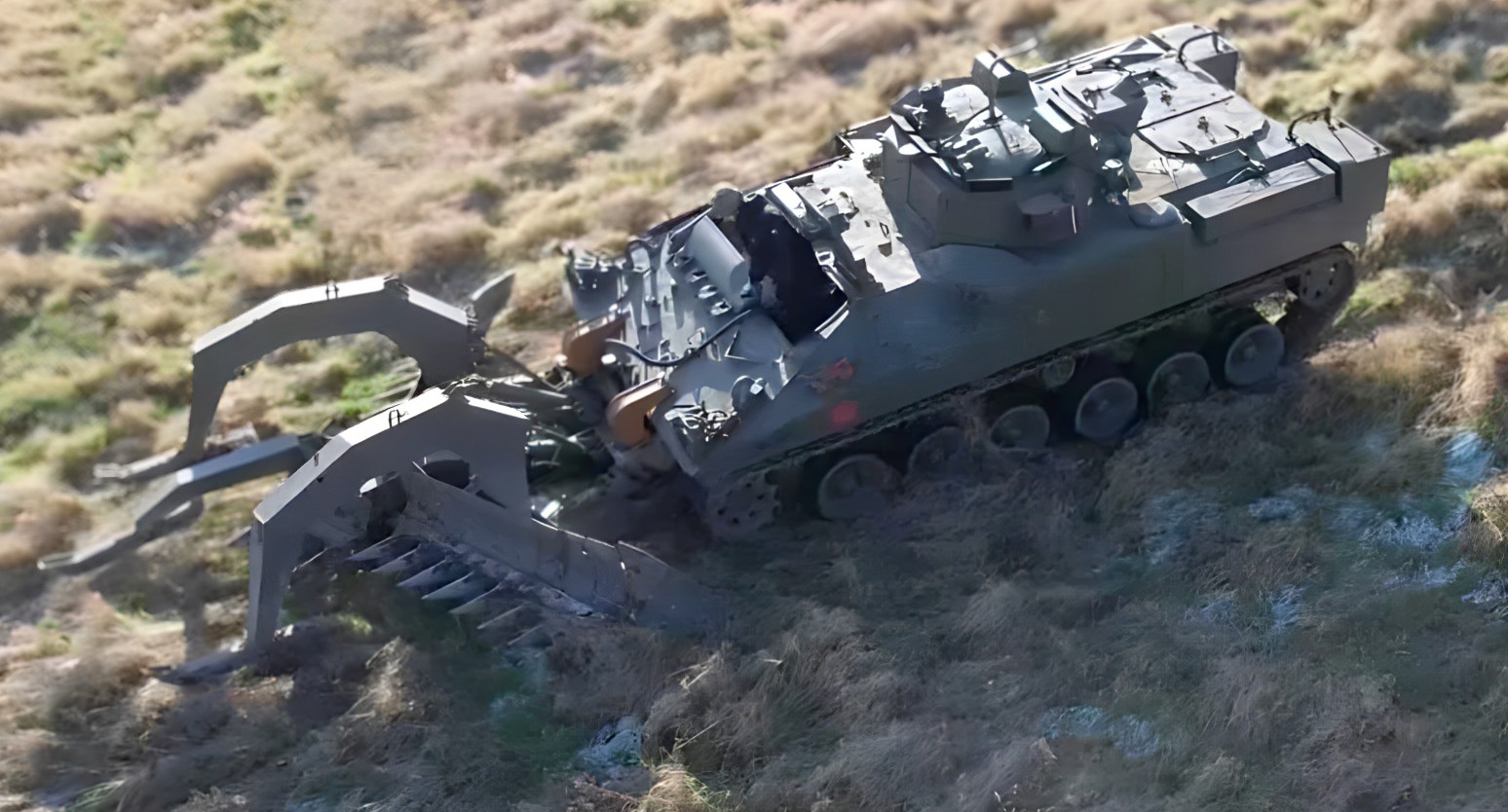
Work has begun on converting Warrior infantry fighting vehicles into uncrewed minefield breaching platforms as part of the trial phase of Project ATILLA, according to a written answer published this week.
Luke Pollard, Minister of State for Defence Readiness and Industry, was responding to Ben Obese-Jecty, the Conservative MP for Huntingdon, who had asked what stage the project had reached, referring back to an answer given in November 2025.
Mr Pollard said: “Project ATILLA aims to deliver an uncrewed ground vehicle minefield-breaching capability. Work is ongoing to convert Warrior Infantry Fighting Vehicles as part of the trial phase.”
The answer marks a further step for a programme we have followed since the Ministry of Defence first set out its plans. As we reported in August 2025, the department published a notice seeking to procure and spirally develop an optionally crewed minefield breaching system based on the Warrior, for use in the United Kingdom and overseas by a Royal Engineer unit.
The contract was valued at £12 million and set to run from January 2026 to March 2028, with an optional one-year extension at the department’s discretion. Suppliers were required to confirm they could provide six optionally crewed systems capable of generating a safe lane comparable to platforms already in service, a requirement set as a pass or fail test that would discount any bidder unable to meet the timelines.
By November 2025, as we reported, Mr Pollard confirmed the project had progressed beyond considering conceptual elements such as evaluating feasibility and was preparing to move into the invitation to tender stage.
What ATILLA is for
The department has described the requirement as an attritable minefield breaching capability, meaning vehicles expected to operate in conditions where losses are likely, which is the reasoning behind making them optionally crewed so they can take those risks without soldiers aboard.
The programme is structured in two concurrent phases under a single contract. Phase one covers the procurement of a minimum deployable capability of up to six optionally crewed systems based on the Warrior donor vehicle, fitted with front end equipment for use as a battlegroup breaching capability. Phase two focuses on advancing autonomy and refining requirements for a future purpose-built heavy uncrewed ground vehicle fleet.
The intention behind exploiting an in-service vehicle is to de-risk and accelerate the later procurement of a modular, autonomous, heavy payload uncrewed ground vehicle within a time and cost bound contract.
The vehicles themselves
Warrior entered service in the 1980s and formed the backbone of the Army’s armoured infantry for four decades. As we reported in December, the Ministry of Defence has ruled out any extension to the planned withdrawal, confirming the type will leave service in 2027 as scheduled, which is what makes surplus hulls available for conversion.
The decision also follows earlier government decisions not to transfer surplus Warriors to Ukraine.
Minefield breaching has become considerably more prominent since 2022. Russian forces in Ukraine have laid defensive belts on a scale not seen in Europe since the Second World War, and the 2023 Ukrainian counter-offensive demonstrated what happens to armoured formations attempting to cross them without adequate breaching equipment, with vehicles halted in the open under artillery and drone observation.
The department has linked the wider effort to a commitment to spend at least ten per cent of equipment procurement budgets on novel technologies including artificial intelligence and uncrewed systems.







So who will be laying minefield in the UK??
This looks like an outbreak of common sense by the powers that be surrounding the institutionally incompetent Ministry of Defence. Whoever thought this up deserves a gong.
I’ll wager these converted vehicles will be used for the forthcoming NATO assault on Kaliningrad, which will be undertaken as part of an Article 5 response to a Russian invasion of the Baltic states. Lets hope this project proceeds at pace.
Total and utter waste of money! At best in any shooting war they would get halfway across a minefield before being blotted by a drone or anti tank fire🙄
If issued to Sqns that’s more vehicles that would need to be looked after by the troops which invariably would mean they would sit on the tank park and rust away as they would not have dedicated crews to look after them!
You really have to wonder what CRE Chatham are thinking,considering ditching Titan for a Boxer variant and now this bollocks😡
Yep. Though I think Titan was reprieved mate.
Thinking RE kit, a modern Shielder on a CAVS would be nice?
Assume the RE are still using Python, so why is this needed?
Hope your right about Titan,
Shielder not an option as long as we are in this stupid landline treaty banning AP mines(thanks lady Di) which removed a layer of defence for us!
Python is still there but again the lane should be ploughed but the risk of missed mines can taken and the breach rushed if needed!
The Sqns have enough on their plate looking after the vehicles that have a crew so unless they are going to create a separate troop to service and operate these they will as I say just be parked up in a corner!
Well so far it’s a trial with 6 vehicles.
Agree, manpower needs an uplift, like all else.
Assume only 22 and 26 would use this, being the only Armoured CS Regiments left.
Very encouraging development and this platform is a well-proven design. An endless list of uncrewed applications should be possible using Warrior and a better way of utilising our mega assets than scrapping or selling them off to other customers.
Seems like an odd choice of vehicle for this. Would seem more sensible to have a cheap platform that pushes the anti mine kit and put the warriors into storage in case one day they are needed or funds come available to use them for something that their cost justifies.
Steve , I should imagine a compromise on mobility combined with second hand re use of the asset. Hope they look at the power train as it takes a lot of moxy to push the plough. Don’t think the warrior was ever envisaged to push a plough like a dozer. So many variables, vehicle mass, torque and the transmission of that torque into the ground, plus of course ground type itself.
It is capable of pushing the smaller route clearing plough as on the Terrier but the photo shows a Full width plough which is a much heavier animal found on Trojan!
True but you would think it would be a whole lot cheaper to just use a tracter.
👍