

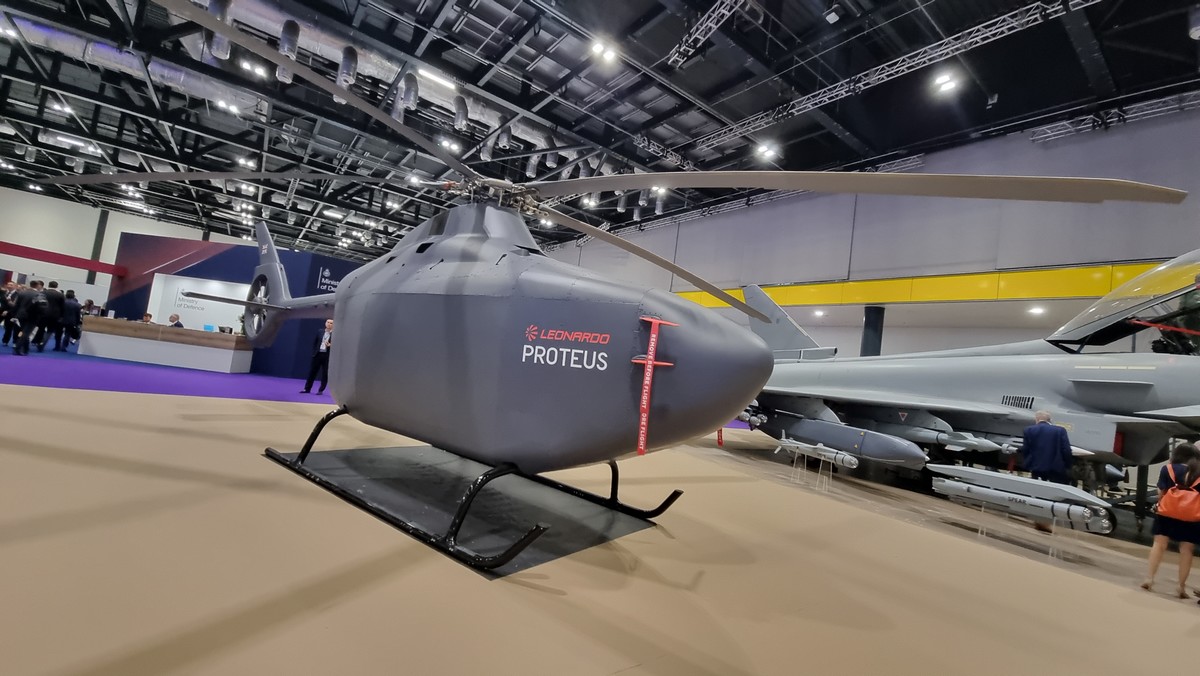
The first flight of the Royal Navy’s Proteus autonomous helicopter is a visible milestone, but the aircraft’s importance lies less in the airframe and more in the operational pressure that led to its development.
Proteus exists because the Royal Navy faces an expanding requirement in the North Atlantic that cannot be addressed through additional ships, personnel or flying hours alone. The area requiring persistent monitoring has grown steadily, while the number of platforms available to deliver that coverage has not.
Undersea activity has increased and subsea infrastructure has taken on strategic importance. Maritime awareness now depends on sustained presence rather than episodic patrols. At the same time, aviation manpower, training capacity and fleet size impose firm limits on how much coverage can be generated using traditional methods.
The UK’s undersea warfare posture relies on RAF-operated maritime patrol aircraft working alongside Royal Navy anti-submarine helicopters. These remain highly capable assets, but availability rather than performance has become the defining constraint. Each sortie consumes finite airframes, crews and maintenance capacity.
Proteus is a response to that problem
The aircraft is a technology demonstrator developed by Leonardo under a £60 million programme, intended to explore how autonomy might extend maritime aviation coverage without requiring proportional increases in manpower. It is not designed as a production platform, and neither the company nor the Ministry of Defence present it as one.
That distinction has been made clear repeatedly in briefings. At DSEI in London last year, Leonardo framed Proteus as a low-cost and deliberately imperfect testbed rather than a final solution. The airframe on display was described as a pragmatic vehicle for testing autonomy rather than an optimal naval helicopter design, particularly for operations in high sea states and harsh North Atlantic conditions.
The focus, company officials stressed, was not the helicopter itself but the autonomy package it carries. Leonardo presented Proteus as a pathway toward genuine autonomous aviation rather than remote control. The system was described as capable of route planning, collaborative behaviour and task allocation without continuous human input. The intent, they said, was to move beyond a model where an operator sits elsewhere controlling the aircraft via joystick.
Leonardo link Proteus directly to the Navy’s maritime aviation transformation strategy, which envisages crewed platforms retained for complex tasks, with uncrewed systems used wherever routine coverage can be offloaded. Much of maritime aviation involves long-duration monitoring, patrol and data collection. These tasks are operationally necessary but resource intensive. They draw heavily on crew availability and flying hours while producing limited immediate effect.
Autonomous systems offer a way to sustain presence over time
Leonardo’s briefing placed particular emphasis on synthetic trials already conducted with the Ministry of Defence and Defence Equipment and Support. According to the company, three Proteus systems have been used in simulated anti-submarine scenarios, detecting a submarine contact, sharing information between aircraft and allocating tasks autonomously. These demonstrations were presented to the Royal Navy at senior level and framed as evidence that the autonomy software is already functioning in practice, even if the physical aircraft remains a test vehicle.
The company described the autonomy package as the “brains” housed within a temporary “body”, with the implication that the software, once accredited, could be transferred to other airframes in future. Leonardo pointed to its wider helicopter portfolio, from light utility aircraft to the AW101, as potential hosts for similar autonomy systems over time.
It reinforces the idea that Proteus is not a discrete programme aimed at fielding a single drone, but part of a broader attempt to determine how autonomous aviation might be integrated across the fleet. The demonstrator also allows the Navy to confront practical questions that cannot be answered through simulation alone. Deck handling, flight safety, interaction with crewed aircraft and authority over autonomous systems all present challenges in the maritime environment.
The work also sits within wider defence planning. Concepts such as Atlantic Bastion depend on layered sensing and sustained awareness across large maritime areas. Delivering that level of coverage using only high-end crewed platforms would require force levels that are unlikely to be achievable. Autonomous systems are being examined because they offer a way to extend coverage within existing constraints.
Leonardo has also positioned the work as sovereign and exportable, with efforts to keep the technology free from restrictive regulatory frameworks and relevant to international partners. That reflects a wider recognition that autonomy is likely to shape future naval aviation beyond the UK alone.
What Proteus ultimately represents is a shift in emphasis
The Royal Navy is no longer asking whether autonomy has a role in maritime aviation. It is examining how far autonomy must go in order to sustain operations in the Atlantic with the force available.
The pressure driving that shift is not technological enthusiasm. It is the growing gap between operational demand and human capacity. Proteus is not intended to solve that problem on its own. It exists to test whether a different model of maritime aviation can begin to close it and that is why the aircraft matters, regardless of what the final platform eventually looks like.







So more endless trials and gold plating. How about producing more, using them operationally and developing them spirally ?
Because its only a demonstrator.
Well not by nature mutually exclusive. A bit of nuance to the descriptions associated to it, so not clear as to whether this is totally unsuitable for even testing while in service or with adaptation and modification it could form the basis for a service ready vehicle, language is rather nebulous. Never thought Dragonfire was a service ready platform until it suddenly apparently was, but we don’t know what changes have occurred to make it go from a demonstration platform to a fit for warships.
Not this one the airframe is entirely unsuitable for maritime operations.. maritime airframes have to be gold plated, because the environment is trying to Destroy them.. there will not be a cheap drone option for our oceans.. it will be a costly drone.. but will be cheaper than a human operated rotor.. it would not surprise me if the final version was not a stripped down autonomous Wildcat version..
I accept what you’re saying Jonathan, but it surely wasn’t beyond the wit or wisdom of the manufacturer to already marinise the airframe to a certain extent. It just reads like another interminable trial and demonstration to inform yet more future decisions. I mean, they’re still fannying around with Peregrine, that should be fleetwide by now.
Exactly.
Basically what I understand is they just took a stock light rotor and bolted the systems on it but it’s definitely a light commercial land based platform.. not something you can safely fly off a ship at sea.. basically the systems will need transfer to a maritime rotor.. but it will not be a challenge as all the work will be done on this one.. if we wanted to do it clever we could simply take all the armies wildcats and transform them.. then give the army a rotor it really needs.
Thanks for the additional information.
It’s based on the Leonardo AW09 basically because it was the only light 3000kg max load rotor design that AW had easy access to and the MOD spec was for a 3 ton airframe demonstrator.. the AW09 is itself not really ready for production and only 3 demonstrators have been built..for essentially light passenger usage.. it’s so very far from what you would want for a heavy duty naval drone..
Peregrine was brought in using a hugely expensive contract. Two drones on one ship for two years: £20m. And that didn’t include integrating them into the ships systems — another two and a quarter million pound contract for the one ship. The RN have to find a way to bring the price down using internal training, operations and maintenance.
If the navy is convinced it matters so much then why are we seeing a software development rather than a working demonstrator. This seems like nothing more than a bone thrown to Leonardo to develop software for helicopters not even made in the UK.
Platforms like Merlin are ridiculously expensive and many of the jobs performed by Naval helicopters could and should be done by drones, yet we don’t have a program in the works and we have nothing more than a cam copter onboard a handful of vessels.
The problem is that a true maritime drone will probably need to be as robust as the marine rotors.. the environment creates the cost.. so even the drones are not going to be cheap.. in the end the RN needs drones that will work in the harshest oceans because we are a North Atlantic island not a Mediterranean or Ocean nation.. and that will cost a drone for the med is not a drone for winter in the north..
I’m sure they framed this a few years back in that RN chart showing the future maritime aviation force, I forget the exact name used.
It was alongside project Ark Royal.
And now, nope, we won’t be buying yet.
Leonardo spent all the money on autonomy, where the RN desperately needs some drones in operation so that it can spirally evolve the concept of operations. Why would you go to a helicopter company to buy software?
Next time the government will have to say, no more money for tweaking software. Give us the right drone for the job and we’ll worry about optimising the software when we know how we actually intend to use it.
“It reinforces the idea that Proteus is not a discrete programme aimed at fielding a single drone, but part of a broader attempt to determine how autonomous aviation might be integrated across the fleet.”
That is exactly what we don’t need – we need hard orders for hard assets to be put in place now then evolved spirally. No more studies. No more informing future decisions. Define a Minimum Viable Product and buy thw damn thing
Why not build it into AW149, killing 2 birds with one stone therefore saving on cost? It is of vital National interest that Leonardo UK, specifically Yeovil, survives due to its immensely skilled workforce both in theoretical and practical engineering.