

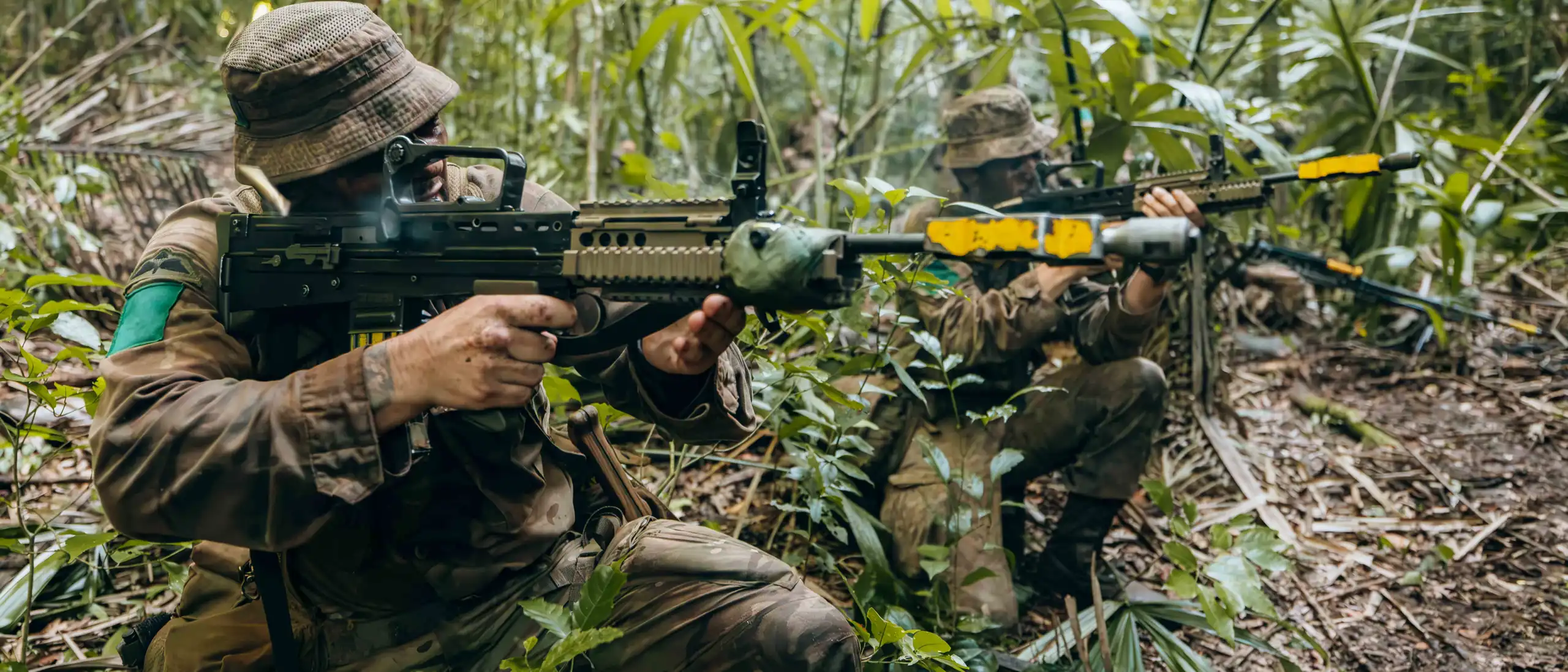
Paratroopers from 3rd Battalion The Parachute Regiment have completed a month of intensive training in the jungles of Belize, an environment the Army describes as one of the most demanding it routinely uses.
The British Army says the aim is to harden airborne forces for operations anywhere, under any conditions.
Exercise Mayan Cyclone placed around 170 troops from 3 PARA’s B and D Companies, along with engineers and gunners from supporting parachute units, into continuous field conditions marked by heat, humidity, dense vegetation and limited external support. According to the Army, the combination of environmental hazards and isolation is intended to build resilience and force soldiers to adapt at every level.
Major Louis Maclaren, Officer Commanding B Company, said the experience goes far beyond learning jungle-specific techniques. He noted that “Belize is the only place that the British Army regularly trains where a unit will spend a month unsupported in a hostile environment.” He added that “the jungle provides a genuine risk to life and brings friction that you must adapt to and overcome,” arguing that this mindset is central to airborne operations where troops are deliberately deployed at distance from support.
Living in the jungle quickly wears down troops, Major Maclaren said, explaining that hydration, infection risks and the simple challenge of staying dry all place pressure on basic soldiering skills. “Personal administration, which is the lowest level of a soldier’s skills, need to be delivered at the highest level,” he said.
Lance Corporal Harry Stone reinforced the strain on routine tasks, stating that in the jungle “you have to do the basics times 10” and that equipment care must be constant rather than occasional. Lance Corporal Jake Threlfall highlighted the cumulative effect of heat, terrain and workload, saying that “time management is much harder in the jungle, because there’s so much more to do.”
Communication and navigation are also degraded. Thick vegetation absorbs electronic signals, reducing radio reliability and rendering GPS less dependable. Major Maclaren said commanders must abandon attempts at tight control, explaining that “you can’t be in constant radio communication… You need to fix a rendezvous and trust that everyone will be there up to 36 hours later.”
He argued that the demands placed on individuals and leaders are the exercise’s core purpose. “The jungle forces leaders at every level to take responsibility for their teams and individuals to take responsibility for themselves,” he said. “A soldier who can operate effectively in the jungle is better prepared for any mission, in any environment, against any enemy.”





What a refreshing change, to read about our troops training in the Jungle.
I’m a very light weight Stealth Camper (or was) and often lurked in the undergrowth, weapon in hand. 😎
1973 in the Malayan jungle being taught by Kiwis on their wind down from Vietnam before going back to NZ!
Now those boys knew their stuff👍
I bet that was an experience.
It was an eye opener to say the least😀funny enough all the traps in films like ‘The Green Beret’ etc were indeed commonplace😳
I’m not sure about the Aussies but Kiwis had to do time in Singapore to destress from combat before being shipped home,unlike the yanks who were straight back into mainstream living with the many documented problems that caused!
That’s nice… why?
I believe it’s called training our armed forces for all scenarios👍
Why did I say why… well because all current potential threats to the UK and NATO, are not from Belize, nor the jungles of Borneo. Perhaps training in a more ‘cooler climate’ may be more helpful at this point in time.
Hello Tom, It’s my understanding that we do a lot of training in cooler climates, as witnessed in the many articles on here but you also have to keep other forms of warfare skills refreshed, as witnessed here in this particular case/article.
Question is, would you prefer to sweat in a Jungle of freeze your balls off in the Artic ? 🤔😁😁😁
I’ve never done Jungle stuff but have done a lot of winter “Wilding” and It teaches you loads about yourself and your abilities to survive.
It’s great that we as a nation can do all this in the harsher climates around the world.
Yup, out in the wild having to be self reliant. Does the command structure loosen up and more team like approach in these situations?
I have had the good fortune of doing both, and would gladly drop doing the jungle stuff in favour of living in the Artic for a month or two. The jungle of Belize is some pretty nasty bush and not a natural environment for those with a northern European DNA. There is a significant number of nasties, beasties and vegetation that all want to do you harm. Ants in particular were a persistent problem. Always remember my first week in a jungle, where you hardly sleep a wink due to the noise and general discomfort. After a week you sleep like a log due to exhaustion.
We do have defence commitments in Belize! There is a constant threat from Guatemala to deal with,so to actually have jungle trained troops to pass on their knowledge to the rest of the battalion IF deployed would be quite handy don’t you think?
Completely unrelated mate. British forces have not needed to deploy in anger to Belize since the 70’s, and most battalions have a go at Jungle Warfare, or at the very least have JWIC’s attached, every few years. This isn’t a handy “It’s nice to have jungle trained” troops. But more that jungle warfare is very demanding for low level tactics and light infantry skills. It’s a very steep and difficult learning curve.
This is a remarkably silly comment. We didn’t have any threats in Canada, yet carried out most of our armoured battlegroup training there. Training isn’t always in politically sensitive regions, sometimes it’s about what the training area can offer us. And operating in the Jungle is some of the best Infantry training anywhere can offer. It’s an unforgiving environment that is incredibly hard to fight in, and by comparison most Woodland and rural areas are relatively simple.
As far as I’m aware Guatemala still claim Belize even if it’s a remote threat and we do indeed have a defence commitment!so why is that a remarkably silly comment?
I never went to Belize but I did go to the jungle training school in Malaya/Singapore in the early 70’s.ANZAC troops had to do a destress period before going home after coming out of Vietnam and very sensibly the British asked them to pass on as much of their expertise as they could in our training exercises in the jungle, To say it was eye opening doesn’t even cover it! Even then we deployed with a full magazine of live rounds as well as blanks as there was still a communist terrorist threat in Malaya at that time!
I didn’t even make any reference to where training takes place! As an ex RE I have done engineering tasks and even (basic) infantry training in all the usual places that we had back then👍
I explained why Tom’s comment is silly but to reiterate: the location of training areas and exercises has little to do with defence commitments. We don’t exercise in Alberta because we are committing to fight Russian tanks rolling down from the Rockies, we don’t deploy companies on JRTC because we are committing to defend Louisiana from Texan aggression.
Sorry my bad🙄didn’t realise your comment was for Tom👍
Why not, Tom?
Our Light Infantry, get to train in Jungle in Belize ( BATSUB ) and Savannah terrain in Kenya ( BATUK ) as well as the usual FIBUA and typical European terrain.
Also the Parachute Regiment forms the core of the British Army’s out of area response force, and Paras are known to go onto SF as well.
All goes to make them better, all round soldiers. We need good Soldiers.
If we lost training opportunities like these we’d be the worse for it.
Hi DM… Why did I say why.. well because all current potential threats to the UK and NATO, are not from Belize, nor the jungles of Borneo. Perhaps training in a more ‘cooler climate’ may be more helpful at this point in time.
I’m with you DM, this is just as important as any cold training, we would have struggled worse If we had ignored desert warfare training during the Cold war years as the two Gulf wars and Afganistan clearly demonstrated.
A Global force should prepare for global events.
We are not a global force though. I get the misty eyed attraction of units preparing for action in every environment, but we simply do not have the forces to be wasting precious training time and money on areas where we are not likely to operate. We don’t even have any tropical overseas territories which we need to be prepared to defend anymore.
We need to be training for the European plain and High North, and for the foreseeable, those environments only.
Disagree, as it is only certain units, though, not the whole force, and should remain so.
16 AA Bde is a global force, as in, it might need to deploy beyond Europe. It actually forms the core of the GRF. The Parachute Regiment is one of the main components with 2 Battalions.
Pathfinder Platoon is another which would use these skills.
The ASOB is likewise a global force and split between the continents. The Grey Zone does not exist in Europe alone.
One RGR Battalion in in Brunei, the Theatre Reserve.
One LI Battalion of the two in Cyprus acts as Theatre Reserve.
That is 10 Battalions out of our 31.
Another, 1 PARA, forms the bulk of the SFSG, which support the DSF.
So 11.
Well rounded & trained Infantry go on to join UKSF, whose pool has reduced already with manpower reductions. You say we are not likely to operate in these places, yet DSF operates in dozens of countries beyond Europe.
The UKSF itself, so 22, has arctic and desert warfare trained personnel, and indeed one of the main parts of progress through Selection involves going through the Jungle School in Brunei, so the skills are needed for that as well.
The RM likewise will need such skills for their new UKCF raiding role which could be anywhere, not just the traditional arctic.
Finally, parts of UKSF support the SIS, which of course operate in all areas of the world.
The skills are needed.
As I stated in my first post, I hope this is reduction, and not outright withdrawal.
Fishing ? well I’m just a tidler but I do know about History and the unpredictability of knowing quite where the next war will happen.
Be prepared, dib dib dib !
Jungle Warfare doesn’t prepare you just for fighting in the Jungle. It’s basically turning the difficulty slider on Light Infantry training up to the maximum. Yes if you are going to fight in Lapland or Estonia you’re going to want to do some specific training for that region, but if you are trying to get your infantry skills up and polished, there’s little that you can do to put your troops through a more demanding training program than throwing them into the Jungle for six weeks.
170? Golly gosh, thats a quarter of the deployable British Army.
😉 Come on, Light Infantry. I assume the rest of the Battalion was split off and sent elsewhere if they’re on a training cycle?
Its classified that mate, half of that lot are always off sick with broken ankles anyway 😅
👍
And “Bite marks” ?
🤣🤣
Good to see Batsub still being used. It was stripped back to the bare bones a few years ago, and there was talk it was close to being shut down completely ….glad that’s not the case.
This is the way of training now. Company Groups not whole units. In the middle nineties 45 Commando RM where the last unit to serve as a complete unit in Belize for a six month tour. Relieved by a Gurkha unit who were only deploying two Company groups. With a lot of kit earmarked for the BDF as 45 departed. The role their was a deterrent to Guatemala and training. In addition support the BDF in training and assistance to the local population on request. For any unit it was a marvelous opportunity to develop jungle skills at all levels to all members. The number of JWI by the end of the deployment increased about six fold. This was then of benefit to the whole brigade going forward. Some on here have raised the question of is there a requirement. I will point out that Artic, Jungle, Desert conditions prove very testing a bad decision can cost lives very quickly. Even the most experienced can get caught out. The argument of do you need it is the same as do you need Artillery or Engineers to build bridges etc. The answer is today no most definitely. Once capability is lost the experienced individuals leave and in depth knowledge goes with them. It would take years to recover that and cost well who knows.