

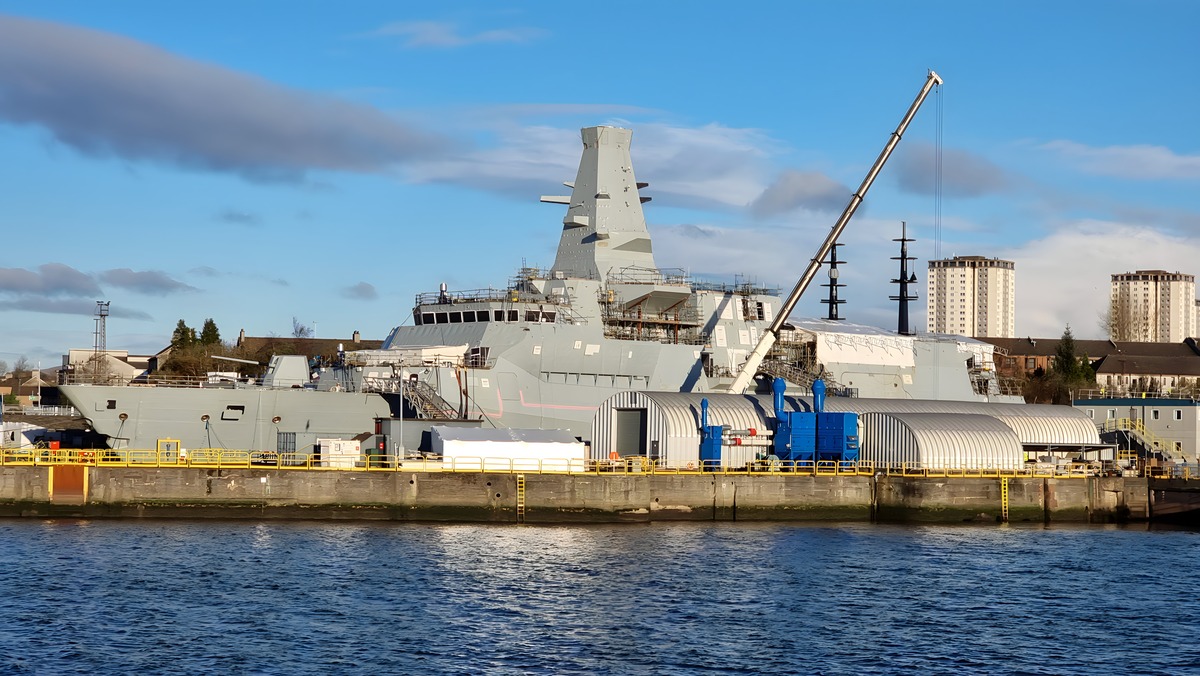
BAE Systems has powered up HMS Glasgow for the first time, a significant milestone in the Royal Navy’s Type 26 frigate programme as the first-in-class ship begins generating her own electricity.
The company confirmed that diesel generators aboard Glasgow have been switched on, allowing the ship to self-power for the first time. The generators form a core part of the Type 26’s hybrid propulsion and power architecture, providing both electrical power for ship systems and quiet propulsion when required.
According to BAE Systems Maritime, the generators are designed to deliver efficient and flexible power management wherever the Royal Navy operates, while also supporting the platform’s anti-submarine warfare role. Low acoustic signature is a central requirement of the Type 26 design, with power generation, auxiliary systems and routing all engineered to minimise noise and vibration.
The Type 26 Global Combat Ship is optimised for anti-submarine warfare but is intended to be a versatile, multi-mission frigate. Quiet power generation is critical to that role, reducing the ship’s detectability while supporting sensors, combat systems and mission equipment.
HMS Glasgow is the first of thirteen Type 26 frigates being built on the Clyde for the Royal Navy and Royal Norwegian Navy, replacing the ageing Type 23 anti-submarine warfare frigates. The class will form a central part of the UK’s future surface fleet and has also been selected by Canada and Australia for their own naval programmes.
The successful power-up of Glasgow’s generators represents another step towards full systems integration and eventual sea trials, as construction and outfitting continue at BAE Systems’ shipyards on the Clyde.








Well that’s good. With the present threat environment both T26 & T31 must be speeded up into service. Yes they are prototypes etc but I’m afraid the security of the nation is a stake so some of their trials will have to be in service.
What a joke!
A multi billion pound drone target.
When will we stop fighting the last war!
Muppet
Do try opening your mind to alternative thought
Idiot Troll
Your comment speaks volumes for a mind closed to any alternative thought
Agreed and if T26 is half as good as it is supposed to be then an order for loads more ASAP might be beneficial.
We cant staff loads more asap though, and with the build rate well only be finishing the ones weve ordered in the mid 2030s
We could if we had a mind to it. Starmer the harmer is all promises and doesn’t have a clue. He could have subbed something worthwhile but he just know’s how give stuff (our tax money) away because he wants to curry favour with various.
Cant exactly build them quickly, can easily recruit quicker than build times.
But there’s no effort being put into a major personnel expansion, which to me says we’re not looking for more than 19 frigates
19 escorts, including destroyers
No such thing as can’t Hugo. We could if we wanted to. Just because it isn’t in the plan doesn’t mean anything.
There is a big difference between the plan, what could happen if we get our act together and what probably will happen if we don’t get our act together.
get it finished now the Nancy nigh need it sooner than we think
I think you will find it is 8 type26 and 5 type31. Type 26 hull numbers were reduced from 13 to 8 with the cheaper 5 type31 making up the original 13 number.
It’s 13 Type 26 and 5 Type 31.
No it’s not . 8 x T26 & 5 x T 31
It’s 8 for the UK and 5 for Norway.
T26 is 8 for UK AND 5 for Norway.
They are including the Norweigen 5 in that 13.
It clearly stated 13 type 26s for the RN and Norway.. which is the being built
Need to re read it again Tim you misunderstood what was said.
You clearly dint read the narrative thoroughly
Good news hope to see her going to sea in the not too distant future.
Navy Lookout article on recruitment says the RN are building the crews for Glasgow, Cardiff and Venturer. Contractor trials for all 3 in 2026. Might even see Glasgow in RN hands.
All 3 in 2026? That would be an achievement, so hopefully we might see a second Type 31 in the water and possibly a third Type 26? These ships are taking too long to fit out and the build process needs to be greatly accelerated, but the Babcock only has one spare drydock for fitting out and BAE has just the two, so there will always be a queue.
Bae has three docks but one is slightly too short.
Lengthening it so there are three available would be an option to speed up T26 delivery
It hasn’t been stated as an option, and out of the 2 docks only one does underwater fit our eg sonar and prop installation
Imagine actually getting geared up to deliver even our 8 from the first order date. That would have been something. We are lucky we have the type 31s or it would have been chaos. The Treasury have no excuse whatsoever. The money has always been there, its just its frittered away on less important things.
Cardiff is not going to sea in 2026 be realistic
2/3 then, but we live in hope 🙂
Dont get me wrong would be nice. But after its underwater fit out is done it has to go into the drydock glasgow is in for the rest of its fit out.
Ah! ok, a recipe for queueing.
Just to remind everyone we were completing medium tonnage ocean liners in TWO years prewar. RMS Mauretania 35000 and RMS Andes 29000 laid down in 1937 and Commissioned in 1939. Mauretania: Laid down May 1937 and maiden voyage June 1939. RMS Andes is also impressive: Laid down 17 June 1937 and Maiden Voyage 26 September 1939!
I believe these were complex for their day. The suggestion I’m making is that in the present day, the skills and experience of yesterday are nowhere close to being achieved. My 37′ seagoing ML was built in 1922 in about 10 weeks.
We stand on the shoulders of giants.
I believe that HMS Vanguard was the largest battleship ever constructed for the RN, think it was completed in a bit over 4 years
“She’s alive” wahahahaha
Fantastic news.
I’d like to imagine there was a little start up ditty, similar to Microsoft Windows.
More like ” Gentlemen, Start your engines” 🔑
I think they had to use the Handle first, with full choke.
And I bet the Captain hung her handbag on the choke.
Ouch !!!!
Diesels don’t have chokes 🙃
As long as it’s not accompanied by the visuals of the blue screen of death.
Now I’m imaging some poor soul strapped to a table in the machine space…
Hmmm, interesting, do you think you are on the right site for that sort of fantasy ? 😂😂😂
Your a bad man.. the right side is always about perception
Geez you must stop reading the Epstein files Jonathan, Andrew is no longer active in the navy don’t ya know. 😱
😁
Merry Christmas Oppo!
#Shhhh… they are watching 👀
Brilliant, now let’s get her on sea trials and into service as soon as possible.
Be years till she’s considered deployable
Oh I love fisheads getting excited, break out the rum and do a Hornpipe.
Bite me
Love from the Light Infantry xx
Dear John, It is with deep regret that I have decided to give up fishing and stop dangling my tackle but I shall still look forward to seing your baiting !!!
Tight lines, keep up the great work.
Watch out for strange blokes with poity ears and no sense of humour, they might just bore you to death.
pointy ears too. 🤦♂️
If you go I will be bereft, one of the only kindred spirits with any humour on here!
Bon voyage then, does that sound fishead?
Oh, ok then, I’ll stay !!! ☺️
Tease, had a woman like you once…..is that you Morag?😛
Yes, yes It is, any chance you can pay for your twelve kids now that I found you ?
It’s really hard living on Benefits you know.
I spent it all on women, booze and horses. So no.
Yeah pongos are light in the brain dept. Ha ha ha. From a Bootneck ret. A real soldier.
You mean a semi fishead? Half soldier half sailor.
Ha ha ha.
Good news indeed. There is still a lot of work ahead however, and remember, Glasgow is the first of class, therefore the prototype. But unlike your average prototype car or aircraft, this ship, the most advanced ASW Frigate in the world, is also the production model! So don’t expect her to be rushed through her completion phase and contractors to join the fleet any time soon, just because we are short of Type 23 Frigates. The whole set to work programme, including the switching on of the diesel generators is a carefully designed process, years in the planning. The list is a long one, but the lessons learned from her build are already being passed down to her sisters, to improve efficiency and shorten their build time to service.
That cheered me up… then I thought about how all that iterative experience supposedly gained was passed down the Starship chain. Let’s hope the booms on Glasgow are limited to the guns.
Batch 3 please, lengthened and “Fitted with not for”
Thumbs up!!
And when would we get a batch 3 exactly, and what would you want them lengthened for
Rams ?
Does that mean the mission bay is going to have a massive set of drums in it?
Never, if we don’t order them.
Lengthened for more internal space, what else?
Actual functional systems instead of just more empty rooms
Empty rooms equates to additional storage space, even additional fuel for added range.
However, additional space would also permit a Batch 3 GP version of the vessel. It might support an enlarged mission bay, extra VLS cells for anti-ship/land attack missiles, torpedo system. If nothing else a roomier ship equates to improved crew conditions. Steel is cheap.
Steel is cheap, extra propulsion to move it isn’t
I note the Indinesian version of the ‘Arrowhead’ has 64 vls cells, if only we could have a significant armament in our Type 31. I understand Mk41 vls has been approved, but God knows when it’ll ever be installed.