

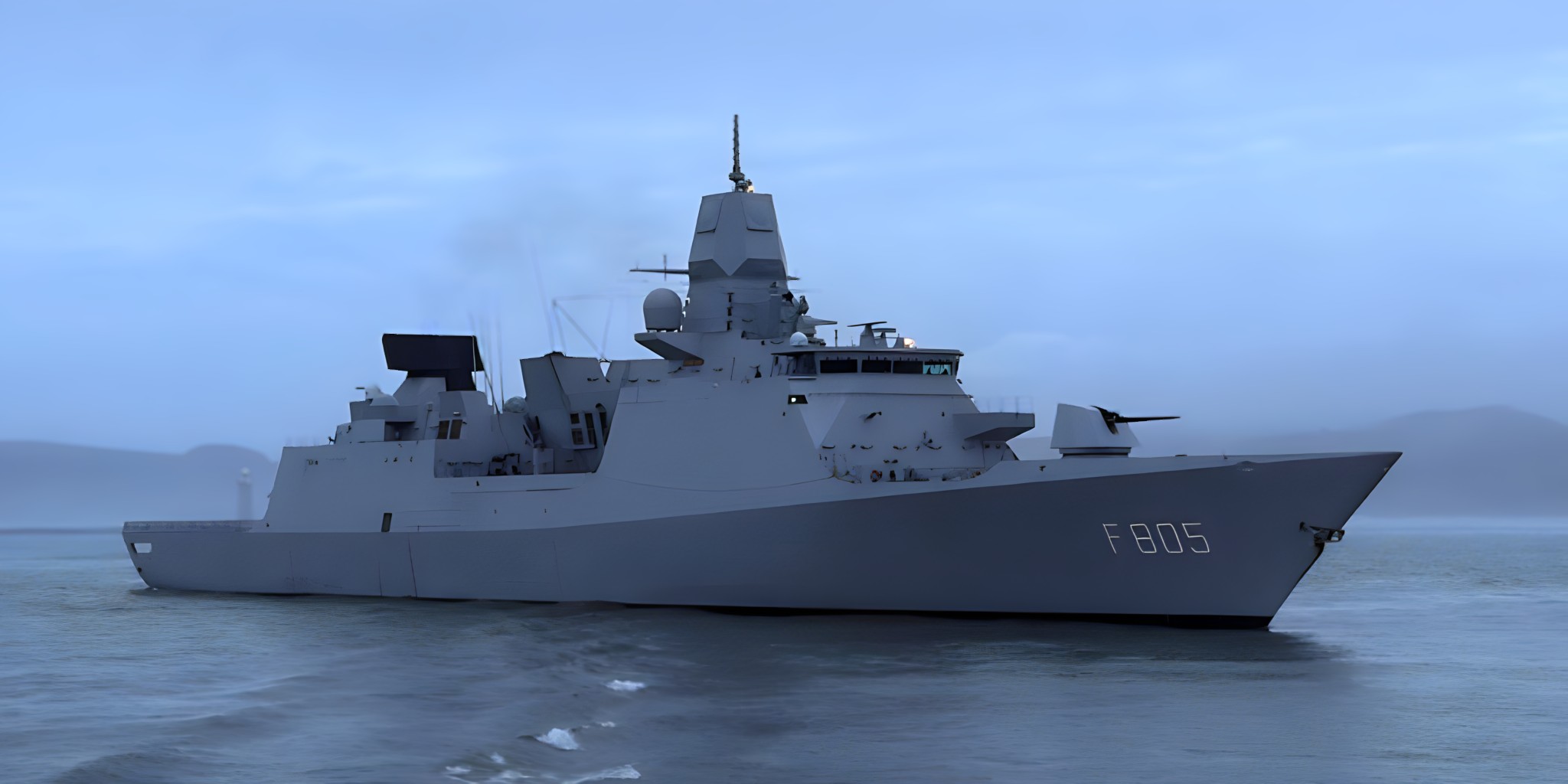
The Royal Netherlands Navy has successfully shot down aerial and surface drone threats during a live-fire exercise off the Welsh coast, becoming the first NATO ally to participate in QinetiQ’s Exercise Sharpshooter.
The three-day exercise took place at the MOD Aberporth range, around 20 miles off the coast of Wales, and saw the Dutch frigate HNLMS Evertsen subjected to simulated swarm attacks designed to reflect modern maritime threat environments. The exercise combined live and synthetic elements, testing the ship’s ability to detect, track and neutralise multiple simultaneous threats.
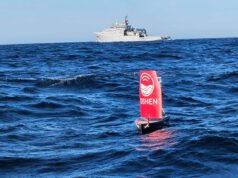
During the serials, HNLMS Evertsen engaged QinetiQ’s Banshee Whirlwind aerial drone targets as well as Hammerhead uncrewed surface vehicles. The ship successfully tracked and neutralised five aerial threats and struck and sank two unmanned surface vessels.
The exercise scenario, designed by QinetiQ-owned Inzpire, required the defence of critical assets in contested waters. Live targets were integrated with synthetic threats representing cruise missiles, ballistic missiles and hostile aircraft, allowing crews to rehearse the full kill chain from initial detection through to engagement.
Commander Marcel Keveling of the Royal Netherlands Navy said the exercise delivered valuable operational lessons, stating: “HNLMS Evertsen and the Royal Netherlands Navy are grateful to have trained on such an immersive level. To be able to fire at live targets and keep our crew in a higher state of readiness for multiple days has taught us many lessons we aim to take with us when sailing on an operational level.” He added that realistic training was increasingly important given the current security environment, describing the exercise as “a prime example” of that approach.
QinetiQ said the exercise highlighted the growing importance of multinational training as drone and missile threats proliferate. Will Blamey, Chief Executive for UK Defence at QinetiQ, said: “With interoperability between nations more important than ever, these exercises give the UK and its allies the opportunity to train alongside each other, sharing tactics and learnings to improve readiness.” He added that combining live and synthetic training helped allied forces “stay battle-ready and make confident decisions in a fast-changing threat environment.”
Exercise Sharpshooter is run by QinetiQ as part of its wider test and evaluation role for the UK armed forces. Under the Long-Term Partnering Agreement, the company operates 16 sites across the UK delivering training across land, sea and air domains.
The Dutch participation follows recent Sharpshooter activity involving the Royal Navy. Earlier this year, HMS Dauntless neutralised drone swarms during the exercise ahead of its deployment with the UK Carrier Strike Group. QinetiQ has also supported multinational air and missile defence exercises including Med Strike in the Mediterranean and Formidable Shield off the coast of Scotland, involving 11 allied nations countering threats ranging from drone swarms to ballistic and supersonic missiles.






Swarm, EG, A large number of, A dense mass of, A Plague of, A swarm of Russian Drones.
So how many Drones were there In this Excercise ?
Half a plague..
Yup, exactly half. 🫡☺️
So It was 7 “Drones” over a 3 day period and the Headline calls it a “Swarm”.
Trouble is with this sort of headline, people will think, people will assume and people will be under a really false assumption. We need to get real and stop all this sensationised false guff.
Just my own opinion.
‘Swarm’ is the word in fashion. Good luck in changing the trend….become an influencer 😂
Ha, I see some really rediculous stuff at times, we seem to be all heading into an Intellegence dead end at breakneck speed.
5 aerial and 2 water threats safely neutralised..But what about 200 small aerial drones launched en masse from a covert mothership posing as a commercial vessel?Or multiple UUVs dropped from a commercial cargo plane?Perhaps a real scenario acted out with real drones(sans explosives) against a Western vessel would provide useful data?Repairing damage caused by small drones crashing into the target ships structure would be a small price paid for the feedback to deal with such scenarios.
Well there’s no hard-kill weapon system that’s going to reliably and efficiently down 200 tiny aerial targets. I guess the solution there is to install highly effective EW equipment… or just not sailing within FPV range of suspicious/unknown aircraft and surface vessels. In a wartime scenario you would hope that’s not the case. Besides if a ship or aircraft can get within a few kilometres (or even tens of km) or a warship in a combat scenario why not just carry heavier weapons that can actually sink the ship?
Birdshot?
North Sea Wind Turbine Farms ?
Basically, but in this case airburst munitions from a 35 or 40 mm gun.
I could imagine canister munitions , which is like birdshot, to be usefull.
No vessel is invulnerable; never has been, never will be.
And the Royal Navy supplied 4 o’clockers Tea and biccies .
We don’t here what would happen if Russia or China launched 20/30/40 or more hypersonic missiles against a task force. The answer I suspect would be a lot of ships lost and a lot of people killed.
How is that any different to a Cold War situation?
Slower missiles but less capable defensive systems too.
Sorry Bob. I don’t understand your reply.
The Soviet Navy had an array of Weapons to cause damage, and potentially Sinking Ships. Times have changed, Weapons and Defensive Systems have evolved but the threat is still the same.
They do. I know people don’t like talking Corvettes here but the Russians are building a good number. Along with their other ships and subs they have an awful lot of systems they could use, many with a 100/200 mile range. Would they survive in a NATO environment? Who knows, but I don’t think the Russians care as long as the strike goes ahead.
One man’s Corvette, is another man’s Marrow 🫡💪
Maybe the marrow from Yarrowwwwwwwwwwwww…………………………………………
maybe the marrow from yarrow?
Lol, I have absolutely no Idea what that’s all about !!!!
The first line is when my keyboard had a nervous breakdown. Second line only please..
I’d bet anything those targets weren’t doing anything remotely evasive.
Does seem like everyone’s proudly displaying their ability to shoot down a ‘swarm’ of 3 stationary quadcopters, or a fixed wing drone flying flat and level. I sincerely hope they’re also getting training on how to shoot down something that’s actually trying to succeed.
Yes exactly and an actual “Swarm” rather than just the wrongly used terminology.
Random, OT, musing, triggered by your post: Ukrainians, after almost 4 yrs.of intensive warfare have probably amassed more knowledge of all facets of drone warfare than any other Western military. Fully realize NATO instructors and observers have been embedded in UKR; perhaps time to request UKR expertise re NATO drone ops? 🤔
Those Qinetiq drones are pretty good at doing evasive manoeuvres and those commercial companies get a lot of practice at ‘attacking’ warships, for example for FOST.
It would be a catastrophe if someone we didn’t like got their hands on the training data.
What would you bet? A nickel?
You have no basis for your claim , except perhaps a disdain for the British and/or Dutch navy or as lk navies and their training efforts?
It would be highly illogical for all this effort to be made , without really trying to tax the defenders.
Too much information?! We do not need to know that secret operations are to take place. Is this a Starmer government plan to tell our potential enemies what we are doing?
Go to bed.