


The Italian Air Force has completed a special operations exercise demonstrating the integration of special forces with fourth- and fifth-generation air assets in support of NATO’s Agile Combat Employment concept, the UK Defence Journal understands.
The exercise, known as Artiglio 2025, concluded in late November and was conducted under the oversight of NATO Allied Air Command. According to Allied Air Command, the activity focused on operationalising ACE and addressing counter anti-access and area-denial challenges through the use of dispersed, austere operating locations and tightly integrated air and ground elements.
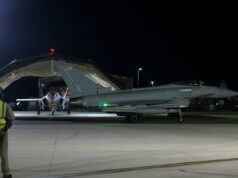
As part of the exercise, Piacenza Air Base in northern Italy was configured as a simulated forward operating node in contested territory. Allied Air Command states that the scenario was designed to replicate a “landing strip of opportunity” secured through special operations, enabling follow-on air activity consistent with Global Access Operations concepts. According to the Italian Air Force, a Special Operations Task Unit infiltrated the area using HH-101A helicopters employing fast-rope insertion techniques. These forces conducted special reconnaissance and direct action tasks to prepare the environment for air operations. Air support was then provided by Eurofighter aircraft in a close air support role, alongside PA-200 Tornado aircraft conducting ground-assisted air interdiction to suppress simulated ground threats.
A central element of the exercise was the controlled insertion of an F-35A Lightning II into the austere operating location. Allied Air Command states that Italian Air Force Combat Controller Teams from 17 Stormo “Incursori” played a key role in surveying, establishing, and controlling the temporary landing area, a capability described by NATO as essential to enabling ACE operations in hostile environments. The exercise also included the establishment of a Forward Arming and Refuelling Point to support the F-35A. According to Allied Air Command, Italian Air Force personnel conducted hot refuelling operations, allowing the aircraft to refuel with engines running and the pilot onboard. This procedure was intended to demonstrate rapid regeneration of combat air power from dispersed locations, which NATO describes as a cornerstone of ACE.






Excellent, good to see such an effective trial of wartime capability, reminds me of the Harrier days in Germany where they were dispersed far and wide, ready at a moments notice to decimate any massed Russian armoured attack.
Great to see Merlins, F35’s, Typhoons and the still potent and usefull Tornados.