

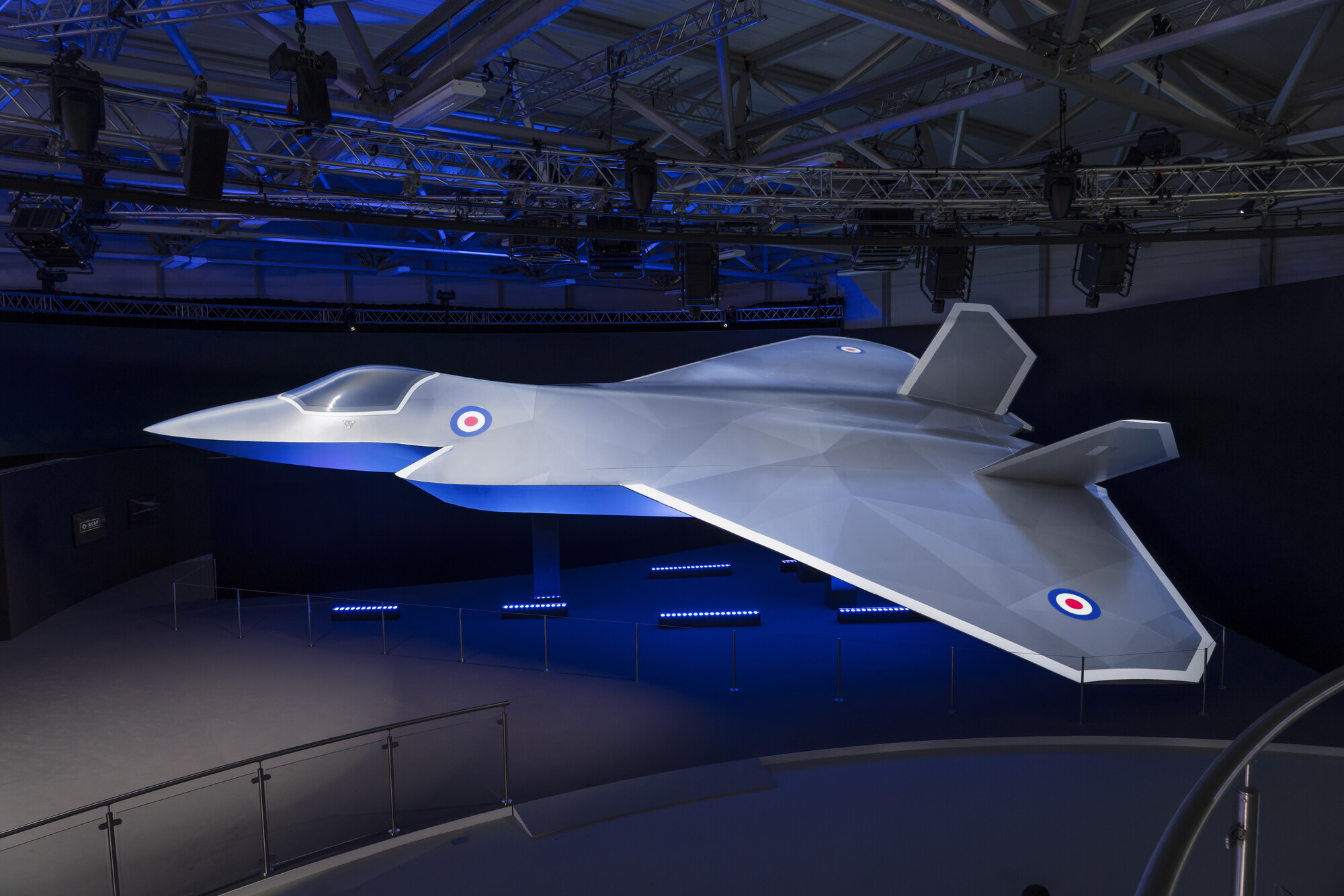
The international headquarters overseeing the Global Combat Air Programme is expected to employ around 500 personnel once fully operational, according to the Ministry of Defence.
The figure was confirmed in response to a written parliamentary question from Gregory Campbell, Democratic Unionist Party MP for East Londonderry, who asked how many UK and overseas military and civilian staff would be routinely employed at the Global Combat Air Programme International Government Organisation based in Reading.
Responding on behalf of the department, Defence Minister Luke Pollard said the organisation is still validating and refining its final structure.
“The Global Combat Air Programme International Government Organisation is validating and refining its organisational design,” he said. Pollard added that tri-national planning assumptions currently envisage a workforce of around 500 employees when the organisation reaches full operating capacity. “A third of employees will come from each of Italy, Japan and the United Kingdom,” he said, adding that the workforce will comprise a mixture of military and civilian personnel from all three nations.
The International Government Organisation, known as GIGO, forms a central pillar of the Global Combat Air Programme, a joint UK-Japan-Italy initiative to develop a next-generation combat aircraft to replace the Royal Air Force’s Typhoon, Italy’s Eurofighter fleet and Japan’s Mitsubishi F-2. The Reading facility was formally opened in July 2025 and also hosts Edgewing, the joint venture between BAE Systems, Leonardo and Japan Aircraft Industrial Enhancement Co. Ltd., which is responsible for the design and development of the aircraft.
At the time of the headquarters opening, the government said the wider programme already supported more than 3,500 UK jobs, alongside around 1,000 apprenticeships, with employment expected to grow as development progresses. Across all three partner nations, around 9,000 people are currently engaged in the programme, supported by more than 1,000 suppliers. Approximately 600 of those suppliers are based in the UK. Under current timelines, the programme is expected to deliver a flying demonstrator later this decade, with the first operational aircraft planned to enter service from 2035.








Nice to see It’s a busy project still.
I do wonder just how many RAF Typhoons will be left to replace though.
We were replacing Tornado, Harrier and others at the same point in Typhoons timeline and look at just how dramaticly slashed those figures were.
40 Tempests anyone ?
The ultimate number is the key question. It will also guide how these are perceived, since the lower the buy the higher the unit price and jets like the f22 and f35b have been roundly critised for their cost.
Hopefully over 100, but I suspect under 50, with vague promises of a future but that never happens
Yes, Aviation Ordering History In the UK does point to that low number.
Tornado, Typhoon and to a degree F35 numbers were all slashed from their Initial proposed numbers.
Apparently we are committed to 100 Tempests as part of our 40% work share agreement. However if Tempest works as advertised we won’t be looking at one to one replacement as it is suppose to be working in conjunction with ACP’s.
Ahh “Committed to”.
It will be Interesting to see how this pans out.
One would hope and indeed expect that with Tempest working with ACP’s that the actual number of airframes (Tempest + ACP) would be significantly higher than the current Typhoon fleet.
“Apparently we are committed to 100 Tempests as part of our 40% work share agreement”
I call bull on this. Totally made up.
32? This could potentially end up being used more like a Vulcan 2 rather than a like-for-like in numbers Eurofighter replacement. Supplemented by cheaper single engined fighters and drones. It is possible that Japan could have more Tempests than the UK and Italy combined. Hence the importance of the export market.
‘Cheaper’ doesn’t go with previous UK purchases…
“A third of employees will come from each of Italy, Japan and the United Kingdom,”
I’d love to see who gets the catering contract for the canteen at this place!!
As long as it isn’t the geniuses who do the catering for Interflex – soggy pizza Fridays all round.
Italians expect good coffee up to lunchtime, then wine for the lunchtime meal (much like the French). I wonder how that it going to work?
Green Park is an interesting place for sure.
With GCAP/Edgewing at 350 Brook Drive, the AWE have taken a building at 250 Brook Drive as well.
Wonder who else is present there.
Anyone know who actually owns the building, given the obvious security issues?
Green Park is owned and managed by Mapletree a wholly owned subsidiary of Temasek (Singaporean sovereign wealth fund).
Lifted from their own prospectus.
Thanks. Well I hope that UKNACE, or the SSG, have suitably secured the buildings. I always prefer assets to be government owned and equally, protected by government assets.
Those two places will be prime targets for cyber espionage given what’s going in them.
As secure as the communications under the new Chinese embassy.
Well I’m in two minds there. Unless the UKIC is also in bed with China, which i doubt, they will have insisted on countermeasures.
I read that the financial traffic can simply be re routed elsewhere, wherever the Chinese place their embassy.
Any knowledge of exactly where the network runs leaves a vulnerability, there are manhole covers on every street in London.
UKIC have a long history of intercepting comms cables, they’ll know the risks.
I wonder if UK Intelligence is actually playing a blinder, they cant reveal the entire reason why the said yes to the public.
But I’m still in two minds aswell. Could be a disaster or a very very clever move.
I agree. It makes no sense otherwise.
Indeed, although we will never know how secure. Although a new Chinese fighter looking remarkably like GCAP may give a hint.
Singapore owned ?
Well let’s hope it’s well defended then.
It’s Ok, I don’t think the Japanese have their sights on invading Reading. Although stranger things have happened.
Still going, had a feeling this idea might get canned due no money but great to see it moving forward. Dread to think how many we might buy and how many years it will take to drag the production out, this DIP should be a laugh cuts hidden in limited orders. Grade statements, sound bites and bluff, and likely less kit than was hinted at.
It’ll be a higher priority thsn the military themselves, not difficult with HMG.
Money to the MIC rules all.
Japan has an urgent need for the jet. Of the three partners they are driving the program. They are currently getting F35As and Bs, but are still running their modified F15s and redesigned F16s (Mitsubishi F2s). In reality the F35s are replacing the F2s in the muti-role tasks, so ground attack, anti-shipping and air superiority. But its the F15s that urgently need replacing, which is where GCAP fits in. The F15s are their primary air defence fighter, which now has to contend with not only Russian jets like the Su-35 and the odd Su-57, but also the Chinese Su-27 clones and their new 5th gen jets such as the J20, J35 etc. Now that China has become a major player in the aircraft business, and looking to field 6th gen jets within the next 10 years. The venerable F15 will be totally outclassed.
Japan’s requirements are very similar to ours, in that they require an aircraft with a large internal fuel volume for either long range or patrol duration, to allow the jets to have a decent stand-off engagement distance. Plus a weapons capability that must at least match their current F15s. GCAP will have the advantage of a large internal weapons bay, to maintain its low radar cross section (RCS), but will also help with keeping its aerodynamics clean, which again helps its fuel efficiency. GCAP will give them that deterrence factor against the latest jets coming from China or Russia…
How long before a very near match Chinese plane built on nicked tec appears?
They already have a number of copies. Best current example is their J15. Which is used on their STOBAR carriers. They did this by purchasing a Su-33 that Ukraine had, then reversed engineered it after Russia refused to sell them the aircraft. They also developed the Su27 into an improved version called the J11. Again breaking the IP agreement with Russia. For Western aircraft, you just have to look at the Harbin Z20, which is an unashamed copy of the Blackhawk. The latest western aircraft that may or may not of been copied is the J35, which has a lot of “influence” based on the F35.
I’m sure China will try their utmost to get data and specs of the GCAP.
Pretty sure they have some one in project already they are very good at such things.
Did anyone else feel a certain foreboding reading the line: the programme is expected to deliver a flying demonstrator later this decade?
It’s supposed to fly *next year*, not later this decade. At best this is weaseling because nobody believes in keeping to deadlines. At worst it’s a signal that the deadline has been abandoned.
And what will all these 500 folks do? Not develop or manufacture Tempests that’s for sure.
🤦🏻♂️
They’re civil servants numbnuts.
I know what they are and what they’re doing. You’re the one asking the stupid questions, dickwad.
“Dickwad” 😁😁😁😁😁😁😁🤦♂️
Jealousy is so petty 🤷🏻♂️
Arguing about workshare? Brainstorming reasons not to write the cheques? Generally getting in the way of the manufacturers?
• There aren’t any arguments about workshare on our 6th gen project (unlike the French/German one). Ever thought for a minute why that might be? (If a minutes thought is too difficult, try 10 seconds and work up from there.)
• “Cheques”… bit of a dinosaur aren’t you 😆
• No reports of the manufactures having issues cooperating. Again, maybe that’s because we have someone coordinating them…?
If the UK procures them at the same speed as the F35 we might have a couple in service by 2040! Just saying !
500 people, earning an average of £50k each, doubling that to cover overheads, would cost £1bn over 20 years.
Maybe that’s reasonable, maybe it’s not. It’s just where my brain goes to when I hear things like this.