

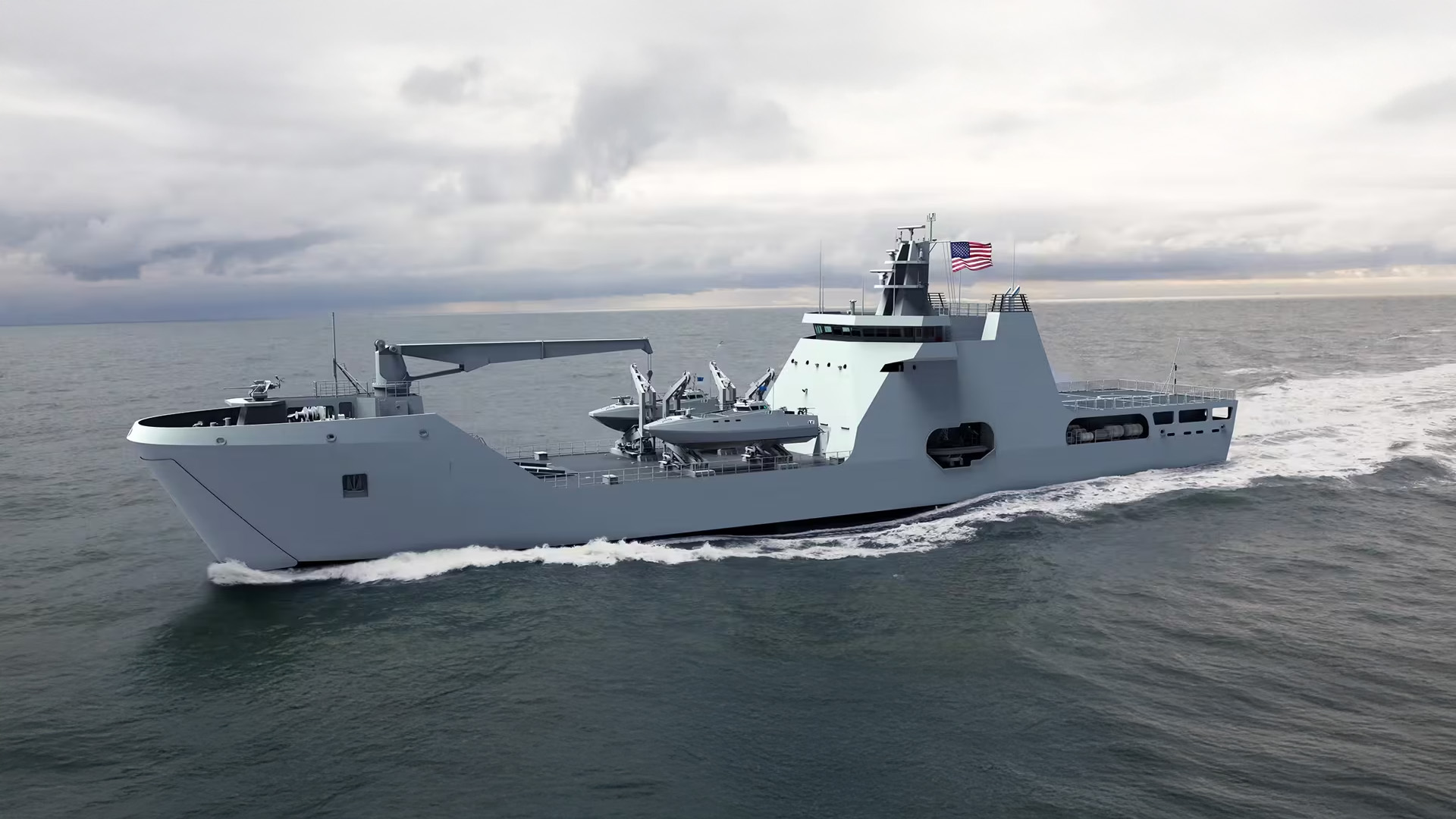
Damen Shipyards Group has confirmed that its Landing Ship Transport 100 design has been selected by the US Navy as the basis for its new Landing Ship Medium programme.
The design was chosen by Naval Sea Systems Command as the preferred platform for a class of up to 35 vessels intended to support US Marine Corps operations in contested environments, particularly across the Indo Pacific. The Medium Landing Ship programme is aimed at restoring the Navy’s ability to move troops, vehicles and equipment directly ashore in dispersed and high threat conditions. To accelerate delivery, the Navy sought a non developmental design that could be built rapidly at American shipyards.
Damen said the LST 100 met that requirement, having already been constructed and delivered into service. NAVSEA officials were able to visit an operational vessel during the assessment process. The selection follows a Request for Information issued in early 2025, with Damen later receiving a Technical Data Package award in July. That package enabled detailed evaluation of the design ahead of its formal adoption as the baseline for the future LSM class.
Under current plans, all ships will be built in the United States, with Damen providing design data and technical support to domestic yards. The company said this model builds on decades of cooperation with US industry, noting that more than 150 Damen designed vessels have already been constructed in America, including the US Coast Guard’s Sentinel and Protector class patrol ships.
The LST 100 has also been selected internationally. In 2025, Australia confirmed the design for its Landing Craft Heavy programme, with up to eight vessels planned to be built by Australian shipyards. The ship measures just over 100 metres in length and is designed to carry personnel, vehicles and cargo across multiple decks. In its standard configuration it can accommodate 282 personnel, operate helicopters from its flight deck and conduct a wide range of missions including amphibious transport, patrol, reconnaissance and humanitarian assistance.
Alan Borde, Damen’s Area Manager for the Americas, said the company welcomed the decision.
“We are delighted at NAVSEA’s selection of the LST100 for its LSM programme,” he said. “We are very much looking forward to continuing our cooperation with American shipyards during the construction of these vessels in the coming years.”
He added that the design had already proven itself in service and was well suited to the operational needs of the US Navy.


How long until they cancel this one, chaps…?
exactly what i was thinking 🙂
We should scrap the MRSS and purchase 6 of these instead. If we opt for the extended version with a hangar then it can easily perform a lot of humanitarian roles as well in the Caribbean.
We already have two massive floating air fields able to operate dozens of helicopters. Combined with these vessels and a new point class replacement we can conduct any amphibious operation required. We can put the savings into getting the T32 frigate program back on.
You realise T32 AND MRSS are both almost dead programs, well be lucky to get one (MRSS) let alone both!
Exactly, kill off MRSS and restart T32.
T32 never started in the first place!! Forget about it, there’s no plans to expand the manned escort fleet.
You won’t know that until the DIP is published.
It’s pretty obvious to everybody with the push for drone ships to fill the gaps
The whole drones concept is just that a concept.. I suspect in the end rationality will be restored and they opt for a minimally manned ship with the option for a short term uncrewed option if you think it’s going to die… the US and China are most advanced with drone ships they have both been testing the concept for about 6 year and are still not any place around a operational plaform or concept..
So just the one MRSS …..keep the Bays going and replace Argus, right 😂
Someone hasnt been paying attention to the RMs future deployment plans clearly.
I have been watching the future plans, I just don’t agree with them, Australia and the US both think the LST 100 is the answer to the survival problem.
It’s not the answer to the survival problem they are accepting that they will lose landing ships and people with designs like these.
Agree re T32. The make up of the fleet evolved into a hi-lo mix with the retention of the B1 Rivers and the advent of the 5x B2 Rivers ( really a new class ). I do think fleet hull numbers will increase; but the new hulls won’t be ‘traditional’ escorts.
I don’t think amphibious ships should be operating in anything but permissive environments. Fort hostile shores then long range insertion by helicopters is what we need and a Queen Elizabeth class can do that very well. For anything needing landed then use an LST, skip the concept of ships with well decks as it’s expensive and everything on them is too vulnerable.
The concept of having massive frigates with small numbers of soldiers on them and limited self defence capability relative to a destroyer seems to be the worst of all worlds.
They cancelled any amphibious related upgrades for the Qnlz class, they’re too valuable to use as an LPH
Not if heavily escorted and far enough offshore. Invest in longer range helicopter insertion.
They may well cancel NMH helicopter entirely and you expect the marines to get new Helos?
Jim, what is going to escort them? Mist?
Welcome Dimwit your brother halfwit didn’t tell us you were joining us. 😂 Any more siblings in the family?
The problem with these is that they are designed to trundle around at 13kts, which isn’t great for strategic relocation and also gives them a lot less flexibility in terms of the coastal areas they can raid. They are also extremely vulnerable to just about anything while on the beach, and to make them safe would given the evidence of Ukraine require them to be a day’s drive away from the front lines- not that useful.
For your later posts, helicopters also aren’t great for raiding as they are much easier to detect than the CICs would be. Trying to hunt down the small, low-profile boats with their own Martlet and RWS would be a lot more difficult than sending a fighter after the helicopters. Instead an 8kt hull with 6 CIC and maybe a couple of Merlin for casevac is much more survivable, especially if there is money available for CAMM.
They will mostly be used for logistics before the fighting kicks off.
Damen is a preferred supplier for the USCG, its reasonable to believe they have this figured out.
For pre-emptively moving Marines to remote atolls they will be very useful.
But we have the Point class for that and the distances we operate over and the destinations allow airlift as a much easier option.
I do think the scenario for the US and Australia predominantly in the Pacific with many hundreds of islands (even off the coast of Sth. America) to consider is very different to UK requirements operating predominantly in a different and generally more compact environment. Beyond that I can’t really determine what would be the best solution for us, not sure those in positions of power do either mind certainly within the limited budget available.
Well argued case for the ‘strike frigate’ design for MRSS. If you have 1 you have 2 or 3 surely?
Does remind me of the Roundtable class, but with a pointier bow.
Well, back to the future it is?
In all honesty, from what I’m seeing here they may be very useful ships.
In all of the years the RNs LSLs were in existence, the Falklands was their only ‘hot’ operation. The rest of the time they provided flexible hulls that could carry helicopters and lift or deliver ‘stuff’ on beaches or harbours. That may well be justification on its own.
They were also involved in Iraq 2003 which did include a major amphibious operation although nothing like the Falklands, no one was bombing them.
Yes. Had to look this one up as i couldn’t remember it fully. HMS Sir Galahad.
The LST100 will be very useful for down here in Aus for transportation around coastal and from mainland to PNG, Indonesia and other islands around and for disaster relief and humanitarian aid. Complement the Canberra LHDs.
Exactly, an excellent choice for the South Pacific and South East Asia.