

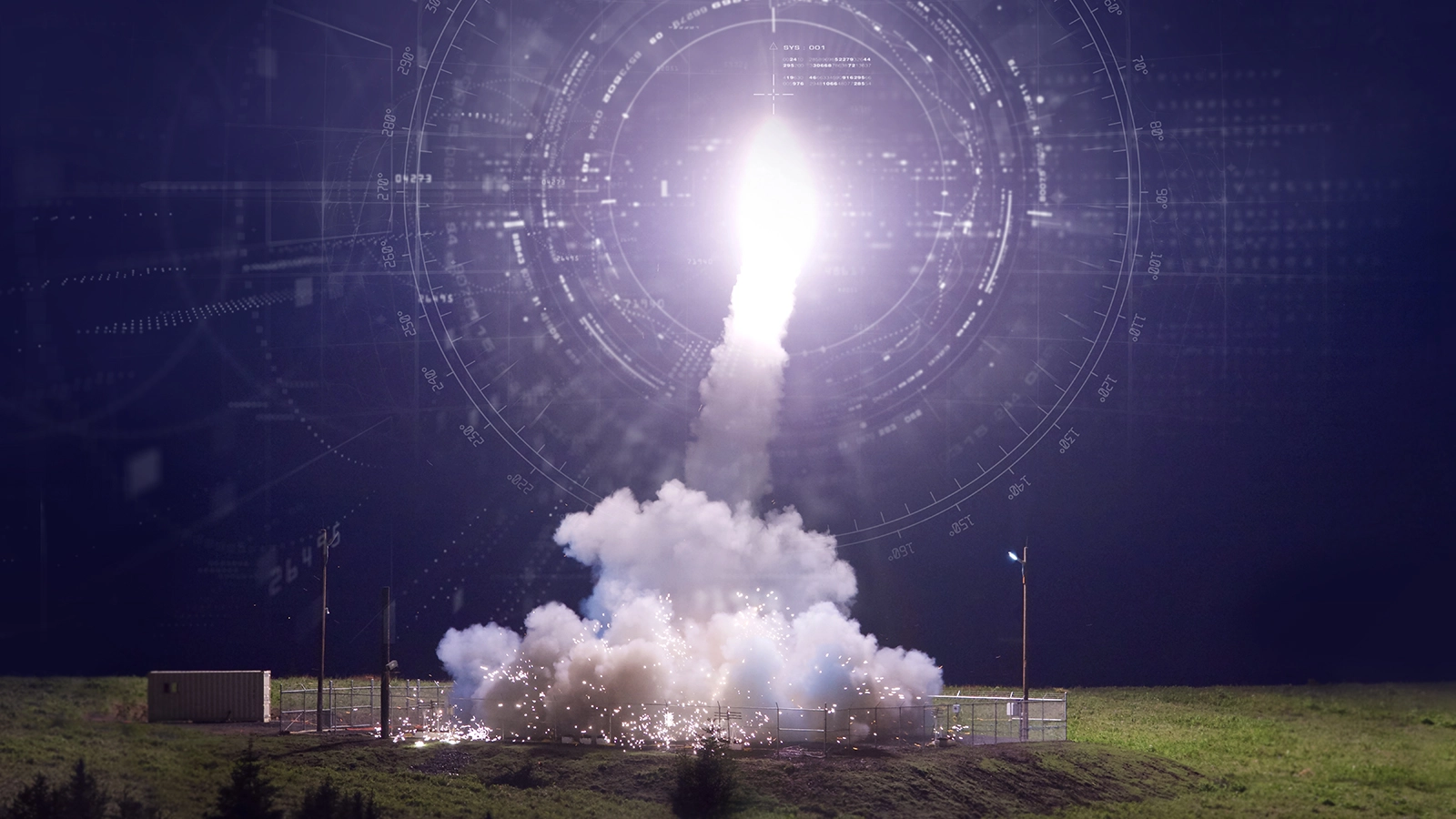
BAE Systems has signed a seven-year agreement with the U.S. Department of Defense to significantly expand production of the infrared seeker used in the Terminal High Altitude Area Defense (THAAD) interceptor missile, the company stated.
The deal will see BAE Systems quadruple its annual production capacity for the THAAD seeker, which provides sensing and guidance capabilities for the missile system. THAAD interceptors are designed to engage ballistic missiles both inside and outside of the atmosphere, according to the company.
Tom Arseneault, president and CEO of BAE Systems, Inc., was quoted in the announcement as saying: “This new, multi-year agreement provides a long-term demand signal that gives us the confidence to further invest in expanding our capacity; and underscores the strength of industry’s collaboration with the Department of War.”
He added: “We remain focused on rapidly delivering superior technology at scale to help our warfighters maintain a decisive advantage.”
The agreement supports the Department’s Acquisition Transformation Strategy, a reform effort aimed at accelerating the delivery and scaling of critical defence technologies. BAE Systems produces the THAAD seeker at facilities in Nashua, New Hampshire, and Endicott, New York, in support of prime contractor Lockheed Martin. The company said it would continue to invest in technology, manufacturing, and workforce expansion to support long-term, high-volume production under the deal.







Sounds expensive… I suppose it’s good news for them.
Currently only around 100 THAADs made per year, but Lockheed Martin recently announced plans to quadruple production. Just as well as Trump has just managed to waste almost all the THAADs the USA had in its inventory.
‘waste’… I’m pretty sure they were doing the job they were purchased for in the first place.
Used in an illegal war that was completely unnecessary and which has given Iran a strategic victory. I’d call that a waste.
Brilliant surname for a defence industry CEO.
Such a shame we let go of this business
Did we let go of this business? To me there was no business to let go of, BAE Plc created a new business.
It is a near-certainty among defence analysts and industrial economists that without the creation and aggressive expansion of BAE Systems Inc, the parent organisation would be a vastly diminished entity, likely relegated to a regional European niche rather than its current status as a global tier-one prime contractor. The creation of BAE Systems Inc. was not merely a business expansion but a fundamental act of corporate evolution that saved the company from obsolescence. Without the American subsidiary, BAE Systems would be a smaller, more vulnerable firm; today BAE Inc has a massive order backlog, currently standing at a record £83.6bn … this money provides its long-term stability.
BAE Inc. isn’t just a branch office; it’s a parallel superpower. It achieves what the UK arm cannot because it has ‘bought’ its way into the American inner circle. By becoming American in its U.S. operations, BAE ensured it could remain a globally dominant British-owned institution. if you want, the UK “let go” of the technical control so that it could “hold onto” the global prime status. Without the 2024 acquisition of Ball Aerospace, a move that firmly planted BAE’s flag in the U.S. Space Force market, the company would be a spectator in the next generation of “Star Wars” style missile defence. Instead, because of BAE Inc. the London parent company is now a peer to Lockheed Martin and Northrop Grumman. In essence, the U.S. entity does the ‘impossible’; accessing the most sensitive U.S. secrets to make the UK’s sovereign future possible.
The U.S. market provides the scale and financial oxygen and technological challenges required to keep the firm at the cutting edge of military engineering. While this shift has created a degree of ‘industrial distance’ from its British roots, it has secured BAE’s position as the only non U.S. firm capable of competing toe-to-toe with the American giants. In essence, by becoming American in its US operations, BAE ensured it could remain a globally dominant British owned institution.
The BAE Inc. contributes approximately 43% of the group’s total sales, outstripping the UK home market’s 27% contribution. The US pivot provided the scale necessary to survive the post-Cold War consolidation that saw American rivals merge into ‘super-primes’ like Lockheed Martin and Northrop Grumman.
The financial architecture of BAE Systems could be seen as a lesson in global capital management. By playing the role of a domestic American firm through BAE Inc., the company captures the massive revenue / budget of U.S. defence, yet the ultimate economic benefit remains tethered to London. The American profits act as a lifeblood for the UK parent, allowing it to pay consistent dividends, buy back shares, and, crucially, reinvest in sovereign British technology like the Launchpad incubator or the Tempest fighter. It is entirely fair to say that without the US side generating these massive surpluses, BAE would be unable to sustain the level of investment in the UK that is required to remain a top-tier global power. In this sense, the ‘Americanisation’ of BAE’s operations is the very thing that secures its British future.
The relationship between BAE’s British and American arms is best described as a strategic enhancement rather than an industrial abdication. It’s not that the UK cannot do what the US side does, the issue is scale, a two fold problem for BAE UK, one/ the size of the ‘domestic customer market’ is too small. Two/ ‘industrial mass’, the ability to produce at volume is more often than not trapped by the high unit costs of low-volume UK orders. Mass needs volume, velocity, and vocational depth, in the United States, these are supported by a Pentagon budget that treats the defence industrial base as a strategic engine for growth. In the UK, until VERY recently, defence spending was often viewed through the lens of ‘efficiency’ and ‘just-in-time’ procurement, which prioritised exquisite, low-volume platforms over the ability to produce at scale.
The UK has chosen to specialise in ‘strategic sovereignty’; nuclear, complex airframes, and maritime stealth while using its American subsidiary to dominate ‘operational high-tech’; seekers, sensors, and electronic warfare. This division ensures that the British parent company remains the master of ‘steel and wings’ while its American child masters the ‘signals and silicon’ creating a global titan that is far more capable than the sum of its geographically isolated parts.
Don’t forget that fact that due to profound protectionist policies and laws you essentially cannot access the US military markets without being a U.S. company…so they had to create BAE INC.
You are absolutely right Jonathan, I managed to omit the very point that I intended to describe, as it’s the very nucleus of “… we let go of this business”.
For BAE Plc to operate / engage in the US market to any degree of success they must operate as a US company, fire-walled off from the UK parent; BAE Plc can enjoy the profits but are not allowed access into the US business, that remains a secure US operation.
This protectionist rationalisation is both an economic and political one, as security isn’t the only concern, laws exist to keep tax dollars within the US economy.
The US Department of Defence operates on a “can we build it during a war?” philosophy, it maintains supply chain resilience, if the US relies on a foreign company for microchips or submarine steel, a maritime blockade or diplomatic spat could paralyse the military.
They include –
The International Traffic in Arms Regulations (ITAR) aren’t just about sales; they’re about keeping technical know-how inside a controlled bubble. It is much easier for the FBI/NSA to monitor a US company than a foreign one.
The Defence Production Act (DPA) law allows the President to force US companies to prioritise military orders over civilian ones during a crisis. The US has no legal authority to force a French or Japanese company to do the same.
The Buy American Act & Berry Amendment, requires the DoD to buy US made products; textiles, food, and specialty metals. While argued as ‘security’, it’s often about preserving high-paying manufacturing jobs in specific Congressional districts.
Maintaining the ‘Base’, If the US buys all its boots from a cheaper overseas supplier, the last US boot factory closes. In ten years, if there’s a war, the US no longer has the skills or machinery to make boots. Protectionism here is used as a tool to prevent atrophy of industrial skills.
The Committee on Foreign Investment in the United States (CFIUS) is the gatekeeper. They review any foreign acquisition of a US tech or defence firm, in reality they rarely block deals from ‘Five Eyes’ allies; UK, Canada, Australia, NZ or close partners like Japan. Yet, even for allies, the process is so expensive, slow and invasive, often requiring ‘mitigation agreements’ that might strip the foreign parent company of any control over the US branch that many companies simply give up.
To access the market without being a US company, but you generally have to ‘Americanise’ through proxy agreements … a foreign company creates a U.S. subsidiary with a board of US citizens; often retired generals who have security clearances. The foreign owners are legally barred from seeing the classified tech their own subsidiary is building or ‘Teaming’ a foreign company like BAE Systems or Leonardo will partner with a US giant like Lockheed Martin to act as the ‘prime’ contractor.
– A point about the US Military Industrial Complex, and the “acquisition of unwarranted influence” much is said about it; the revolving door phenomenon, Gold-Plating, Cost Overruns, Lack of Accountability, Lock -in, Audit Transparency and even Incentivising Conflict and “Forever Wars” … much of the criticism is valid. However, one shouldn’t lose sight of the prime directive of a U.S. business (military industrial complex entity or not) … Shareholder Primacy, to operate as a profit-generating machine for its owners. The legal and structural anchor of American capitalism is the maximisation of shareholder value; bound by ‘Fiduciary Duty’.
No doubt shenanigans prevail.
The UK’s “can we build it?” philosophy increasingly relies on ‘on-shored’ foreign entities, companies like Thales; France or Leonardo; Italy etc. have effectively ‘Britishised’ their UK operations over decades, employing thousands of UK citizens and maintaining domestic R&D hubs. This mirrors the way BAE Systems operates in the U.S. For the UK, the goal is not necessarily to block foreign companies, but to ensure that the technical anchors and manufacturing mass are physically located on British soil, under British law, and subject to the MoD’s security jurisdiction. In essence, the industrial capacity and intellectual property are legally tethered to the UK.
They are subject to the full force of British security and corporate law. From a technical and legal standpoint, these subsidiaries operate as domestic firms under the jurisdiction of the National Security and Investment Act 2021 (NSIA). This Act ensures that any acquisition or significant change in control of a UK-based defence firm, even one already owned by a foreign parent, is subject to mandatory notification and potential government intervention if it poses a risk to national security.
The UK does not operate an identical proxy system for every foreign bid, but for sensitive defence contracts, the requirement to establish a UK subsidiary with List X accreditation, List X is a formal designation applied to commercial sites within the United Kingdom that have been granted government approval to hold and process information classified at the level of Secret or above, this accreditation functions as a similar protective barrier. This ensures that the UK government retains the legal authority to monitor the ‘know-how’ and force production priorities during a crisis, matching the core intent of the US controlled bubble.
Also, don’t forget that BAE Systems took over United Defense and is an important armoured vehicle manufacturer in the USA, although I don’t know how much of the business that is now. I think a rebranding to AES – Advanced Engineering Systems – could be a boost. But if they are getting the business maybe that would not add much.
Any interest by the UK for this type of system or the MBDA Aquila program or even SAMP/T Aster NG? Is anything happening with CAMM-MR? Is UK GBAD going to ever have a higher level of cover and engagement beyond CAMM and Starstreak/LMM?
Something the US has to do considering the silly nature of chinas rocket forces..
It’s always so funny listening to the bae b******* when all the factories are in the United States… All the brain power is there and the manufacturing capability. But yes the UK is winning