

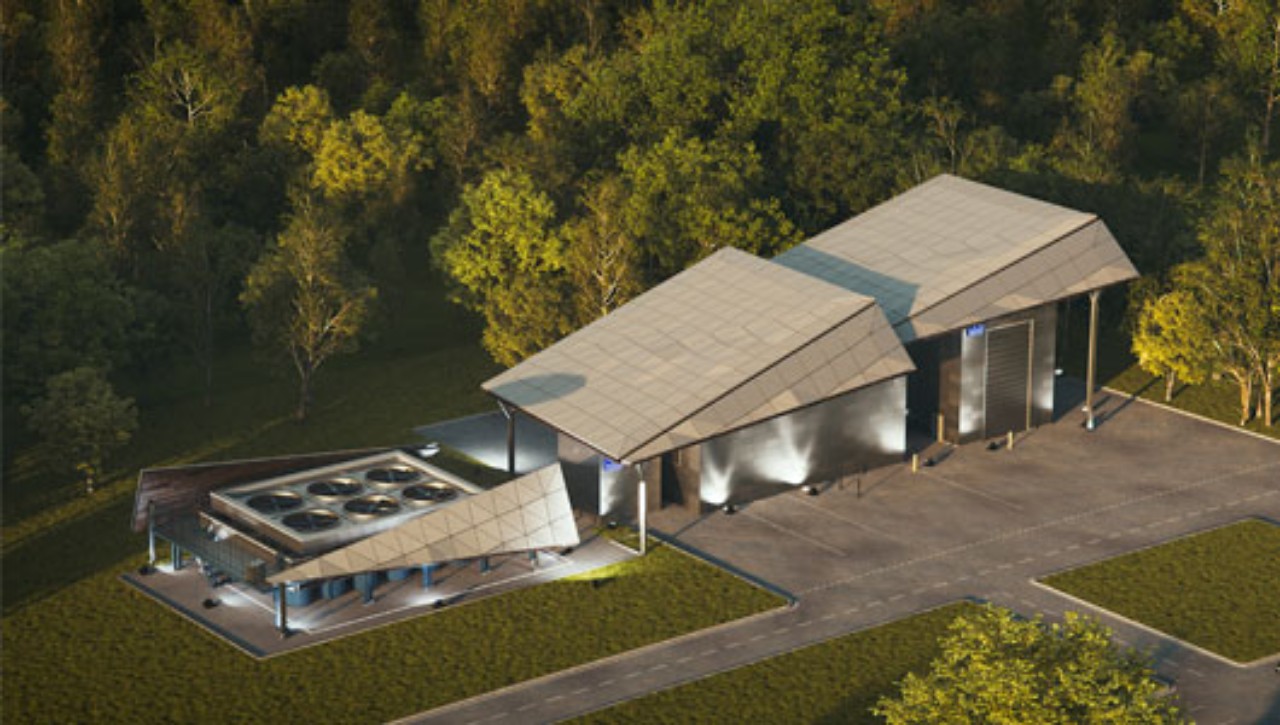
Rolls-Royce has outlined how its Advanced Modular Reactor (AMR) could support both defence operations and wider energy resilience, with an emphasis on deployable, long-endurance power and export potential.
Speaking to the UK Defence Journal at UDT in London, Mark Cheeseman, a Programme Executive within Rolls-Royce’s AMR team, positioned the concept as a next step beyond existing small modular reactor efforts, designed to deliver more flexible power closer to demand.
“What we think comes next is a smaller power plant that can be positioned closer to larger population densities, where we can provide more flexible power that provides higher heat,” he said.
Cheeseman explained that this capability is particularly relevant for industrial use, highlighting sectors that are difficult to decarbonise.
“It can really help us to transition hard to abate industries, steel making, hydrogen production… [and] help the UK with its clean economy.”
From a defence perspective, he made clear that resilience and independence are central to the concept, particularly in environments where access to reliable power is constrained.
“The resilience that this kind of product would offer… being able to fuel for between five and seven years… is very attractive,” he said, adding that the ability to pay upfront for fuel provides cost certainty over extended periods.
He also stressed that the system is designed to be power-dense and continuously available, characteristics that align with military requirements for persistent capability.
A key differentiator, Cheeseman argued, is the use of coated particle fuel, which underpins what he described as inherent or passive safety.
“You could walk away from this reactor, and everything will be fine… it will safely come to its own controlled stop,” he said.
Cheeseman made clear that this reduces the need for the complex redundancy typically associated with large nuclear plants, enabling more flexible siting and deployment.
“You don’t need the redundancy you typically need with large reactors… you can place them closer to populations.”
He added that the design is being developed with mobility in mind, including the ability to transport units by road, which would allow deployment into remote or austere environments.
This has clear implications beyond defence, particularly in regions without established grid infrastructure.
“If you take it beyond the UK… where you have a lot of mining companies that really need electrical power… some of them don’t have a grid at all… why not deploy… an array of these smaller reactors.”
Cheeseman suggested that multiple units could be deployed together to provide scalable power and heat, ensuring continuity of industrial processes in isolated locations.
He also pointed to a broader strategic opportunity for the UK, linking the programme to domestic fuel production and export potential.
“We are working very hard as a country to produce the fuel that will be required… this will separate us from the dependence on oil and gas.”
“If we can make it right here in the UK, this can become a huge export opportunity.”
However, he was clear that the programme remains at an early stage, with further progress dependent on backing and investment.
“We’re in a concept design stage right now… it’s really important to us to make sure we have UK home-grown support for this.”
Cheeseman indicated that, with sufficient support, the programme could move towards a first-of-a-kind reactor in the mid-2030s, while noting that international competitors, particularly in the United States, are already advancing similar technologies. His remarks framed the AMR as a dual-use capability, positioned at the intersection of defence resilience, industrial decarbonisation and long-term energy security.












Nuclear power at a seabed warfare conference? Has anyone asked the Russians for advice, they make quite heavy use of self-contained reactors deployed by GUGI subs in their acoustic surveillance systems.
Also, do I hear a subtext of naval use or is that just projection? “you can place them closer to people”, “high power density”, “don’t need a grid”.
Nuclear engineering international, 10 April 2026, “Scorpio, Ampera target nuclear shipping”. Another start up developing Thorium powered micro reactors for shipping.
Reliability engineering is not something that the Northern Fleet and their suppliers are known for so very unlikely.
Serial production, rather than Research and Development pretending to be just a big project, has validation for the build, maintain, and dispose phases before a design and its manufacturing plant is signed off. So it’s harder than a one off site build, but much more productive once the design is done.
Naval use can benefit from the lower cost and productivity from serial production compared to low rate production of half a dozen vessels. Not clear that SMR for civilian use can meet military standards however COTS usually requires a different mindset to the few exquisite products that are military legacy.. Designed for Reliability from ground up can avoid much cost and complexity of fail over duplication.
Perhaps the seabed was the Russian disposal mechanism, as that’s where their nuclear reactors tend to end up.
Loads of talk but nothing ever happens. Not even the first spade as hit the ground anywhere. Sums up UK industry.
Of course they are diddling not only themselves out of any profit but also the country and especially you, by not doing anything!
Plonker!
Interesting that i have read a couple of articles recently where they are looking to use “disused” mine shafts to store energy. When wind and solar is abundant, the excess energy is used to move heavy weights / water up to the top of the shafts, and when demand is required, release the water/ weights to generate additional electricty.
Very old idea. Isn’t there a reservoir in North Devon that’s filled when power is available and then emptied driving turbines when power isn’t?
Mark, its a non starter as the energy stored is trivial compared to a battery and even that is not great. We here lots of talk about battery storage but these are really only useful for balancing the network and not for a steady long term supply. I think the total battery storage we have today would supply a quarter of the UK electricity supply for maybe 2 hours. This is the problem with renewables is the volatility of supply and the inability to store large amounts of spare energy easily. And when there is oversupply we have to pay the generators to switch off.
This summer will be a litmus case as there are serious concerns of oversupply of unregulated solar power (not under grid control) which could cause serious problems with the grid which is part of the problem Spain had. People with little engineering knowledge have pushed for more solar and wind without understanding the implications to a grid not setup for this type of generation.
This is being seriously looked at. However all the one’s I have heard of involve water (not weights). You need a big mine & a reasonable reservoir at the top. It’s just a variation of pumped storage hydroelectric systems which have been around since 1907 (Switzerland). There is a 250MW plant under construction in Australia utilising two open pit mines (one on the top of a hill & one at the bottom of the hill) with a water head difference of 218 meters & 8 hour runtime. There are others around the world being looked at using various mine types, including former limestone & coal mines.
Retired coal powered plants often have a reservoir (for the steam turbines) & nearby coal mines & the transmission infrastructure already in place.
AMR? Seeing as ordinary modular reactors dont exist as intended, advanced is like running before you have learned to walk. The whole point of small modular reactors is to mass produce the parts in a factory and assemble on site. So far everything called SMR are one off prototypes.
Serial production manufacturing always starts with prototypes for demonstration and validation so it’s not concerning that SMR is generally at the prototype stage.
Obviously Rolls Royce has PWR2 and PWR3 experience that is very valuable and likely to ensure that their SMR prototypes will be closer to serial production than other entrants.
Could I politely point out that this article and the subsequent reader comments are chock-full of undefined acronyms which are a characteristic feature of an exclusive group talking amongst themselves, but a big turn-off to any non-military reader with a genuine interest in UK defence topics.
Chock-full of undefined acronyms? I only count two in the article and one of those is UK. The other is UDT, standing for Underwater Defence Technology, which was a defence show running last week at the Excel centre. A show that the UK Defence Journal has run multiple stories from over the last six days, has advertised on its home page for the last month, and weirdly is still advertising on the home page despite the show being over.
Here’s a fun trick that I tried out, inspired by your comment: I highlighted the ariticle (in Firefox), right clicked and selected “Ask an AI chat bot” for an explanation. I expect it’ll be a different mechanism in different browsers or on phones, but it really was that easy to get explanatory commentary. I also tried it on a reader acronym and it was very lucid.
You can’t hold readers to journalistic standards. Nevertheless many here are friendly and will help if Google or AI yields no joy (as sometimes it won’t). If you are interested in a subject and want to get further into it, you’ll get used to searching for the bits you don’t already understand. Of course some of us just talk twaddle and no AI can help with that.
I’ll get my coat.
“Here’s a fun trick” could be construed as condescending, which rather proves my point that this website is a chat-room for enthusiasts who share the group-insider jargon. As an interested layman who wishes to stay up to date on defence matters, I was looking for a jargon-free debate. I will look elsewhere.
Everybody can earn $250+ daily… You can earn from $19845-$38514 a month or even more if you work as a full time job…It’s easy, just follow instructions on this page, read it carefully from start to finish… It’s a flexible job but a good earning opportunity..
go to this site home tab for more detail thank you…… Jobathome1.com