

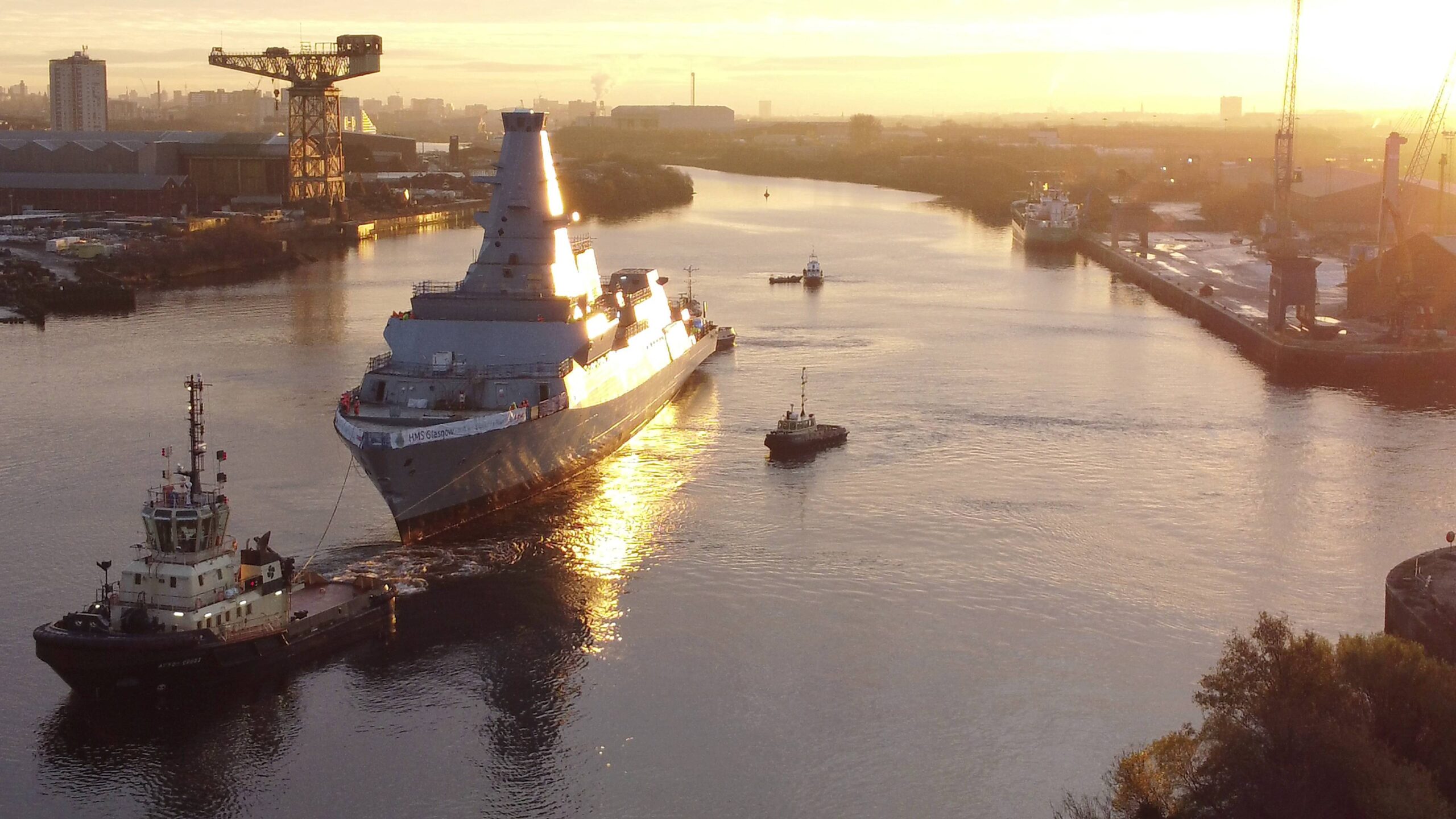
The UK will need to place additional Type 26 frigate orders after the government confirmed that build slots currently allocated to the Royal Navy are being transferred to Norway, leaving a gap that has not yet been addressed and which will be a consideration of the forthcoming Defence Investment Plan.
The detail emerged in a parliamentary answer from Minister for Defence Readiness and Industry Luke Pollard on 22 April, in which he confirmed that 13 frigates were ordered between 2010 and 2024 across the Type 26 and Type 31 programmes, adding that of the Type 26 slots “a number have been ceded as part of the Norwegian deal” and that “the delta is yet to be made up through additional orders, and this will be a consideration of the Defence Investment Plan.”
The transfer was first officially confirmed in February, when Pollard told parliament the UK was “working together with our Norwegian partners” and “assessing options for offering Type 26 build slots currently allocated to the Royal Navy to the Royal Norwegian Navy.” At that point Pollard also confirmed the Royal Navy’s total would not be reduced, stating “the Royal Navy will receive all eight Type 26 ships during the late 2020s and 2030s as planned”, and describing the intended outcome as a combined fleet of “eight British and at least five Norwegian” ships operating jointly in northern Europe where “the only difference between a Royal Navy Type 26 and a Norwegian Type 26 will be the language on the signs.”
The eight-ship commitment has nonetheless come under scrutiny, with Conservative MP Dr Andrew Murrison telling the Commons that “well-placed sources are suggesting that the number of Type 26 hulls on the order book may be reduced or transferred to our Norwegian allies”, and asking Pollard to confirm that the government would “proceed with a minimum of eight Type 26 frigates, particularly given the increase in Russian submarine activity” discussed earlier that week.
Pollard’s response was unequivocal, asked directly whether he could confirm a minimum of eight, he replied “I can indeed“, before going further and describing the Norway arrangement in some detail, saying the deal “sustains Type 26 production on the Clyde for many years to come and involves not only the eight British Royal Navy Type 26s but five Norwegian ones”, adding that “we are currently working with Norway on build slots” and that the result would be “a truly interoperable, interchangeable force” where “the only difference between a Royal Navy Type 26 and a Norwegian Type 26 will be the language on the signs.”
Pollard also said the Norway deal was “part of an agreement about how we can work more closely with our joint expeditionary force allies in northern Europe” and that he hoped it “can be expanded to other nations as we look to sell the Type 31 frigates to more of our partners.”
The commitment was also given previously in a written answer from Al Carns MP in March 2026, who confirmed that “the Type 26 programme will deliver eight anti-submarine warfare frigates for the Royal Navy, which are designed primarily for operations in the North Atlantic and will form a core component of the Atlantic Bastion concept”.
It is worth noting that because Norway is paying for the slots it receives, no money already committed to the Type 26 programme is necessarily lost, and the additional orders needed to get the Royal Navy back to eight ships are expected to be handled through the Defence Investment Plan as spending plans are recalculated, though the practical consequence either way is that the Royal Navy’s later Type 26s are likely to arrive later than originally planned, putting additional pressure on the retirement schedule of the Type 23 frigates they are intended to replace.
There is a broader argument that the flag on individual hulls matters less in the North Atlantic than the total number of capable anti-submarine warfare frigates operating together in that theatre, and the Lunna House Agreement signed in December 2025 is explicitly built around that logic, committing the Royal Navy and Royal Norwegian Navy to operate as a single interchangeable fleet where crews train together, share maintenance and operate virtually identical ships.
From a NATO perspective, a combined force of 13 identical frigates working as one coherent anti-submarine warfare capability across the GIUK gap and Norwegian Sea may represent a more meaningful contribution than eight purely national hulls operating alongside Norwegian ships of a different type, and the agreement has been welcomed by many in defence precisely because it moves beyond the kind of paper interoperability that characterises much of NATO’s surface fleet toward something closer to genuine integration.
The position as it stands is therefore that the Royal Navy’s eight-ship requirement is confirmed and has been stated repeatedly at ministerial level, that at least one hull already in build is expected to be reallocated to Norway to meet the Norwegian requirement for early delivery, and that the additional orders needed to replace those slots and get the UK back to eight have not yet been placed, with the Defence Investment Plan the stated vehicle for resolving that, a document that was originally expected last autumn and for which no publication date has yet been announced.









Just avoid giving the tabloids and Internet commentariat anything to get their teeth into, and confirm that they’ll be replaced. Because, they are being replaced, right?
*Just to avoid anyone going off at me – Pollard has confirmed as recently as last week that eight will be procured. Not sure why the language of ‘consideration’ needs to be used, then.
George is absolutely right to point out the significant change in semantics.
Those slight semantic changes are a very typical drafting trick to disguise
a policy pivot.
In the present defence media frenzy George pointing this out might
actually save the T26 program. Things really are that bad.
There is no point in sugar coating things. There isn’t remotely enough
money. No real uplifts have been given so damaging cuts continue.
Yes im not convince defence spending is invreasing this year if the mod was asked to find around 3 billion in savings. All very dissapointing and the current govt still getting away with not spending and not showing there hand in defence
The MoD has to find savings because it wants lots of shiny new kit but at the same time what’s to keep its old stuff. It’s pretty normal for the MoD to be finding in year savings and £3 billion is 5%.
However the £3 billion figure is much like the £28 billion figure. Straight out of the mouths of “well placed sources” as “reported” by the daily mail.
The same people told us just last week that the T26 program was definitely being cut and now we have a minister making a legal statement to parliament that it is unequivocally not being cut.
I could cut 5% of my company operating cost next year with little trouble most companies do this every year. The fact that rhe MoD can’t find cost savings an and it’s only answer to its problems is we need more money sums it all up.
This is how the US spends $1 trillion a year and can’t keep two carriers on station in the gulf.
If you want thousands of new drones and missiles you can’t expect to keep the same number of airplanes, tanks and ships.
Something has to go and that’s what in year savings are about.
Ask yourself why the British Army still has 500 horses but only 160 planned main battle tanks and tell me this is a force that can’t cut 5%.
The RAF has six fighter squadrons and can still have an entire display squadron.
We will be needing that cavalry don’t ya know.
Yes the Cavalry are needed to protect the Royal Horse Artillery as we have very little other artillery available. Comes complete with PC environmentally low carbon, organic fertiliser which is handy as there is demand all getting out of the Gulf.
😂
Didn’t think about that one 😀
I wouldn’t put much store by legal statements made in parliament given the recent goings on. Frankly given the state of the navy I cannot comprehend why anyone would think this was a good idea. Oh 13 frigates are 13 frigates, it doesn’t matter about the badge, until it does. At a time when NATO may very well look totally different in 5 years I think this is bonkers. I have zero faith in this government, who seem utterly incompetent.
Looking back over the last 4 or 5 decades you could be forgiven for thinking that our problem isn’t incompetent governments so much as a nation that just doesn’t want to be governed. 🤔
Sorry But I Smell a Rat..!
SB, I’m not saying that George shouldn’t be using ‘consideration’ – he’s absolutely in the right to do that. I’m saying that Pollard shouldn’t be using it.
Yes the 8 T26 order for RN is now : 8 minus the Norway order- there you have your billion savings.
If 2 or 3 ships it means RN will get 5 or 6 T26
For RN to get 8 it needs a further order of 2 or 3.
If I read this Right ..The Royal Navy will get their 8 t26..BUT on an Extended Time Scale..Thus Saving The MOD/HMT Billions…! Something Goverments in the Past have done but via a diffrent route..Leaving the Navy Short once Again and Probably kicking the t45 Replacment t83 into the long Grass also…@
Knowing Politicians..They’ll put the ‘New’ Orders in DIP and call it an Expansion of the Navy…!
So our boys have to serve in ageing rust buckets for longer. Ps is Norway coming to our aid if we have an out of Nato emergency like the Falklands
I think the existing t23 us getting scrapped asap despite desperste shortage of ships. I think tge navy is do small mow that im not convinced a surface gleet to defend zfalklands is now practical. We have what about 4 frigste desyroyers in workong order and thsts about it
Better to order another five zt31thid is all very well and good if you have yards that take 4 years to build a river class patrol ship
Yes, they will continue to guard the bear gap while we sail off to the Falklands just like happened in 1982.
Well fact is hopefully we don’t let an uncontested invasion to take place which caused that navy requirement back in 1982. Fact is if the assets there, or can be quickly sent by air bridge there by air can’t prevent any invasion we are no longer in a position to be able to retake them I fear. If a seaborne asset is to help prevent such an invasion then a submarine would be far more useful and probably better occupied for a bit than in Australia. The North and Norwegian Sea is like it or not far more of a priority. The homeland and access around it are vital to protect and Norway itself is vital to our defence and the Norwegians will be doing that, in theory later it might even allow us to spare a frigate to go south without weakening that role.
I would say the Norwegian Navy will struggle to crew more than 4 T26’s! They presently only have 4 lower spec frigates. Five T26’s is expecting a lot, for a country of only about 11m people!
Try 5m people, about the same size as Scotland. Not exactly sure what the relative crewing requirements are, but T26 was designed to be lean I believe. Maybe offset a bit by being larger.
Norway helped considerably with last year’s carrier strike group to the Pacific, so they might well continue to help in non-NATO matters.
WE ACCEPTED The NORWEGIAN Order NOT Really Having the Building Capacity to Undertake Such a Task while our Own Navy Deteriorates before our Eyes…! The IRANIAN Conflict and HMS DRAGON Debacle has Certainly put this Goverment on Notice..!
I’ve noticed George’s writing becoming more overtly critical over the past few weeks. I’d assumed he was holding back in order to retain the closeness to official sources, perhaps that doesn’t matter given that so much of industry has come out for increased spending?
Now that Robertson has broken cover and everyone else had piled in behind him there isn’t any wool left to pull over people’s eyes.
Maybe DIP will be an investment in more wool?
I wouldn’t frame it as criticism to be honest, my job isn’t to be positive or negative about anything, it’s just to accurately report what’s happening. If that comes across as critical, sometimes it’s because the facts are what they are, I don’t get to choose them. We do have a good relationship with official sources and I’d like to think that’s because we report fairly and accurately, including when it reflects badly on them. I think I’d actually be respected less if I didn’t do my job propoerly. Besides, they’re not paying our bills, the readers are. Would you read the site if it was just PR?
If it’s this Type 26 story you’re thinking of though, I’d push back a bit on that one. Every claim in it comes straight from a parliamentary answer or ministerial statement. Slots ceded, replacement orders not placed, Defence Investment Plan with no publication date etc etc, that’s all the government’s own words.
Now that there is official acknowledgment that there will be a third batch of 26’s perhaps we could have an article giving an update on the programme. Such as when Glasgow is expected to start trials, and when ship 3 is going to be rolled out. It will be a good day when we can see a photo of Glasgow anchored at Tail of the Bank, or better yet full out on the measured mile on Arran.
The question is, is it really a problem yet? As the ships are bought in batches and the later batch orders have yet to be placed. Is it a case that the the ceding of T26 slots to Norway will be covered in a later batch order. I guess the problem comes when Government whichever colour they are fails to place that batch order.
There’s the problem DaveyB. Will that, effectively, 4th Batch be placed
Nothing on BAE increasing work tempo – they have no plans, or what? Nothing.
Nothing on orders for 5 sets of additional engines and other engineering that has to be ordered in advance? Nothing.
Nothing on gun weapons and radar systems being ordered in advance. Nothing.
There is nothing to suggest that an additional 5 frigates are to be built other than hollow words from a terrible government; that amounts to nothing.
We are at the point where we need a new Government and not a bunch of clueless wasters like Michelle Scrogham MP et al, nor Reform, nor the Cons and yet, who?
All fair and reasonable. .
About the Edit function, so we can do our “job propoerly” please?
I’m exhausted, I’m leaving that there as evidence that I’m crap at my job.
@George – you are doing exactly the right thing simply putting accurate verbatim quotes together into a coherent story.
It simply puts the onus on HMG to tell a more coherent story.
There is an old saying, ’XYZ was clearly stated in the press’ – nobody denied it so the clear deduction is that it is true.
You work hard George and it is appreciated, many thanks! Are you needing a breather? We all do now and then.
I’ve just noticed a few more notes at the bottom of articles pointing out how long such and such a programme has been delayed for and what ministers have promised in the past, that’s all. In the past there wouldn’t have been much commentary on one of the parliamentary answer or press release articles apart from a bit of context of what the equipment under discussion does. I think it adds to the article, better for someone to come away with a decent history of the programme and what the possible outcomes are than just know exactly how it stands at present. Of course, the ministerial vagueness doesn’t help you there.
RE your ‘just PR’ comment, I did find some of the articles about companies like Babcock, the interviews with Nick Hine being the example I can think of first, where the article written around the interview struck me as slightly too readily accepting of the vision he was trying to put across. Babcock are doing a great job from scratch but there is stuff they could do better and in my own opinion it would be better to include the potential pitfalls in their path as well as the good news stories (few though those are).
You are doing a great job at the moment, anyway!
And it is very good that @George is giving references to previous statements and decisions. It is all factually accurate and does mean that readers don’t need an encyclopaedic knowledge of defence decision making to understand the background to the article.
…and of course the Japanese line is that the DIP delay is holding back GCAP progress and delaying financial commitments to the programme so a valid point that it potentially raises questions on T-26 timings and delays even if there is a commitment to the final number.
Well said.
For what its worth George I think you are doing a grate job.
Better crack on with batch 2 of the type 31 programme, they’ll need bow sonar, towed arrays potentially and a medium gun.
I don’t mind the type 26s going abroad as that has happened before with French and Italian frigates but the UK needs to order replacements pronto.
I would be happy just to see a second batch with the same fit as the first. Costs are well known and there will be commonality of spares and training. I think it is unlikely that Bae can crank up the output rate of 26’s so there will be a gap in service entry given that at least two of the second batch will go to Norway. No doubt the Treasury are rubbing their hands at the prospect of spinning out the spend on that programme but we will still need new hulls, particularly since the last 23’s won’t be operational much longer. And yes the 31 is not optimal for ASW but the gap has to be filled. Once the 26 class is more complete the first 31’s can always be sold, which I think was the intention.
Absolutely. An immediate order for a further 5 ship batch of upgraded Type 31s would both clear the bottleneck created by the Norwegian commitment on the Clyde, and allow some room for export opportunities of the Type 31 design. Babcock need something to occupy their military capacity when the initial 5 ship. order is completed. Either use it or lose it.
So basically delay an order for a tier one ASW T26 and instead buy a second rate ship and call that a strategy – Jesus
Smithy old bean
We need warships in the water asap.
Other nations in Europe allow allocation from their warship orders for foreign sakes, most recently France FDI frigates to Greece and Italian Fremms- forget who bought those.
The type 23s can’t be kept going.
So unless the type 26 programme can speed up we will most definitely need more type 31s. I admit they aren’t as cutting edge as the type 26s but they are a proven NATO frigate design able to be extensive expanded for equipment fit to make them a viable ASW platform/ general frigate platform.
I personally think HMG have lost the plot and should have ordered more type 31s already and boosted the type 26 programme. Seems we have no money for essential defence but plenty for welfare, illegal asylum seekers etc
Hard to believe that some or all of the 3-4Bn of savings can’t be found in those “other” departments you mention other than in Defence or some Defence levy created to fill this gap.
Indeed-the priority is hulls, so more Type 31s are the only option
The only reason not to go for more T31s is to have Babcock build MRSS amphibs at Rosyth.
T31 frigates, don’t need a bow sonar! They are not configured for quite operation. A hull sonar would be sufficient for T31.
Pronto wont translate to ships appearing sooner. If we had T83 fully specced putting pressure on timescales, perhaps an extra build hall might be considered, but short of that, I can’t see BAE doing anything other than queuing them up to whatever timescale is commercially agreed.
A second batch of T31 makes sense, but T31 isn’t that suitable for a bow sonar, though a towed ystm makes sense. A larger caliber gun also feels like a mistake, recent events have shown that magazine depth is key and the 57mm gun comes with a lot of ammunition.
The RN is in no position to accept any delays to the T26 programme. Why can’t they just knock extra ships at the shipyard simultaneously? Why not expand the yard and take on more workers? Surely it is not beyond the British state to get this yard humming.
It does make you wonder if Babcock could be utilized to ease the bottle neck – it would hardly be the first time we have split a class over different yards perhaps?
Janet Harvey Build Hall anyone ??
If you go onto the search facility and Type in Simon Lister it will give you an insight of just what the BAe investment means to build rate. By ship 5 they plan to be on an annual Drumbeat and 66 month total build time, that’s motoring ! To be fare that’s about right to deliver 13 T26 to UK and Norway, what concerns me is “then what ?”. I wouldn’t be too surprised if T83 ends up being a developed T26 with AAW front and centre, BAe actually showed a model at an Australian Defence Show !
There aren’t enough skilled workers to take on. Developing the workforce takes a long time.
If RN slots are being given up to Norway that means that the Norwegians will be paying for those ships. As the ships have already been ordered, then surely no new money is required from the DIP as funds had already been budgeted for those ships. The only downside surely will be the timescale in which the latter Type 26s are delivered to the RN. Or am I missing something?
The ‘theory’ goes, because this is a convenient delineation between two T26 batches, the MoD could use this to cut the remaining three frigates.
Purely a way of saving money.
Because Norway is paying for the slots it receives, no money already committed to the Type 26 programme is necessarily lost, and the additional orders needed to get the Royal Navy back to eight ships may require only a reallocation of funds rather than significant new expenditure. The more immediate concern is timing rather than cost.
Given the parlous state of the RF Northern Fleet, and the real time collapse of the RF sovereign wealth fund, that just sold 22 tonnes of Gold, isn’t delay for UK funding a good decision when Norway has NATO North Atlantic responsibility like the Royal Navy so that’s covered and the DIP can address short term needs such as UAV countermeasures while keeping 8 vessels in the medium term?
In other words the timing works in UK favour while the Northern Fleet decays through corruption, incompetence and no funding…
So realistically then this “Should” just be a case of formalising the placement of new slots, rather than actually buying new ships. In which case fair enough but why do they need to hold off for the DIP then I guess.
Hi George that spacing out may just save MOD some in year funding issues !
Trigger! I pointed that out several weeks ago Rodders!
I belive only batch one ( first 4) have been paid for Iain….
I wouldn’t be surprised in the slightest, if the remaining 3 arn’t ordered with this useless government.
There ought to be quantity savings coming back to the RN, rather than extra costs.
Great answer that answers nothing, agrees to nothing and its the stanard MOD press release under this Government of big words and saying a lot about nothing.
RN currently has 6 ASW and 1 GP Type 23 on the books. The 5 T31 replace the 5 GP we had. 8 T26 replace the remainder.
If the T31 don’t get going soon the Rivers, which are doing a sterling job, will start dropping too if we are not careful.
We need BOTH the T26 and T31 to be in service before any more “cups in the cupboard” get broken, so there is no point in splitting the manufacture for one over the other.
I’d rather Norway got 1 or 2 T26 before 2031 if they have trained crews ready to go.
Just build with whatever effectors we have ordered and accelerate the effort. The only hold up is the staged payments from HMG surely?
I think the first 2 T31s are due to enter service in 26/27/28, are they not?
Last time I saw anything reported T31 “In service Guide” was 2027/28/29/30/31.
Not unexpected news.
Remember what this is all about. It’s about providing a robust ASW deterrent against Russia by having a force of 13 identical Type 26 Frigates, operated by two of the closest allies in NATO. There are lots to look forward to.
UKDJ, why do you print this stuff?
It is nonsense, you know it, we know it.
We print it because it’s directly sourced from ministerial parliamentary answers and confirmed by multiple written questions over the past month. The story is straightforward: the government has confirmed in parliament that Type 26 build slots allocated to the Royal Navy are being transferred to Norway, that the delta has not yet been made up through additional orders, and that this will be a consideration of the Defence Investment Plan. That is not speculation or analysis, it is what the minister told parliament. If you have a specific factual objection we are genuinely happy to look at it, but ‘it is nonsense’ without any supporting argument is not something we can engage with constructively, is it?
My supporting argument is that I am now retired and have far too much time to fester over this STUFF.
When I have finished this bottle of splendid white port I will probably not come back with another cutting reposte.
Another cutting riposte? Where was the first one?
Don’t start, I am chilling my next bottle.
My wife has “retired” I am “allowed”
Frankly this talk of “slots ceded” is Treasury double-speak The MOD has a contract for 8. Restructuring the delivery schedule does not change 8 to 6. Therefore there does not need to be any additional order.
What the minister is implying is that 2 ships will be sold by the MOD directly to Norway out of the RN fleet in a government to government deal. That’s not “ceding a slot” that’s flogging off two brand new ships
Pollard was explicit in the parliamentary answer that ‘the delta is yet to be made up through additional orders’ so regardless of the commercial mechanics of how the Norwegian transfer is structured, the minister himself has confirmed that the existing contract for eight ships will not deliver eight Royal Navy ships without further orders being placed.
I don’t doubt it and a great bit of reporting. Just saying it’s a cut by stealth that’s been snuck in under the radar, and obviously Treasury driven. You don’t need to reduce the order to meet Norway’s requirements, just tweak the schedule
It’s obvious what will happen from here – there are barely 6 T23s active, so the MOD will say “Here you go – like for like transition to 6 T26s”
So we are not “ceding” a slot to the Norwegians at all. As SD quite correctly points out we are selling 2 of the ships scheduled for the Navy without ordering a replacement. Unless those 2 new ships are “re-ordered” that is a cut no matter how much lipstick you put on it.
Precisely, and this was a great bit of detective work by George and this site. 2 T26 cancelled.
What makes you think they won’t be reordered?
Typically the reorder would be automatically when the contract with Norway is inked. If not there will be a review which means….
Experience.
The underlying issue here is one of opportunity cost. Because the MoD operates within a fixed-ceiling budget, the money required for the “delta” cannot simply be pulled from a new pot of gold; it must be cannibalised from elsewhere in the existing equipment plan. Every time the government chooses to spend an additional billion pounds on a Type 26 frigate hull, they are simultaneously choosing not to spend that billion pounds on something else.
The reality is that if the MoD remains committed to all eight frigates via this delta, something else in the budget inevitably has to give. When Pollard describes the replacement orders as a “consideration of the Defence Investment Plan,” he is essentially admitting that the cash isn’t sitting in a vault ready to be spent. Every pound diverted to make up the delta is a pound that cannot be invested in drones, cyber defence, or personnel, this is ‘crowding out’ in its purest economic form; because the Type 26 is a Tier 1 priority, it effectively pushes every other project further down the line.
This delta represents a fundamental choice; do we use shipyard slots and engineering hours to build extra Type 26s for the Royal Navy, or do we use that same capacity for cheaper, vessels like the Type 31, or more DragonFire mounts or maybe accelerate the development of autonomous underwater vehicles. By using the word “consideration,” Pollard is acknowledging that the MoD is performing a live cost benefit analysis. They are weighing whether the value of the seventh and eighth frigates outweighs the value of whatever must be cancelled to pay for them. If the ‘lost opportunity; is deemed too high, for instance, if it threatens the Army’s main battle tank capability (off the cuff example) that “consideration” might lead them to decide not to place the additional orders after all.
By pushing the UK’s final ships further into the future to accommodate Norway’s slots, the inflationary risk grows significantly. The funds allocated for Ship 8 in 22′ will have nowhere near the same purchasing power in 37’. Norway is effectively paying to cut in line, in March Norway announced a massive NOK 115 billion defence uplift. This move was specifically designed to end speculation that they might cut their frigate order, they are now firmly committed to at least five ships. This confirmation makes the queue jumping even more likely.
So with Norway’s cash guaranteed, the pressure on the Glasgow shipyards to prioritise Norwegian hulls over the final UK ships 7 and 8 is at an all time high, the RNs final hulls just might be in a precarious ‘danger zone’ (fsck, earworm … Kenny Loggins). They risk becoming so prohibitively expensive in future accounts due to these delays that the Treasury may eventually argue that a combined fleet of 11 ships is sufficient, using our allies’ hulls as a convenient excuse to drop the UK’s final two vessels.
13 ships, combined fleet 8 UK, 5 Norwegian gives around 4.3 ships at sea on watch. Good.
11 ships, combined fleet 6 UK, 5 Norwegian, gives around 3.6 ships at sea on watch. Bad.
Norway should order 1 more ship to give 4.66 ships on watch.
However, if we don’t solve the personnel crisis, the ship math might still only result in 3 or 4 ships on station, because the others will be stuck at the pier awaiting trained manpower.
What? That was a diatribe and a half over a counter argument with no basis with added souffle waffle and a tad of Canadian maple syrup.
Should the RN be allowed to order an additional 5 frigates, they would come from a re-profiled spending plan beneficial to the Treasury and the MoD spending plan. Simples
Will the Treasury allow the MoD to actually buy the now delayed RN T26 order is a different question but the Treasury can trouser £5Bn+/- and say the North Atlantic is now secure and because of interoperability, RN bods can work Norgie frigates. Simples
Is this Govt fit for purpose? No. Simples,
You inability to read and comprehend marks you as a Plonker. This comment was obviously not for you, move aside and let other people read.
No, it marks me out as being cognisant and you as a complete… lacking in ability… thing.
‘Handle’ rings true.
You do not seem to understand the word “diatribe”
diatribe | ˈdʌɪətrʌɪb |
noun
a forceful and bitter verbal attack against someone or something: “a diatribe against consumerism.”
Please point out where I was
A/. Forceful.
B/. Bitter.
C/. Attacking.
You: “… Should the RN be allowed to order an additional 5 frigates, they would come from a re-profiled spending plan beneficial to the Treasury and the MoD spending plan. Simples”
Yes that’s exactly what I stated in my initial comment, but I was more nuanced and explained the possible downsides of re-profiling and how any cuts affect many things, ‘on station’ being chief amongst them. As I replied it wasn’t for your ‘big all knowing brain’, other people read this website and might not fully understand all the intricacies involved … I’m simply trying to help other people get a clearer perspective. No where did I attack anyone Gov. / political party / MoD / you.
I explained the re-profied spending plan … re-profied means “stretching the costs”; it was ‘this’ now it’s ‘this’, changing the timing of the payments to fit a specific budget year. the gov is building them so slowly, stretching the build, delaying costs, however, the cost per ship increases due to inflation and maybe by the time they get to ship 7, the budget might be ‘empty’. Ships 7 and 8 might not get a slot.
In UK defense planning, there is a hierarchy of how ‘real’ a ship is –
Planned: Included in the 10-year Equipment Plan, but no money is moved.
Committed: The “Main Gate” investment decision is passed; the Treasury allocates the specific billions.
Contracted: A legal agreement is signed with the shipbuilder.
The formal contract for the second batch of UK ships (the remaining five) 4,5,6,7 and 8 was signed on November 2022, however, contracts for large military projects often have “break clauses.” If the UK economy struggles, the final two ships, HMS Edinburgh and HMS London are the most likely candidates to be cut.
Even though the Norways purchase helps ‘Fixed Cost Dilution’, ‘Economies of Scale’ and ‘Supply Chain Survival’. The risk is that by the time the UK has to “re-order” its own slots, inflation may have eaten up any benefit from the Norway deal, and I repeat, the final two ships, HMS Edinburgh and HMS London are the most likely candidates to be cut.
Re-profiling and scaling back accounting in defence was initialy a labour construct back in the 1997–2010 years, however the Conservatives perfected the art of re-profiling the schedule to keep the shipyards open without actually delivering the ships on time. In the late 1990s, Labour originally planned to build 12 T45s, by 2004, they re-profiled the requirement down to 8 ships. In 2008, just as the financial crisis hit, they cut the order again to just 6 ships. To justify this, ministers argued that the ships were “so much more capable” than the old ones that 6 could do the work of 12. Military leaders corectly pointed out that a ship cannot be in two places at once, regardless of how “capable” it is. Today we don’t yet know what the final number will be for T26’s … this is the evolution of 30 years of bipartisan creative accounting.
Also see the “Lunna House Agreement” December 2025. Designed specifically to address the missing ships problem. It isn’t just a sales contract; it’s an interchangeability pact. The UK and Norway have agreed to use the exact same technical specifications for their Type 26s. Usually, export ships have different radios, sonars, or weapons. In this case, the ships will be identical twins. The treaty allows for British sailors to serve on Norwegian ships and vice versa. This means if the UK is short a hull for a sub-hunting mission, they can legally and operationally plug in a Norwegian Type 26 into a Royal Navy task group. They are merging their spare parts warehouses and maintenance schedules. If a Norwegian ship breaks down in the GIUK Gap, it can pull into a British port and use British spares and technicians to get back to sub-hunting immediately.
The treaty effectively splits the map, instead of the Royal Navy trying to patrol the entire North Atlantic with 8 ships, the “structural commitment” allows for a specialized hand-off – Norway takes primary responsibility for the ‘High North’ and the Arctic approaches.’The UK focuses on the “Central Atlantic’ and protecting the nuclear deterrent at Faslane. Together, they maintain a combined fleet of 13 (hopefully) high-end sub-hunters, which Treasury argues is better than 8 British ships working alone. It’s a formal bilateral agreement backed by their shared membership in NATO and the Joint Expeditionary Force.
JEF is a UK-led group of ten Northern European nations. It is designed to be faster than NATO. Article 5 requires 32 nations to agree before acting, that takes time. JEF allows the UK and Norway to act together without waiting for a consensus in Brussels or Washington. This makes the pact more reliable for “grey zone” threats, like someone cutting an undersea internet cable, where NATO might hesitate to call it a full-scale ‘war’.
At the end of the day we realistically want 14 T26s, 8 x UK 6 X Norwegian. There is strong political will, around 75%, to order a sixth ship as protecting gas infrastructure is now a vote-winner in Norway.
I thought we needed the new T26 ships asap to replace the aging RN fleet. Surely supplying Norway with some of the earlier build T26 will delay the supply of the new T26 ships to the RN and exacerbate the aging fleet issue further.
This has been discussed at length on here – the Norway Order was literally too good an opportunity to miss,the UK rarely supplies New Builds from UK Yards for Export.When Delivered they will be doing the same Job in roughly the same area,and someone else is paying for them to do so,so a win win at the end of the day.
Here’s an idea since we have already cut the steel of the 5th and last Type 31, we could order a couple more from Babcock to cover the gap then sell them to Brazil for £4.99 when we get all our Type 26’s in service?
You could do a buy one get one free offer!
Or better yet keep them. The type 31s are based on a full fat NATO frigate and have excellent growth potential and “wide margin”.
SDSR clearly stated the RN will be increased to “at least” 25 frigates and destroyers, so the RN is currently at least 6 ships short even with all type 45s being eventually fixed and serviceable, all type 31s in service and all 8 type 26 built.
The RN can ill afford to sell any ships off currently.
SDSR has been replaced by the SDR, which made no such commitment.
Sorry I was trying to be funny since we spent 67 million on an assault ship and I think Brazil paid 20 million for her, Brazil always recognise a bargain
I’m pretty sure first steel has not been cut on Campbeltown. It was only cut on Bulldog a couple of months ago.
Hi Jon, I did get my numbers mixed up, but if on schedule Formidable should be out of Shed next year.
Leaving room for Campletown build, there is then a gap that a couple of more MK41 ships could fill the Tyre 26 gap due to Norway order.would be good
Think thats probably not a goer as Brazil is reportedly (Naval News 21 Apr) going to buy 4 more Tamandare type frigates which look like a T31 lite but must be right enough for them.
Watched a youube video on Tamandare, you should look it up, they look good for constabulary duties and they have a big area to protect, but very light on anti-air with only 12:sea ceptors but could add another 6 camms making 18 vls
They will need something bigger to replace the 32 vls Type 23’s at some stage. They may build under license the Type 31’s, but do think Rosyth will build them.
They’re onto number five already? If that’s the case Babcock must be wondering about what’s coming next in the way of orders? Be silly to lose this momentum. Has anything more come of the Danish order and still waiting on Sweden ‘s decision?
Sorry got my numbers mixed up the their are on number 4 Formidable in build, Bulldog steel was just cut on the day Active was launched so just Campbelltown to go.
Haven’t heard anymore info on Danish Order yet or Arrowhead 120 for Swedish navy but this has just been submitted.
Madness.
Here we go. I posted a few weeks ago that we would end up selling off part of our order and got critisized. Now, that is exactly what we are doing. Batch 1, if it can be called that, was scheduled for the early to mid 30’s and that was far too late. So what is the timescale now? 2040 perhaps. We will get 3/4 T26 in 5/7 years time. All the T23’s will be clapped out by then so we will have only four ASW frigates. Starmer, Reeves and their cronies are a disgrace to the country.
Geoff, not defending Starmer or Labour, but this current situation has more to do with the Tories delaying and kicking the can down the road, and when eventually when the type 26 was ordered, it was contracted at a snails pace of construction. Blind Freddy could see what was going to happen….
Agree. Tories caused this stinking pile of dung. Labour are getting criticism as the government in power. Fair enough, but they aren’t the cause, but most definitely should be the cure.
It’s all about political decisions on spending. HMG are determined to have a glutenous welfare bill rather than defence of the realm
So the Tories caused all the problems by ordering all the ships while Labour have only made cuts. Come on Mr. B. Labour have been in “power” for nearly two years. They have done absolutely nothing for the R.N. Nothing!
What do you expect them to do about the frigate gap? No amount of money will be able to free up an extra drydock in Rosyth, so T31 production is capped. No amount of money will hire and train the required amount of workers fast enough to boost production in Govan.
As impotent as Labour are, there is literally no realistic way of avoiding the Tory-caused frigate gap.
What Tory frigate gap are you talking about ? Is it the one where they ordered 8 T26, 5 T31 and had plans for 5 T32. Ah, I now I understand. You might be better off reading the post from Micki.
Come on Geoff lets forget the party politics. The Tories faffed around for years with the Global Combat Ship and ordered the T26’s and T31’s far too late. Labour are compounding this by giving away build slots to Norway and not committing to Type 31 batch 2. Its a failure 20 years in the making across both parties.
No argument from me. If you had read my posts in recent times you would have seen me having a go at the Tories as well It’s not really party politics but Labour have been in power for nearly two years and they are a shambles on defence. I don’t blame any of the other parties because they are not in power. Labour are.
It’s the delay in ordering T26, Geoff.
Bloody Tories deferred for so long to save money short term and the existing 13 T23s fell apart.
Some might conveniently forget the 12 Escorts lost pre Tories by Labour to add to the flavour…..but that’s another story.
iI’s not a term Iwould ordinarily use Daniele but they are all the same. We have had 30 years of indiference. There are no votes in defence. But knowing that Blair and Brown were useless and Cameron and Co. were useless does not help. We have to be pragmatic. Labour are in “power” now so I’m blaming them.
What do you mean they haven’t done anything? Scrapping the RFA Argus, three Type 23 frigates, two LPDs—they never stop doing things. Now it seems they’ve cut another two Type 26 frigates. Just wait until a good offer comes in for one of the aircraft carriers. They’ll say, “Why do we need two aircraft carriers if we barely have any escorts?” This government is actively involved in disarming the country, and they’re doing it quickly and effectively. Let’s not take away their merit.
Good point. I looked at it the wrong way round didn’t I? 🙃
You know me Andrew. They’re all to blame. If by some miracle I could find away of keeping our useless politicians out of defence decisions I would do it but they have the purse strings. As I have just said elsewhere Labour are currently the ones in power so I’m blaming them.
I think its NATO first now, and no distractions with far eastern cruises, it’s North Atlantic. So they will hope an identical Norwegian crewed ship does the ASW role regardless. The French have a newer fleet and seem happy to sweep for our ever lengthening Trident patrols. Both Norway and German P8s will be flying from Scotland when needed and the carriers will be focused North.
Trump looking at Greenland will prompt The Dutch and Danes to get more sea time.
Another T45 rejoins the fleet with CAMM at the end of the year and Daring will appear soon.
It’s interesting to see Germany order 8 sets of Spy-6 for it’s new airdefence ships which should add a much greater boost to the Northern flank after 2030 along with a much more modernised Northern NATO SSK fleet
Yes it’s too slow to build and the SSN availability needs sorting but our flank is probably one area that will get lots of attention.
A second batch of T31 would be a boost, particularly with drones that can deploy and process sonar buoys and maybe a sea krait array from its boats.
Just as a bit of a silver lining.. the three batch 1 vessels were a massive 1.3 billion each.. the follow on batch as about .8 billion each.. if the batch 3 is the same price that’s a saving of .5 billion pounds.. that’s an extra frigate.
Seriously? You don’t realize that batch 1 has first of class costs included? Good grief.
Yes and Norway would be buying that so jog on lad.
Don’t be stupid. Norways’ not paying FOC.
1.3 billion is batch 1 contract divided by 3, not the cost of any particular ship. Jeesh.
And you know that because?
They want ship within 3 years that’s not something you just get.. if they want a ship from that specific contract they will pay the cost for that specific contract.. otherwise the UK taxpayer is subsidising their ship..
But in reality neither you or I know… do we laddie.
Your maths is right. It should equate to 2 extra frigates as long as unit price doesn’t go up drastically due to inflation.
Even if it does we should be aiming to get 10 type 26
Or, for rule of 3, even one extra T26 and one extra T31.
Those batch 1’s will have by now, quite a substantial RN crew for some time? If the RN crew was turf off the ship.and re-crewed by Norwegian’s, they will have little time to learn all the in’s and out’s of a new T26 frigate!
I would imagine it will be Belfast. If remember the Norwegians wanted one by 2030 and Belfast would fit the bill…
Pollard would never mislead Parliament, who could suggest a thing like that? What would straight as a die Starmer say to verbal gymnastics and smart Alec verbalism. Snake oil salesmen the lot of them. The most honest thing they could do is introduce Russian, Farsi and Mandarin onto the national curriculum, just in case it all goes wrong.
I’ve gained $17,240 only within four weeks by comfortably working part-time from home. Immediately when I had lost my last business, I was very troubled and thankfully I’ve located this project now in this way I’m in a position to receive thousand USD directly from home. Each individual certainly can do this easy work & make more greenbacks online by visiting
following website—.,.,.,.,.—>>> JobatHome1.Com
I’m more interested when a better radar will be fitted to the T26’s. The Artisan NG models and renders seen recently imply a replacement is in the works.
Aussie CEFAR radar is very very good. Not sure about costs Vs Sampson but it’s pretty close to Sampson’s capabilities and with Aukus is available to us
The CEAFAR obsession is getting a little absurd. The UK does not need to buy in major naval radar systems from abroad. T31 should’ve received Artisan from the outset.
As to CEAFAR itself, whilst very, very good, is about as over-hyped as SAMPSON is itself.
the royal navy; the last of the ‘great spinners’ … cheap bang for predictive buck.
I don’t think ceafar or sampson are particularly over-hyped. one (ceafar) is the master of modularity / scale / redundancy / multiplicity / continuous tracking. the other (sampson) is the master of low-altitude physics / multi-tasking / adaptive digital beamforming / and now BMD.
bae’s t83 radar should prove interesting.
… seem to be having a lowercase-fest.
There will be eight Type 26 frigates, with maximum of six of them available for operations at any one time.
The two that are not available won’t be seen very much.
/s
There are 2 questions to be asked here, assuming the DIP comes out before the last type 45s out of service date, if there is the ‘promised’ next order of I assume 5 type 26s to cover for the Norwegian order, what’s the final build date of the last 26?
Question 2 is what’s the planned in service date for they type 83 ( it is known to need to be before 2038 unless the oos date of the Type 45 is incorrect)
It would have to have an in service date of 2035, when the first T45 went out of service, which goes to show the T45 OOS dates are nonsense.
Exactly and I don’t understand why the government are not being called out on this
Why are we not going all guns blazing on the T-31 frigates yet? The Japanese are aiming to build 2 mogami class frigates per year, which is a very similar vessel comparable to an upgraded T-31 (T-32). We should be aiming to have at least 20 or so on order for the price to either keep or export.
They need a drydock for fitting out. Only one drydock is available in Rosyth. The other two are used for submarine dismantling and emergency carrier repair. Venturer occupies the dock currently, and Active can only begin fitting out when Venturer leaves the dock.
It’ll be interesting to see how quick the first three Mogami’s arrive and their finals costs for the RAN. And then there’s the remaining eighti to be manufactured locally and those costs. We had one here in Sydney recently they looked a very lean and clean design, a bit like a number 1 haircut! I like the fact the T31 has the pair of 40mm but having a 5″ has definitely more clout.
To be fair, the Japanese face an altogether different naval threat.
So the already glacial pace of T26 delivery to the RN will be dragged out still further.
And replacing the build slots now allocated to Norway is to be part of that shimmering mirage the DIP.
We have had some poor governments over the last few decades but none as incompetent, evasive and mendacious as this bunch of third rate inadequates.
What do you mean they haven’t done anything? Scrapping the RFA Argus, three Type 23 frigates, two LPDs—they never stop doing things. Now it seems they’ve cut another two Type 26 frigates. Just wait until a good offer comes in for one of the aircraft carriers. They’ll say, “Why do we need two aircraft carriers if we barely have any escorts?” This government is actively involved in disarming the country, and they’re doing it quickly and effectively. Let’s not take away their merit.
The flag does matter.
So, this is basically saying that ALL of the UK Type 26 frigates will be allocated to the North Atlantic? What about the RN’s committments in the rest of the world, including carrier escort duties?
George, does this mean after Sheffield the slots will be allocated to Norway and none of the current ships under build are being renamed? as I did think this would be the case.
I think we should order another couple of Type 31’s to fill the gap plus add to our Frigate numbers
”From a NATO perspective, a combined force of 13 identical frigates working as one coherent anti-submarine warfare capability across the GIUK gap and Norwegian Sea may represent a more meaningful contribution than eight purely national hulls operating alongside Norwegian ships of a different type, and the agreement has been welcomed by many in defence precisely because it moves beyond the kind of paper interoperability that characterises much of NATO’s surface fleet toward something closer to genuine integration.”
To add to the NATO perspective, the 15x River Class (Type 26) that are being built for RCN will be starting to appear in the North Atlantic in the coming years to bolster that gap and be vessels of very similar class and functionality of the RN and RNoN.
There would be either 7 or 8 of these vessels based for the Canadian Atlantic fleet upon completion of the program.
Let’s rephrase that from
‘Conservative MP Dr Andrew Murrison telling the Commons that “well-placed sources are suggesting“‘
To
‘Conservative MO Andrew Murrusin, in an attempt to turn a good news story of Norway buying the Type 26 to a bad news story, imagines voices in his his head suggesting…’
There, rage-bait story fixed.
Now go check your blood pressure guys.
I get paid over 220 Dollars per hour working from home with 2 kids at home. i never thought i’d be able to do it but my best friend earns over 15k a month doing this and she kaz convinced me to try. it was all true and has totally changed my life. This is what I do, check it out by Visiting Following Website
HERE————— http://www.giftpay7.vip
In as far as we could trust a Labour Government (and the Treasury), which is not a lot, this sharing concept makes sense. First 3 T26s to the RN, then Norway and the same allocation onwards. Remember also that there are currently 4 T26s in build so as the contract experience speeds up, it can work (unless there are funding issues, in which case forget about any defence spending and give all remaining funds to welfare and immigrants).
If I read this Right ..The Royal Navy will get their 8 t26..BUT on an Extended Time Scale..Thus Saving The MOD/HMT Billions…! Something Goverments in the Past have done but via a diffrent route..Leaving the Navy Short once Again and Probably kicking the t45 Replacment t83 into the long Grass also…@
I suspect this is Rachel & HM Treasury wanting to put off spending on RN T26 by a few years. Anyone would think the RN was awash with frigates, at this lacksadasical attitude.