

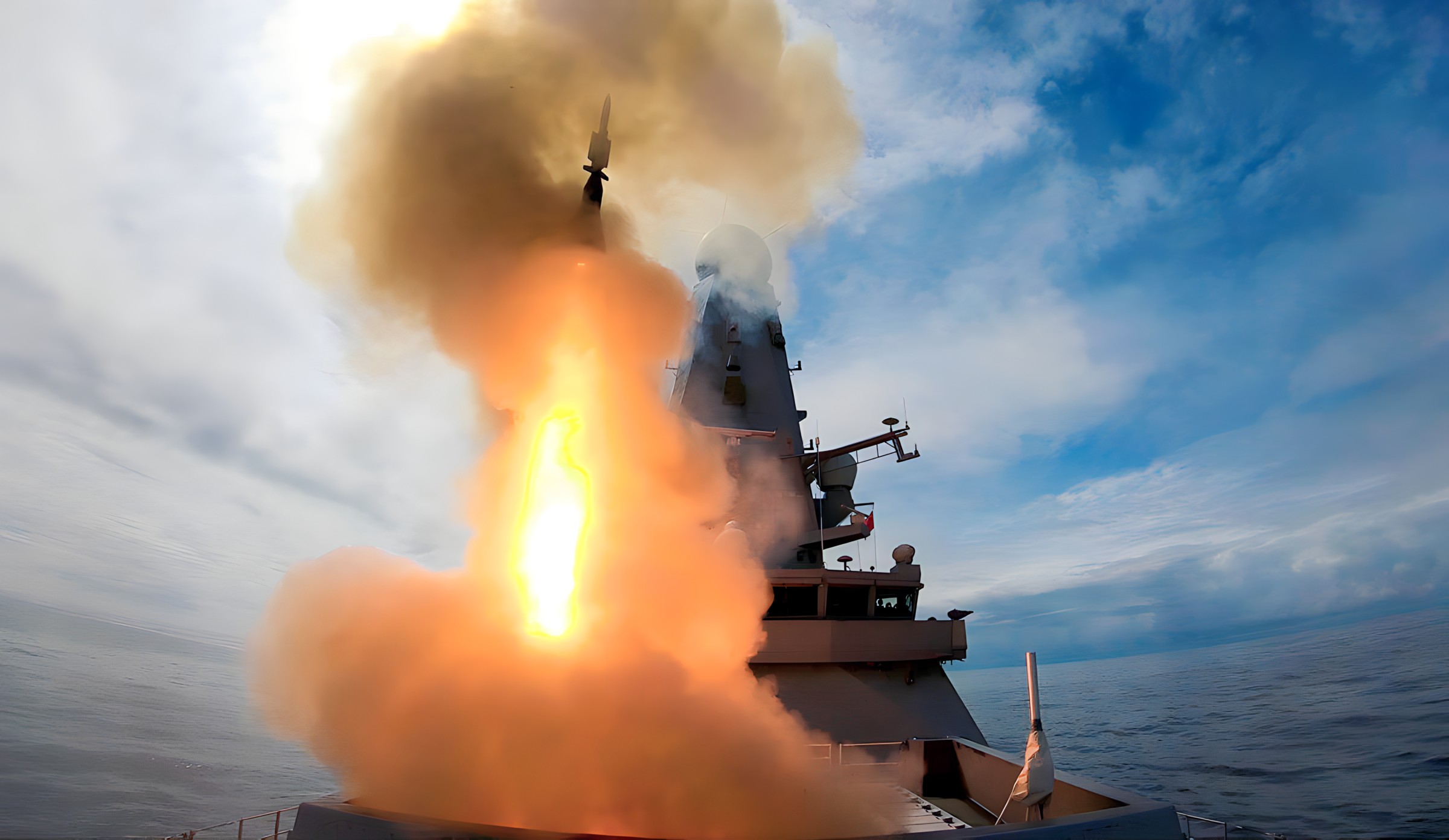
HMS Defender, which has been undergoing Sea Ceptor CAMM installation alongside a major propulsion refit in Portsmouth, is expected to complete the upgrade by late summer 2026, Minister Luke Pollard confirmed in a parliamentary answer on 21 April, narrowing the previously reported end-of-year timeline.
This is the latest concrete public timeline for a capability upgrade that has been in development since 2021 and forms part of the most significant enhancement to the class since it entered service.
Asked by Conservative MP Ben Obese-Jecty to specify when the first vessel would receive the fit, Pollard said “the CAMM capability is being fitted to the Type 45 fleet under the Sea Viper CAMM programme, which will augment the existing Anti-Air Warfare capability of those platforms”, adding that “installation on the first vessel will be completed in late Summer 2026.”
The Sea Viper CAMM programme, for which MBDA UK was awarded an 11-year contract in 2021, adds a new 24-cell silo for Sea Ceptor missiles forward of the existing 48-cell SYLVER launcher, increasing each destroyer’s total missile capacity from 48 to 72, a 50 per cent increase in magazine depth that addresses one of the most persistent criticisms of the class since it entered service, namely that six ships carrying a combined total of fewer than 300 anti-air missiles represented a thin margin for a fleet responsible for protecting carrier strike groups and fulfilling a range of standing NATO commitments simultaneously.
Sea Ceptor itself is already well established in Royal Navy service, having been fitted to the Type 23 frigates and slated for the Type 26 and Type 31 as well, and its integration onto the Type 45 under the Sea Viper CAMM designation exploits the UK’s existing CAMM missile stockpile and maintains a high degree of commonality across the surface fleet, which has practical benefits for logistics, training and maintenance that are easy to understate but genuinely significant at scale.
The timing is also relevant given the broader threat environment, with recent conflicts having demonstrated the ability of relatively low-cost drones and missiles to saturate naval air defences and impose disproportionate costs on even capable platforms, and the Sea Ceptor addition giving the Type 45 a much greater capacity to engage multiple simultaneous low-end threats without expending the more expensive Aster rounds that are better held in reserve for higher-end threats, a point that has taken on added urgency as drone and missile attack profiles have become more sophisticated and widespread.






Whilst good news, an 11 year contract would indicate another long period of inactivity for the destroyer fleet.
You do understand that ships will get fitted as they go through refit?
Are you sure? My understanding was refit and fitout were being done at different docks / suppliers?
Your understanding is wrong. The first sentence “HMS Defender, which has been undergoing Sea Ceptor CAMM installation alongside a major propulsion refit in Portsmouth”
That was interesting to read actually it struck me as notable as I did so, because I too had previously understood that these would take place separately, there were certainly discussions on the matter here in the previous years so it was clearly thought to be so by others too. So it would be interesting to know if it was a misunderstanding all along or a sensible change in the process has taken place along the way or it just worked out as logical and timely in this particular case.
I don’t believe it is supposed to be misleading. But representative of the RN managing the availability and the maintenance (docking periods) of the T45s. With so few warships available, I suspect the RN are trying to keep those spinning plates from falling. So if a ship is going into a long period of maintenance for the power improvement program, then it makes sense to add on the CAMM modification at the same time. Bus as Dauntless, Dragon and Daring have had the power modifications already. Their CAMM upgrade will need to be scheduled in to the next deep maintenance cycle. As Defender, Diamond and Duncan go through their power upgrade program. It’s likely that Duncan and Diamond will have CAMM fitted at the same time as per Defender.
That’s a positive, although i don’t understand why the engine refits are taking so long.
It would be nice if the T45s were not in refit at some point….
You would have thought the ship’s name might be in included in the article. I believe it’s HMS Defender.
First two words of the article?
Updated
Good, but another dragged out programme lasting years. Five years to fit a system for a class that has spent a good part of time in port.
Should have been done during the engine upgrade. Should also have added Martlet launchers either side to add real cost effective anti-drone capability.
They did PIP and CAMm during this refit.
And no magic martlet launcher for ships exist.
The ones used in Ukraine and on Wildcat are any system capable so yes it does exist.
Read again
For
Ships
Navy Lookout in 2019 would beg to differ
https://www.navylookout.com/royal-navy-test-fires-ship-mounted-martlet-lightweight-multi-role-missile/
Well they did do tests years ago from ships so one presumes had they wished to they could have developed and fitted Martlet by now or imminently as ship launched. It seems they decided not to and preferred helicopter launch only for good or bad.
Not actually true Hugo.
Martlet has also been developed for Ship Installation by the manufacturers, either on It’s own pedestal or paired with the 30mm Bushmaster.
And the Navy wasn’t interested, it wasn’t safe
“It wasn’t safe”
Lol.
Martlet Is also shoulder launched, Is that safe then ?
I read somewhere the launch was made meant the exhaust plum hits the ammunition for the 30 mm and so risked detonating the whole magazine
There Is also a Stand alone Version and Wildcat had Initial Issues until solved. These Martlet design versions do exist though which was my answer to Hugo.
Do you mean the SEA Ancilla? This is a decoy launcher that the makers say could launch Martlet. I’m not sure how it would be targeted though so might be a complex solution.
Lightweight , navalise Rapid sentry might be possible but I assume the issue is making arcs of fire safe and avoiding having it conflicting with other weapons ( or friendlies)
They do exist. But the efflux was an issue.
Yes, there is an ammunition store right behind it but there is also exposed cabling.
The other issue is that it didn’t really offer a lot more than the 30mm offered anyway as Martlet doesn’t have either an enormous range, or warhead. You’d probably get more effect with high performance 30mm ammunition and certainly by swapping 30mm for 40mm – let’s not stat the convo again!
The efflux was an issue on the Type 23 trials installation….a ship that we are retiring….
Type 45’s DS-30B are not compatible with the MSI Seahawk Sigma 4 round launcher regardless…
But it shouldn’t be an issue on the Type 26….which has a dedicated area for the DS30M.
LMM (not Martlet) has a combat proven 8km range (a Russian KA-52 was downed on film at that range)…that’s dramatically more than the 30mm Bushmaster. The SuperForty that can be added in place of the 30mm on DS30M does not increase range much….there seems to be confusion with people thinking 40mm means Bofors 40mm which is a very different beast….
@Rudeboy
“The SuperForty that can be added in place of the 30mm on DS30M does not increase range much….there seems to be confusion with people thinking 40mm means Bofors 40mm which is a very different beast….”
The mount is canon agnostic so either 40mm can be put onto it: according to the manufacturers.
The question was around Martlet and not LMM at the top of the thread. I agree that LMM has a very different usage case.
FYI – The MSI mounts will take Bushmaster SuperForty, which is a Bushmaster II, but with the cartridge ‘necked out’ to handle a 40mm projectile…but they will not accept a Bofors 40mm gun…the mount wouldn’t handle the recoil and Bofors make their own mounts and have long since stopped allowing licencees to make their own.
Difference between SuperForty and Bofors 40mm is colossal….SuperForty case length is 180mm…Bofors 40mm is 365mm…double the length….the current MSI mounts won’t handle the Bushmaster III either, which comes in 35mm and 50mm flavours…the 35mm is substantially more powerful than the SuperForty (228mm cartridge vs 180mm)…but even that or the 50mm (which is in 228mm or 319mm) don’t come close to the recoil of a Bofors 40mm shell…
Makes you wonder who thought that testing It, was a good Idea ?
Worrying that these experts didn’t think about that.
I guess another Expert might just have come up with a great Idea to move the Burning bits out of harms way ?
Maybe some signs could be made.
Don’t stand In front of the Launcher.
Don’t stand behind the launcher.
Those kind of old fashioned helpful signs we used to get before H&S got all Big Brother like and expensive ?
Maybe keep the Martlet launcher and 30mm separate tgen? Put a navalised Rapid Sentry or adapted Ancilia launcher on the hangar roof space? Shouldnt be too heavy and good arc of fire especially on T23s.
Aren’t Martlet and LMM basically the same missile? The former being the air launched version?
LMM is the missile name.
Martlet is the RN name for the Wildcat/LMM capability.
There is no difference between the LMM missiles that are launched from the shoulde fired CLU, Triple mount, Stormer, Rapid Ranger or Wildcat. From a shared stockpile as well.
Aah a more nuanced response this time I see. They decided not to pursue it correct that was not in question, that particular fitment was deemed ‘unsafe’ true but had they wished to they certainly could have developed an alternative or more compliant set up, they simply did not deem it worth the cost/effort in their view.
Actuall it does. Bae trialed it two or three years ago…and it works.
Whats the point of fitting martlet when the wildcat carries them? Its safer for the ship to engage further away sticking the same missile on a helicopter and thats 50 miles away from the ship offers better protection cheaper than trying to integrate martlet into the combat system.
Wildcat has limited load and and availability why not add an extra capacity? Agree the Wildcat is the first option at range.
20 is limted ok mate
How often do you have a helicopter in the air?
The 30mm mount trial had issues.
At 90 degs the efflux was directly onto the 30mm upperdeck magazine. Not good.
If facing fwd the efflux was over the cross passage.
If facing aft the efflux was onto the RIB sea boat.
During firings the EOS director could not be used for anything else.
A better solution is a 1990s proposal for a Seastreak standalone launcher on the Hangar roof.
But would those issues be present on the Type 26 30mm installation which is in a dedicated area?
Believe it or not…but SeaStreak actually dates back to the 80’s…
How often do you have a helicopter in the air?
Shame If It’s 50 miles away in the wrong direction though !!!
Because drones don’t just only appear when the Wildcat is flying and in the right position to shoot them down.
Meanwhile in the real any AAW officers isnt going to wait until a drone gets into martlet range. Is risking the ship
Doesn’t that make SeaRam a poor choice too?
Would have made sense but maybe that’s the main problem. Common sense!
What do you want all the type 45s in dry dock ?
Some people do, so that they can then whinge that none of the Type 45s are available…
🥱🤦♂️😁
HMS Daring represents 1/6 th of those whinge’s I guess.
9 years and counting 🤦♂️
Did I say that? What I would like is them to be out of port, where most of them have been for years, fully equipped to fight. How do you imagine they are going to get refitted without going into dock?
He’s playing Vulcan Mind Games mate !
Welcome back my friend. May the FARCE be with you always. 👍🙃
😁 Thanks Geoff, as always, you are a very welcome voice here.
🚀🤔
Only one available presently mind.
This was the full power refit programm… hole in the ship snip out the diesels and put in new ones as well as other stuff..
Spot on. Fixing T45 design flaws are costing the RN a real capability gap!
Should also replace the main gun.
Too much work and no money for it.
Definitely a thought, would be interesting to know how many Sea Ceptors they could fit into its space.
Good news for a change, even if its a stupid dragged out contract. Should have all the Type 45s up graded by the time they retire in 12 years time. There has to be some logic in that, up grading the last opne just before it goe out of service. Only the MOD could do that again like HMS Albion/Balwark, money well spent.
A good excuse to cut the number of available ships to one.
Oh hang on !
I wonder If the Dreadnaughts will have a similar program In a few decades, to Increase the number of launch tubes ?
Makes you think though doesn’t it.
Cut’s cut’s and more cut’s.
No, the dreadnoughts are a weapon of last resort, they are not going to increase the launch silos, there is no point to that.
Chill Hugo, You missed my point entirely.
I’m lobbying my MP to ask about fitting a 300 meter tall crows nest tower to Dreadnought.
I’m watching the Poole harbour Osprey nest Cam, If that’s any help.
The type 45’s full potential has always been held back by the FFBNW mindset
After being in service for how many years? They are only now getting Seaceptor.
It took years to get Harpoon fitted to them, and now the promised NSM fittout is being dragged out too.
It is the MODs and Treasury’s favourite phrase, all whilst forgetting that eventually that “with” is required and it is a hell of a lot more expensive to cut a ship open again to stick something on than just to fit it in the first place.
The Type 45’s were Designed around the PAAMS/Sea Viper System,i doubt if anyone at that time had thought that they would end up with another Missile System to compliment it,Aster 15 being the Short Range Missile of choice.NSM is still an issue but a Type 45 will end up with it at some stage.
As part of the PAAMS development there was in fact an IIR Homing Asraam derivative called NM21, Inner Layer Missile System. It had a booster and TVC for vertical launch. It was ditched from PAAMS, but later (conceptually at least) evolved into CAMM…
So really Type 45 has come full circle…
It would be nice if we could come up with a better launcher for CAMM though. It’s such a wasteful launch system in terms of deck space. The 24 on the Type 26 takes up about the same amount of space as 20 Mk.41 which would hold 80 CAMM instead of 20.
Also please can we purchase the CAMM-ER, 45km against 25km range is a massive difference, both can be quad packed, and the actual price difference is pretty small between the two.
But, an extra 24 Aster 30 on a ship is never a bad thing, the CAMM allowing that increase
JK, this has been brought up by many before. Totally agree. Choices of Mk41s, ExLS, expanded CAMM farm and they go for just 4×6 CAMM. Its a under utilised of the space. Plus its flush with the foredeck in s paddling pool which doesn’t seem good for water ingestion. And 24 is really not a big deal. They could try squeezing in some side aligned 2×6 CAMM farms on each side of the Aster silos or maybe on the hangar roof? To get up to 48. Or, even more simpler expand the CAMM farm 6s into 8s or 9s for 32 or 36.
CAMM-ER is Italian, UK seems to not want anything with it, maybe because the propulsion is Italian and that means less money for the British company.
I wasn’t aware that the propulsion is different for CAMM and CAMM-ER but i guess it has to be as the missile is longer and heavier. I saw on the Pakistani frigate that has the ER that they also have a 6 cell farm for the ER. I suppose the UK can always make its CAMM model go a bit further and faster, for a CAMM-EX or CAMM-UK (lol) and have the CAMM-MR. The ER seems to be a nice middle ground.
Yeah, you don’t get more range without another propulsion, it is not just adding more fuel when CAMM is a very light missile, more fuel means is heavier and would loose acceleration and speed so in the end the range would maybe similar, so no advantage.
The advantage of CAMM-ER is that it fits CAMM launchers.
The box that CAMM comes in is the launcher. It is exactly the same box as the Army has for Sky Sabre and they bolt to the back of a truck. It’s even green in colour as its a common store of missiles.
It is secured below deck onto a rail attached to the deck with a simple clamp. The top part that is where the missile comes out is also secured with a simple clamp. The “mushroom” is the weather proof top for everyday sailing around. Prior to action it’s removed.
If you want you could spend north of 15m ( 20m with fitting and integration) USD for a 8 M deep 8 cell MK 41 launcher designed for hot launch with efflux management and drench system to fit a 2.5m long cold launch missile in. Or… Don’t spend it and use the cash elsewhere.
Exls would be a bit cheaper but again you are putting a launcher in a launcher with a flip top door and deluge system because… You can…
Hi GB, your kind of suggesting that the CAMM doesn’t need to go into a mk42 at all though maybe the MR version. Are the UK and Italian manufacturers of the 6 silo farm blocks looking at bigger or more compacted design farms? Maybe in 8s, 9s or 12s? I thought i read somewhere that the Naval Group are designing an integrated 32 CAMM block for their FDI frigates. If thats the case why isn’t the UK doing it? It must be a more compact version of the T23 silo of 32. Elevatingthd need of Exls. Would have offered a greater front load to the T45s and even on the T26s and whatever is going in on the T31s.
*mk41
**alleviating
Truth is on CAMM-MR we just don’t know. The CGI seen to date is a twin pack launcher from Mk.41, although whether that was because it was hot launched could not be seen in the CGI (missile emerging from mk.41 but no efflux shown in the CGI) though that may be because its aimed at the Polish Navy with the Mk.41 on the Wicher Class. MBDA were saying a decision on whether or not it was hot or cold launch, or would involve a 2 stage booster were still under assessment…
UK Soft Vertical Launch was trialed originally to 250kg….although it was said it could go further…..CAMM-ER weighs in at 160kg..I suspect CAMM-MR will be at least twice the size from what we’ve seen to date…
That would be true if the CAMM-ER’s nozzle stayed the same size as the baseline CAMM. But why would it, as you are not releasing the full potential of the motor?
The exhaust nozzle size/throat diameter is the critical factor for missile/rocket performance. With CAMM-ER, you have the same forebody containing the sensor, avionics, battery and warhead as used by the baseline CAMM (new nose cone though!). However, the rear body has been replaced by a longer and wider diameter body. This 1m longer and 25mm wider body, contains nearly twice as much propellent as the baseline CAMM. Which means you can either burn the propellent slower for a longer duration burn using a smaller nozzle, or go for a larger nozzle for more impulse power to accelerate the missile faster. Initial acceleration will be slower than a baseline CAMM due to the increased mass. But the additional thrust will soon overcome this and accelerate it to a faster terminal speed.
As this is a surface to air missile, being used to defend the ship or other ships in the area. You want the missile to reach the intercept point as fast as possible. The CAMM-ER also uses mid-body strakes. These are used to add lift to the missile, which is important when you want to get as much effective range as possible. It means the missile’s attitude can be set to generate some lift, whilst not generating too much drag, which slows it down. Thereby allowing it to go further when gliding when the propellent has all been used up.
I’m guessing you’re replying to a comment further above?
T45 was designed with space to backfit a 16 cell Mk41 VLS silo.
Naturally, being MOD – fit an OTS Mk41 VLS and stuff it full of quad packed SAMs – nah.
Or, having fitted said Mk41 VLS silo – oh lookit! You can fit all sorts of nice useful toys like cruise missiles and beefy anti ship missiles too.
One thing I’ve never found out anywhere is if there is sufficient length available in the GWS.35 install for CAMM-ER to be placed inside the current arrangements. The CAMM-ER canister is exactly the same dimensions as CAMM apart from in length, where its around 1 metre longer.
We know that the Royal Artillery’s iLauncher should be able to fit it, but no idea on GWS.35 on RN ships (T23, T26 or T31). The Pakistani Navy has CAMM-ER fitted on its new ships (under the name Albatros NG as it was sold by the Italian’s) using GWS.35…but they may have allowed an extra 1 metre in clearance within the ship.
Any idea? It’s interesting as we know the RA have CAMM-ER in their plans for Land Ceptor…and it is a shared missile stockpile for CAMM with the RN…
As far as I’m aware all CAMM variants are using the soft launch method.
There have been a number of images of the CAMM-MR. The one’s I’ve seen are like an enlarged CAMM-ER. Where it keeps the baseline CAMM forebody, but marries to a much longer and wider rear body. But it is a unitary rocket, i.e. all one piece. The problem with unitary rockets is that after the propellent has burnt out, you are carrying dead weight, that also adds more drag. A two stage system like the Aster, is better in this regard, as it dumps the 1st stage booster, so less weight is being carried.
I have heard though that CAMM-ER and MR may be using a dual pulse rocket motor, which in some respects mitigates the dead weight issue (though not completely). It sort of works like a 2 stage system. In that you use the 1st half of the propellent to accelerate the missile to it terminal speed. This half of the tank is used up and the missile starts gliding towards the target and slowing down. At a determined point the 2nd half of the propellent is ignited to reaccelerate the missile. Which give it more energy and range to combat any manoeuvres the target tries.
Logically if you consider that all the images of the MR in a MK41, show that they can only fit two CAMM-MRs into a cell. Then the missile must be much wider in diameter than the CAMM-ER (I’ve read as much as 300mm in some publications, ER is 190mm, whilst CAMM is 166mm). Lengthwise is a big question? Aster 30 is 4.9m long so it can fit in the Sylver A50 (5m) cell. If CAMM-ER is 4.2m long, will CAMM-MR be more like Aster 30 at 4.9m? Or will it look to use the full length of a strike length Mk41, so nearer 7m long? I think it will be closer in length to the Aster 30. If you go longer, you really need to consider redesigning the missile to make best use of the available space, i.e. match the diameter of the forebody and rear body, make it a 2 stage missile etc.
Nothing has been confirmed yet. MBDA at the Polish expo were on record as saying they were not far enough on to decide if soft or hot launch would be necessary, or if there would need to be a booster to get additional range. We also don’t know if the models shown alongside each other were to scale…CAMM and CAMM-ER appeared to be, but CAMM-MR had little detail.
You could say the for the Sylver VLS. It has much wider spacing between rows than the comparable Mk41. A 48 cell Mk41 farm would have taken up less deck space, possibly allowing for a greater number of launchers.
Absolutely pish availability stats on the 1-billion-a-pop T45s.
Whats happening with NSM ?
Whats happening with Dragonfire ?
Are these upgrades going to be grouped together or will they need to come in from them individually ?
They closely model the Council/Utilities way of Roadworks.
One lays a nice new road, then another comes and digs It up, then another comes a bit later. This all ensures that the Road remains un-usable for long periods whilst groups of blokes (Insert all the other options yourselves as I can’t be arsed) can sleep In their Cabs or lean on Shovels.
It’s the British way.
Defender will have NSM when it comes out this year, with CAMM and SVE….it might have had some work done for Dragonfire as well (we don’t know)
Diamond will emerge in 2027 with NSM, SVE, CAMM and Dragonfire.
When Diamond comes out all 6 ships will have got PIP’d so power no longer any issue whatsoever, and in truth hasn’t been for a long time.
Following that the 4 other ships will get CAMM, NSM, SVE when they go into refit. Dependent on how Dragonfire goes they may get that added as well…
Well at least they won’t suffer from Sea Salt Damage too much.
Not quite – Duncan will be the last T45 to have to have PIP done.
Will the old 30mm mounts be replaced with the newer mk38 mounts?
That would seem to be a quick easy efficiency saving…so I bet not.
Its going to be interesting where they’ll put the Dragonfire then if amidships or forward aft and for them to have a decent firing arc. If they keep the 30mm or Phalanx’s plus Ancilia it could be a bit squishy?
Are we betting HMS Defender is released from PIP sooner or later than HMS Diamond?
Why woudn’t she be finished Diamond ? She started the process probably 18 months earlier than Diamond.
* before Diamond *
So all of these will be done by 2032.. at that point defender will need its 6 year deep maintenance period so I would imagine she will be in line for a new set of updates .. aster 30 Block 1NT being the obvious.. I do wonder at that point if they will removed the 4.5 inch gun from service.. as all the T23s will be going or gone already.
The 5-6 year refit does give you a possibility of what an out of service date could look like… 2032-2036 then 2036-2042 ( defender would be 29 at that point ) so the question would be would she get a final refit in 2042 lasting out to 2048 at which point she would be 35 and a bit nackered.
With all the T23s being retired there’s got to be a decent pool of spare 30mm, 4.5″ maingun, Artisan, Sentor, TWS/Stingray, other decoys, even CAMM, a happening. Good for refurbishment and re-purposing and even upgrading on other RN ships.
Bit of a whacky thought but could the remaining 4.5″ gun unit get a re-barrelling to 5″ and upgraded with added AA maybe in collaboration with Bofors or Oto Melara? If it saved a few quid on buying the current BAE 5″?
No chance, BAE bought Bofors that is why they sell the 57 and 40mm
A lot of the T23 gear will go on T26 and T31 so is already accounted for (Artisan, DS30M, Stingray etc.)
Upgrading 4.5inch was possible with BAE’s TMF to 155mm years ago…but 5 inch is a non starter.
Speaking of spare gear though…the most egregious is that we will have 5 x S2150 bow sonar spare….and T31 does not have a bow sonar dome…or any real sonar….plus we will have 3 x S2087 available as well….
It’s not the RN’s fault…blame lies with MoD’s handling of budget, politicians and the Treasury (although they get more blame than they deserve, half the time they’re working hard to stop MoD doing more damage…).
– We should have insisted on Aster in Mk.41 from day one…or we should just stick with Sylver as our VL (and join with Italy in developing the Sylver A70NG that makes it more equivalent to Mk.41 Strike Length)….OR…we should have made our own VL…like the Japanese and South Koreans.
– IF we’d fitted the 16 Mk.41 Strike Length alongside the 48 Sylver A50 (why not just stick with one VL????) we could have added ExLS inserts and increased the space for CAMM from 16 cells to 64 in total….total missile’s available would go up from 64 to 112…plus with Mk.41 we would also have the option of adding CAMM-Er…and after 2030ish CAMM-MR (which is twin packed in Mk.41).
There’s a lot more I could say on VL choice for the RN and gun choice as well….RN was on the right track originally, but MoD, Treasury and circumstances/events have forced them down the wrong path…