

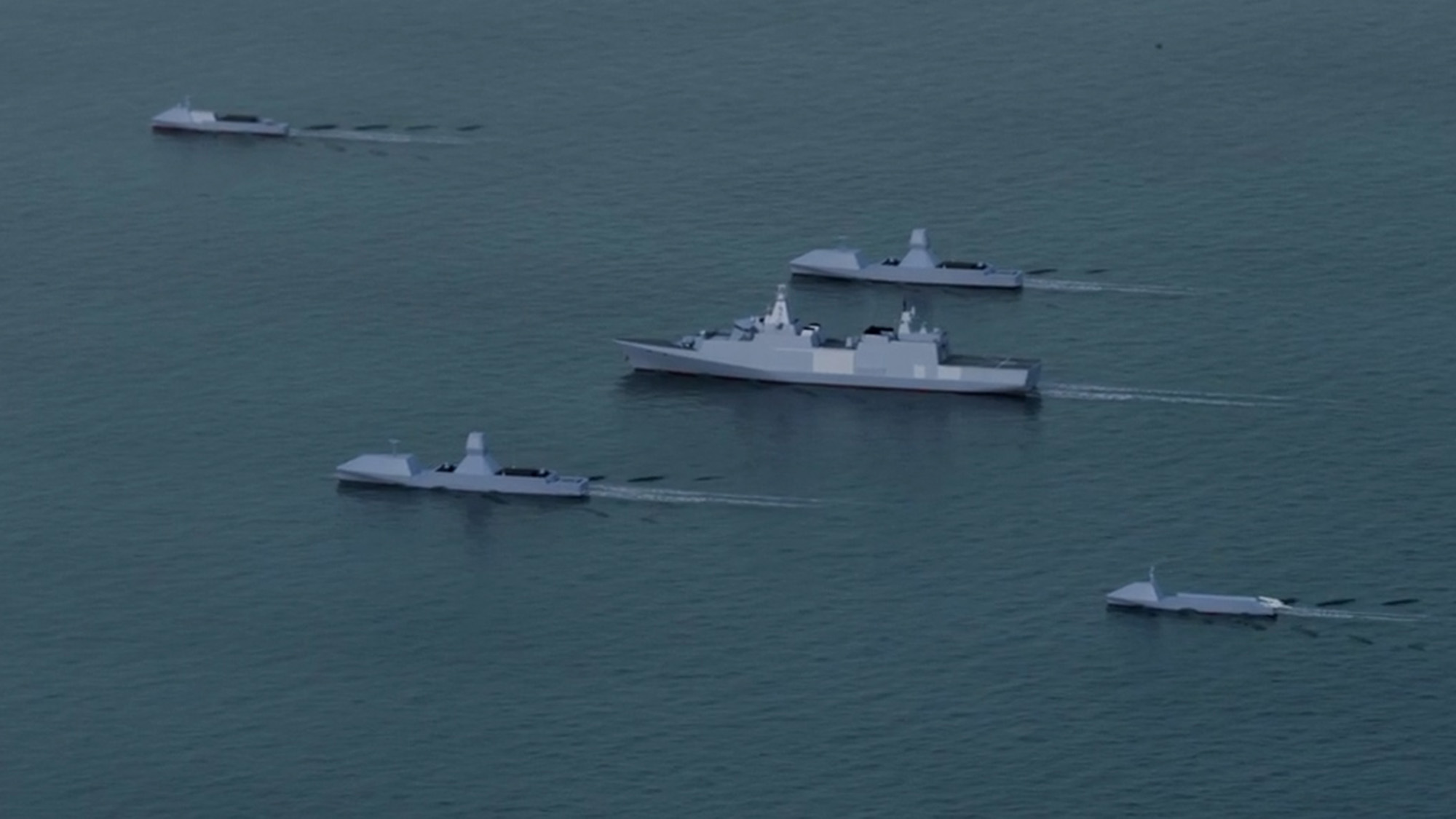
A concept pairing Royal Navy frigates with unmanned surface vessels has been given fresh detail during a recent industry briefing, with HII executive Eric Chewning expanding on this with the UK Defence Journal.
The partnership between Huntington Ingalls Industries and Babcock isn’t new, and neither is the ARMOR Force concept itself, which Babcock has outlined before, but the information provides a glimpse into current thinking.
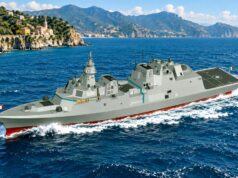
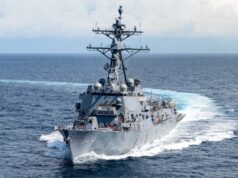
Chewning described ARMOR Force, standing for Autonomous Robotic Maritime Operational Response Force, as centring on combining crewed warships with groups of autonomous systems operating in coordination. “The idea there is taking a Type 31 frigate, at which Babcock produces the Arrowhead 140, and then pairing that frigate up with a squadron of Romulus USVs,” Chewning said.
He added that the unmanned vessels would carry modular payload systems. “Babcock calls them pods, but it’s the same concept of containerised capability… the Romuluses are able to operate in coordination… working with the Type 31.”
In this kind of setup the frigate would essentially act as a command node while unmanned vessels push sensors, payloads or potentially weapons further forward into more contested areas, extending the reach of the crewed ship without putting more sailors at risk.
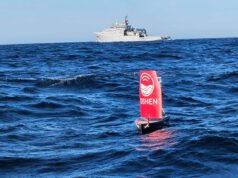
Duane Fotheringham, president of unmanned systems at HII, said the Romulus platform is intended to operate ahead of crewed ships. “We see the Romulus USV… being a manned, unmanned teaming partner with frigates, able to put the USVs further into the contested environments and support the frigate.”
No specific timelines, trials or contracted activity linked to the UK were mentioned during the briefing, but the comments do give a reasonable indication of how the existing industrial relationship between the two firms is being applied to future force design questions. The concept sits broadly in line with thinking from the First Sea Lord around a “hybrid fleet” mixing traditional warships with autonomous platforms, and similar approaches are being pursued by the U.S. Navy, pointing to some degree of convergence in how allied navies are approaching distributed maritime operations.




I don’t know why a clever company like Babcock would be jumping in to such an obvious dead end as working with a US defence contractor famed for massive costs and budget over runs that no one in Europe will want to touch.
It all sounds dandy but I don’t know how these USVs operate in anything other than a mild sea state. Who is going to chip crusted salt off the radar array, who is going to give the jammed missile hatch a nudge and who is going to tinker with the engine? How long can a USV stay on station mid Atlantic? They will either have to exceedingly reliable or require recovery and servicing, possibly at sea.
And all the dollars spent on these things which can go into a manned ship more fully or even building a ship to a higher spec. There might be need a tender type ship to store, refuel and maintain all these drone type ships on long patrols?
Wouldn’t an extra T26 and or 4-5 more T31s suffice to give the fleet enough surface capacity? Are these ship paired drones actually necessary?
Precisely my thoughts too. We are better off increasing T26 and T31 numbers and infilling with T91 lean manned Trimaran hulled ships.
Same principle, with containerised mission loads, but with a 12 man crew.
I would suggest a fully capable unmanned platform, is going to be extremely complex, probably more expensive than a lean manned ship.
We need fewer US collaborations, not more – the US is moving away from ally status to unreliable neutral at best.
I’d say the US military and industry is as ally friendly as they always been. Its just the crap that’s coming out of the presidents mouth that suggests otherwise. He may change his tune after the midterms.
Where there is a large amount of money to be made they are very allied friendly, until the village idiot (or his successor) kicks his toys out of the pram.
Whether partnering with a company that has zero experience in actual combat with drones, just theoretical models and profit projections is a good idea, I an not so certain about.
Yes while those we are dealing with seem to remain sane and reasonably reliable it’s best to, though with caution mind, continue some level of cooperation. Nothing much is going to be set in concrete before at least the mid terms later this year anyway and companies and the Govt can re assess thereafter when hopefully he will be at least semi cut off at the knees. The danger however will be if Trump truly loses it after such a humiliation and effectively brings everything down around him like a pack of cards. In that scenario we can put on hold or pull out of the ground work now being done to enable these potential cooperations.
However I would agree that wherever possible we should look to cooperate elsewhere but little point at this juncture of cutting off noses to spite our face, as much as I would love to we can’t simply banish America and options need to be kept open at some level.
But what we need to do is insure is sovereign control.. essentially if they cannot be upgraded, maintained or replaced under full UK sovereign control then they are not a good idea..
That’s fully accessible UK IP.. so Huntington Ingalls Industries sets up a UK subsidiary with uk ip, maintenance ans update hub set up in the uk…. And hell help them set up their own UK yard.
While I agree with you in principle, we aren’t capable of handling the maintenance of current vessels at the moment. So I imagine the rush to acquire new uncrewed vessels will inevitably come with outsourced maintenance as part of a package. How long would it take for HII to set up a yard in the UK, and what guarantees of further work would we have to commt to, to get them to agree to it? Might we head for some kind of TOBA problems, like with Govan, and we end up overpaying HII maintenance in the future? It’s not simple. The temptation to just package up foreign purchases with foreign maintenance and have done, might be too much.
If Trump gets a kicking at the midterms, you can pretty much guarantee he will cry election rigging and fake news.
Britain is the unreliable ally , just looking at Royal Navy and British Army tells that and gives reason to Trump.
But the issue behind it is cultural. UK is managing decline at best comiting suicide at worst, has no pride. Except perhaps the NHS.
What nonsense you write.
I presented facts that show Britain don’t respect the NATO alliance it belongs to. Yes i am aware that there are others Euro countries like that also, but none had such a cliff in military capability.
Romuluses or Romulans?
I’ve gained $17,240 only within four weeks by comfortably working part-time from home. Immediately when I had lost my last business, I was very troubled and thankfully I’ve located this project now in this way I’m in a position to receive thousand USD directly from home. Each individual certainly can do this easy work & make more greenbacks online by visiting
following website—.,.,.,.,.—>>> JobatHome1.Com
Whilst this looks good on the surface – quantum computing and AI may render this useless unless we can come up with some sort of super encryption
the west is not necessarily winning the race to Quantum and Russia is excellent at encryption.
Ukraine has also showed how blocking drones has made tethering the preferred solution. at this point in time everything is pointing to autonomous solutions having limited value in an actual war situation.
Am sure they are onto this – but it does make me nervous and I think all warships should have analogue backups as standard