

The Ministry of Defence has been engaging with private sector partners including the telecoms industry to discuss the threat posed to undersea telecommunications infrastructure by Russian sub-threshold interference, Armed Forces Minister Al Carns confirmed in a parliamentary answer on 22 April.
Asked by Conservative MP Ben Obese-Jecty what discussions the Defence Secretary had held with the telecoms industry on countering the threat, Carns said the MoD was *”committed to a collaborative approach between government and private sector to work together on national resilience”, adding that the Defence Secretary had engaged with industry as part of “a broader effort to protect critical national infrastructure from a range of threats, including Russian sub-threshold interference.”
Carns confirmed the work sits alongside the Secretary of State for Science, Innovation and Technology’s lead on telecoms security, suggesting a cross-government approach to what has become one of the most prominent infrastructure security concerns facing the UK.
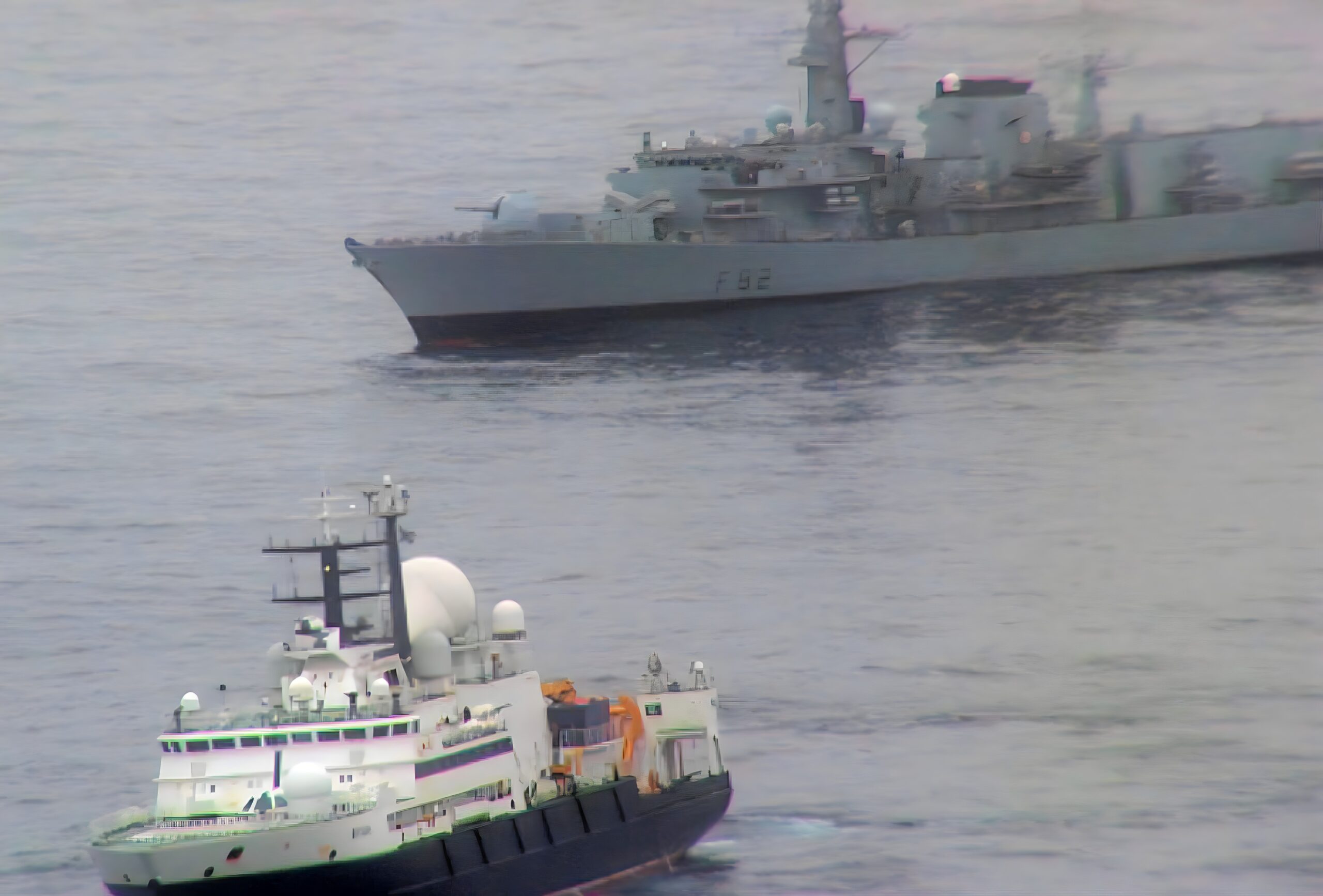
The parliamentary answer comes less than two weeks after Defence Secretary John Healey revealed that the Royal Navy had spent more than a month tracking a Russian attack submarine and two spy submarines operating near undersea cable infrastructure north of the UK, forcing all three vessels to return to their bases, with Healey warning that “any attempt to damage them will not be tolerated and will have serious consequences.”
The same Russian spy vessel Yantar had previously been tracked loitering over UK offshore cables in January, with Healey describing the broader Russian programme as one specifically designed to survey underwater infrastructure during peacetime and sabotage it in conflict.
The threat has been building for some time, with a series of cable severings in the Baltic Sea in late 2024 raising alarm across NATO member states, and the UK having launched the Atlantic Bastion programme to develop a combination of autonomous vessels, advanced sensors and naval assets specifically to counter Russian undersea activity.










Why don’t we just close the Channel so that “workers” in hi-viz can dig bloody big oles and bury them like we do on our roads and pavements (sidewalks for our American contingent) Easy Diversion around the top of Pictland. (especially for rubber boats).
Shouldn’t take more than 1000 years.
Then when the Channel Is finished, we could start on the Baltic, Bristol Channel and maybe North Atlantic.
Sort of like HS2 for Internet Traffic
“Dig baby Dig”.
Lol as always….just hush and get in line for your bird flu jab. Captain Project Fear knows best. Trust government like wot l do.
Mate… I’m suffering with Swine Flu at the moment, got It after recovery, dosed up to the hilt and sneezing like a twatttt, nearly 4 weeks and counting.
“In Labour, we trust”.
Get better soon mate. We old sweats are going to the Suwalki Gap. Apparently less than half of the youth benefit queen’s will fight Ivan. I love our government and Starmer is being set up…..
Let me at him !
Ok, the American contingent is highly amused. Thanks for the laugh.
More drivel driven by the need to be seen as “taking action”. When it kicks off, and it will, send these windbags over the top first. Anyone with any level of intelligence, including the amoeba community, can see and smell government bull crap before it emerges…. No one, well not one person in my varied and socially diverse circle believes anything sourced from “government”.
With apologies to the amoeba community as I do not count you as part of my “circle”.
ps Message me and earn $4000 an hour, no risks, no upfront.
Lol.
PFFT, $4000 ? , I wouldn’t leave the Dole Queue for that.
OK, inbox me for enhanced benefits scrounger pack.
This could be an example similar to fisheries where a small charge could be levied on any pipelines or cables transiting the UK EEZ. Just like with fisheries the funds could be used to pay for a small squadron specifically dedicated to sea bed warfare in the Atlantic. Given the value of these cables the charge would be tiny.
How about deploying static sensor arrays/sonars parallel to the cable locations?
These could be monitored 24/7 from land.
Who knows what is already at these locations.
We wont.
But It’s tens of thousands of miles of cables, no way on earth or below the Sea, we could monitor all that and If we did, then what ? send a River ?
…_ _ _…
(that’s SOS for the uneducated digital age Phone Zombie types on here) 🤦♂️🥱😁 (that’s for Spock)
It could be done for connections to Europe and Ireland.
Transatlantic cables you could only partially monitor (closer to shore).
If a military response was intended, then sending a P8 would be better than a River class
Sounds easy yet we can barely monitor an airfield perimeter on land, let alone tens of thousands of miles (KM’s X 1.62) of under sea cables.
From the sounds of the account last week from the aborted Russian mission we already seem to have undisclosed capabilities on the sea bed. Proteus remained in harbour but we cleared the sea bed the Russians had been working on.
Ha.
Well that’s a rather well embellished version of events, by all accounts.
Have you a link so we can see what went on ?
Research on fibre optic cables has shown that these cables themselves are viable sensors for geological and kinetic (anchors) effects so with appropriate funding can move from lab experiments to operational sensors. Provided that the fibre is contiguous they work as sensors using equipment at either end. Because many cables aren’t a contiguous fibre but sections bridged together (fine for data), the bridges within the cable would need upgrades to function as sensors. So this is more than firmware updates rather bridge unit replacement and who knows if or when that’s planned. Again with funding anything is possible. Both telcos and defence have skin in this game. Reliability engineering and business continuity measures are required to assure a robust service level.
Wishing George and happy St George’s Day 😀
I started this as a simple side hustle, and last month I made a little over $6,137 just working a few hours a day from my phone. If you want to check out how it works, the website has all the details.
Here—>> http://www.giftpay7.vip