

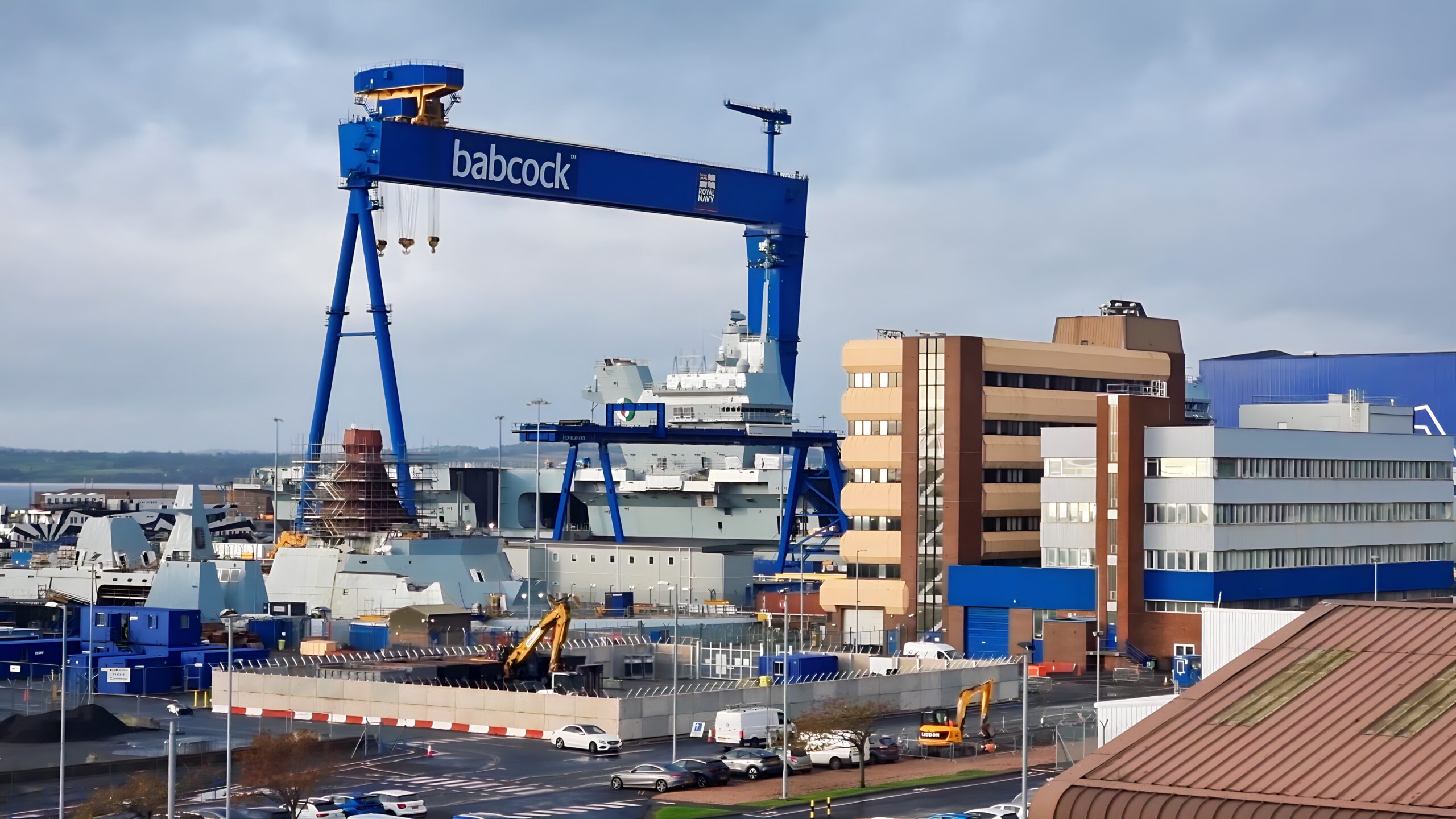
A coordinated attack on the UK’s subsea infrastructure could cause economic disruption on a scale comparable to the COVID-19 pandemic, potentially totalling hundreds of billions of pounds, Babcock has warned in written evidence submitted to the Defence Committee’s Defence in the High North inquiry.
The company, the second largest supplier to the Ministry of Defence, told the committee that around 95 per cent of UK goods by volume move by sea and that subsea cables underpin tens of billions of pounds of economic activity annually, making the threat of grey-zone disruption to cables, pipelines and trade routes a national priority issue that had not received adequate policy attention.
Babcock’s submission describes the High North as “a central geographic pillar of UK security” that “functions as the country’s northern buffer, the point from which threats, including Russian aircraft, submarines, and long-range strike capabilities, approach UK territory via air and sea” and warns that “a co-ordinated campaign targeting subsea infrastructure could cause economic disruption on a scale comparable to COVID-19, potentially totalling hundreds of billions of pounds.”
On the state of UK capability, the submission is blunt, warning that “the UK lacks the necessary mass in escorts, amphibious lift, maritime patrol aircraft, and submarines to conduct sustained operations in the region while meeting global commitments” and that “planned fleet expansion through the Type 26, Type 31, and future naval programmes will not resolve these gaps until the mid-2030s.” The submission notes that the UK’s escort fleet has shrunk, limiting the country’s ability to meet simultaneous commitments in the High North, the Baltic and the Middle East, and risks “undermining the credibility of UK leadership within NATO and the Joint Expeditionary Force.”
The submission identifies a significant gap between policy ambition and delivery, saying that while concepts such as Atlantic Bastion, Atlantic Shield and Atlantic Strike are “strategically coherent, the challenge lies in delivery, with key elements still uncontracted or delayed within the procurement pipeline” and that “a significant say-do gap has emerged between policy announcements and the placement of contracts necessary to realise them.”
Personnel shortages are identified as a further constraint, with the submission noting that several Royal Fleet Auxiliary vessels remain in reduced readiness and that both UK aircraft carriers are unable to be fully crewed simultaneously, saying this “combination of platform shortages and personnel deficits limits operational agility and the UK’s ability to maintain persistent High North presence.”
On export opportunities, Babcock reveals that Saab has publicly endorsed its Arrowhead 120 proposal for Sweden’s forthcoming Luleå-class surface combatant programme, saying the partnership “demonstrates both the strong confidence placed in UK naval design excellence and the significant potential for deepened industrial collaboration with key High North partners.” The submission also references Babcock’s partnership with Finnish company Patria to offer a UK-built version of the Patria 6×6 armoured vehicle to the British Army, and notes the UK’s accession to the Common Armoured Vehicle System programme in September 2025.
The submission warns that policy delays risk undermining export success, saying that “delays in UK procurement and industrial policy risk constraining the sector’s ability to scale, threatening both export success and the UK’s long-term strategic influence in the region” and calling for a more integrated whole-of-government approach to exports supported by prompt procurement decisions and a predictable industrial pipeline.
On the Skynet satellite constellation, which Babcock operates, the submission flags that existing satellite coverage is not optimised for Arctic latitudes, adding communications to the list of capability gaps that would need to be addressed for sustained High North operations.
The submission concludes that while the UK’s strategic intent is sound, “the gap between ambition and deliverable capability is widening and the connective tissue between intent and delivery is missing.”





Totally agree, although that ‘planned expansion’ is probably insufficient.
Ideal task for drones such as Cetus to patrol and protect or undersea cables I wonder how fast they can be built and a very big number counted in the fleet inventory forward based all over the globe id expect that a weaponised version will be produced.
Agreed. A system of both surface and subsea drones on regular patrol would be very useful. However, I would say these would be needed for routine monitoring – manned systems are more flexible and better able to adjust to changed circumstances. We need those unmanned systems as well as, not instead of, increased manned units.
BBC Scotland now reporting both on TV and on-line on unidentified drones (with lights) appearing around rigs in the North Sea over the last 18 months.
Money hungry people suggest an attack can happen and an attack will happen. These rich people need to stop giving attackers ideas
I’ve gained $17,240 only within four weeks by comfortably working part-time from home. Immediately when I had lost my last business, I was very troubled and thankfully I’ve located this project now in this way I’m in a position to receive thousand USD directly from home. Each individual certainly can do this easy work & make more greenbacks online by visiting
following website—.,.,.,.,.—>>> JobatHome1.Com
Unfortunately, Putin thinks he is at war ALREADY with NATO. He is especially hostile to the UK over aid to Ukraine. The undersea cables are a very easy target and he seems to be probing these…the RN simply does not have enough assets currently.