

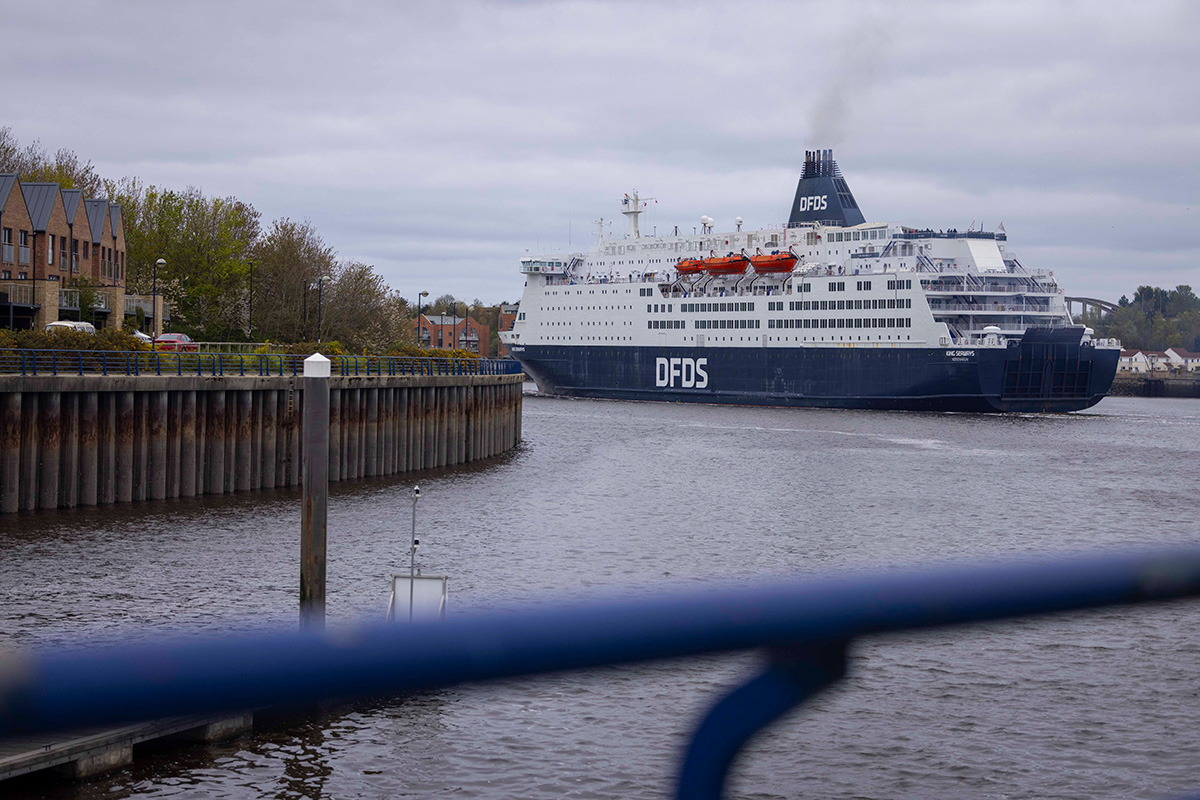
More than 1,400 British soldiers have boarded a chartered civilian passenger ferry to travel to a major military exercise in Germany, the first time the British Army has used civilian sea transport on this scale in over two decades.
The troops, drawn from the 7th Light Mechanised Brigade, known as the Desert Rats, sailed from Newcastle on the King Seaways, a ferry operated by DFDS, before continuing by rail through the Netherlands to Germany, where they will join hundreds of French soldiers from the 13th Demi Brigade of the Foreign Legion for Exercise Rhino Storm.
Lieutenant Lucas Handyside from 7 Brigade said the deployment demonstrated the brigade’s ability to move by multiple means, saying “7 Brigade is deploying more than 3,000 soldiers and 900 military vehicles to Exercise Rhino Storm which has offered us the opportunity to prove a range of deployment methods both military and civilian” and that “Exercise Rhino Storm demonstrates that the Desert Rats can deploy by road, rail, sea and air.”
He added that “as a Light Mechanised Brigade, it is incredibly important that we are able to rapidly and reliably respond to threats anywhere in the world, and testing this capability has been an integral part of the exercise” and that the exercise was “designed to challenge the Brigade at all levels and will provide a realistic scenario to bring together the Brigade’s fighting units and supporting elements.”
The use of a chartered civilian ferry to move troops at scale has practical significance beyond the exercise itself, demonstrating how the Army can draw on civilian infrastructure to supplement military transport capacity during a major deployment to Europe. Transporting 1,400 troops by air would require at least seven RAF Voyager aircraft plus additional flights for equipment, making civilian sea transport a significant force multiplication option for large-scale operations.
Brigadier Andrew Watson, Officer Commanding 7th Light Mechanised Brigade, said the exercise “proves we are ready to deliver credible combat power at scale as part of NATO’s Advanced Readiness Force” and described it as being “about moving a brigade quickly and efficiently, just as we would in real operations”, adding that it “sends a clear message that the British Army can project force rapidly and work closely with our NATO allies.”
Exercise Rhino Storm forms part of the wider NATO Steadfast Defender 27 series, which tests the ability to deploy forces rapidly across Europe, with the Desert Rats’ deployment alongside French Foreign Legion units reflecting the multinational character of NATO’s collective defence posture on the continent.
The use of civilian vessels for military transport has a long history in British military operations, including the evacuation at Dunkirk, the D-Day landings, the Falklands War, Bosnia, Kosovo and the Iraq War in 2003, and the current exercise represents a deliberate effort to demonstrate that this capability remains viable and practised for large-scale operations if required.




… and it gives the lads a chance to grab some Duty Free too (luverly jubbly ☺️)
I’ve gained $17,240 only within four weeks by comfortably working part-time from home. Immediately when I had lost my last business, I was very troubled and thankfully I’ve located this project now in this way I’m in a position to receive thousand USD directly from home. Each individual certainly can do this easy work & make more greenbacks online by visiting
following website—.,.,.,.,.—>>> JobatHome1.Com
The media is trying to make some big deal of this, seems like a sensible idea to me. No need to keep a dedicated military pool of car ferries, much better to use UK ferries that can be taken up from trade if needed in a war scenario.
We have always done this and every British army in the 2oth century that crossed the channel did so on commercial ferries.
We should do something similar with trains and practice running direct services down the east and West Coast mainline into the channel tunnel. Freight trains can do it so no reason passenger trains can’t also do it.
The Chinese have a lot of duel use RORO ferries… infact most of their new large RORO ferries are duel use civilian military.. they have huge great heli pads on the top.. mil spec vehicle lanes.. they even practice lowering the stern ramp and driving amphibious assault vehicles straight from the vehicle lanes into the seas and then onto beach assaults.. essentially turning a RoRo ferry into a first leave amphibious vessel.
To be fair the RN maintains some Roro ferries on contract via the points.
That’s a very good point actually.. and shows the real benefits of that type of contract. Although if we were being really switched on they would have all the highland and island RoRos as duel use design as well as the Channel RoRos ( have a shared agreement with France on usage and jointly fund them to be a NATO resource).
No pun intended? I think the issue is more that given the size of the Army now, the points realistically are all the strategic life we realistically need on any sort of regular level, so the drive to use Channel RoRos is not really something innate.
That’s a good point, but if I was planning a war.. one of the easy peasy things I would do is just kill all the points.. just ram a tanker or some such into each of them on day mins 1.. they are valid targets as contracted government ships.
I think we need to have a mindset that we are going to loss a lot of our special toys and what’s plan B and C..
Agreed. For UK to Europe transfer.
The issue with the trains is UK loading gauge, British trains can’t carry Challenger for example, and a lot of European Freight cars can’t run on British Rail lines (same for Passenger trains btw). This is why Eurostar is effectively limited to HS-1 now (also why not building the HS-2-HS-1 Link was foolish).
The British Army is also slightly allergic to trains for day to day taskings for reasons I suspect have to do with the IRA. Most camps used to have railway connections and their own stations, some effectively still do; Lympstone for example has a dedicated passenger station. But for the most part they are, for example like Aldershot, disused, or ripped up like they’ve been in Bulford, and Tidworth (Tidworth’s old military station is now a Tesco Superstore)
At least Lugdershall is maintained, there looks to be a loading ramp there?
I smiled at your Aldershot reference, passed there many times including on the ground out on track one time in my railway career, shadowing a MoM.
It’s all fallen into disuse as you say, but the MoM ( Mobile Operations Manager ) explained how parts have been retained should it need to be reinstated.
If I recall it went into St Omar or Buller Bks?
Yes, I think Lugdershall is in use for both Tidworth and Bulford, but, especially for Bulford it’s a road move away anyway, plus the afore mentioned loading gauge issues means I don’t think it sees that much use? Could be wrong though.
It’s Ordenance Barracks in Aldershot that has the Branch/Spur, techincally I guess since the remaining track is outside the wire. But the 400m ROW is pretty much all that’s left. There’s maybe 50m of track at the freight station still in situe, but it doesn’t connect to the Aldershot mainline, and any platforms or loading ramps are long gone.
Thanks.
I must speak to my mate the MoM who can give any updates here as he walks that track.
Railmaps online shows how things once were
I use Open Railway Map because it has more data outside the UK and helps see electrification etc but same thing really.
Practicing running trains is a good idea. I think all the private/commercial operators could use the practice too! You can’t turn up to a war late and all that.
Rent 5 Paint them grey and you have the MRSS…. 5 billion saved… and they could have them sorted in a few month.. weld some .50cal MGs on and job done.
Plus Phalanx’s, LMM, Terrahawk and a heli pad….
Far too expensive and gold plated for the treasury to sign off 🤣😂
Thought I’d give it a try! 😆
Enjoy reading all your very detailed posts BTW.
x 2
Look back to the 1970s-80s
Britain’s largest military exercise in a decade at the time, featuring 10,000 regular troops and 20,000 Army Reserve soldiers moving from the UK to West Germany.
Objective: To reinforce the British Army of the Rhine (BAOR) to test national mobilization and logistical support. moving 20000 then TAVR now rebranded Army Reserve troops + 10000 regular troops from UK to North German Plain.
This was done by Civilian RORO ships. RAF VC10 Aircraft. and by Road and trains. Reinforcements from UK to BAOR.
2026. Moving 1400 troops by sea should be a piece of cake.
The state the Tory Governments of 14 years has left the nation and its armed forces in. IMO, its going to take who ever is in Government 10 years plus to rebuild UK military. If we have that long?.
I suppose it’s all good planning – training to move the British Troops. IMO only. UK needs to build-up its regular heavy and light infantry to about 55000 with all the supporting arms – Artillery. Mix of tracked & wheeled APC. Tanks. Engineers and Helicopters -Trucks etc for light infantry.
Just my thoughts on subject.
Russian invasion of Ukrainian sovereign territory on NATO border is IMO a wake up call to strengthen British conventional military.
Remember using a civilian ferry for a large scale NATO exercise back in 1988 when I was in the Royal Marines, even though we still had the Landing Ships, Fearless and Intrepid in those days. We enjoyed all the advantages of the “Dana Regina” for the full 3 weeks we were at sea, the troops lived it, great food and a Bar at nights, oh happy days.
I also remember taking part in these large NATO-BAOR exercises many moons ago. When Europe was divided and Russia (USSR) Built a fence with mine fields. dogs and guard towers along it. the Iron curtain. In Berlin, a wall to divide the city was built in 1961 by the Russians/East Germans. We faced the Warsaw Pact Forces then. We face the ruthless Russian dictator now.
In the 1970s, Tyrant Dictator Putin was stationed in East Berlin-Germany as a young KGB Officer ending up a Lt Colonel. Putin is a product of the USSR – cold war. IMO Putin wants to rebuild some of the Soviet Empire, Starting with Ukraine at any cost, Human-Financial. Dictators can do that sort of thing.
Hi Gemma
This generation need to wake up to the danger from Russia, Britain is seen as public enemy number one and Putin would not need much encouragement to cause serious damage to our way of life. Like yourself I recall the state of the world in the 1980s where the world was close to Nuclear confrontation on a few occasions, mostly due to misunderstandings and miscommunications, from my part we were tasked with defending the Northern flank from any Soviet movement. Norway is a group of islands joined by bridges and every one of these bridges had explosives placed in strategic position to bring them down to stall Russian troop movements. We are potentially getting back to that stage now. Going back to original point about using civilian ferries, remember that during the Falklands campaign civilian ships such as QU2 and the Canberra wee used as troop carriers
I find this just a show off. With risk averse inculture in UK there is no chance this will happen ever against a peer enemy.
It all seems a bit short-sighted now, withdrawing British Forces Germany back to UK.
Given that there is no effective counter to Rus ssn activity, would you really put all your eggs in one basket crossing the North Sea AND, moving into Holland when they could have gone direct to Germany and enjoyed the benefit of no cross border movement.
NATO and the EU are working to remove those barriers but they still exist and more pressure needs to be put on EU MS to negate any hinderance on cross border movement of NATO forces.
Gauge widening is now available through to Barking Euro-Terminal but that is a long way from the Chally fleet, however, a light mech should have had no problem rolling from oop north to Germany through the Chunnel.
While I am encouraged that this is practised, it can only be done in the transition to war. The survivability, damage control capacity and damaged stability of a civilian ferry fall short of what is required for a ship expecting to be attacked.
Why have they not used the Point Class ships? These were under long term charter and were regularly used. Has the charter ceased?
Are they not RORO transporters rather than ferries for large numbers of troops?
No.
All in use at the moment and well worth the money, never still for long 1.Anvil Point on way back from Faulklands 2. Eddystone in refit in Denmark 3. Hartland Point passing the Bahamas 4. Hurst Point at Marchwood near Southampton only problem they are Ro Ro not passenger ferries. Its interesting following them on vesselFinder.com
Some Camouflage paint them it will luck the part. 🤗
No different to the RAF using Antanov 124 (or other chartered Aircraft) for big lifts and exercises when moving a significant amount of equipment.
This summarises how far defence has fallen. The RFA were able to move the army and its equipment to and from Germany with the LSL’s and Two RORO’ s however with 20 years of under investment there are now only 3 LSDA’s and a workforce of about 1600 sailors. Something had to be done to rebuild the RFA the biggest YK employer of British seamen. We are an island and need to ensure we do not rely on non UK mariners! Defence need there own methods of logistics support which means invest now. The RFA may have 3 FSS vessels by 2032 but no one is looking at Replacements for Tides and the LSDA’s need confirmation the they will be replaced with a suitable number and although discussions are underway as to a multi purpose amphibious vessel to replace them and Argus plus Albion and Bulwark there is no order and time is running out. Come on Starmer get you act together!!!!