

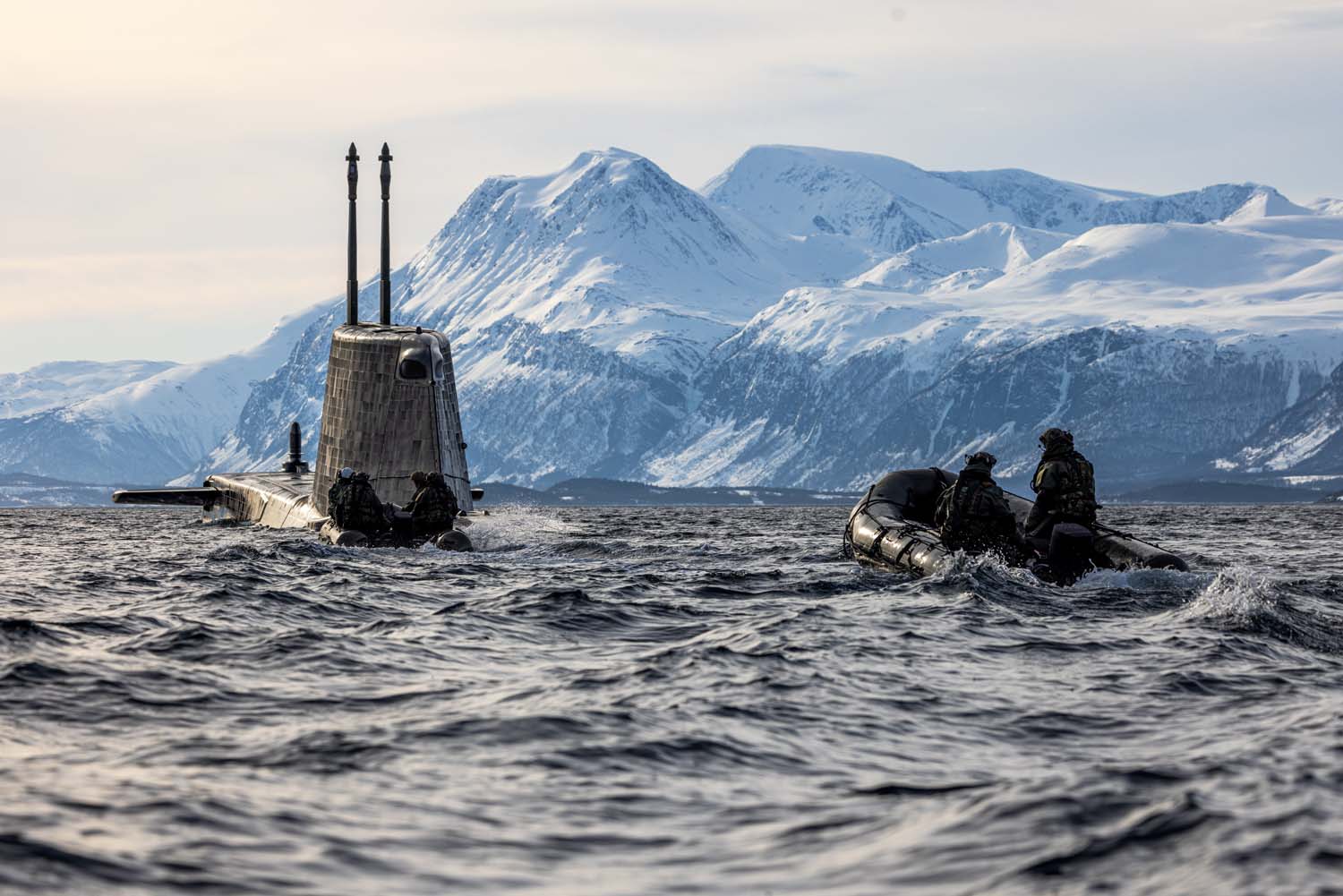
The UK risks being unable to fulfil its leadership role in the High North while simultaneously meeting its other NATO commitments, a senior Atlantic Council analyst has warned in written evidence to the Defence Committee’s Defence in the High North inquiry, raising questions about whether the UK has the readiness, mass and enabling capacity to sustain its ambitions in the region.
Dr Anna Wieslander, Director for Northern Europe at the Atlantic Council and Head of its Northern Europe Office in Stockholm, told the committee that some defence analysts argued the UK risked strategic overcommitment, assessing that it could not simultaneously lead the JEF, meet NATO war plan commitments for major land reinforcement and sustain its nuclear deterrent under existing defence investment plans, and that the current British Army would struggle to deploy even one division quickly.
The same concern emerged from the UK’s response to drone threats against its own bases, with Wieslander noting that limited quantities and availability of key air defence and maritime assets had constrained the speed and scale of UK action, illustrating what she described as a wider capacity ceiling that could also affect the UK’s ability to surge and sustain forces for the High North alongside other commitments.
On Russia, Wieslander described its High North posture as enduring and strategic, noting that even where Russia’s ground capabilities had been affected by the war in Ukraine, its naval, air and nuclear-linked interests and infrastructure in the north remained central and could be rebuilt over time. She quoted the UK Defence Secretary’s description of Russia in February 2026 as the greatest threat to Arctic and High North security since the Cold War, and pointed to the departure of the ballistic missile submarine Knyaz Vladimir from the Kola Peninsula for patrol in March 2026 as an example of Russia continuing to operate strategically relevant assets from the region.
On the UK’s policy framework, Wieslander described the Atlantic Bastion concept as framed around a connected approach to North Atlantic security including counter-submarine tasks and undersea infrastructure protection, but questioned how explicitly it was connected to High North requirements and NATO activity, and whether ends, ways and means were stated clearly. She noted that achievability depended on prioritisation, pointing to Cold Response 2026 where a planned US F-35 squadron was withdrawn as an illustration of how competing contingencies could affect availability even during high-priority northern exercises.
Critical undersea infrastructure protection is identified as a core High North deterrence task that should be integrated into allied planning and operations, with Wieslander calling for monitoring, attribution and response coordination to be treated as military priorities rather than regulatory ones. She also called for escalation management frameworks to be treated as a priority given the increased pace of allied and Russian activity in the region, saying a more continuous pattern of deterrence postures, surveillance and infrastructure security interactions was raising the risk of incidents and misperception.
On the JEF, Wieslander said it added most value when complementary to NATO plans and timelines, interoperable with allied command, control and ISR sharing, and deconflicted to avoid parallel initiatives that could complicate signalling and escalation management. She called for a clear first-mover role to be defined for the JEF with a structured transition into NATO command arrangements, and questioned whether JEF activity and NATO’s Arctic Sentry coordination were integrated in practice, particularly in the early phase of contingencies.



Just drop other NATO commitments then, plenty of other big militaries in NATO. We need to focus on the North and nuclear weapons and we have no need to deploy more than one division. European NATO has 20 divisions it can deploy in a month. Even if we double our deployable divisions from 1 to 2 then we are adding in an extra 5% to any European force.
I’m not sure if any of those experts have looked at a map but Russia only boarders NATO in the Baltic and Finland. The North is the only thing that ENATO hs to be worry about now Ukraine wiped out the Black Sea fleet.
It also borders Alaska. In the Bering Strait, the closest points are the Diomede Islands, just 2.4 miles (3.8 km) apart, with Big Diomede (Russia) and Little Diomede (USA) separating the two countries.
I’ve gained $17,240 only within four weeks by comfortably working part-time from home. Immediately when I had lost my last business, I was very troubled and thankfully I’ve located this project now in this way I’m in a position to receive thousand USD directly from home. Each individual certainly can do this easy work & make more greenbacks online by visiting
following website—.,.,.,.,.—>>> JobatHome1.Com
‘…evidence of cooperation between pro-Russian Poles and a Moscow-based government fund… This is the so-called Pravfond, which, since its inception 14 years ago, has awarded…(millions) to beneficiaries in Europe’
Russian armoured formations cross its border with Poland and seize the Suwalki corridor, triggering NATO Article 5. Russian vessels from Kaliningrad also mine the Baltic approaches cutting off the Baltic States by land and sea. Meanwhile Russian supported political parties seize power in Poland on the back of widespread anti EU anti Ukraine sentiment.
CDS in Whitehall looks in his safe for the relevant contingency plan.
What is that plan?
Of course theres no mass. We have 1 SSN somewhere East of Suez, and a slack handful of escorts. Thats it.
Of course commentators on here think we can use them in the high North, down in the Falklands and East of Suez simultaniously.
Talk about stating the bleeding obvious…
I wonder how much it cost to have an analyst state the bleedin obvious?
Just the royal navy⬇️
*List includes potentials and obviously not all concurrent, not in any order.
1. Assist border protection and help local police/border maintain law and order.
2. UK homeland defence.
3. Exclusive economic zone and fishery protection, UK and British overseas territory.
4. Anti piracy missions (horn of africa etc).
5. Freedom of navigation missions (Taiwan straight, Hormuz).
6. Protection of UK assets and the British overseas territory.
7. The Continuous At-Sea Deterrent (CASD).
8. Hydrography surveillance.
9. Carrier at sea deployment.
10. All other existing navy taskings.
11. Some form of littoral response group.
12. Training missions home and abroad.
13. Diplomatic missions.
14. Maintain the UK nuclear weapons.
15. Royal Marines.
16. FAA.
Anything else I missed?
The point being that is just the royal navy, if we have to provide something into the high north we are very limited because Westminster seem to operate outside the reality bubble and without any additional funding we are struggling to maintain our existing commitments.
The DSC has no teeth. Tell this to ministers in camera and see them put fingers in ears while talking of so many %
Scum.
We already know this, over commited while most of our kit is brocken or we simply do not have the ki,t state normal. Grand statements by fools adding more things to do with out any more money, more kit or more personnel. Thats what you get when the MOD and military are out of touch with reality and full of deluded yes men.
Yes she is right, and yes we should be doing something about it,
Speed up delivery of the T26’s and T31’s and ordering more would help,
Speed up the rebuilding of the docking facilities for the SSN’s and SSBN’s would help,
Reinstate our amphibious fleet, would help
Get the RFA working correctly with the guys getting the right amount of pay and the shipping they need would help,
More anti submarine aircraft for the RAF along side more aircraft in general would help,
At least 3 armoured divisions would help.
But is there any one in parliment willing to push even a small amount of this agenda forward, I think not. So we have to hold our heads in shame and watch our once grate kingdom vanish into the pages of history.
Will no one listen to the Prime Minister? For Gods sake we are increasing defence spending more quickly than at any time since the end of the Cold War or was it the Cod War. Sir Kier Starmer an ex QC and peer of the realm has told you time and again everything is fantastic so stop worrying, be happy all will be well. Or he could just be a lying two faced bluster merchant allowing our defences to continue to be eroded so as to give people with a headache disability benefit for life, who knows. I am going to emigrate to the Falklands its much safer there big Al Carns has promised.