

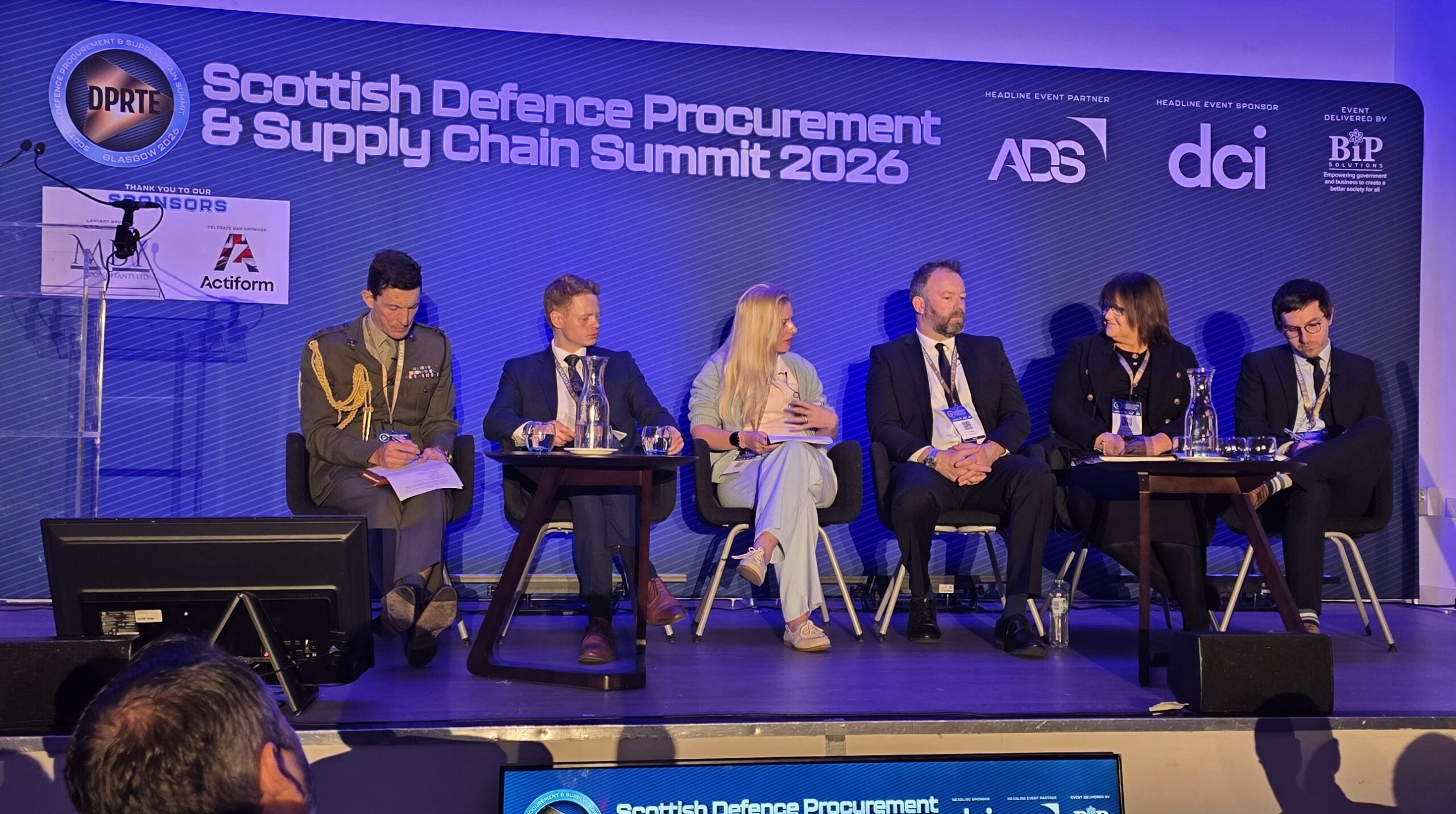
Senior representatives from Leonardo and Thales used a panel session at the Scottish Defence Procurement and Supply Chain Summit in Glasgow to set out new initiatives designed to improve SME access to their supply chains, as the defence industry grappled with how to turn increased government investment into genuine opportunity for smaller firms.
The session, titled Defence as an Engine for Scottish Prosperity, brought together the MoD, Scottish Enterprise, Leonardo, Thales, and the Royal Navy’s Naval Regional Commander for Scotland and Northern Ireland, Brigadier Andrew Muddiman. The panel was moderated by Emma Baker, Senior Defence Policy Adviser at ADS Group.
Muddiman set the operational context, describing vastly increased levels of Russian activity in the North Atlantic and UK territorial waters. “We have seen on a number of occasions in the past year the presence of Russian forces in areas and in numbers that would five years ago have been unthinkable. We are in a completely different paradigm.”
He said the Royal Navy needed to be ready to fight a peer adversary by 2029, and that achieving that required the kind of industrial ecosystem the Scotland Defence Growth Deal was designed to build. He pointed to XV Excalibur, the Royal Navy’s extra-large autonomous underwater vehicle developed by a Plymouth company, as the sort of capability he wanted to see emerging from Scottish investment. “I give you that as an example of the type of thing that we as a service would really like to see coming out of the Defence Growth Deal in Scotland, something that leads directly into the front line and our ability to counter emerging threats.”
Mark Stead, Senior Vice President for Radar and Advanced Targeting at Leonardo and Vice Chair of ADS, argued that primes needed to be more deliberate about opening themselves to the supply chain. “We need to push more outside of the wire into our supply chain to help build that capacity, because geographically it allows spread, it allows those skills and those jobs to be created more widely, but it also fundamentally allows us to service what are going to be greater needs and greater volumes from our domestic and NATO allied customers.”
Stead called on everyone in the room to be relentless about making the case for defence and aerospace. “Whichever way the politics leans locally or personally, fundamentally we need to demonstrate a prosperous nation, and defence and aerospace is a growing sector. No one anywhere in the world is believing otherwise.”
Stu McPherson, Head of Digital Strategy at Thales UK, spoke about two concrete steps the company had taken to improve SME access. A new Strategic Supplier Programme links smaller businesses directly with the engineers making programme decisions, cutting out the bottleneck of procurement and category management.
A Thales Innovation Ecosystem, launched in April, offers SMEs the opportunity to sit within Thales’s Glasgow office and engage with programme teams directly. “We want to bring you into the business. A lot of the contracts coming out from the MoD now have a requirement to team up with SMEs, so it is in our interest more than ever to bring you on board.” McPherson also cited the example of Thales Belfast’s HUST programme, a £1.6 billion air defence systems contract for Ukraine that required the company to rapidly scale from tens to hundreds of missiles a month, as a demonstration of what supply chain engagement at pace looks like in practice.
Calum Taylor, Deputy Head of Place and Industry Skills at the MoD, said the government had put significant resource behind improving SME access to defence contracts, pointing to the Defence Office for Small Business launched in January as a single front door for companies engaging with defence, alongside a new SME Commercial Pathway and the ambition to increase SME defence spending by £2.5 billion by 2028. “How do we get the latest innovative capability to the frontline quickly? That’s the main lesson we’ve learned from Ukraine. That’s what defence growth is trying to do, make it easier for you not only to compete for domestic defence contracts, but international ones as well.”
Scottish Enterprise offered practical guidance to smaller firms, telling them to be clear about their capabilities, invest early in supply chain readiness and quality accreditations, and build for scale. “Defence is a great market for many of our SMEs to get into. When you look at the long-term contracts and the long-term future you can see, there are few sectors where that is the case.” They added that Scottish Enterprise had 30 offices in 23 countries to help companies access international markets and navigate finance options.










I’ve gained $17,240 only within four weeks by comfortably working part-time from home. Immediately when I had lost my last business, I was very troubled and thankfully I’ve located this project now in this way I’m in a position to receive thousand USD directly from home. Each individual certainly can do this easy work & make more greenbacks online by visiting
following website—.,.,.,.,.—>>> JobatHome1.Com
more words, more statements, same thing every day.