

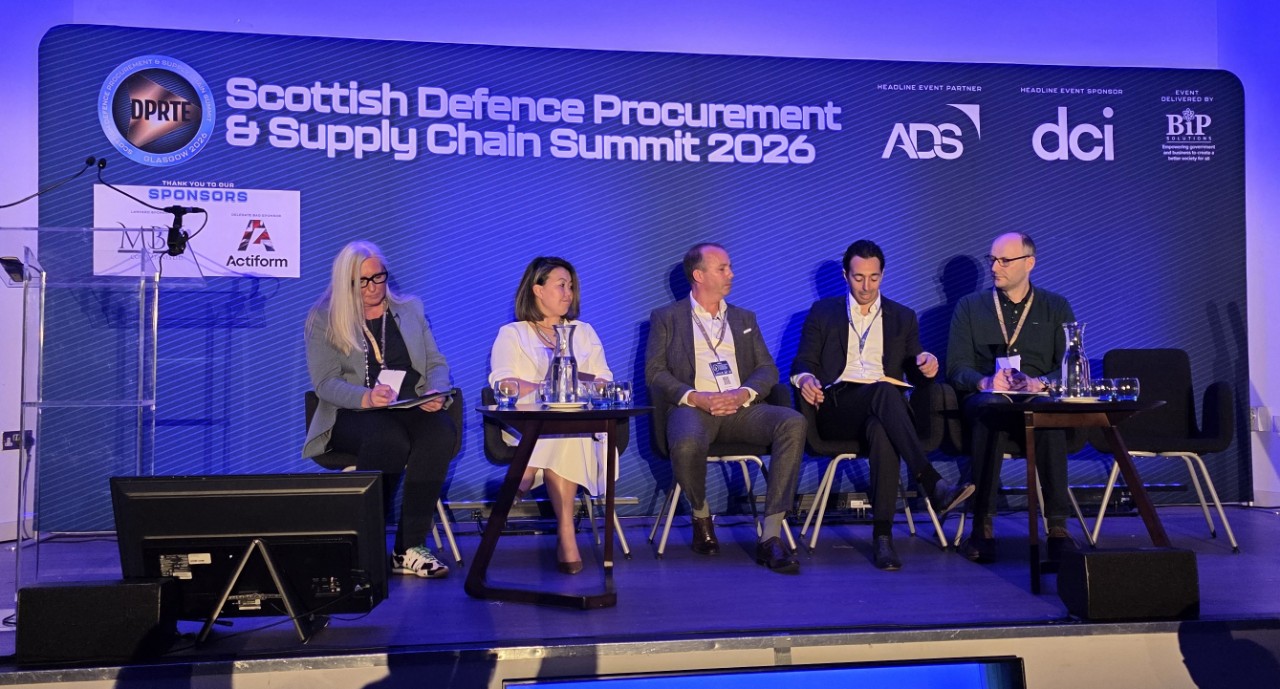
A panel of prime contractors, SME leaders, and supply chain specialists at the Scottish Defence Procurement and Supply Chain Summit in Glasgow set out what smaller companies need to do to successfully enter the defence supply chain, and what the primes themselves are changing to make that easier.
The session, titled Prime Contractors: Opening Doors for Scottish SMEs, brought together Gareth Hedicker, Chief Operating Officer at Babcock Marine, Didde Bjerglund-Martin, Head of JOSCAR at Hellios Information, Andrew Cowie, Chief Executive of Denchi Group, and Yan Tiefenbrun, Managing Director of Castle Precision, with the session chaired by Coreen McCubbin, Chief Technology Officer at the National Manufacturing Institute Scotland.
Hedicker opened by arguing that the pace of change in defence was itself the biggest opportunity for SMEs right now. “The pace of change is staggeringly different to what it had been before. To deliver that, you not only need a lot more ideas, you need that agile approach. There’s no way we can meet all demands coming in just to us without changing.” He said Babcock was actively shifting from a predominantly service organisation toward one that also delivered products, and that this created genuine gaps in capability that SMEs were well placed to fill.
Tiefenbrun said the opportunities were visible across two distinct areas. “First is the ramp of existing products and the supplier’s ability to bring on additional capacity at pace and deliver programmes that are in demand. But there’s also the flexibility of suppliers for the development of new sovereign capabilities, development of new products where we need suppliers, and then existing products ramping from teens to hundreds per month.”
Bjerglund-Martin said SME speed and agility were genuinely valued by buyers, but that the foundations had to be in place first. “Your ability to move a lot faster than larger clients who have more red tape is an opportunity, but in order to add value to industry you need to demonstrate your resilience, and for buyers to trust you.” She said accreditations such as ISO 9001 and Cyber Essentials were increasingly hygiene factors rather than differentiators.
Tiefenbrun broke down the challenge for SMEs entering the supply chain into three areas, none of which he said related to what the company actually makes. “There’s the hygiene factors in terms of accreditations that get you in the room. Secondly, these are complex commercial structures, how do you navigate them, how do you develop opportunities? And then there’s the onboarding and assessment aspect of getting onto the qualified supplier list and actually opening all the opportunities.”
Hedicker acknowledged that the prime contractor system itself needed to change, not just the SMEs trying to enter it. He said Babcock had worked with the University of Exeter to understand what smaller companies actually needed, rather than deciding internally. “We could have quite happily sat down and decided ourselves what SMEs need, but a better approach was to partner with someone independently who went out and talked to not just SMEs but also our own teams and some of our customers.” The result was a new SME charter covering contracting approaches, payment terms, and direct support for companies working toward required standards.
Tiefenbrun said he was beginning to see OEMs leverage shared qualified supplier lists across their group structures rather than maintaining siloed systems, which he described as a meaningful improvement for suppliers already on those lists. “Once you’re on that qualified supplier list, we’re seeing OEMs start to leverage that more rather than the disjointed systems it was before.”
Cowie, speaking from the perspective of an SME that had successfully navigated the process, said the journey required sustained effort across multiple dimensions. “I’ve been involved with developing new relationships, improving credibility, maintaining and nurturing that credibility when things get hard, and then delivering products for use in the field successfully.”
A question from the floor raised the idea of a Dragon’s Den style format where SMEs pitch directly to a room of prime contractors, an approach previously used by tier one contractors in Aberdeen’s oil and gas sector. Hedicker said Babcock would be open to exploring something similar, particularly where a specific demand was already known, adding that the company was also planning to publish lists of known demand signals so SMEs could respond to something specific rather than approaching blindly.











…. Next.
I’ve gained $17,240 only within four weeks by comfortably working part-time from home. Immediately when I had lost my last business, I was very troubled and thankfully I’ve located this project now in this way I’m in a position to receive thousand USD directly from home. Each individual certainly can do this easy work & make more greenbacks online by visiting
following website—…,.,,,.—>>> PayAtHome1.Com
I’ve gained $17,240 only within four weeks by comfortably working part-time from home. Immediately when I had lost my last business, I was very troubled and thankfully I’ve located this project now in this way I’m in a position to receive thousand USD directly from home. Each individual certainly can do this easy work & make more greenbacks online by visiting
following website—.,.,.,.,.—>>> JobatHome1.Com
Been said every 5 years for the last 40. It doesn’t matter how many times you say 2+2=5 it always equals 4. SME’s are higher risk and lack the capital that the larger operators have and the primes and the MoD isn’t going to act as venture capital for SME’s. Its always the same, a new administration makes the same noises but with first contact with reality it quietly disappears.