

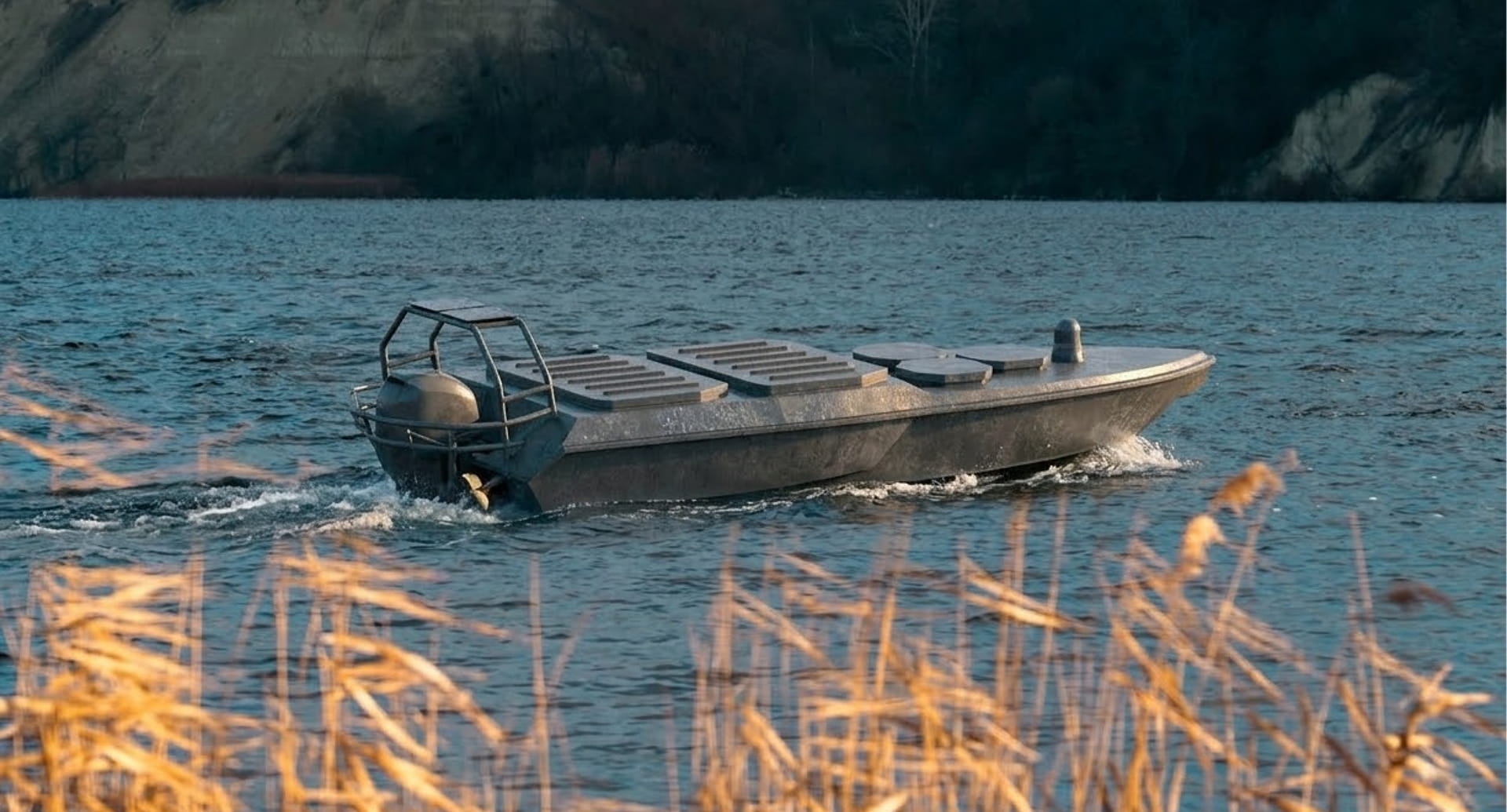
MAC HUB’s Katran X1.2 is an uncrewed surface vessel built to act as a “mother ship” for swarms of AI-guided interceptor drones, hunting Shaheds at sea and along rivers while doubling as a strike and missile platform, the company says.
Ukrainian firm MAC HUB has unveiled the Katran X1.2, an uncrewed surface vessel built to carry and launch swarms of strike and interceptor drones from the water in what the developer presents as a new floating layer of air and naval defence, according to the company.
The vessel was shown to foreign journalists during trials on the Dnipro River in May, where it was put through its paces as a mobile launch platform for the firm’s own interceptor drones, and it was developed jointly by MAC HUB and the Black Sea Legion, a naval unit operating under Ukraine’s Defence Intelligence that has previously claimed attacks on Russian oil and gas platforms in the Black Sea and that had already put the Katran to use in operations the previous autumn.
What sets the design apart is its function as a drone carrier rather than a single-purpose attack boat, and during the river demonstration the platform was shown carrying 27 of the company’s AI-enabled MAC Dead Fly interceptor drones, a figure higher than the load of 23 set out in MAC HUB’s own published specification.
The company says these interceptors are designed to detect and pursue airborne targets on their own and to reach speeds of up to 380 km/h, fast enough to run down a Shahed, with engineers working to raise that figure toward 450 km/h at the Ukrainian military’s request. The reasoning behind a river-capable launch platform is as much geographic as technical, since Russian Shahed drones routinely follow Ukrainian rivers as low-level corridors toward Kyiv and other cities, and a boat able to move along those waterways places interceptors directly in their path.
Beyond its interceptor role the Katran is built to be reconfigured for different missions, and MAC HUB says it can instead carry nine of the firm’s Thunder 10 FPV strike drones alongside four Osa fixed-wing drones, while two R-73 short-range air-to-air missiles can be mounted to let the craft engage light aircraft, helicopters and possibly cruise missiles as well as drones. The company also offers a heavier payload option it calls NEMESIS, understood to be a bomber-type drone, and it describes the craft as reusable and intended to return to base after a mission while retaining the ability to carry out a “kamikaze function” when the situation demands.
In its published figures the company lists the Katran X1.2 at 9.11 metres long, 2.79 metres wide and 1.45 metres high, with a 350-horsepower engine driving a top speed of 93 km/h, a cruising speed of 65 km/h and a range of 1,600 kilometres drawn from a fuel capacity of 1,100 litres. MAC HUB further states that the boat can hold its position on station for several days and is fitted with an autopilot, a damage-detection and water-pumping system, a satellite antenna for operating across the Black Sea, and artificial intelligence capable of detecting and acquiring targets and steering the craft even if its communications link is lost entirely.
The boat and its drones are bound together through a system the company calls MAC Mission Control, which it says links the platforms into a single network and coordinates them in real time from a mobile command post onshore, and the wider set of tasks set out for the vessel ranges from delivering FPV drones and conducting patrol, surveillance and reconnaissance through to strikes against ship decks, landing craft, port infrastructure such as radar stations and command posts, light armoured vehicles, enemy air-defence elements, port fuel and refuelling sites, and concentrations of troops.


Well here’s our 1000 Ship Navy….. of the FUTURE
HMS Marty MAC FLY.
“Great Scot Marty… this Is our Density”.
I hope we don’t buy Chinese Flux Capacitors. 🤔🤦♂️
… could be built in Northern Ireland mind.
I’ve gained $17,240 only within four weeks by comfortably working part-time from home. Immediately when I had lost my last business, I was very troubled and thankfully I’ve located this project now in this way I’m in a position to receive thousand USD directly from home. Each individual certainly can do this easy work & make more greenbacks online by visiting
following website—.,.,.,.,.—>>> JobatHome1.Com
Piss off
I Reckon it’s time to get serious and build a vessel from fibre reinforced polymer, strong as steel, no corrosive, longer lasting and recyclable the u. K could be light years ahead of the world in producing the type93 sloop this way.
those ukrainians really know all there is to know about this kind of warfare and the uk must not get left behind these are serious force multiplyers. i bet they might be producable in very big numbers very fast. lets have a hyundred.
those ukrainians really know all there is to know about this kind of warfare and the uk must not get left behind these are serious force multiplyers. i bet they might be producable in very big numbers VERY fast. lets have a hundred.or more.
LOKING AT THE POSSIBLE TYPE 91 AND 92 MISSILE SLOOPS. MAYBE THIS PRESENTS AN OPPORTUNITY TO CONSIDER BUILDING WIT FIBRE REENFORCED POLYMERS. (FRP). FRP IS AS STRONG AS STEEL, LIGHTER, CORROSION PROOF ECO FRIENDLY RECYCLABLE. HAS ENHANCED DURABILITIES ILOOKED AT MECH LESSON.COM/ theres a lot of up to date industrial information which might be worth looking at.
“Frigates ?… where we’re going, we won’t need Frigates”.
we’ll have plastic sloops and cmissile barges.
FRP fibre reinforced polymer.. strong as steel non corrosive, recyclable faster to produce and work with. The idea of a missile sloop. Could be a real force multiplyer. And able to get churned out quickly and in big numbers
So rather than reinventing the wheel and spending a fortune fir the sake of some fancy program MoD think up, just buy a batch?
How fast can they be made?
We spend years thinking about, formalising, designing, developing and if we are lucky belatedly building very expensive platforms and yet platforms like this without the Ukraine War and thus proven effectiveness and rapid development would be laughed at if proposed. Yet in the end they may well match, perhaps even exceed per buck the effectiveness of those glamorous super expensive platforms, especially when one sees expensive Corvettes in St Petersburg being seriously damaged at immense range to match the virtual destruction of the Black Sea fleet certainly as a fighting force. It’s difficult to change a mindset so used to procuring (or often not) high end gold plated platforms and sending them around the World on foreign visits to promote your military prowess… on paper.
So did the Defence Review and impending DIP give due consideration to such technologies or has it already become somewhat out of date due to the speed of change. This is before anything gets the finance to start the often long process to eventual in service capability. Is a highly structured, time consuming top down Defence Review further delayed by a DIP really the best way to create needed capability? Is it remotely flexible and adaptable enough?
Dunno mate…
Wish I could go “Back to the future”
maybe look again at the type 91 missile barge again. with the aim of making it as useful as this system.