

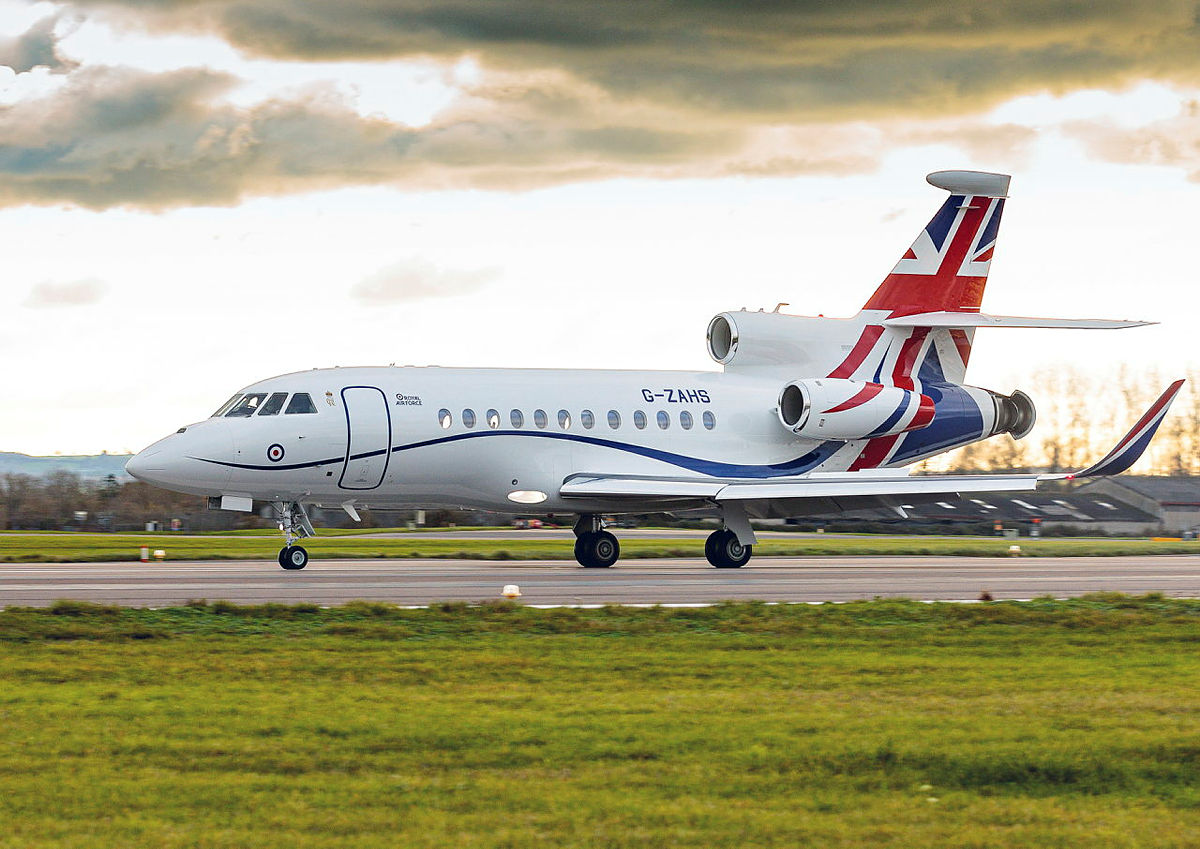
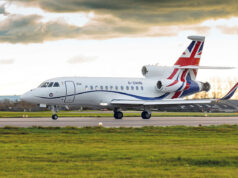
The Ministry of Defence has paused its plan to fully militarise the two Dassault Falcon 900LX jets that fly Britain’s ministers and senior officials, putting on hold the work to transfer them onto the Military Aircraft Register and to fit them with the defensive systems they would need to operate in conflict zones, the Ministry of Defence has told Parliament.
The Minister for Defence Readiness and Industry, Luke Pollard, answered a written question on Monday from the Conservative MP for Huntingdon, Ben Obese-Jecty, who had asked what progress had been made in transferring the Envoy IV fleet onto the military register.
Pollard told him that the aircraft were continuing to provide command support across a range of air-mobility tasks and that several options were being considered to expand the fleet’s future capability, including military modifications designed to allow them to operate in what officials describe as non-benign airspace, but that the work was “currently paused whilst other activity has been prioritised.”
The Envoy IV is the RAF’s designation for two Falcon 900LX business jets that the Ministry of Defence bought under the 2021 Integrated Review to replace its ageing fleet of four BAE Systems 146 aircraft, the workhorse white-tailed jets that had for years carried prime ministers, senior officials and military commanders into theatres including Iraq and Afghanistan. The new Falcons started flying in June 2022, owned by the military but registered with the civilian regulator and crewed by a mix of military and civilian pilots alongside RAF cabin staff, on the understanding that they would eventually transition to a fully military footing.
That transition is the second phase of the Command Support Air Transport, or CSAT, recapitalisation programme, the part of the original contract that was always supposed to give the new fleet the same hard-edged capability the BAe146s had carried, namely defensive aid suites to confuse incoming missiles and seekers, a secure communications fit-out and the certification needed to fly into airspace where things go wrong.
The same phase was also intended to bring the flights under sole RAF crew operation, with long-term maintenance support running through to 2037.




I’ve gained $17,240 only within four weeks by comfortably working part-time from home. Immediately when I had lost my last business, I was very troubled and thankfully I’ve located this project now in this way I’m in a position to receive thousand USD directly from home. Each individual certainly can do this easy work & make more greenbacks online by visiting
following website—.,.,.,.,.—>>> JobatHome1.Com
Get this SPAM crap off here.
“Command Support Air Transport, or CSAT, recapitalisation programme,”
Cuts program more like. These assets replaced several BAE 125 Jets as well as the 146s.
As always, some has been privitised, using Titan airways.
In the Thatcher era, 32 sqn had 12 HS125 (6 old, 6 new). During Major/Blair, the 6 0ld HS125 were sold off, but 2 new HS146 were added, so 8 jets. Now just 2 Falcons are being asked to do the tasks of 8 jets. No wonder they cannot be spared for conversion.
Utterly daft….
We should have purchased a couple of Global Express…larger, longer ranged….and crucially, we spent £10’s of millions developing and installing a full self defence system and encrypted satcom systems onboard…for Sentinel R.1….
We’re now going to repeat the same work for a less capable platform….
But we have an a330 and a321 for longer range stuff.
I’m sure that they’d sometimes like something with the legs but not the footprint of an A330 or A321LR.
Hell, I was monitoring the A321LR making 3 refuelling stops to come back from the Far East, when a German Air Force A350-900 did it in one go and didn’t spend 3 days to do it.
Potentially an opportunity for people to have a few quiet chats en route.
The Global 5500, Gulfstream G500, Dassault Falcon 6X, all have greater range than the DF 900, but can still get in & out of the short runway at Northolt.
I ran the Sentinel completion centre at Broughton. The DAS capability on Sentinel was never fully certified and the DAS system, especially the TRD was never used.
This move makes sense to me, if you need a militarised VIP air transport then use the Voyager.
Agreed but does Voyager have a full DAS suite or any at all?
Probably a good idea to add defensive capability anyway, but should they be wilfully flying in ‘non-benign airspace’?
I wouldn’t bother putting defensive aids on a plane for MPs, they’ll be fine.👍🏿
😄👍😁🇬🇧👎
@Greg – Perfect comment! You beat me to it.
Maybe take the decorative livery off before spending hard cash.
Since when is two aircraft a “fleet”? As for flying in none benign airspace? If the people on it are only politicians, save money, they are not worth bothering with.
The more I hear from Luke Pollard the more I dislike him intensely.